This is f*cking insane. Andrej Karpathy:
"Prompting is going away
Delete everything and keep the graph"
In 2 hours, he shows how to build graphs and why they're the only layer that survives
Prompts → Agents → Loops → Graphs
A loop keeps one agent running until the job is done. A graph decides which agents exist and what each one passes on
Anyone can build an agent. Almost nobody builds the graph that runs them
Bookmark and watch it tonight
Then read the full guide on graphs: Harness, Loops, Graphs ↓
Elon Musk cautions that the time left is short:
You have 3 years at most to keep earning from selling your work. After that, AI takes over most tasks, and paying people for their time stops making sense.
The 200-year-old model, "I give you your salary in exchange for your time", will soon be over.
This will set off the largest wealth transfer in modern history. People already making the shift get it. People waiting for the headlines will show up too late.
In the end, what you own counts for more than how much you work.
The smartest asset to build right now ranks above Bitcoin and land: an income stream powered by AI that compounds while you sleep.
AI accessibility. "If you don't have permission to open the door and you cannot look inside the door… not documented capability and missing capability is the same thing."
Plus the test: "if I cannot understand it, no one else will be able to understand it."
I resigned from Anthropic today. I spent the last three years doing pretraining research at both OpenAI and Anthropic. Neither company is acting responsibly. They are racing straight to self-improving superintelligence and gambling with our lives. More thoughts below.
@LutzFinger Let's not forget that LLMs are good not only in summarizing, but also in organizing and linking. Let it do the work. Long live LLM Wiki by Karpathy who just recently joined Anthropic.
We’ve decided to open-source a multi-agent harness we use internally at YC.
We call it “QM” and it’s meant to be easy to customize, like Hermes or OpenClaw, but useful for a whole company. We use it across accounting, legal, events, and engineering (including building QM itself!).
The whole project is under an MIT license. It is cloud-first and has Slack and web UI natively.
This is a new paradigm for interacting with Claude that is significantly more "inline" with all the other human activity org-wide. Once you do all of the under the hood engineering work to make this "just work" (e.g. across tools, integrations, compute environments, memory, security, etc.), Claude basically joins the team in a seamless way - you can talk to it as you would talk to a person and it can help with a very large variety of workloads.
Imo this is the 3rd major redesign of LLM UIUX. The first paradigm was that the LLM is a website you go to, the second was that it is an app you download to your computer. This third one is that it is a self-contained, persistent, asynchronous entity with org-wide tools and context, working alongside teams of humans. It really takes a while to wrap your head around it, but it works and it is awesome.
Anthropic just showed a 24-minute workshop on how to actually prompt Claude.
Taught by the people who built it.
Free. No signup. No paywall.
I've watched $300 courses that don't cover what they teach in the first 8 minutes.
Usage limits are up, effective today we're:
1) Doubling Claude Code's 5-hour limits for Pro, Max, Team and seat-based Enterprise plans
2) Removing peak hours limit reduction on Claude Code for Pro and Max plans
3) Substantially raising our API rate limits for Opus models
Someone just built the world's first Office suite designed for AI agents.
It's called OfficeCLI and it lets agents read, edit, and create Word, Excel, and PowerPoint files from the command line.
→ Single binary with zero dependencies
→ No Microsoft Office, no WPS, no runtime needed
→ Every command supports structured JSON output
→ Path-based addressing for every element in every document
→ Resident mode keeps documents in memory for batch edits
→ Works on macOS, Linux, and Windows
→ Ships with a SKILL.md that teaches Claude Code how to use it
100% Open Source. Apache 2.0 License.
https://t.co/3WHWD1aY8y
Paste this to your coding agent right now:
```
read the code for this repo and write a markdown doc telling me everything you can infer or know with certainty about the high level intent and idea behind this repo
ask me questions for anything that isn't clear
then pop open the doc for me to review and answer
the goal here is to make sure my intent is obvious to any agent reading this code
```
Codex 5.5 hack:
"Are you 100% confident in this strategy? If not, find all possible loopholes, suggest proper fixes and run this loop until you are factually 100% confident in the new startegy"
This works like charm. It makes Codex 5.5 high perform even better than codex 5.5 extra high.
Why? Codex 5.5 is the only model i noticed that is self aware. It never makes high claims unless the model verifies everything.
This doesn't work with Opus 4.7 cuz that's a very insecure model. You can paste this prompt over and over again, the model keeps saying "you're absolutely right,....."
But with codex, after 2-3 iterations you'll notice yourself it actually patched all loopholes and this genuinely sounds like a good strategy.
Try this out, thanks me later.
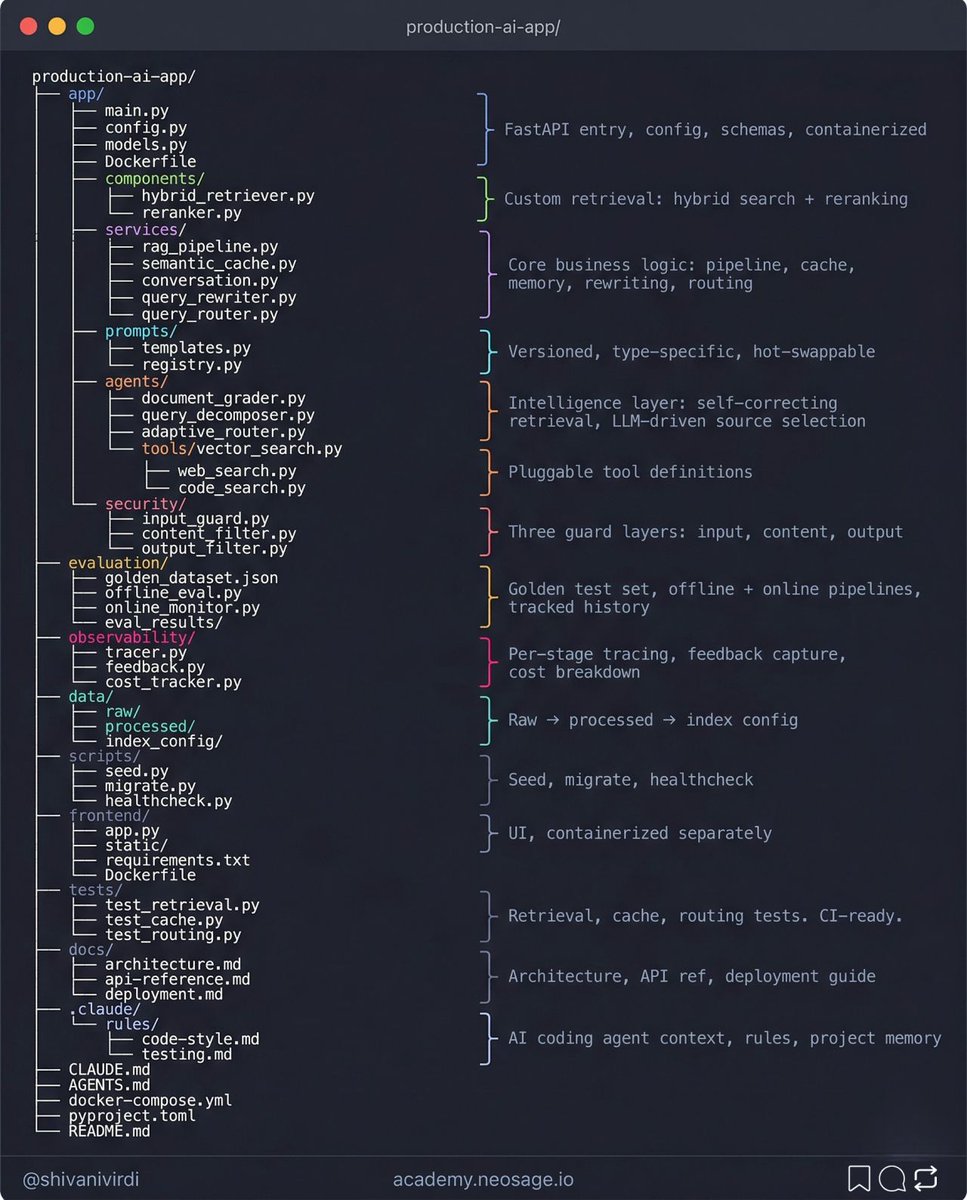
This is probably the most honest AI architecture breakdown on the internet right now.
9-layer AI production architecture
services/ - RAG pipeline, semantic cache, memory, query rewriter, router. Not one file. Five.
agents/ - document grader, decomposer, adaptive router. Self-correcting by design.
prompts/ - versioned, typed, registered. Never hardcoded.
security/ - input, content, output. Three guards not one.
evaluation/ - golden dataset, offline eval, online monitor. Most people skip this entire layer and ship blind.
observability/ - per-stage tracing, feedback linked to traces, cost per query.
.claude/ - agent context so your AI coding assistant knows the codebase before it touches a file.
The demo is one file. Production is this.