I have stage 4 cancer. I thought I'd fight it alone.
I was wrong.
Since mid October, ~20 strangers on X have stepped up to help me. All for free so far:
- An NYU Langone lab offered to run my tumor data through their system to sharpen my vaccine targets
- A U Michigan lab offered to test drugs on my actual tumor cells
- A biotech ran AI analysis on my tumor RNA
- A vaccine company offered to design a second vaccine to check the first one
Scientists. Engineers. People I've never met.
Cancer has been picking us off one at a time for all of human history. It counts on us fighting it alone, scared and quiet.
Not anymore.
We have AI. We have the internet. We have each other.
Cancer, we're coming for you, bitch. Buckle up!
Super proud to announce AlphaGenome 2 - our new DNA sequence model! 🧬 It predicts the impact of DNA variants in different specific cell types - unlocking crucial information for understanding complex diseases. Available for academic research via our API: https://t.co/dEyrvpTxIl
Data center bans will be disastrous for America, but a tremendous opportunity for other countries. It’s hard to imagine a more shortsighted way to undermine economic growth and technological progress. China must be celebrating.
Ultimately, you cannot stop AI or the coming age of superintelligence. If not on Earth SpaceXSI and others like Google will build them in space. You can only ensure that your country falls behind and citizens are impoverished (it’s all about intelligence) while others race ahead.
We have fundamentally inverted our ethics.
We treat the commission of a physical error as a crime, but the omission of progress as a virtue. If a bureaucracy delays a medical device or a nuclear reactor by ten years, they never count the invisible body count of the delay. Stagnation is not morally neutral.
This tweet has gotten 2 million views and is wrong.
Musk doesn't think space cooling is easier because space is cold. He thinks its easier because it's a strait forward engineering problem that scales well.
Cooling in space is indeed difficult, because vacuum is an insulator.
But it's also straightforward, you just need a radiator.
Since 99% of the heat you are radiating comes from power consumption produced by solar panels, the amount of radiator panels equals a percentage of solar panels. It's around 25%.
The International Space Station has ~2,500 m² of photovoltaic panels generating power, and ~645 m² dissipating the heat.
There is no scale problem like there is on earth -- you can just keep building bigger and bigger and bigger.
Scaling is what makes cooling harder on earth. The bigger the data center, the more difficult the cooling. This comes not just from the engineering challenges but also the political challenges from communities rejecting huge data centers, taxes, etc.
However, we haven't built anything larger than the ISS for radiators. We have a lot still to discover, such as micrometeorites puncturing fluid lines. I wouldn't bet on space data center, but Musk isn't making simple errors by thinking that space is "cold" instead of "insulated".
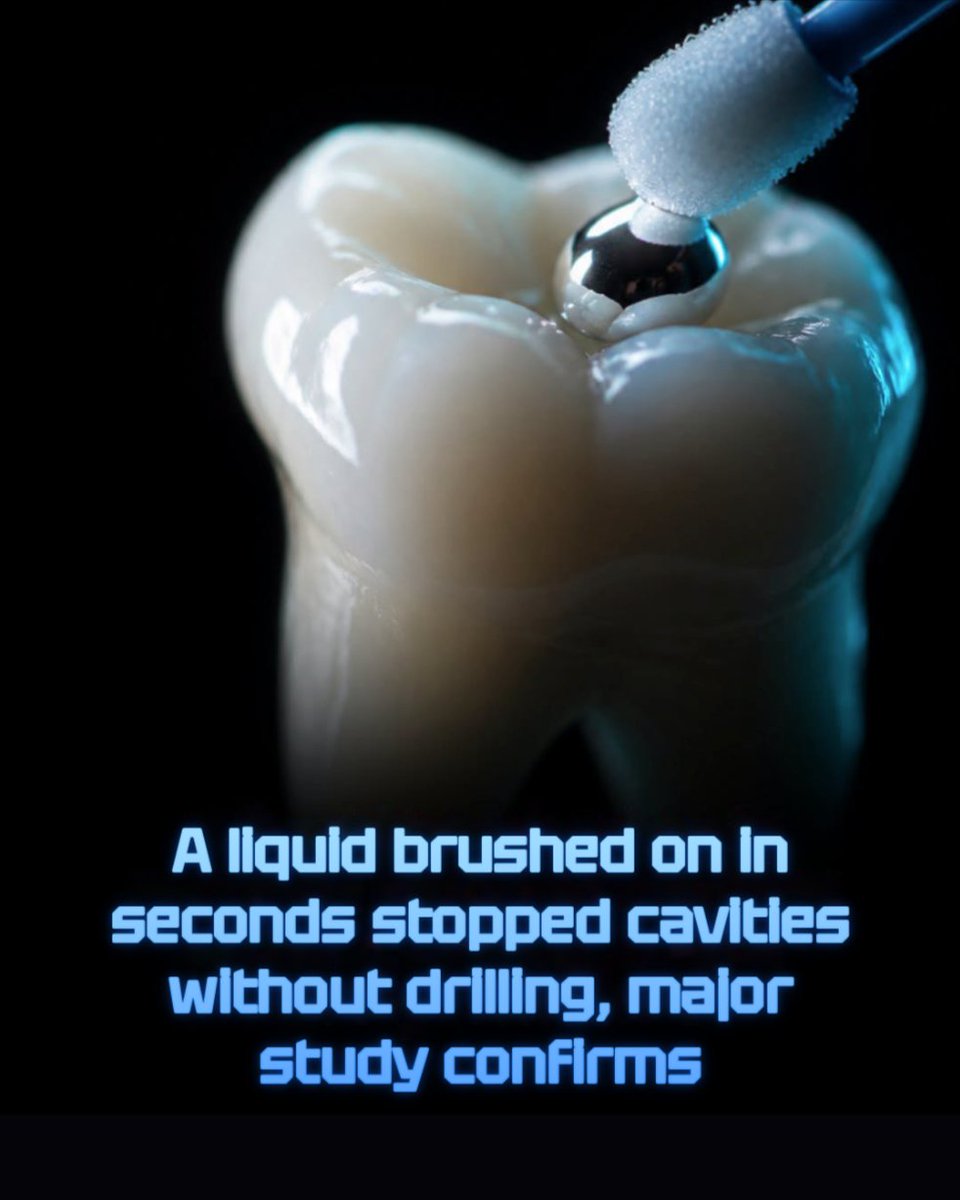
A liquid painted onto teeth in just seconds halted tooth decay in a large US trial.
The liquid is silver diamine fluoride. A dentist applies it to a decayed tooth with a tiny sponge, and the whole process takes only a few seconds. The silver works against the bacteria that cause decay, while the fluoride strengthens the remaining tooth structure.
The trial was led by the University of Michigan and New York University, with study sites in Michigan, New York, and Iowa. Researchers treated 830 children under the age of 6 who had severe tooth decay. With applications every six months, the treatment stopped the decay in more than half of the affected teeth.
This matters because drilling and filling very small teeth often requires sedation or even general anesthesia, and many families cannot access that kind of care at all. Lead researcher Margherita Fontana says the treatment is both highly effective and safe, even for children as young as 1.
There is one drawback that parents will notice: the treated area turns permanently black.
The FDA has already cleared the liquid for treating tooth sensitivity, and the researchers say these results support approving it for stopping cavities as well.
[Fontana M, Moursi A, Gonzalez-Cabezas C, et al. Efficacy of silver diamine fluoride on young children with severe early childhood caries: a randomized clinical trial. JAMA Pediatrics. 2026. DOI: 10.1001/jamapediatrics.2026.2567]
These two mice are the exact same age, the human equivalent of 85.
The mouse on the right was given an antibody blocking a single inflammatory protein (IL-11) starting in late middle age.
Starting treatment at human-equivalent age 55:
- Extended median lifespan by 25% in both males and females
- Prevented grey hair, frailty, and muscle wasting
- Cut late-life cancer deaths in half
Three anti IL-11 antibodies (that might extend human lifespan) are already in human clinical trials right now.
Next step: Longevity and Rejuvenation. We are almost there.
Researchers in Bonn turned blood cells from an 80-year-old into neural stem cells with a molecular age below 20. More than 60 years younger by epigenetic clocks, which estimate age from chemical marks on DNA.
The team directly reprogrammed blood precursor cells into neural stem cells, skipping the usual pluripotent stem cell stage. The rejuvenation unfolded gradually and could be tracked for over 100 days.
GPT-Rosalind surfaced a new lead for drug discovery: could restoring cholesterol transport protect neurons from degeneration?
DCTN1 is a gene linked to Perry syndrome, a rare neurodegenerative disorder. In mouse-brain data, disrupting it increased expression of genes involved in making cholesterol. GPT-Rosalind suggested a possible explanation: cholesterol may not be reaching where neurons need it.
That gives scientists a specific mechanism to test and, if confirmed, a direction for developing new treatments for neurodegenerative disorders.
With @perturbai_tx and @scrippsresearch, a team of thousands of GPT-Rosalind agents worked in parallel, connecting gene-expression results from millions of mouse brain cells with scientific literature in just 32 minutes. We’re now expanding this collaboration to identify new drug targets.
https://t.co/oHdF3ELsMj