$NVDA JUMPS 35% AFTER ANNOUNCING JENSEN HUANG WILL BE REINSTATED AS CEO.
It's insane is that it still has a PEG ratio of only 0.15.
Here are the most undervalued tech stocks in the market right now.
Are you buying the dip?
The S&P 500 is up 0.9% this year through Friday's close, even with Nvidia and Alphabet, 2 of its 5 biggest stocks, in the red
Its 20 largest companies make up 49% of the index, and 13 of them are beating it
> Apple $AAPL, the biggest weight at 8.2%: +26.0%
> Micron $MU: +108.3%
> AMD $AMD: +98.2%
> Nvidia $NVDA: -32.7%
> Tesla $TSLA: -23.1%
Nvidia, Alphabet, Broadcom, Meta, Tesla and JPMorgan are the 6 names still down for the year. Returns are price only from the Dec 31 close, via State Street SPY holdings and Yahoo Finance
A hot jobs report pushed yields higher, but the long-term power trade still looks strong.
$GEV around $948 — grid modernization and turbine demand
$BE around $242 — fast, onsite power for AI data centers
$BN around $40 — infrastructure capital at an attractive entry
$CEG around $285–$290 — scarce, reliable nuclear generation
$TSLA around $353 — energy storage, autonomy and robotics optionality
These aren’t five versions of the same trade. $GEV and $BE sell the infrastructure, $CEG supplies dependable power, $BN finances real assets, and $TSLA turns electricity into products and platforms.
Rates will create noise, but AI, electrification and grid investment remain multi-year trends. I’m staying constructive on the entire group.
I like companies that can turn revenue growth into higher FCF growth, and can turn FCF growth into higher FCF/share growth. That's the beauty of boosts from pricing power, operating efficiency, cash conversion and share repurchase.
Here's a list of companies that are doing just that.
🚨 WARNING: TOMORROW WILL BE THE WORST DAY OF 2026!!
98% of people will lose everything.
Something TERRIBLE just happened behind the scenes.
But almost nobody is talking about it.
And it's far worse than people realize.
You MUST read this before the market opens on Monday.
This is no longer a normal market correction.
The global financial system is entering a full-blown crisis.
Stocks, bonds, gold, silver, and crypto are all dumping AT THE SAME TIME.
This has NEVER happened in a normal market.
The biggest market collapse in history is happening in real time.
→ Japan and China are preparing to dump BILLIONS in U.S. Treasuries.
→ China's AI stocks have crashed more than 50%, and the AI bubble has officially collapsed there.
→ Asian stock markets are nonstop dumping, with selling pressure intensifying EVERY DAY.
→ The U.S.-Iran conflict is escalating, threatening critical energy supplies and driving inflation higher.
→ Trump's midterm defeat is fueling political chaos and economic uncertainty.
→ The S&P 500 has suffered a historic crash, triggering the fastest selloff ever recorded.
→ Nvidia, the world's most valuable company, is down 40% in just a few months.
→ Bitcoin has collapsed, wiping out billions and triggering panic selling across ALL crypto assets.
→ The Fed is injecting BILLIONS to prevent a complete market collapse.
→ Taiwan has banned short selling in an attempt to stop the market crash and stabilize investor confidence.
All those issues are now connected in one massive financial disaster.
The collapse in China is exposing the weaknesses of the entire global financial system.
The AI sector is experiencing its first major correction.
But this is NOT another dip that people will keep buying.
The global AI bubble is BURSTING.
People are dumping overpriced AI stocks.
And they are not buying gold or silver like before.
They are desperately raising cash.
And the panic is spreading into every major asset class.
Meanwhile, Japan and China are aggressively selling U.S. government debt.
Billions in Treasuries are flooding the market, forcing buyers to demand higher yields.
→ Treasury dumping floods the bond market with massive amounts of supply.
→ Investors demand higher yields to absorb the selling pressure.
→ Rising yields cause government borrowing costs to go parabolic.
→ Higher borrowing costs crush stocks, metals, real estate, and crypto.
→ The collapse of Asian markets triggers panic across global financial markets.
→ AI losses accelerate, fueling even more panic and fears of a total AI bubble collapse.
→ The recent Bitcoin crash triggers more forced liquidations.
→ Energy disruptions push inflation higher and drive yields even higher.
→ Political instability accelerates economic uncertainty.
→ Emergency liquidity injections and short-selling restrictions show how bad the situation really is.
→ Investors dump ALL risk assets to protect whatever capital they have left.
This is how multiple crises merge into one global financial catastrophe.
EVERY asset class is now under pressure.
The largest financial crisis in history is unfolding right in front of us.
Pay attention NOW.
By the time the next financial crisis becomes obvious to everyone, it'll already be too late.
I've spent more than a decade studying financial markets and calling nearly ALL major tops and bottoms.
And I'm warning you now:
If you want to survive the 2026-2027 cycle and protect your portfolio, follow and turn on notifications.
Ignoring this warning today is a decision many will regret forever.
36 STOCKS RANKED WITH THE HIGHEST RETURNS ON INVESTED CAPITAL! 📊
Which company do you think will maintain the highest ROIC over the next 10 years?
Return on Invested Capital measures how efficiently a company generates after-tax operating profits from the capital invested in its business.
ROIC = After-Tax Operating Profit ÷ Invested Capital
🟢 S TIER — 100%+ ROIC
$PLTR $SNDK $NVDA $MU $SPOT $APP
🟩 A TIER — 75–100%
$AAPL $ASML $MA $BKNG $NU $SKHY
🟢 B TIER — 50–75%
$FTNT $TSM $ADBE $V $WDC $GEV
🟡 C TIER — 25–50%
$NFLX $COST $MNST $SHOP $MSFT $AZO
🟠 D TIER — 0–25%
$GOOGL $HD $MELI $ARM $AMD $ORCL
🔴 F TIER — Negative ROIC
$BA $NET $CRWD $SNOW $MRNA $APO
Why do some companies rank so highly?
- Asset-Light Business Models: $PLTR, $APP, and $SPOT can scale operations without needing proportionate investments in physical assets.
- Pricing Power: $NVDA benefits from differentiated technology and strong demand, supporting exceptional profitability.
- Cyclical Profitability: $MU and $SNDK can experience dramatic improvements in ROIC when memory prices and operating margins rise.
Why do others rank lower?
- Capital-Intensive Operations: Businesses requiring substantial infrastructure, equipment, or manufacturing investments often have larger capital bases.
- Growth Investments: $NET, $CRWD, and $SNOW are investing heavily in future growth, potentially sacrificing near-term profitability.
- Operating Challenges: $BA and $MRNA face profitability pressures that can drag ROIC into negative territory. Companies that consistently earn returns above their cost of capital can compound shareholder value over decades.
However, extremely high ROIC can also reflect a small invested-capital base, accounting differences, or temporarily elevated earnings
@grok which ones have the potential for the highest ROIC growth?
Will delete in 11 hours!!!
Please buy before November 28
Current price: $6.61
Target price: $99+
The company has signed a strategic partnership with $MSFT + $SNDK + $AMZN + $NVDA + $MU
Visible only to those who like, follow, and comment on "stocks.'
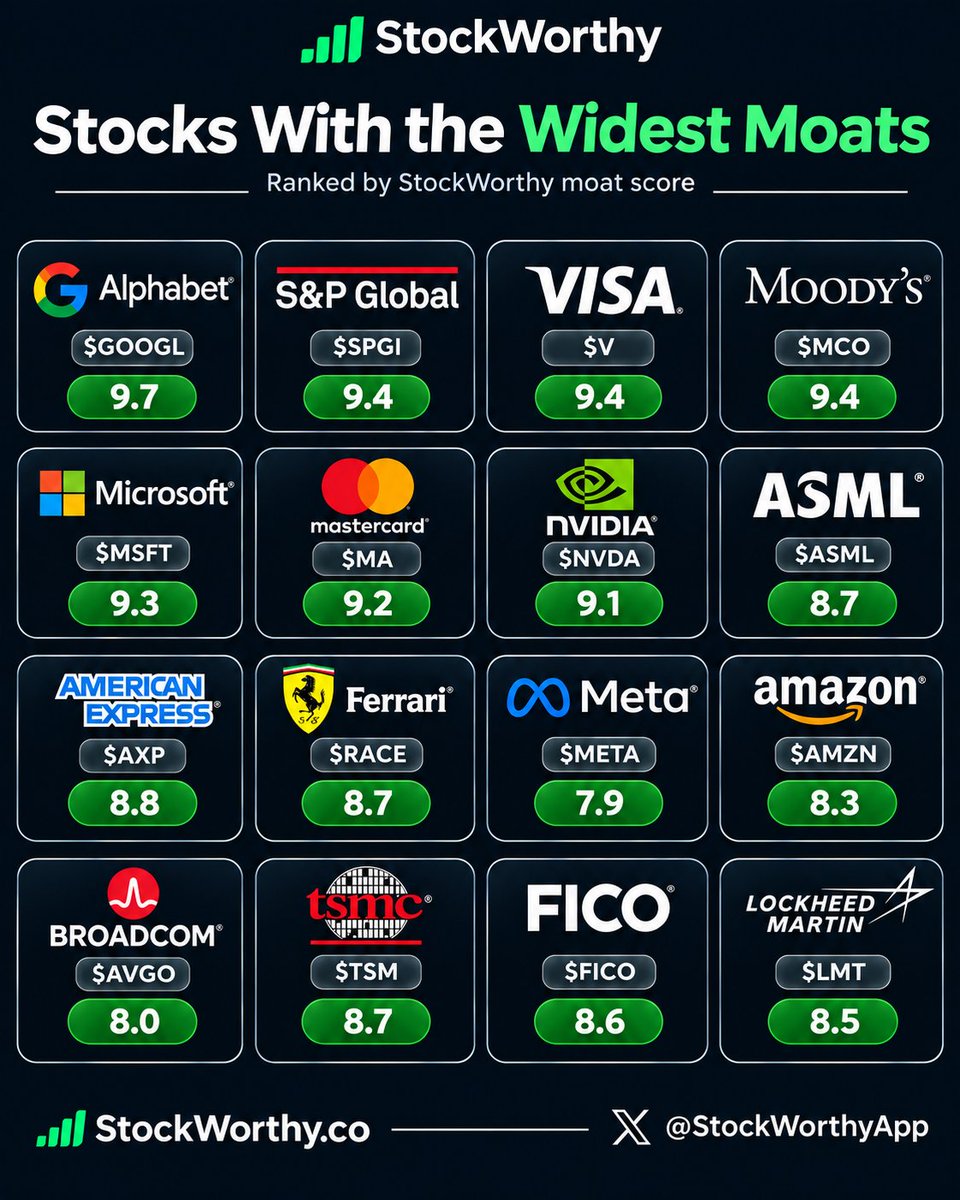
16 STOCKS WITH THE STRONGEST ECONOMIC MOATS TO BUY!🏰
Which company do you believe has the strongest economic moat in the stock market?
Warren Buffett famously looks for companies with wide economic moats. This is a company's ability to protect its competitive advantage and defend profits against competitors over time. The wider the moat, the harder it is for competitors to take market share.
What creates a wide moat?
- Network Effects: $V, $MA, $META
- High Switching Costs: $MSFT, $FICO
- Brand Power: $RACE, $AXP
- Economies of Scale: $AMZN, $TSM
- Intellectual Property: $NVDA, $ASML
- Industry Dominance: $GOOGL, $SPGI, $MCO
Companies with durable competitive advantages are often better positioned to:
✅ Maintain pricing power
✅ Protect profit margins
✅ Generate consistent free cash flow
✅ Earn high returns on invested capital
✅ Compound shareholder value over decades
Source: StockWorthy moat scores (out of 10)