compartilho alguns trechos acerca do @STF_oficial , na análise feita por Joaquim Fonseca , sobre descomprometimento com os anseios do povo brasileiro!!!
Jev vs. LLM as Judge, clearly explained.
Imagine a support agent says, “Done. I issued your refund.”
The trace shows that the agent looked up the order, but never completed the refund. An evaluator now needs to decide whether the answer is grounded, honest, and useful.
Both an LLM judge and Jev can make those judgments. The difference is how they produce them.
→ Both need the same evidence
The customer request, policy, tool results, and agent answer must be included. A judge cannot evaluate evidence it has not seen.
→ An LLM judge generates an evaluation
You describe the rubric in a prompt and specify the desired output. The model then generates a verdict, score, structured JSON, or written explanation one token at a time.
This works well when the evaluation needs detailed reasoning, an explanation, or an answer outside a predefined set.
→ Jev returns structured decisions
You provide the evidence once, then define separate questions with predefined answer formats.
For a yes-or-no criterion, Jev returns the probability that the statement is true. For an ordered criterion, it returns a rating and a separate confidence value.
The Jev calls these formats Noul and Score, but the core idea is simple. The possible answers are defined before the evaluation runs.
Jev evaluates independent questions against the shared evidence in parallel. Your code receives values it can immediately use for thresholds, routing, or review.
→ The workload determines the better interface
Use an LLM judge when you need open-ended reasoning or a written rationale.
Use Jev when you repeatedly need focused judgments such as whether an answer is grounded, whether an action claim is honest, or how actionable the response is.
Multiple LLM judge calls can also run concurrently. The important distinction is not concurrency between calls. It is token-by-token generation versus parallel structured judgments within one request.
That distinction matters at scale. When every agent run needs several checks, a faster and cheaper evaluator can help you inspect more traces, measure more dimensions, and catch failures earlier.
Jev does not replace every LLM judge. It gives bounded evaluation workloads a more direct interface.
The agent generates the answer. The judge should only generate when the judgment requires it.
I also published the complete evaluation workflow using Jev and Comet’s open-source Opik platform. The repository includes frozen agent traces, structured rubrics, result mapping, and the experiment runner.
You can explore and run the code here: https://t.co/XVmpg6ldHT
I wrote the full breakdown. The article is quoted below.
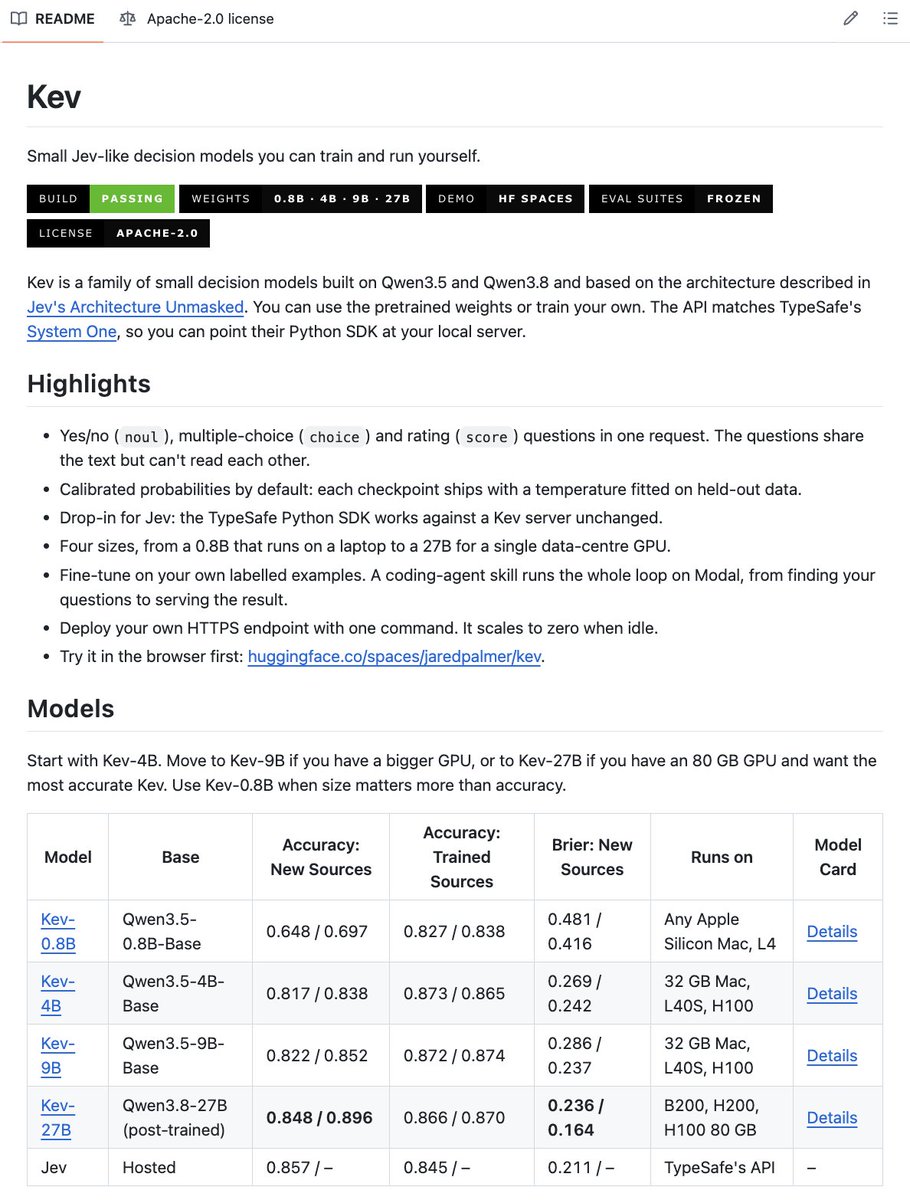
Jev + Qwen-3.8 = Kev. you can now run your own decision model locally, for free.
kev is an open source family of small decision models built on qwen3.5 and qwen3.8, reverse-engineered from jev's own published architecture.
> drop-in compatible with typesafe's own sdk
> answers yes/no, multi-choice, and rating in one call
> sizes from 0.8b (laptop) to 27b (data-center gpu)
> try it in the browser, zero install
100% free. open source.
"JEV-as-a-Judge: Accept When Confident, Escalate When Unsure"
This paper shows you can just use JEV for every evaluation instead of expensive LLM.
JEV basically acts as a cheap first-pass judge, returning both a verdict and how confident it is.
When confidence is high, keep the answer. When it’s low, escalate to a stronger LLM.
This simple routing keeps ~99% of GPT-6’s accuracy while reducing evaluation cost by a lot.
https://t.co/cP4EzOreaO
Researchers from Meta Superintelligence Labs and the University of Washington introduced Context Language Models, which treat model context as an editable file. Code: https://t.co/1TYGsdkR1m
#AI#Meta#OpenSource#LLMs
Se você ri, corre o risco de parecer tolo. Se você chora, corre o risco de parecer sentimental. Se você se declara, corre o risco de ser rejeitado. Se você expõe seus sonhos ao mundo, corre o risco de ser rediculirizado. Somente quem se arrisca é verdadeiramente livre.