Jason Njoku's words cut deep for a reason. They're true.
Even with majority ownership, founders can find themselves constrained by investor protections, board influence, and expectations that don't match ground realities.
Before you sign the term sheet, ask yourself: Are you building a house to live in, or a house to sell? The answer changes everything.
@vangeorgh There are solar tracking systems. The cost of having them nullifies the benefits. Most times it's more cost effective to install twice the number of panels facing north and south than to install a few that follow the sun from east to west
The older I get, the more I realize that life has seasons. And not every season needs to be your best one. Some seasons are for building. Some are for healing. Some are for just surviving. You don’t have to win every single chapter for the whole story to turn out well.
I had to go look up the “just one engineer”
Ladies and gentlemen there are levels to this sh*t
The just one engineer is a distinguished engineer at Microsoft who has been with the company since 2001 and has been focused on .NET concurrency and runtime
He led the team that rewrote .NET runtime to native C and C++
He architected the task base asynchronous programming model in C#
This man is not just one he’s a power house
Ukraine : pourquoi les blindés russes deviennent-ils plus difficiles à détruire ?
Le commandant du corps ukrainien Azov, Denys Prokopenko, avertit que les chars russes sont désormais plus difficiles à neutraliser. Cette évolution ne repose pas sur un nouveau blindage révolutionnaire, mais sur l’accumulation de protections complémentaires et sur une meilleure coordination tactique.
Les véhicules reçoivent davantage de blindage réactif explosif, notamment sur les flancs et les parties autrefois moins prot��gées. Les premières « cages » artisanales sont également remplacées par des structures mieux conçues, parfois installées directement en usine. Leur fonction est de provoquer l’explosion des charges creuses transportées par les drones FPV avant qu’elles n’atteignent le blindage principal.
Certains chars sont aussi équipés du système de protection active Arena-M. Celui-ci détecte la menace et lance une contre-munition afin d’intercepter les roquettes, les missiles antichars et certains drones. Après les premiers retours du front, la Russie envisagerait de porter le nombre de ses effecteurs de 12 à 36. Des dispositifs mécaniques ou électromagnétiques de déminage complètent cette protection en déclenchant les mines avant le passage du véhicule.
Mais l’évolution la plus importante est tactique. L’infanterie russe cherche à s’infiltrer jusqu’aux positions des opérateurs ukrainiens de drones, tandis que l’artillerie frappe leurs zones de lancement. Les blindés peuvent ensuite être engagés en plusieurs vagues : la première force les défenseurs à consommer leurs drones et leurs munitions antichars, la suivante tente d’exploiter leur épuisement.
Lors d’un affrontement, une unité ukrainienne aurait ainsi employé près de 125 drones FPV pour arrêter seulement deux ou trois chars russes. Ce chiffre illustre les limites d’une défense reposant principalement sur ces appareils : tous n’atteignent pas leur cible, les brouillages et les protections réduisent leur efficacité, tandis que les stocks doivent être rapidement reconstitués.
Le char russe n’est donc pas devenu invulnérable. Il faut simplement davantage de drones, des attaques successives ou des armes antichars plus puissantes pour obtenir le même résultat. L’idée selon laquelle les drones auraient rendu les blindés obsolètes apparaît une nouvelle fois prématurée : la Russie apprend de ses pertes et transforme progressivement ces enseignements en solutions produites en série.
https://t.co/bu2CCmRZy0
I once argued with someone, not even a foreigner, that rice and so many of our other grains were not colonial imports. They completely disagreed.
Oryza glaberrima was already ours. Monty Jones had the curiosity to refine it. Most of our agricultural technicians and scientists today don't have that same curiosity, so these grains just disappear.
Our educational systems are failing us, and the lack of curiosity about ourselves in the African mind is contributing to it in enormously.
This is a BIG DEAL ‼️‼️‼️
Imagine the Nigerian economy is a car.
For a while, the CBN had its foot firmly on the brake.
High interest rates discourage borrowing. Less borrowing can reduce demand, which can help bring inflation down.
Now, the CBN is releasing the brake somewhat.
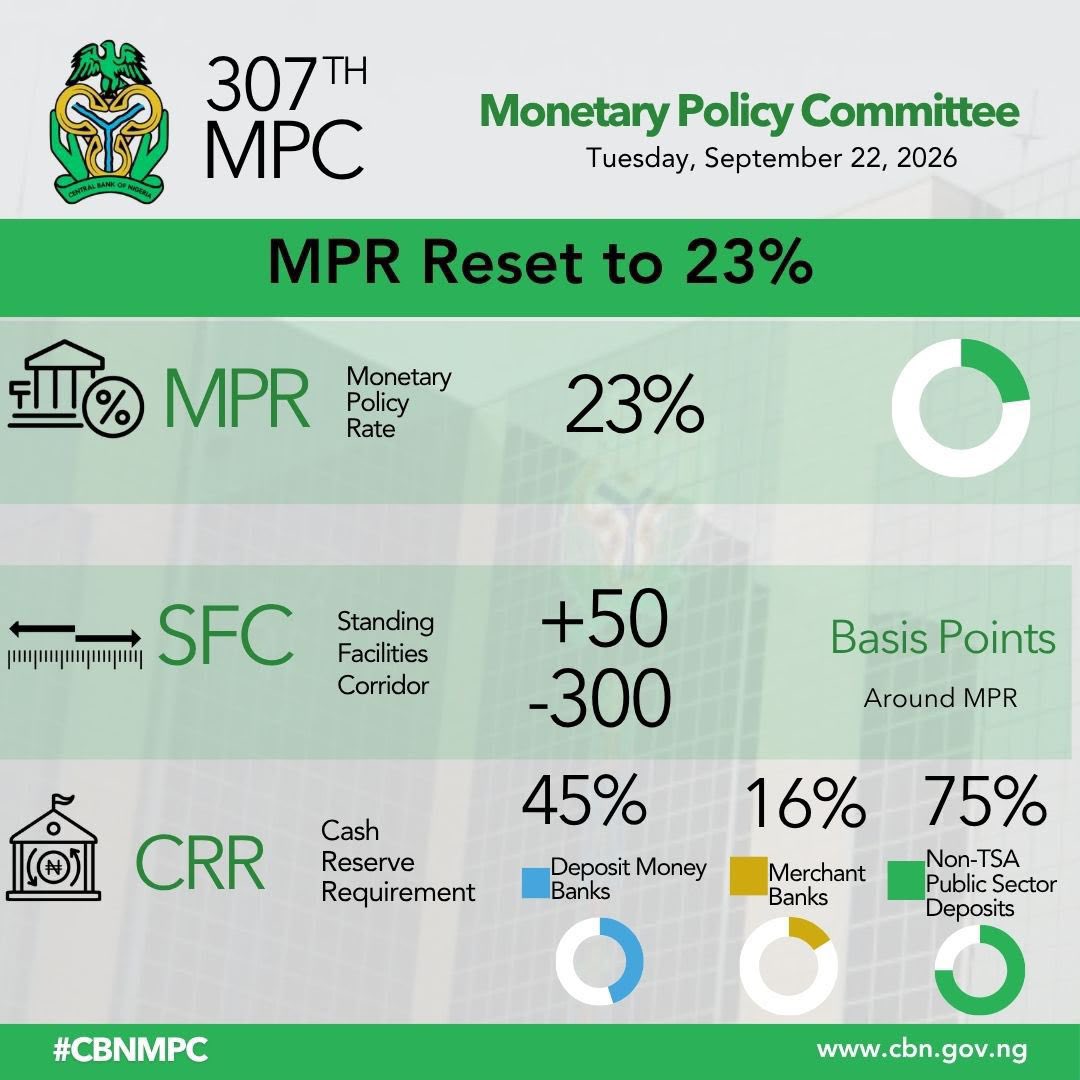
MPR has gone from 26.5% to 23% that is a 350 basis-point cut.
What could this mean?
1. Credit could become cheaper.
Lower rates can make it more attractive for businesses and individuals to borrow, invest and expand by supporting economic activity.
2. Savings returns could come down.
If you’ve been getting returns of 20% or more on some fixed-income products, don’t be surprised if those yields eventually fall.
And when risk-free/low-risk returns fall, investors may start looking more closely at equities, businesses and other productive assets.
3. Capital could start flowing differently.
People have been asking for lower interest rates for a LONG time.
For context, 23% is roughly back to where Nigeria’s MPR was in February 2024.
But the CBN hasn’t completely taken its foot off the brake.
The CRR is still 45% for deposit money banks.
Very simply, if a bank has ₦100 of qualifying deposits, ₦45 has to be kept as reserves, before considering other liquidity and regulatory requirements.
So this isn’t just about interest rates.
It is about the flow of capital through the Nigerian economy.
The price of capital is changing.
And that could have implications for businesses, banks, investors, consumers and the broader economy.
What do you think?
As a founder you know your numbers, you know how much runway you have left , you know that you wouldn’t be able to meet up with the next months salaries, the ideal thing for you to do is temporarily pause and communicate to your staffs , ask them to stop working and if things get better you would reach out to them , it’s wicked for you to make them keep working, sweating and toiling for you when you know you have no means of paying them.
I have so much to say lol
It’s a pattern at this point. We’re so obsessed as a people with looking good rather than being good.
It’s why I rarely post my work on here, I genuinely can’t stand the dickriding, even when it’s directed at me.
We’ve spent 3 days taking a new payment app into a busy market, and one thing became clear the first day. People don’t need another cool app. They need a reason to leave the one they already use.
They don’t care about your cashback, referral bonus or free transfers.
I know when a startup will not survive especially if the target market is Nigeria or Africa.
Especially if I have seen people build similar things before.
I told a founder something fundamental about Nigerians that will make his startup struggle, he wished it away. I understand for him because it’s his first time.
You see those Nigerian first time founders with money, it’s after two years their eyes go clear…
Tantalizers Plc has a total of 273 employees.
About 161 staff earn N400k or below annually.
80 staff earn between N400k to N1m, while 32 staff earn above N1m annually.
You shouldn’t vibe code and expect paying users for your app.
That’s still the domain of software developers.
You wouldn’t open a photography studio just because you have an iPhone that takes good pictures. No one would patronize you.