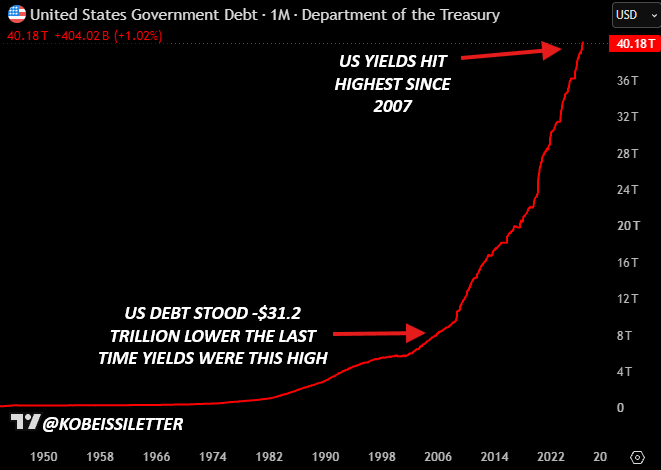
The last time US Treasury yields were this high, total US national debt stood at just $8.9 trillion.
Today, US debt stands at $40.1 trillion. That's +$31.2 trillion more, or over 4.5 TIMES higher.
This means every 1 percentage point in the average cost of servicing the debt now translates to ~$401 billion per year in interest expense.
In 2007, the same 1 percentage point translated to just ~$89 billion.
That’s an additional ~$312 BILLION in annual interest expense for every percentage point increase in borrowing cost.
This is a vastly different situation than it was 19 years ago.
The bond market matters more now than ever.
U.S. real estate investment has collapsed by 50% over the last four years.
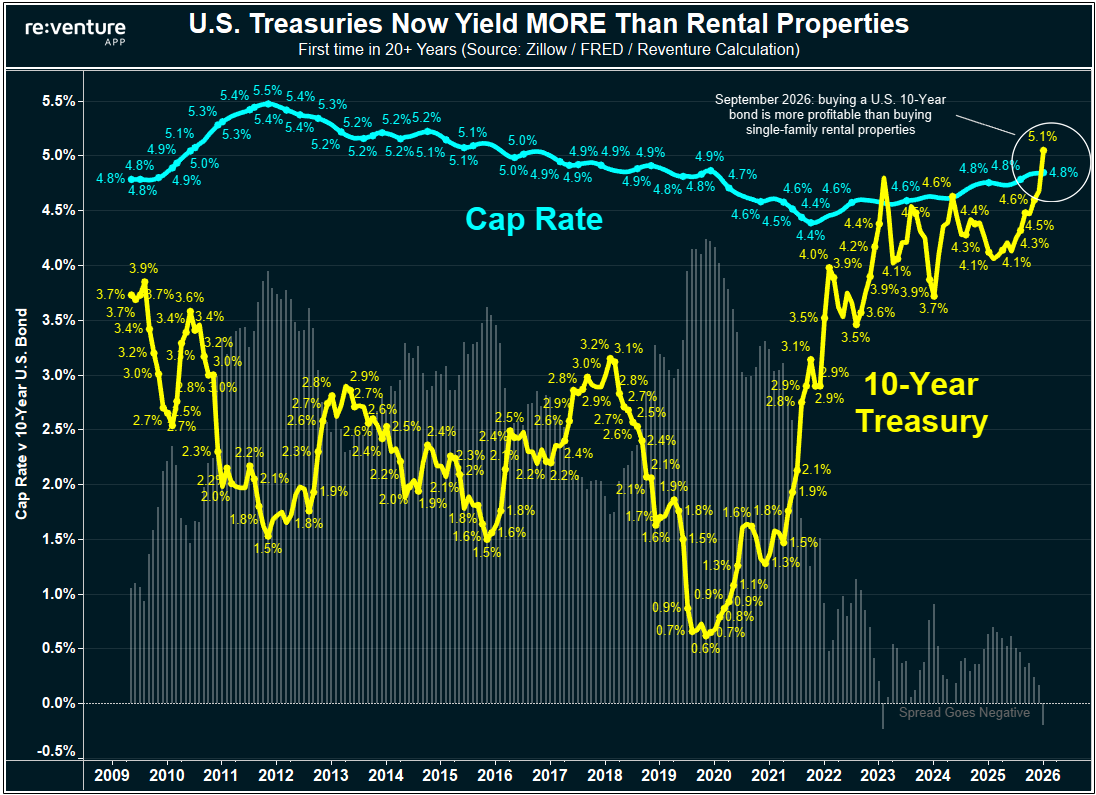
The reason? It's now more profitable to sit on your couch and buy a 10-year government bond than to buy an investment property.
10-year yields are now 5.1%.
While the single-family cap rate for rentals is 4.8%.
For the first time in nearly two decades, buying real estate for cash flow has a negative opportunity cost v buying government bonds.
And as a result, the number of people buying investment properties has plummeted by 50% over the last four years.
This is having a massive price impact on certain markets. Track Cap Rates for your area at https://t.co/DP6pgVhZUb.
The presumption that the Fed raising short-term rates reduces inflation is predicated on the belief that higher rates reduce demand and investment.
But what if higher rates don’t reduce demand and investment because the demand for intelligence and energy is unaffected by higher rates because winning the race for super intelligence has a near infinite ROI and the demand for compute will remain incalculable.
Why won’t higher rates at this unique moment in history therefore lead to more inflation as interest costs are embedded in everything?
And the problem is compounded as the more the Fed raises rates, the more inflation we will have and the more the Fed will need to raise rates further and so on.
But what if the old models don’t apply to the current paradigm and the Fed is wrong?
I think the Fed might have just made a mistake. Am I right or am I wrong?
Will 5.0% be the ceiling for the nominal Treasury yield? Maybe not, but for bond investors the risk-reward math has gotten considerably better. The 5% yield provides such a good cushion that if the 10-year yield were to fall 100 bps, an investor would make 11.9%, while only losing 1.9% if the yield were to rise to 6%.
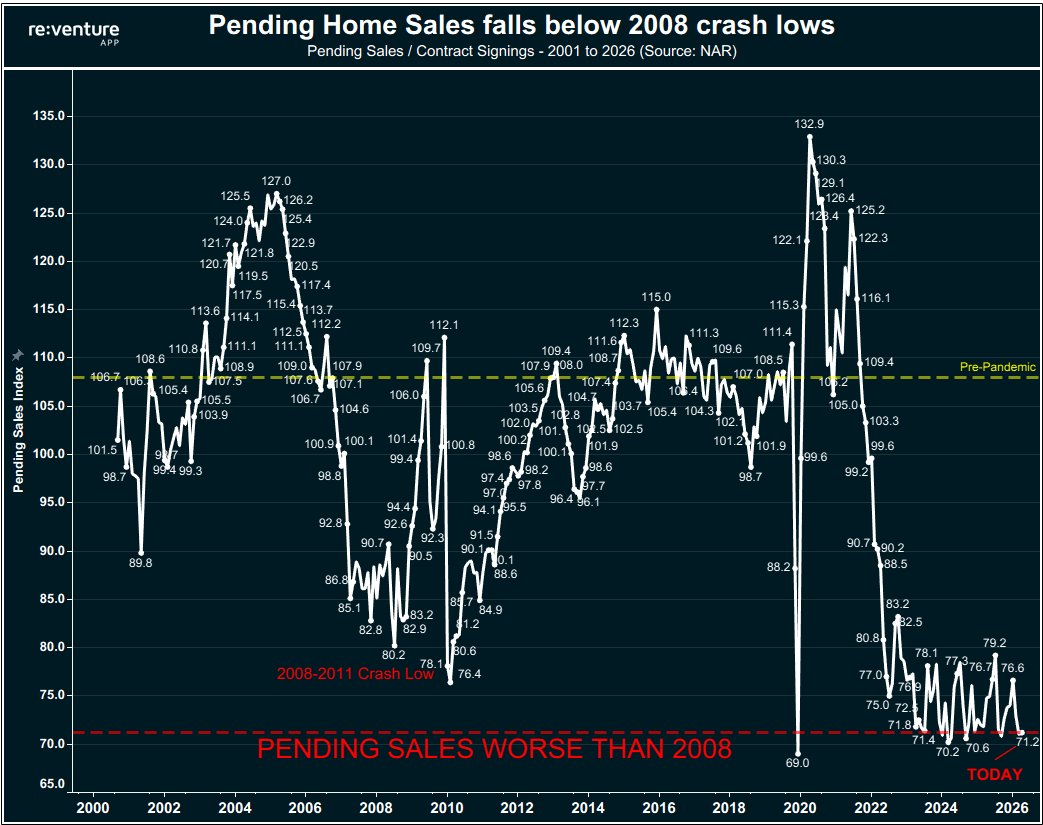
U.S. homebuyer demand has fallen so far that pending sales are now worse than 2008.
In August 2026, the NAR pending sale index registered at 71.2.
Lower than during any period of the 2008-2011 crash.
Worse yet, contract signings are down 47% from the pandemic peak, and 35% from normal pre-pandemic levels.
This is a full-scale housing demand recession, and it's not getting any better.
The longer that pending sales stay this low, the more pressure there will be on sellers to cut prices.
But there's big differences depending on market. Check home sales and inventory data for your ZIP at: https://t.co/HpNEVEtQMK
This guy is very smart. Thanks for the shout out Pharaoh. I also agree with the time line. Not sure we will ever see BTC below today’s level again though.
I reread this every year.
I cry like a baby every year.
Todd Beamer died a father, husband, and hero.
Todd: Hello… Operator… listen to me. I can’t speak very loud. This is an emergency. I’m a passenger on a United flight to San Francisco. Our plane has been hijacked.
Lisa: I understand. Can they see you?
Todd: No. There are three that we know of. They have knives — razor knives, like box cutters. Someone announced from the cockpit there was a bomb. It sounded fake.
Lisa: Your name?Todd: Todd Beamer. United Flight 93.Todd: They killed one passenger in first class. They forced most of us back. Fourteen of us here. Five flight attendants. The guy with the bomb ordered us to sit on the floor.
Lisa: Are you okay?
Todd: We’re going down… wait. No. We’re leveling off. We changed directions. We’re flying east again.
Todd: A guy named Jeremy called his wife. She told him two planes hit the World Trade Center. Lisa, is that true?
Lisa: I have to tell you the truth. It’s very bad. Both towers are gone. A third plane hit the Pentagon. Our country is under attack. I’m afraid your plane may be part of their plan.
Todd: Oh God. Lisa, will you do something for me? Call my wife and my kids. Promise me you’ll call.
Lisa: I promise.
Todd: Our home number is… You have the same name as my wife. Lisa. We’ve been married ten years. She’s pregnant with our third child. Tell her I love her. I’ll always love her. We have two boys — David, he’s 3, and Andrew, he’s 1. Tell them their daddy loves them and he is so proud of them. The baby is due January 12th. I saw an ultrasound. We still don’t know if it’s a girl or a boy.
Lisa: I’ll tell them. I promise, Todd.(Lisa patches in the FBI.)
Agent: Todd, your plane is on a course for Washington. Best guess is the White House or the Capitol.
Todd: I understand. I’ll be back.
Todd: Everyone knows this isn’t a normal hijacking. We have decided we will not be pawns in their plot.
Lisa: What are you going to do?
Todd: Four of us are going to rush the one with the bomb. Then the cockpit. A stewardess is getting boiling water. We’ll take them out.
Todd: Would you pray with me?They pray the Lord’s Prayer. Then: Yea, though I walk through the valley of the shadow of death, I will fear no evil, for thou art with me.
Todd: God help me. Jesus help me.Are you guys ready? Let’s Roll.
10 years ago: 30-yr mortgage rate was 3.4% & median existing home price in the US was $240k
Today: 30-yr mortgage rate is 6.8% & median existing home price is $429k
Result: $38k increase in down payment (assume 20% down) & 163% increase in monthly payment (from $851 to $2,237)
Video: https://t.co/7GaxNVRCqN
10 year treasury yield is now 5%
You can buy $1 million of these bonds
Get $50k/year and pay $0 in state tax
Every single year for 10 straight years
Guaranteed and completely risk free
Then get your full $1 million back after
But you’re just not going to do it 🙂
After shrugging off $AVGO -12.6% on Thursday, the strong jobs report drove the 2yr yld +10bps to the highest levels since early 2025 & S&P -2.6% on Fri. For the wk, S&P/Nas/SOXX/Mag7 were -2.6%/-4.7%/-4.7%/-5.8% despite oil -3% to $91.
This is what I posted on X on last Sunday night “Over the near-term, the overall market at some point will need to take a breather from increasingly overbought technical conditions. After nine straight weekly gains, the S&P is now up 19% from its recent closing low on March 30th. But I feel like any losses will be contained to the typical ~5% pullback which is typically seen three to four times per year.”
After being up for nine straight weeks, the S&P went from an all-time closing high on Tuesday June 2nd and 14-day RSI of 75 to an RSI of 49 on Friday June 5th and down 3.0% from that Tuesday level.
During the internet infrastructure buildout between December 31, 1994 and the peak on March 10, 2000, the S&P tripled, the Nasdaq went up 6.7x and the SOXX Index advanced 9.5x. The S&P during this time had its 14-day RSI cross below 70 (overbought level) fifty times. 36% of the time, that day was the low point before it crossed back above 70 again. 42% of the time the low was reached within 2 trading days and 62% within three days. The average was 10 trading days to hit a short-term low and down 2.5% on average from the overbought level before the advance started to the next overbought reading.
Next week, there will be several potential market moving events. The $AAPL WWDC is on Monday. With the stock price surge into this event, a sell the news reaction would not be surprising much like with recent tech results. But I am bullish longer-term given after a 2 year wait we should finally get an AI infused iPhone. I am also very bullish on the larger form factor of a foldable phone that has driven major upgrade cycles in the past. Samsung introduced a foldable in 2019.
CPI on Wednesday will be closely watched along with how bond yields react. $ORCL results are also that day which should be solid given recent commentary from major customer OpenAI as well as related hyper-scaler cloud results. Having said that, a new CFO may want to set very achievable initial FY27 guidance that could disappoint.
The ECB is likely to raise rates on Thursday since being on hold after cutting rates in June of 2025 to 2.0%. Commentary will likely set the bar for the Fed in the following week.
Over the long-term I remain bullish given: 1) S&P earnings are expected to increase 25% this year driven by the advent of Agentic AI, 2) I believe oil prices will come down to the $80ish level given the political toll it is extracting on the US administration every day that the Strait of Hormuz is closed, and 3) new Fed Chairman Warsh is likely to push back against calls to raise rates. I view this recent pullback as well needed to work off the recent froth versus marking "the top."
All the best in the week ahead.
High level suitcoining here. This is how you talk to Boomers. Mapping risk allocation to port allocation is smart/ prudent, limits nasty surprise potential and helps behavior.
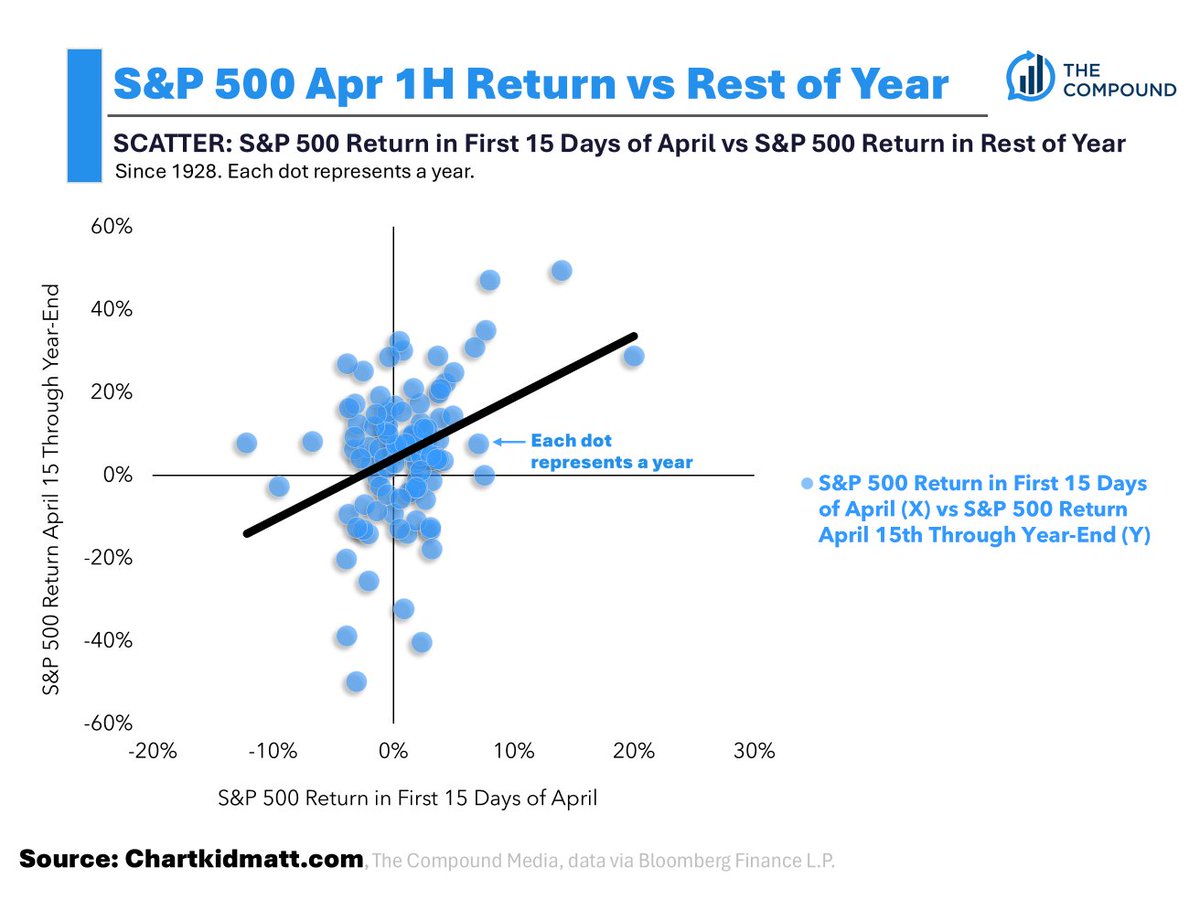
Since 1928 when the S&P 500 is up >= 5% in first 15 days of April, the market is up 31.9% on average for the rest of the year.
We're up 7.6% in 2026.
The first half of April matters.
CIO Chart of the Week: We continue to believe it is the Golden Age of Fixed Income. After the recent move higher in rates, high-quality yield (income) offers an attractive risk-reward for a portfolio. For example, if you bought US IG 3Y today at 4.57% yield, rates would need to rise more than 320 bps over the next year for returns to turn negative. On the other hand, if rates fall 50 basis points over the next 1y, you would return 5.4%. That asymmetry is representative of the opportunity in bond markets today: income can do much of the heavy lifting while preserving flexibility and providing a liquid ballast amidst an uncertain market.
The S&P 500 has averaged +24% in the 12 months after an oil shock.
Crude prices have surged 20% in 48 hours just 8 times in the last 40 years.
Stocks were up in 7 of 8 instances.
History favors the bulls.