EXCLUSIVE: Former US Army Pacific Commander, Retired 4-Star General Charles Flynn Warns of Arctic Vulnerabilities And Says CCP Has Already Infiltrated Alaska Military Bases With Cameras and Drones
“I was stunned to find out the amount of penetrations that had been happening at our bases up there by Chinese nationals that were in the United States. These individuals were going to the gate. Some of them were getting into the installations and when they were getting into the installations, they would have cameras and unmanned aerial vehicles in the trunks of their cars.“
@thelatmg@latimesstudios_
Here’s another case of fraud that has plagued Minnesota while under the failed leadership of .@GovTimWalz.
A young woman who was living in an apartment subsidized by Medicaid due to being disabled, was evicted from her home.
Upon further investigation it was found that - American Home Health Care, LLC her caregivers are being investigated for services not provided.
The company is owned by Mohamod Jama - they should investigate whether he had any dealings with .@Ilhan.
There’s no way of knowing how many people have been affected by this fraudulent scheme.
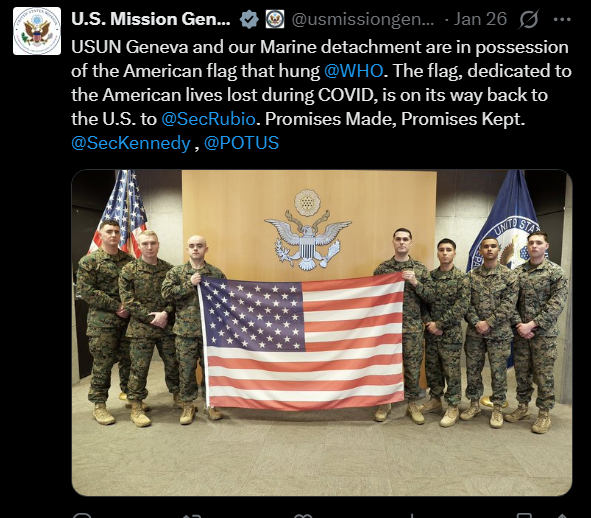
The World Health Organization (WHO) refused to return the US Flag to Rubio after President Trump withdrew from the organization.
President Trump sent the US Marines to capture the flag.
The WHO claimed they had not approved the US withdrawal. Sec Rubio said, "FAF0".
U.S. Treasury Secretary Bessent on Iran:
“We created a dollar shortage in the country. It came to a swift conclusion.
I would say the culmination came in December, when one of the largest banks in Iran went under after a bank run. The central bank had to print money.
The Iranian currency went into free fall, inflation exploded, and as a result, we’ve seen the Iranian people out on the streets.”
Some sad news, the fishing boat
Lilly Jean is missing and presumed to have sunk off of Gloucester, MA this morning.
Gus Sanfilippo’s 80-foot fishing vessel Lily Jean was once featured on the History Channel TV show Nor’Easter Men.
They had reported that they were sinking. The Coast Guard has located an empty life raft.
In addition to Gus, we hear he also had the two Paul’s on board, a father and son duo of deckhands, the Beal boys, as well as a younger crew member from Lynn and a federal observer was also on the boat when it went down. There may have been an additional crew member on board as well.
Lily Jean is the boat pictured on the left.
Alex Pretti: Evidence his gun may have been defective
Gun rights advocate @TaylorDRhodes2A made a video 5 months ago showing the same gun Alex Pretti was carrying can accidentally discharge.
Some people are speculating the first shot heard in the footage was Pretti's gun after an officer removed it from his belt, after they shout "GUN GUN", and the second officer reacted with the next shot.
Did the gun go off unprompted?!?
If that's the case, ICE agent/liability debates aside, Alex Pretti's family could probably sue Sig Sauer (the manufacturer of the P320 pistol).
This video shows repeatable unprompted discharge.
My god. The derrick basically disintegrates when it hits the ground. Doyon 26 weighs nearly 10 million pounds. Absolutely no clue how the rig could tip over like that.
⚡️This table is a map of who absorbs system instability.
1. These brackets are really about load-bearing
Notice where the curvature steepens.
The system is designed so that earned income becomes the primary shock absorber for monetary disorder.
Once you cross into the middle brackets, marginal rates climb quickly while:
•asset holders retain deferral
•leverage remains privileged
•unrealized appreciation stays largely untouched
•inflation quietly erodes purchasing power beneath the surface
The state is telling you something very clearly:
If you work for income, you are the buffer.
2. Inflation already taxed people before this table appears
These brackets sit on top of an invisible tax that never shows up here.
Currency dilution.
By the time income hits this chart, it has already been taxed through:
•housing inflation
•healthcare cost drift
•education inflation
•insurance repricing
•asset price exclusion
This table is secondary extraction, not primary.
The real tax happens before you get paid.
3. Progressivity exists on paper, regressivity exists in reality
On paper, higher earners pay more.
In practice, people whose wealth is stored as:
•equity
•businesses
•real assets
•carried interest
•jurisdictional flexibility
operate on a different plane.
Wage earners cannot reprice time.
They cannot defer realization.
They cannot relocate income easily.
They cannot hedge policy risk.
So the burden concentrates where mobility is lowest.
4. The system quietly discourages earning more through labor
Look at how fast marginal rates rise relative to income bands.
The message is subtle but unmistakable:
Do not scale through effort.
Scale through ownership.
Effort is linear.
Ownership is convex.
The tax code enforces this distinction.
This is a steering mechanism.
5. Why this creates the psychological shift you feel everywhere
This is why people stop saying:
“I want a good job”
and start saying:
“I want optionality”
“I want leverage”
“I want an exit”
“I want assets”
“I want freedom”
They are responding rationally to the incentive field.
When systems punish throughput and reward insulation, behavior adapts.
6. The deeper truth no one wants to say plainly
This table is structurally coherent for a debt-based system.
A highly levered sovereign cannot tax capital aggressively without risking capital flight.
So it taxes what cannot leave.
Time.
Labor.
Domestic earners.
The state is managing fragility, not fairness.
7. Final compression
This chart describes who the system expects to carry risk.
If your wealth comes from wages, you are inside the blast radius.
If your wealth comes from assets, you are managing the blast radius.
If your wealth comes from jurisdictional flexibility, you are outside it.
That is the real message.
Once you see it, the rest of the economy starts making sense.
⚡️California’s future looks like this.
The symbols remain intact.
The GDP stays large.
The universities stay prestigious.
The brands keep their glow.
The coastline stays beautiful.
The headlines stay loud.
From the outside, it still looks like power.
But the function changes.
The state stops being a generator of new reality and becomes a curator of old success.
Here is how that happens structurally.
First, risk migrates out.
Every system has a risk tolerance profile. California once absorbed risk in exchange for upside. People moved there to try things that had no precedent. Capital accepted losses because the upside justified it.
That equation flipped.
Risk is now punished faster than success is rewarded. Permits. Compliance. Litigation. Social scrutiny. Political volatility. Tax uncertainty. These do not stop activity. They select against edge activity.
The people who leave are not average. They are the ones closest to new gradients. Founders. Engineers. Capital allocators. Cultural producers. The people who feel friction earliest.
What remains is competence without frontier instinct.
Second, innovation becomes performative.
When a system loses its edge, it compensates with language.
Everything is framed as “leading.”
Leading on climate.
Leading on equity.
Leading on innovation.
But leadership becomes declarative rather than causal.
Real innovation looks messy and uncomfortable in real time. It produces inequality before it produces abundance. It creates power asymmetries before it creates stability. California once tolerated that phase.
Now it tries to legislate the outcome without accepting the process.
So innovation becomes grants, panels, accelerators, and press releases. Activity increases. Breakthroughs decline.
Third, talent inverts.
In a frontier system, ambitious people ask one question:
“What can I build here that cannot be built elsewhere?”
In a mature bureaucratic system, they ask a different one:
“How do I extract status or safety from what already exists?”
That shift is invisible at first. Everyone is still smart. Everyone is still credentialed. But the orientation changes.
You get resume optimization instead of company building.
Policy fluency instead of technical mastery.
Network signaling instead of output.
The system fills with people who are very good at navigating it and increasingly bad at escaping it.
Fourth, capital turns defensive.
Capital never moralizes. It responds to gradients.
As soon as returns elsewhere become cleaner, capital reallocates quietly. Texas. Florida. Miami. Austin. Nashville. International hubs. Private markets. Digital rails.
California capital does not vanish. It becomes rent seeking.
Real estate. Regulation arbitrage. Litigation. Political capture. Defensive moats around incumbents.
Wealth stays. Velocity drops.
This is how you get a place that feels rich but stagnant.
Finally, the myth breaks.
California ran on a story.
Come here. Pay the cost. Endure the chaos. It will be worth it.
When that story stops being true for enough people, the system loses its gravity.
People still live there. They just stop believing the future is being written there.
That is the moment of irrelevance.
And the most brutal part is this.
Irrelevance is stable.
It can persist for decades.
Rome did not fall when it stopped innovating.
Venice did not collapse when trade routes moved.
Britain did not implode when the empire ended.
They became museums with nice accents.
California is not dying.
It is aging.
And aging systems can be beautiful, wealthy, influential, and completely unable to shape what comes next.
That is the trajectory.
Engine to archive.
Builder to landlord.
Frontier to memory.
That is what I see.
⚡️What you’re looking at is industrialized entitlement fraud, not a one-off scam, and it works because of how modern public payment systems are built.
Here’s the real structure.
1. The Program Layer
Most of these schemes sit on Medicaid home health, personal care assistance, or behavioral health reimbursement.
These programs have three properties that make them exploitable:
• Services are hard to verify physically
• Payments are volume based, not outcome based
• Oversight is post-payment, not pre-approval
The system pays first and audits later.
That single design choice is everything.
2. The Corporate Shell Stack
The building with “14 companies” is a feature.
Each entity is:
• A separate LLC or nonprofit
• Registered to the same address
• Sharing staff, billing infrastructure, and often patients
• Legally distinct on paper
Why this matters:
When one entity gets flagged, the others keep billing.
When audits start, assets are already moved.
When licenses are revoked, new ones appear.
This is redundancy for fraud, exactly like redundant servers.
3. The Billing Engine
Here’s how money actually moves.
1. Enroll patients who technically qualify
2. Enroll caregivers who technically qualify
3. Bill for maximum allowable hours
4. Inflate service frequency
5. Duplicate or overlap care claims
6. Auto-submit claims in bulk
Nobody checks whether care actually happened in real time.
Audits happen months or years later, if at all.
By then:
• Money is gone
• Entities are dissolved
• Principals are shielded
4. Why the Same Address Keeps Appearing
Regulators flag individuals.
Fraud adapts by flagging entities instead.
One address means:
• Centralized paperwork
• Shared compliance consultant
• One billing contractor
• One legal defense structure
It looks sloppy from the outside.
It’s actually optimized for scale.
5. The Oversight Failure Nobody Talks About
The system relies on:
• Whistleblowers
• Random audits
• Paper verification
There is no physical verification loop.
No biometric check.
No real-time service confirmation.
So the honest providers drown in compliance while dishonest ones scale faster.
That’s why this persists.
6. Why This Keeps Getting Framed Wrong
People argue morality.
They argue politics.
They argue culture.
That misses the point.
This fraud exists because:
• Payment systems reward volume
• Oversight is delayed
• Fragmentation prevents pattern detection
• Accountability is diffuse
If this were defense contracts or agricultural subsidies, it would look identical.
Same mechanics. Different label.
7. The Brutal Truth
This is rational behavior inside a broken incentive system.
The state built a system that assumes good faith.
Bad actors found the edge cases.
Then professionalized them.
Once that happens, the fraud does not stop until:
• Payments pause
• Verification becomes real-time
• Or political cost exceeds inertia
None of those are currently true.
8. Why It Feels So Infuriating
Because you’re watching:
• Taxes converted into paper claims
• Care reduced to spreadsheets
• Trust turned into arbitrage
And the system keeps paying because stopping would expose how much is already gone.
That’s the quiet part.
Bottom line
This is process abuse at scale.
And until the payment architecture changes, new actors will replace old ones as fast as licenses can be filed.
That’s the real truth.