This gets at the heart of why I have such a repulsion for grindslop culture.
When someone glorifies behaviors that statistically lead to health problems, burnout, and bad decisions, I trust them less.
In grindmaxxing there are a couple of questions inside it.
First question is that whether you should do it or not, and to what level. I don’t think there is one right answer because it is situational and plays into the dynamics of the market.
Most startups the mode is either finding PMF or scaling that.
PMF is about building, talking to customers and learning from those activities. There is some level of grind involved but I think the risk of too much grind and you don't internalize the learnings enough to correct the path. The speed makes you blind.
Then at scaling, there can be grind because the business is booming, but goal should be finding leverage to scale effectively. With leadership, hiring, with processes, software, anything.
Then there can be higher urgency when you are in some landgrab moment where there is real advantage in being first. Many will over-index on being the first, often it doesn't matter the way you think it would. It matters when you learn from it, because you gain advantage being the first to learn, not because you somehow automatically capture the market and can keep it. Often in reality doesn't really matter much if someone comes later with lot better product or experience. Customer will gravitate to the better solution, not to the solution that was first.
And I think you can be fast in different ways.
You can be very fast but have a very inefficient model. Or you can have a very efficient model and use less effort to the get same speed. The latter will might be slower at first, but will be more compounding and more scalable in long run.
For example in the beginning, you might be onboarding every customer. But eventually you have to realize it probably won’t scale, your and your team's time is not leveraged well, you don't learn much from repeating that over and over. You have to find leverage from the product, or some other solution that doesn’t require as many human hours.
So many startups and teams do have to work a lot and intensively. But there will always be a tradeoff to consider. Teams will burn out. Mistakes will happen. Bad decisions will be made. A lot of the work might be wasteful if the team never stops to consider.
Sometimes it is not an option. You have to grind through it. I get that. But you as a founder can still choose the culture, the values, the operating principles. Is it based on grind, or is it based on something else? Grind is not always optional, but culture built around grind is.
--
And second questions which the most interesting part to me, which is always optional, if you make the grind as part of the narrative and the brand.
Does the grind narrative actually make your brand better or more valuable for customers? I’d argue only a few businesses benefit from the grind narrative. Most probably do not.
For example, when I joined Coinbase early, we knew that trust was the most important thing. We had to be secure and project stability and trust. That was what I was also trying to do with design. The team also did it on the legal side by trying to be the trusted option operating from the US instead of the Caymans or China or somewhere else (many of those are now gone).
In the aspect of trust, in domains where you want high trust and stability, like banking, security, databases, payments, insurance, infrastructure, etc., the grindmaxxing narrative doesn’t make me trust the vendor more. It makes me trust it less.
Because it makes me think about the mistakes that might eventually happen, or the risk complete implosion of the vendor.
I always evaluate vendors on their culture and brand. I want my vendors trustworthy and operating values that provide stability. We’ve picked vendors over others because we sensed stability and a kind of unhurried expertise. And often we have picked right.
I don’t want to buy vendors and then have them create problems for us, or force us to find another vendor a couple years later.
When you work in a high-trust domain and sell to businesses, the better story is almost how stable and boring your operations are. I want people operating in healthy way, making solid decisions, focusing on operational excellence not building cafes, sleeping at the office or other various side quests.
Exact reason I've avoided this. Unless you submit to slipping human review, you just pile at the end of the funnel. I also observe more failure patterns repeating when running more in parallel before correction.
does anyone actually use the coding agent kanban boards ?
I built one in https://t.co/vSIX2IxOgK and all tasks would just pile in the “ready for review” column
totally useless
"If you are not working 7 days per week, you are going to lose".
Corgi Insurance is the most intense workplace culture in startups.
- The company works 7 days per week.
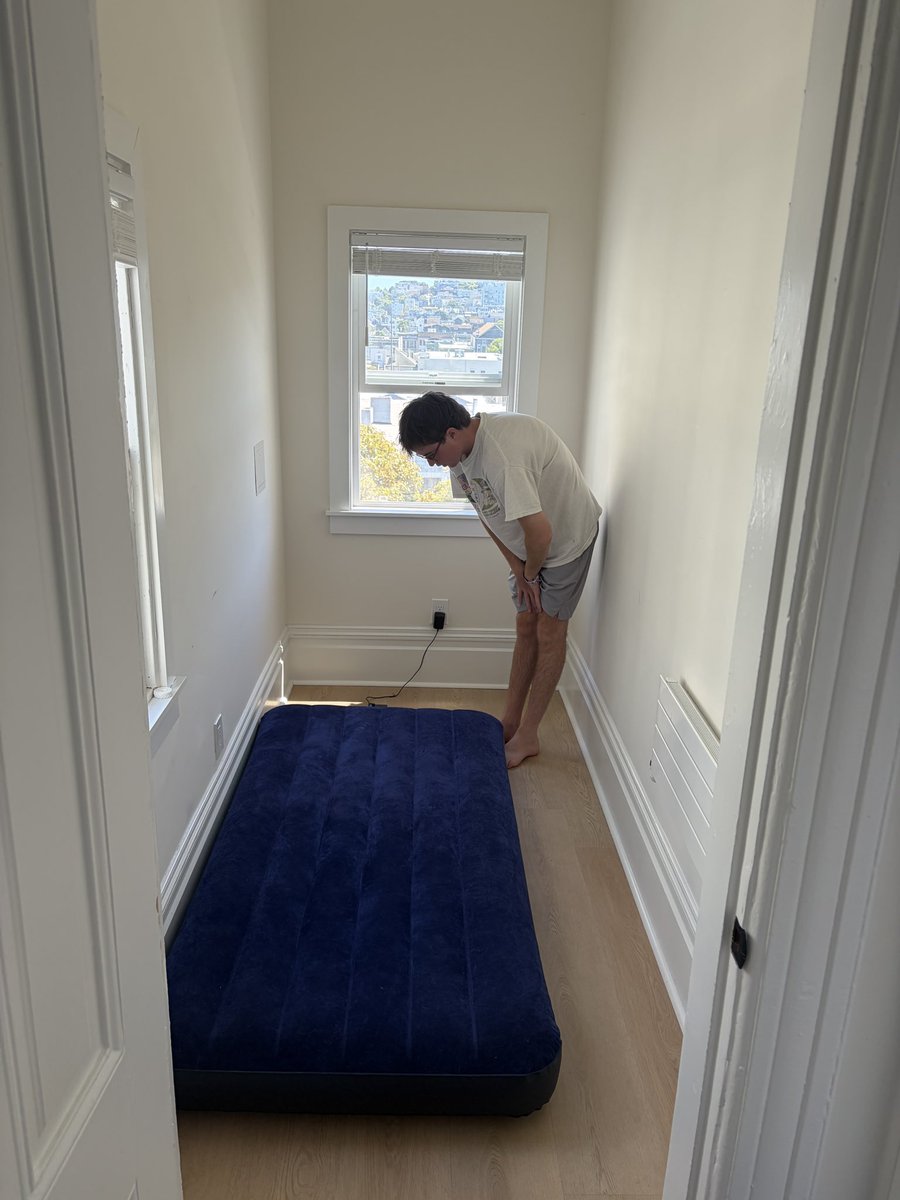
- Founder (@nico_laqua) lives and sleeps in the office.
- He built a cafe in the office because there was no local cafe that was open 24/7.
- 2/3 of the first 30 team members have the Corgi logo as a tattoo.
Today I went behind the scenes with Nico, who has used this culture to scale the company to a $2.6BN valuation in just two years.
My condensed notes below:
1. If You Are Not Working 7 Days Per Week, You Are Going to Lose:
Whatever you can get done in 5 days, you'll get more done in 6 and 7. If you are trying to solve the world’s hardest problems, a standard 5-day workweek will not cut it.
2. Work Trials Repel the Mediocre:
Corgi forces candidates into mock work trials over the weekend. If seeing a full office on a Saturday scares them, they don't belong. True intensity acts as a natural filter to attract killers and repel clock-watchers.
3. Lead from the Front Lines
You can’t demand 7-day weeks while sitting on a yacht. Nico sleeps 3–4 hours a night on a mattress inside the office. If you want your troops to bleed, you have to be in the trenches with them.
4. Culture Only Means One Thing: Winning
Forget superficial jargon like "hackers" or "ex-founders." Strip away the corporate fluff. A great startup culture is aggressively optimized around one single word: Winning.
5. Lifespan vs. Victories
Building something world-historic requires radical sacrifice. When asked if he'd rather build a trillion-dollar company and die at 50, or fail and live to 80, the answer was easy. "I would rather measure my lifespan in victories."
6. Reject the Comfort of "Quiet Quitting."
If you are operating in a hyper-growth environment and your days off happen to be Saturday and Sunday every single week, you are quiet quitting. To win, you must deliberately bypass the off-ramps of personal comfort and low volatility.
Corgi isn't for everyone—and that’s exactly the point.
Uber c-suite being fooled on AI by what has literally been the Uber corporate strategy of get the customer dependent early, raise the price absurdly, and maybe (not) find profitability later is absolute peak tech comedy
The new AI web design giveaway is tasteless use of serif fonts plus italics. I mean, there's about 1000 other giveaways cause its all so very ugly, but that's the initial slap in your face giveaway.
Android jams Magic Cue AI into Messages, and the things pulls a confirmation number from 2 months ago instead of the one from 2 hours ago. Bravo @Google, world class.
@badlogicgames I have an easier time reviewing my own agent's output, because it's following the plan I wrote and hopefully implementing an approximation of what I'd have written myself. Reviewing another person's PR first requires me to figure out wtf I'm even reviewing.
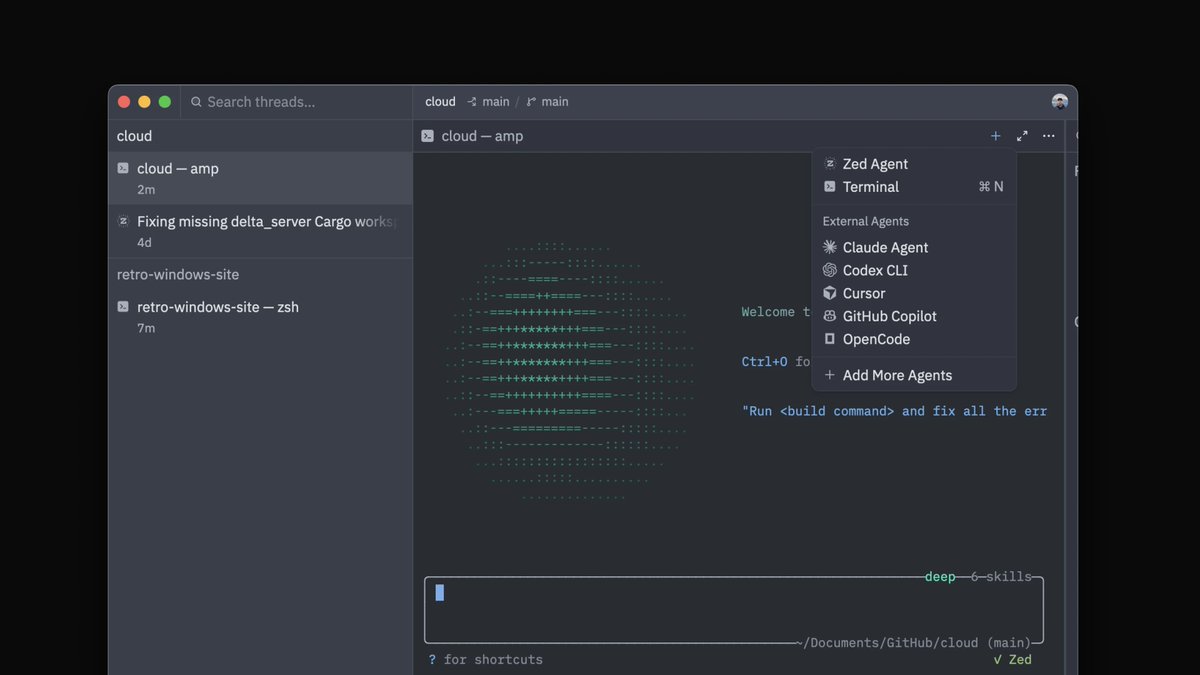
I don't think this is advertised, but Terminal Threads restore remote sessions on reload.
The implication is that I can keep sessions running on desktop, connect to them from laptop, and restore all of them when Zed restarts or reconnects. This is fantastic.
Terminal Threads are live in Zed v1.3.5!
You can now run claude, amp, pi, or any terminal-based workflow as a managed thread in the Threads Sidebar, right next to your other agent threads.
I talked about this on the standup podcast yesterday, but I'll reiterate here: if you're losing sleep because you need to keep feeding the agents STOP, I promise it's not worth it. You got caught in a [prompt -> reward] dopamine cycle and you're addicted to the feeling of the token slot machine. It's not your fault, but you need to escape before it grinds you into a pulp and you can't look at a computer for a month (this was me). If you can break out of it and spend some more time offline, or find other healthy sources of dopamine in hobbies/etc, you'll start to realize just how warped your perception was and that the thing you were chasing wasn't actually productive.
In this climate, company loyalty is strange.
Unless someone stays due to family, golden handcuffs, or only being able to work on their specialty in that place, I'd question staying somewhere this toxic for too long.
Unfortunately, HR types are programmed to select for it.
Meta reached to interview me for a principal role the same week they decided to layoff 8,000 people!
I’m sure there was at least 1 out of those 8,000 people who got let go who would’ve been a good fit for the role they wanted to hire me for. A few of my staff engineer friends got let go so I know this is true.
Instead they:
- axe everybody
- treat them like a cost
- rehire where there’s pain
What ever happened to employee retention?
Why do companies expect us to be loyal to them if they don’t even try to retain us when they have hundreds of billions of dollars?
It would be cheaper financially for them to retain one of those 8,000 people. It would be cheaper emotionally for the people who got let go too
How do these big tech companies expect people to put their blood, sweat and tears into work while also saying, “yeah we’ll cut you at any moment.”
I don’t know. The culture around AI and layoffs has gotten unbelievably toxic
Wait, are the inference providers flagging cyber abuse for doing security reviews on our own code?
I assumed OpenAI flagged me for either home network or GCP operations, but local code security analysis would be nuts.
Anthropic's terrible safety situation is making it so that I cannot have Opus review p0 issues in Hermes Agent to review and help fix security issues.
This does nothing but give hackers an asymmetric advantage over everyone - they will find jailbreaks, they will find ways around this to exploit systems - and the rest of us are locked out of using AI to protect from them.
What a joke
@mogpilled@coolcoder56 Saves you the need to train every interviewer on how to handle it gracefully. Many interviewers won't want to deal with the confrontation, and they really shouldn't have to.
@0interestrates I've historically liked code to be standardized to the degree I can't tell which team member wrote it.
With prose, that translates to everyone sounding like they came from LinkedIn.