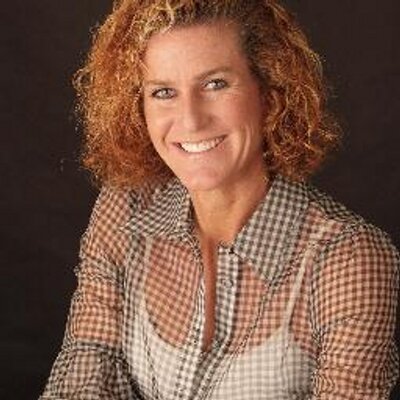
Born June 18, 1962: Theoretical physicist Lisa Randall. "I think the weird thing about being a scientist, or an academic in general, is you have to believe really strongly in what you do, while questioning it all the time and that's a hard balance to have"
https://t.co/4tAvgJhcIA
"Advanced Calculus" (Department of Mathematics, Harvard University) is one of the most remarkable advanced mathematics texts I have come across.
The book develops vector spaces, differential calculus, differential equations, integration, differentiable manifolds, differential forms, potential theory, and classical mechanics within a unified mathematical framework.
What I particularly appreciate is the combination of mathematical rigour and geometric intuition. It serves as an excellent introduction to modern analysis and differential geometry.
Definitely worth saving to your bookmarks if you are interested in understanding the mathematical structures underlying advanced calculus.
https://t.co/ZbShWnOpWN
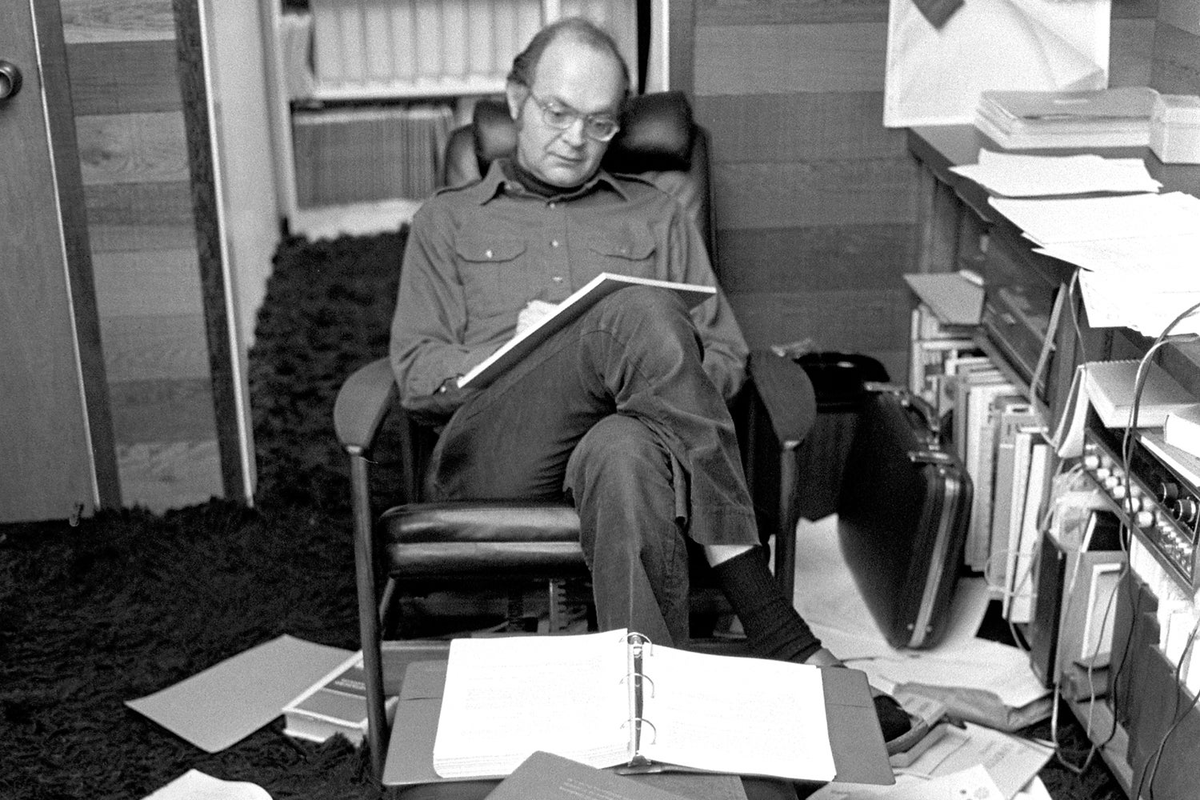
A computer scientist won the Turing Award at 36 and then walked away from almost every other project for the next 50 years to write one book that he has still not finished at age 88, and it may be the most important book in his field.
His name is Donald Knuth. He won the Turing Award in 1974, which is the closest thing computer science has to a Nobel Prize.
He was 36 years old. He had already written volumes one, two, and three of a book series called The Art of Computer Programming. He was the youngest person ever to receive the award at that point in its history.
Almost anyone else would have ridden that moment for the rest of their career. Founded a company. Sat on boards. Gone on speaking tours. Knuth did the opposite. He went back to his desk and kept writing.
He started the book in 1962. He was 24 years old. His publisher had asked him to write a short paperback on compilers. He sat down to outline it and discovered that to explain compilers properly he would have to explain the deeper algorithms underneath them first.
The short paperback became a draft outline of 12 chapters. The 12 chapters became a planned 7-volume series. The 7-volume series became the project he is still working on 63 years later.
Volume 1 came out in 1968. Volume 2 in 1969. Volume 3 in 1973. He was producing books faster than most academics produce papers. Then everything stopped.
In 1977 he received the printed proofs of the second edition of Volume 2. He looked at the pages and was so disgusted by how the publisher had typeset his mathematical notation that he could not bring himself to release the book.
The equations looked ugly. The fonts looked wrong. The spacing was off. He decided he could not in good conscience publish another volume of TAOCP until the typesetting problem was solved.
So he paused the book.
He stopped writing TAOCP and spent the next 8 years inventing TeX from scratch.
TeX is the typesetting system that every academic paper, every math textbook, every physics journal on earth now uses. Every PhD thesis in the sciences is set in TeX. Every paper on arxiv. Every equation in every paper Anthropic, OpenAI, and DeepMind have ever published. The system that the entire scientific publishing world runs on exists because one man refused to compromise on how the second edition of Volume 2 looked.
He gave the entire TeX system away for free. He never tried to commercialize it. He went back to writing TAOCP.
In 1992 he retired from Stanford at the age of 54. Most professors retire to slow down. Knuth retired to speed up. He explicitly said he was leaving teaching because he needed every remaining hour of his life to keep writing the book. He stopped using email on January 1, 1990.
He answers no calls. He takes paper mail only. He is on a personal mission to finish a multi-volume series that nobody is forcing him to write, on a deadline that only exists in his own head.
Volume 4A came out in 2011. Volume 4B in 2022. He is currently working on Volume 4C. Volumes 4D, 4E, 4F, 5, 6, and 7 are still ahead of him. He is 88 years old. He will almost certainly die before he finishes.
The thing that should haunt anyone reading this is the math of his choice.
Every modern incentive structure tells you to optimize for speed. Ship the imperfect version. Get it out the door. Iterate later. Move on to the next thing.
Knuth has spent 63 years doing the exact opposite. He pays a $2.56 reward in hexadecimal dollars to anyone who finds an error in his published books. Real checks, until check fraud made him switch to certificates of deposit. He treats every single error in every single volume as a personal failure. He revises. He rewrites. He goes back to fix issues that nobody else could have spotted.
He could have written 30 books in 63 years. He chose to write one.
The reason is the one almost nobody understands the first time they hear it. There is a category of work that loses all its value when it is done quickly.
A reference book that engineers will rely on for the next 200 years is not the same kind of object as a blog post that has to ship today. The slow project and the fast project look like the same activity from the outside. They are completely different games.
Bill Gates once said in an interview that if you can read the whole of TAOCP, you should send him your resume. He meant it. He was not joking. The man who founded Microsoft was telling the world that the rarest skill on earth is being able to finish a book that one man has spent his entire adult life writing for an audience that mostly does not have the patience to read it.
The book may never be finished.
The man writing it knows this and keeps writing anyway.
The work outlives the worker. That is the entire point.
You can turn your phone into a particle detector for cosmic rays and contribute to a worldwide collaboration of smartphone detectors that measures astrophysical processes and searches for dark matter
https://t.co/EWcZ32kHm5
Terence Tao: "We lived in a world with cognitive friction until very recently, where every task required us to use our brain.
So we didn't really think about it, we just thought this was the cost of doing something intellectual. But now we have AI and the other technologies that can bring these frictions down to zero."
Most research time is not spent having cinematic insights.
It is spent checking cases, chasing references, translating intuition into computation, testing a path, finding it false, and deciding whether the failure taught you anything.
AI changes the cost of that loop.
Terence Tao says that now he can try “crazier things,” and that makes so much difference. Because unconventional ideas are often not rejected by proof, but by inconvenience.
A mathematician may avoid a strange direction not because it is foolish, but because the bookkeeping, coding, or literature search needed to test it is too expensive for a hunch.
This is where cognitive friction becomes scientific friction.
Lowering it does not make taste, judgment, or proof disappear; it makes more weak signals cheap enough to inspect before they are abandoned.
AI is making hesitation less expensive, and that is often where discovery begins.
Arguably the most popular and most used Calculus textbook in the whole world. It doesn't mean it's the best. Far from it. You can start learning Calculus on your own time using a used copy of this textbook. Earlier editions can be found on eBay for around $10-20.
Fully focused on Taylor's Classical Mechanics now to dive deeper into mechanics. First few chapters were mostly a review of intro mechanics. Now learning Lagrangian and later Hamiltonian. Brushing up a lot more on my calculus and it's fun! Enjoying author's writing style too
An English engineer wrote a calculus book in 1910 opening with the line "what one fool can do, another can," and proved that almost everything making math feel impossible was put there on purpose by people who wanted it to stay exclusive.
His name was Silvanus P. Thompson.
He was a physicist, an engineer, a Fellow of the Royal Society, and a professor at the City and Guilds Technical College in London.
He had spent his entire career teaching calculus to working-class engineering students who needed the math to actually do their jobs, and he had watched generation after generation of bright kids walk out of math classrooms convinced they were stupid.
He knew they were not stupid. He knew exactly what was wrong, and he was about to say it in print in a way that would get him quietly hated by every academic mathematician in Britain.
In 1910 he published Calculus Made Easy. He published it anonymously at first, listing the author only as F.R.S., which stood for Fellow of the Royal Society. He did not want his name attached to it until he saw how the establishment was going to respond. Because the prologue of the book was not a polite introduction. It was an accusation.
He wrote that calculus was not actually hard. He wrote that the people writing the standard textbooks were what he called "clever fools" who deliberately took the easiest parts of the subject and presented them in the most complicated way possible, because doing so made them look more impressive.
He wrote that they "seldom take the trouble to show you how easy the easy calculations are" and instead "seem to desire to impress you with their tremendous cleverness by going about it in the most difficult way."
Then he opened the first chapter by telling readers something nobody had been willing to admit out loud. The reason calculus felt impossible was not because calculus was impossible. It was because the symbols had been chosen to feel impossible. The notation looked like ancient ritual on purpose. The Greek letters, the formal epsilon-delta definitions, the abstract limit proofs that opened every standard textbook, were not how Newton and Leibniz had originally thought about the subject. They were a 19th century renovation of the field done by professional mathematicians who wanted calculus to feel like a closed shop.
Thompson refused to use any of it.
He went back to the way Leibniz had thought about it 250 years earlier. The letter d in front of a variable, he told his readers, just meant "a little bit of." That was the whole secret. dx meant "a little bit of x." dy meant "a little bit of y." dy/dx meant "a little bit of y divided by a little bit of x," which is just how steep the curve is going at that exact moment. Integration was the opposite. It just meant adding up all the little bits.
That is calculus. That is the entire subject. Everything else is technique, and the technique only works once you understand what you are doing.
A 12-year-old can follow that explanation. A 12-year-old cannot follow the opening chapter of a typical university calculus textbook. The gap between those two facts is the entire reason most adults walk around believing they are bad at math.
The book became one of the bestselling math books in history. Over a million copies. Still in print 115 years later. Still recommended by physicists, engineers, and self-taught learners as the only calculus book they actually finished. Martin Gardner revised it in 1998 and the foundation of the book did not need to change because Thompson had built it on Leibniz, not on the academic conventions that have come and gone since.
The deeper point Thompson was making is the part that should haunt anyone reading this in 2026.
Difficulty is often a marketing strategy. It is not always a property of the subject. When a discipline is taught in a way that feels impossible, the difficulty is doing a job for someone. It is keeping the field small. It is protecting the salaries and the status of the people already inside it. It is filtering out the kinds of people who would otherwise show up and crowd the room.
This happens in math. It happens in law. It happens in medicine. It happens in finance, in machine learning, in philosophy, in software. Every field has a layer of jargon and notation and ritual sitting on top of a core idea that is usually much simpler than the people inside the field want to admit. The jargon is not there to communicate. It is there to gatekeep.
The way you recognize a real teacher is that they keep stripping the ritual off. The way you recognize someone protecting their priesthood is that they keep piling it on.
Thompson finished his prologue with five words that are the entire spirit of his project. "What one fool can do, another can." He meant it as both a joke and a threat.
If a working-class engineering student in 1910 with no Greek and no Latin and no university privileges could learn calculus from a 200-page paperback, then so could anyone the establishment had been excluding for the previous 200 years.
Most subjects you have given up on were never as hard as the people teaching them needed you to believe. You were not stupid. The course was designed to make you feel that way.
What one fool can do, another can.
Instead of watching an hour of Netflix, watch this 2 hour hour Stanford lecture will teach you more about how LLMs like ChatGPT and Claude are built than most people working at top AI companies learn in their entire careers.
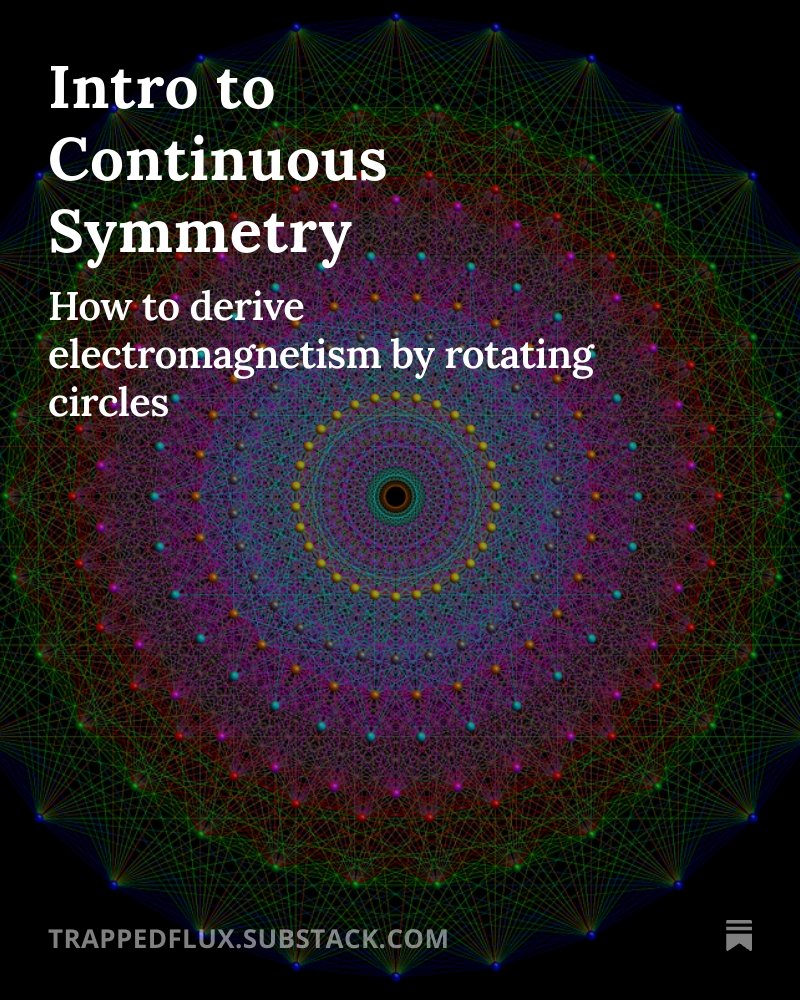
New post, and the first of my Lie nerdfest: an intro to continuous symmetries in physics.
We start by rotating a circle, play with some simple Lie group math with it, and then end up deriving the electric scalar and magnetic vector potentials by doing that!
L*nk below
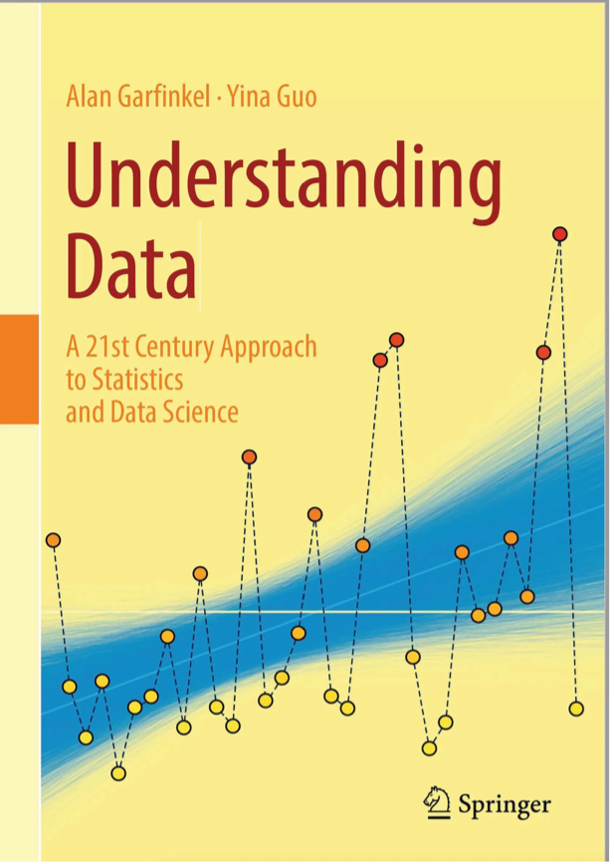
Thrilled to announce the publication of our non-conventional stats text, which takes a pure computer-intensive simulation and resampling approach to statistical tests, confidence intervals, power analyses, plus an intro to Bayesian methods at the end.
https://t.co/INR8cwWJze
Day 83/365 of GPU Programming
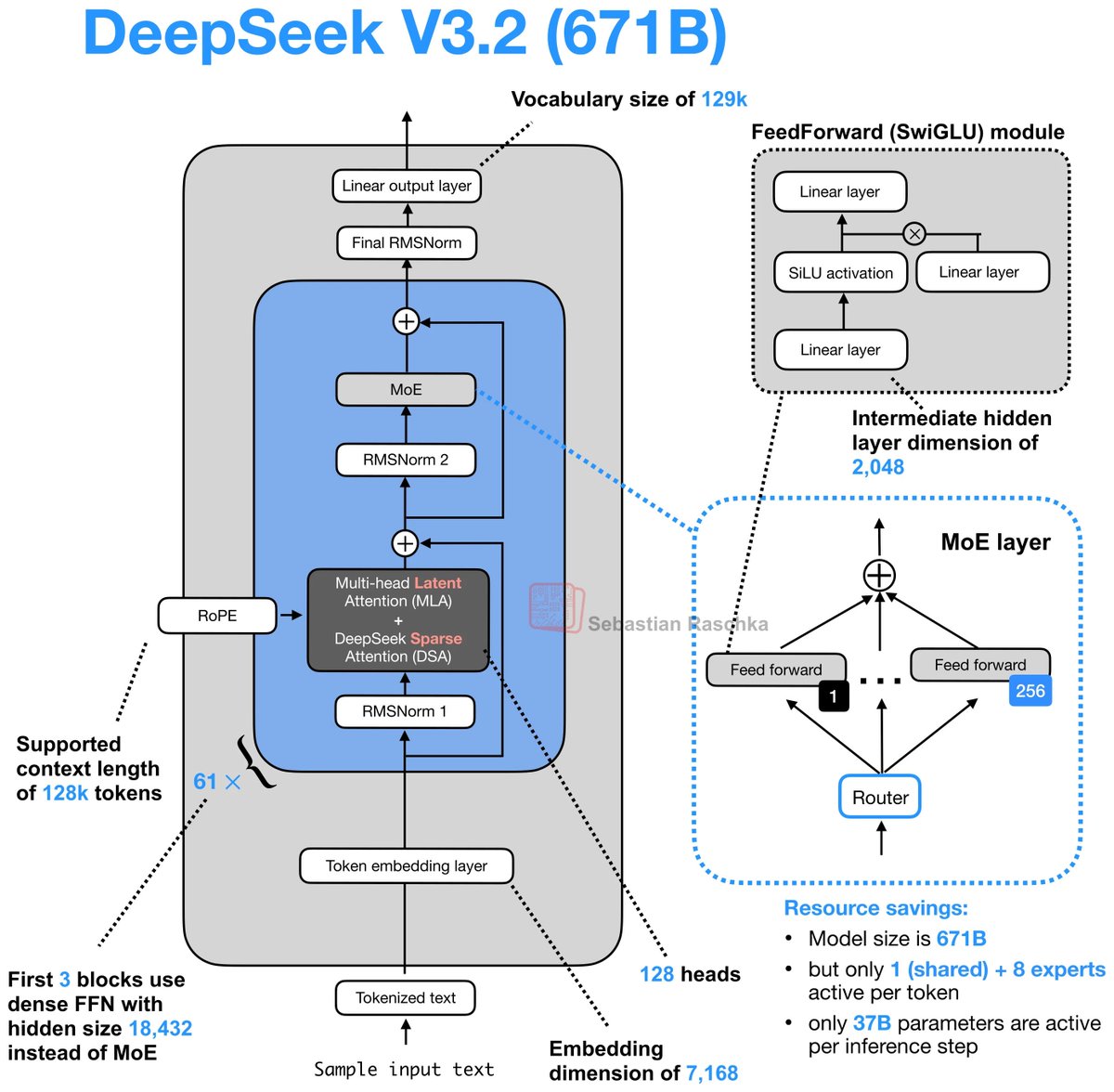
Looking at DeepSeek's Multi-Head Latent Attention today. The last part of the AMD challenge series is to optimize an MLA decode kernel for MI355X where the absorbed Q and compressed KV cache are given and your task is to do the attention computation.
A resource that really helped internalize what MLA does was @rasbt's incredible visual guide to attention variants in LLMs (luckily he posted that last week!), which covers everything from MHA to GQA to MLA to SWA, et cetera. If there's one place to get a visual intuition for recent attention mechanisms, it's this blog post.
@jbhuang0604's video on MQA, GQA,MLA and DSA was the best conceptual intro I found on the topic and progressively builds up the ideas from first principles.
The Welch Labs analysis of MLA is a great watch as well. Beautiful visualization of the changes DeepSeek made for MLA.
Tried out a few kernels once I had a basic understanding of MLA and I think I'm slowly getting more comfortable with at least analyzing kernels.
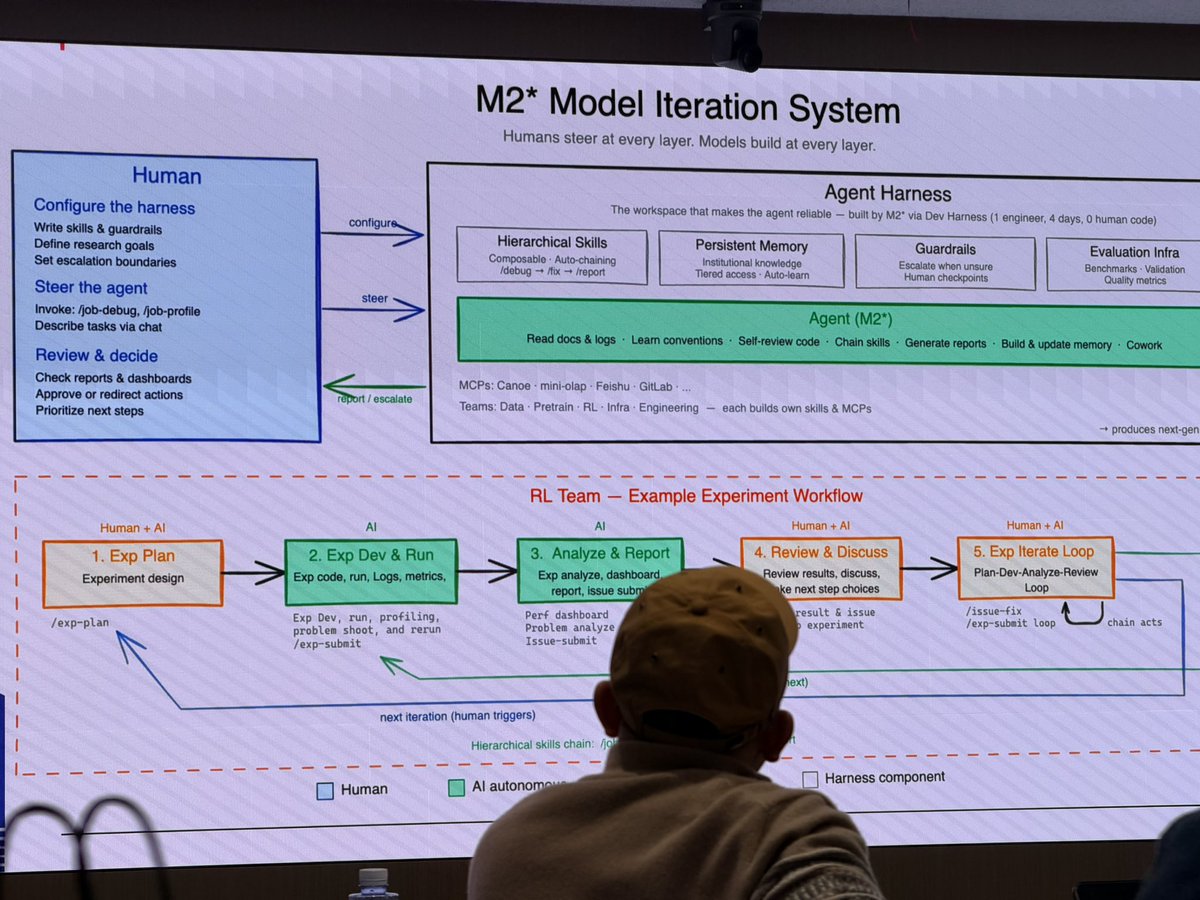
autoresearch basically starts the era of disposable model. AI labs that can't automate their own R&D pipeline will be outrun by those that can. The moat isn't talent anymore - it's the speed of your automated experimentation loop.
- minimax 2.7 was built from an autoresearch-like pipeline - models designing models.
- half-life of a frontier model is now down to a month in 2026
- at minimax & miromind, the model now decides who to hire. Not HR. Not hiring managers. The model evaluates market talent, identifies capability gaps, and recommends candidates. If your AI can build the next AI, it sure as hell can pick the humans it needs to assist the process.