NEW: malware developers added nuclear & biological weapons text to to their spyware.
Goal? To trigger LLM safety refusals... so that their spyware wouldn't be analyzed by an AI security scanner.
Cleanest practical example I can think of for why over-indexing on first order safety alignment is risky.
When closed (and open) models ship with aggressive refusals, they will be sprinkled with second-order blindspots that attackers will discover...and exploit.
We are only in the earliest days of attackers leveraging these features, and it wouldn't surprise me if users systems that need to handle complex cybersecurity issues demand that models be less safety-blunted.
In the weeds: @SocketSecurity's post also shows why intention matters in how you design a malware analysis pipeline to avoid prompt manipulation.
H/T to colleagues that shared this with me https://t.co/f3Aj9TYxU4
“I’m buying spot Anthropic on the Solana blockchain” has to be one of the funniest phrases I’ve heard this week.
There is nothing spot about this.
Brother you are 4 layers of financial abstraction and broker crime away from touching an actual Anthropic share certificate.
Your “spot” position is a tokenized receipt for possible future economic exposure to a Cayman SPV that owns shares in another Delaware SPV that maybe owns rights to future equity pending transfer approval.
You are approximately Anthropic-adjacent at best
Two weeks without mobile internet improved mental health more than antidepressants and reversed roughly 10 years of attentional decline.
Screen time dropped 49% (314 to 161 min/day).
I am not going to motivate you because if you need motivation from a stranger on a plane the answer is stay
but I will give you the game theory
your corporate M&A gig is a repeated game with diminishing marginal returns. year 1 you learn everything. year 2 you refine it. year 3 you are executing pattern recognition. year 4+ you are being paid more to do the same thing with slightly larger numbers. the learning curve flattens but the golden handcuffs tighten because every year the comp goes up and the opportunity cost of leaving gets more painful on paper
this is a classic status quo bias trap. the payoff of staying is known and comfortable. the payoff of leaving is uncertain and scary. so you stay not because staying is optimal but because the asymmetry of regret is lopsided. you can imagine regretting the leap. you cannot as easily imagine regretting the years you stayed too long because that regret builds slowly and never hits you in one moment
here is where game theory actually helps:
in your M&A seat you are playing someone else's game. the firm sets the rules, the deal flow, the comp structure, the promotion timeline. you optimize within their framework. you are a very well-compensated player in a game you did not design. your upside is capped by whatever the partnership or MD economics look like. your downside is protected by a salary. that is the trade
owning a local business flips the entire payoff matrix. you design the game. you set the rules. the downside is real and unprotected but the upside is uncapped and compounds in ways a salary never does because you own the equity. a $2M EBITDA business bought at 4x and grown to $3M EBITDA over 3 years is worth $12-15M on exit. no M&A salary trajectory produces that kind of wealth creation in that timeframe unless you are a founding partner
the Nash equilibrium of your current situation: you and every other M&A professional are competing for the same promotions, same deal credit, same bonus pool. the competition is fierce because the players are identical. same schools, same skills, same hours. you are in a crowded equilibrium where everyone works 80 hours to stay in the same relative position
local business ownership is a different game with different players. the competition is a 62-year-old owner who stopped innovating in 2014 and a 35-year-old who inherited the business and does not want to be there. you walk in with financial sophistication, deal structuring experience, and the ability to read a balance sheet faster than anyone in the room. you are overqualified for the game which is exactly where you want to be. the best strategy in game theory is to play games where your existing skill set gives you an asymmetric advantage over the other players
the timing question is about optionality. every year you stay in M&A your financial optionality goes up slightly because you save more. but your operational optionality goes down because you get further from the reality of running anything. the M&A guy who leaves at 28 adapts to operations in 6 months. the one who leaves at 38 has a decade of habits built around delegating to analysts and reviewing decks, and managing a P&L feels foreign in a way it would not have 10 years earlier
but again. if you need me to motivate you, stay. the people who actually do this do not need motivation. they need a spreadsheet that shows the math works and then they cannot NOT do it. if you have the spreadsheet and you are still asking strangers for motivation the spreadsheet is not the problem
NEW POST
If You're Not First, You're (Maybe? Potentially? Probably?) Last
shorter post with some recent thoughts on
> convexity of tail outcomes
> relative value traps
> winners winning
> why flattening your thinking is dangerous
link to full piece below
🚨 Google has sounded the quantum alarm 🚨
Today, they released groundbreaking progress towards breaking crypto using a quantum computer.
TLDR - Existing cryptography is dead. Mempool attacks are real. We must migrate to post-quantum now.
Thread 🧵
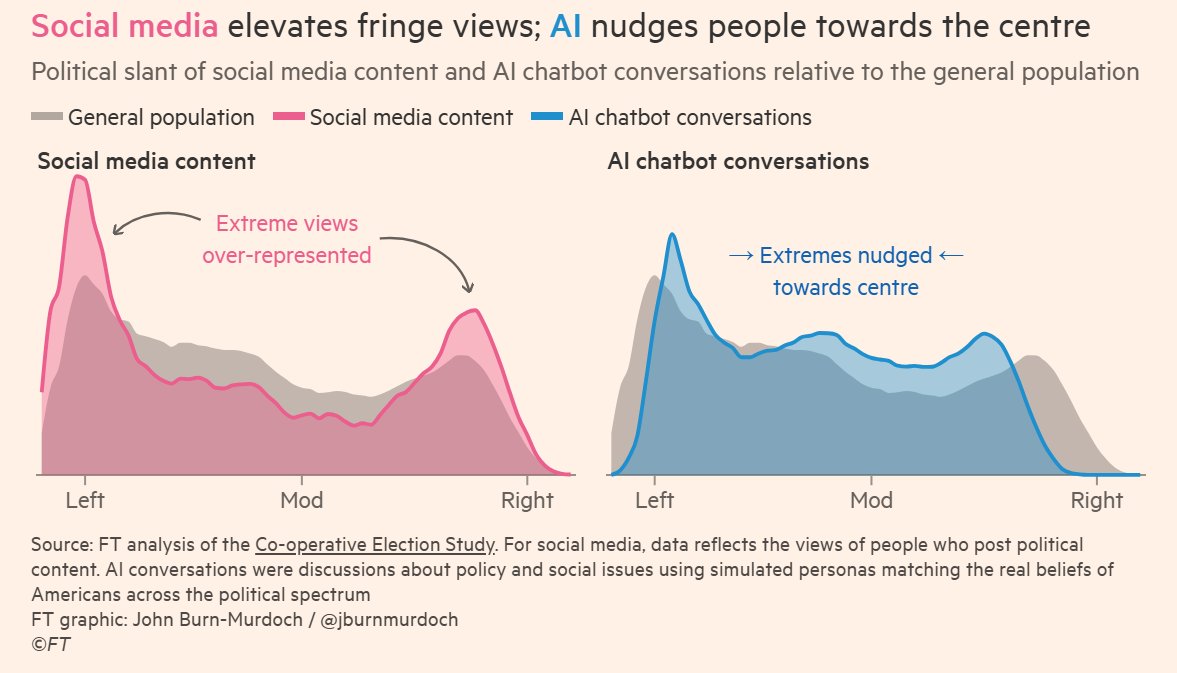
While social media is polarising, evidence suggests AI may nudge people towards the centre.
This holds true of all studied models. Grok is more right-leaning than other models, but also has depolarising effects.
By @jburnmurdoch.