El problema de inventarte un fraude es que, cuando ganes tu, te inventen un fraude. En ambos casos se socavan la institucionalidad, que es justamente lo que te protege de tus miedos que gane el otro lado.
Esta moraleja podría estar en un cuento para niños.
Absolutamente increíble. Lo que hoy ha hecho Barcelona se recordará mucho tiempo. La Sagrada Familia, Gaudí y los que durante 140 años han creído en ello, lo merecían.
We live in a world full of study Bibles. I praise God for the abundance of tools to help us know God’s Word.
I’m also very excited about this new study Bible.
This is a tool I could have used over twenty years ago when I started taking Greek as an undergraduate. It is not only a Greek Reader’s Edition but the notes include syntactical explanations and much more.
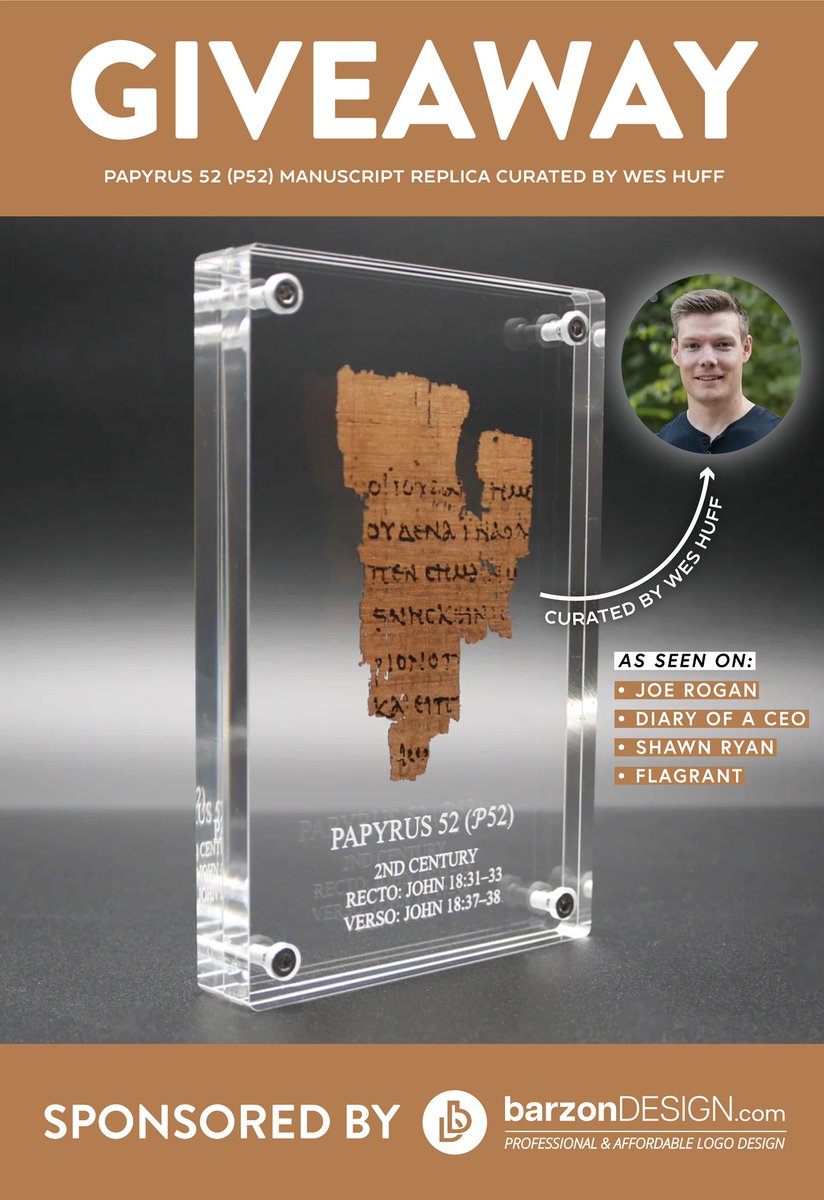
🚨 COOLEST GIVEAWAY EVER! 📜
I am giving away one of @WesleyLHuff ’s P52 New Testament Manuscript Replicas.
Entering is simple. Just…
• Follow @JoshuaBarzon & @WesleyLHuff
• Like & Share the post
• Tag someone below
I’ll pick the winner a week from today on 4/17/26.
When we ask what Augustine of Hippo taught about the primacy of the pope, the first thing to note is that Augustine never uses the concept of “the pope” in the later Roman Catholic sense of a universal monarch of the Church.
The bishop of Rome was respected as one of the important apostolic sees, but Augustine’s writings reflect the conciliar structure of the early church. Nowhere does he ratify the later doctrine defined at the First Vatican Council.
How do we know this?
First, Augustine consistently places Scripture above all bishops, including the bishop of Rome. In On Baptism, Against the Donatists he writes:
“Who does not know that the canonical Scripture… is so far superior to all later writings of the bishops that it cannot in any way be subject to doubt or dispute?” (On Baptism 2.3.4)
In the same passage he explains that regional councils may be corrected by universal councils, and even earlier universal councils may later be corrected as the church grows in understanding. The framework he established assumes that the final norm is Scripture and the discernment of the whole church, not an irreformable judgment of one bishop.
Second, Augustine did not ground the authority of the church in Peter’s personal office in the way later papal theology does. When reflecting on Matthew 16:18, Augustine later wrote in Retractions:
“I have somewhere said of St. Peter that the Church was built upon him as the rock… but I know that I have since very often explained the words of the Lord… as referring to Christ or to Peter’s confession.” (Retractions 1.21)
In other words, Augustine recognized multiple interpretations and eventually leaned toward the view that the rock references in Matthew 16:18 is Christ himself, or the confession of faith, not Peter as the foundation of a continuing papal office.
Third, when Augustine argues for orthodoxy against the Donatists, his appeal is not to Rome alone but to the universal church. In Against the Letter of Petilian he writes:
“The whole world judges rightly.”
For Augustine, the authority of the church appears through the consensus of the catholic (universal) church dispersed throughout the world, often expressed through councils.
Augustine clearly honored the Roman see and sometimes welcomed its agreement with the African councils during controversies such as the Pelagian dispute. But his broader ecclesiology consistently reflects a hierarchy of authority like this:
1. Scripture as the supreme authority.
2. The universal church expressed through councils.
3. Major apostolic sees such as Rome, Constantinople, Antioch, and Alexandria as influential voices within that larger structure.
Rome was respected as an important apostolic church, but it did not exercise universal juridical authority over the whole church in Augustine’s framework.
For that reason, the historical evidence reveals that Augustine did not teach the later doctrine of papal supremacy or infallibility. He respected Rome and corresponded with its bishops, but he remained a North African bishop within the wider catholic (universal) church, and the structure of authority in his writings is conciliar and scriptural, reflecting the practice of the early church rather than the later papal system.
One genuine question follows from this: Can anyone point to a place where Augustine explicitly speaks of “the Roman Catholic Church” or describes the bishop of Rome as possessing universal jurisdiction over the church?
In the second century, a Christian apologist tried to explain to pagans what made Christians so different.
He said: “Like others, they marry and have children, but they do not destroy their offspring.”
Strange indeed.
It took a few centuries before Christians acquired any political influence in the Roman empire, but when they did, they passed laws outlawing infanticide (in AD 374).
Then they passed laws granting government aid to poor families so they would not be tempted to abandon them or expose them.
Yet infanticide was ended only when the clergy finally persuaded parents to give up their babies at the door of the church instead — which gave rise to the first orphanages.
Today Western societies are reversing course – we’re seeing an increase in abortion and infanticide.
We are losing the mindset that regards children as persons made in God’s image, to be valued and cherished in their own right.
A challenge of teaching textual criticism (OT or NT) is that the apparatus can seem like overwhelming chaos. Connecting the data to actual manuscripts helps students get over that feeling. Today's @DailySeptuagint aims to do this with R-H.
https://t.co/Fks4yroomP
No puedo creer que la presidenta de México, @Claudiashein elija la ideología antes que celebrar el Nobel de la Paz para la segunda mujer en la historia de ese reconocimiento y no asistir a la Cumbre de las Américas por solidaridad con tres dictaduras. ¡Inaudito!
En la Escritura, el enemigo es llamado “diablo” (διάβολος [diábolos]), es decir, el que calumnia.
Y también “Satanás” (הַשָּׂטָן [ha-satán]), el que acusa.
Calumniar y acusar… si eso resuena con cómo estás actuando, quizá convenga revisar para quién estás jugando.
Wow - it’s been so fun seeing the response to my Jubilee debate. The Holy Spirit was 100% there, and Charlie’s advice in our final conversation helped so much. Thank you to everyone for your encouragement.
Interesante manera de torcer las Escrituras.
El pasaje que cita (y en su momento Ted Cruz citó lo mismo) es Génesis 12:3, en donde Dios le dice a Abraham: "Bendeciré a los que te bendijeren, y a los que te maldijeren maldeciré,".
El apostol Pablo aclara: “Y si vosotros sois de Cristo, ciertamente linaje de Abraham sois, y herederos según la promesa.” Gálatas 3:29
No se refiere al estado-nación actual de Israel, ni a los talmúdicos, claramente se trata de bendecir a la Iglesia. La nación que bendiga a la Iglesia y la proteja, será bendecida.
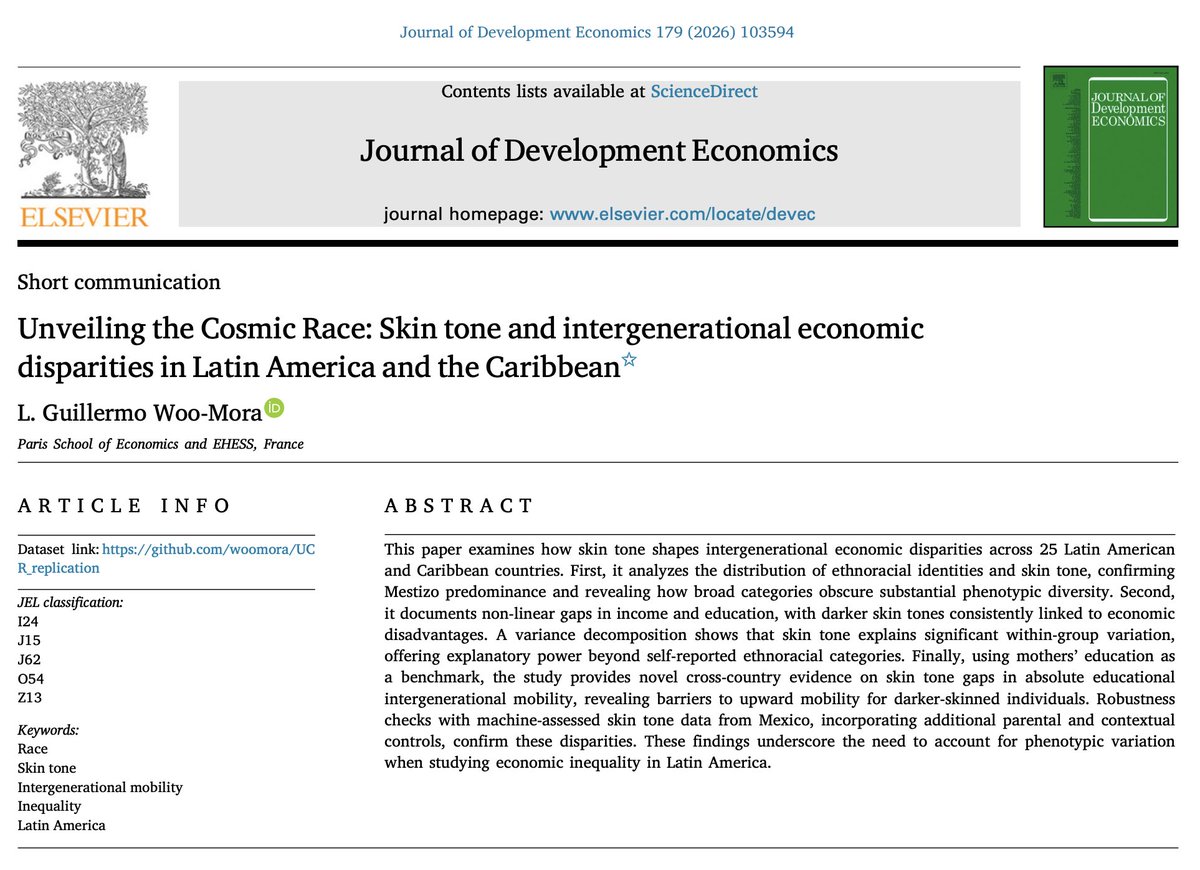
Thrilled to share that my paper on skin tone and intergenerational economic disparities in Latin America & the Caribbean has found a great home at the Journal of Development Economics! 🎉📄
Thread with free access link below 🧵👇🏽
Al comienzo, dijo Abraham: "Dios proveerá un cordero para el sacrificio." (Gn 22:8).
A mitad de camino, el Bautista gritó: "¡Ahí va el Cordero de Dios que quita el pecado del mundo!" (Jn 1:29).
Al final, los santos reconocerán: "Digno es el Cordero que fue sacrificado" (Ap 5:12).
En este caso, la señora está diciendo claramente que NO se alegra por la muerte de Charlie Kirk y que incluso ha hecho un minuto de silencio por él. Otra cosa es que esté en desacuerdo con sus ideas (que me parece legítimo). Una cosa es denunciar a la izquierda fanática y otra tratar de buscar un enfrentamiento porque sí.