Ahead of a crucial NATO summit, analysts say Ankara's ties with Kiev, Moscow and Washington have made it one of the few alliance members capable of keeping diplomacy alive while containing tensions in the Black Sea
🔗 https://t.co/S72cqfBKB7
Pleased to share my new op-ed pitch: "Will Abiy Ahmed be Ethiopia’s Bismarck or its Mandela?" at African Argument
"The prognosis for the Ethiopian political landscape is intimately tied to the future trajectory of Abiy’s political behaviour...
https://t.co/0hvVCBwBXj
Il est des gestes modestes qui contiennent une civilisation tout entière. Préparer le thé, le servir, le recevoir : tout cela pourrait sembler infime. C’est pourtant une morale du monde. Aujourd’hui, je veux vous parler du « Livre du Thé », d’Okakura Kakuzō.
Face à un Occident sûr d’incarner à lui seul le progrès, ce livre nous dit qu’il existe des formes de grandeur qui ne passent ni par le bruit, ni par la conquête, mais par la délicatesse. Le thé y est une école de l’instant, où la beauté loge dans la trace, dans l’imperfection, où le « vide » est une place faite à l’autre, à la respiration, à l’invisible.
Lire ce livre aujourd’hui, c’est retrouver une boussole très contemporaine.
Première leçon : l’attention est une souveraineté. Dans un monde de flux et de notifications, tenir une tasse de thé en pleine conscience devient un acte de résistance.
Deuxième leçon : la douceur est une force. La civilisation se mesure à sa capacité de préserver des formes de délicatesse.
Troisième leçon : l’imperfection est humaine. Le « Livre du thé » valorise la patine, la fissure, l’objet imparfait, parce que l’imperfection dit le vivant.
Quatrième leçon : la rencontre des cultures exige l’humilité, parce que la vraie modernité sait accueillir plusieurs manières de vivre.
Au fond, le thé n’est pas le sujet : le sujet, c’est la dignité de l’instant, et la possibilité, au milieu du bruit, de redevenir présent.
A View from Tehran: Iran's Leadership Is Entering a New Phase But Not a New Direction
A. As Iran prepares for the post-Ali Khamenei era, it is worth examining the power dynamics emerging inside Tehran. Khamenei was the architect of the Islamic Republic's strategy of resistance for more than three decades, and only weeks after what Iranian leaders view as a war of survival against Israel and the United States, the system is beginning a new phase of adaptation.
B. It is still too early to draw definitive conclusions. The Islamic Republic is only at the beginning of what could be called its "3.0" phase. History offers a useful reminder: when Ali Khamenei himself became Supreme Leader in 1989, he was chosen largely because he was perceived as a compromise candidate rather than the strongest figure in the system.
C. Still, The emerging leadership appears likely to be more collective than under Khamenei. Mojtaba Khamenei is widely seen as first among equals, but not as an undisputed decision-maker like his father. For the first time since the 1979 Revolution, senior Islamic Revolutionary Guard Corps (IRGC) commanders are likely to play a much larger role not only in security affairs but also in shaping the Islamic Republic's broader strategic direction.
D. The current leadership seems relatively pragmatic, but that should not be mistaken for moderation. There appears to be broad agreement among the political and security elite that negotiations with the United States should continue, but only within the Islamic Republic's established red lines. The fact that even Mohammad Baqer Zolghadr, the secretary of the Supreme National Security Council, publicly endorsed the memorandum of understanding with Washington reflects that consensus.
E. At the same time, Tehran has not become more trusting of the United States. Quite the opposite. Iranian leaders continue to assume that Washington could return to military action if diplomacy fails. As a result, Iran is determined to preserve what it considers the strategic gains achieved during the recent conflict, particularly its expanded leverage in the Strait of Hormuz. From Tehran's perspective, control over Hormuz is no longer merely a military asset, it has become an ideological symbol of sovereignty and an essential pillar of deterrence. Likewise, Iran's nuclear program remains a non-negotiable bargaining chip. Tehran is unlikely to make meaningful nuclear concessions before reaching a comprehensive agreement with Washington.
F. Lebanon remains another major obstacle. Iran is unlikely to abandon its demand for a full Israeli withdrawal from southern Lebanon. Combined with the practical difficulties of maintaining continuous negotiations, this makes it unlikely that the current talks will conclude quickly. If both sides continue to see value in diplomacy, an extension of the negotiating process appears more likely than a rapid breakthrough.
G. Iran's willingness to pursue diplomacy is driven largely by economic necessity. The country's economy was under severe strain even before the recent war, and the conflict only deepened those challenges. The leadership increasingly appears to believe that a favorable agreement, one that provides economic relief while preserving Iran's strategic capabilities, would strengthen, rather than weaken, the long-term survival of the Islamic Republic.
H. Meanwhile, internal political tensions remain visible. The recent interruption of Parliament Speaker Mohammad Bagher Ghalibaf's televised interview highlighted underlying rivalries. Beyond personal competition, hardline factions such as Paydari continue to oppose diplomatic engagement. Supreme Leader Khamenei's reported effort to reassure critics, while backing President Masoud Pezeshkian after receiving guarantees about Iran's red lines, suggests an effort to manage these divisions rather than allow them to widen.
I. At the same time, Tehran continues preparing for the possibility of future confrontation. It is rebuilding military capabilities while deepening strategic cooperation with China, with Ghalibaf playing an increasingly prominent diplomatic role. The vacuum created by Ali Khamenei's departure has not destabilized the system, but the new leadership structure remains a work in progress.
The bottom line is that Iran's leadership wants to preserve negotiations with the United States, but not at the expense of what it considers its core strategic assets. That is likely to produce a prolonged negotiating process rather than a quick agreement. Although internal rivalries persist, there is broad consensus around a pragmatic strategy that combines diplomacy with deterrence. Mojtaba Khamenei appears to be the ultimate arbiter, but unlike his father, he is likely to govern through a more collective leadership whose contours are still taking shape.
#iran
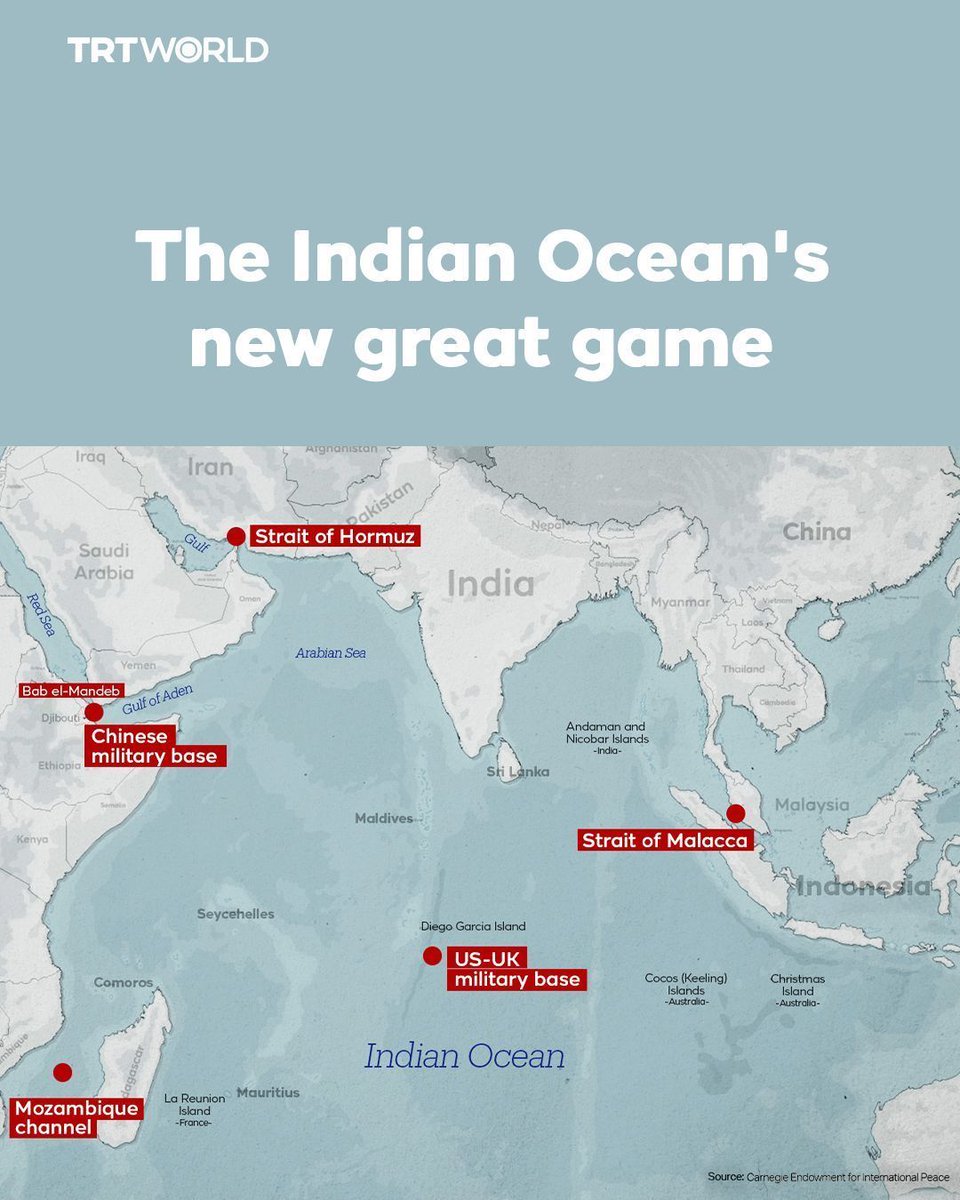
From Hormuz and Bab al Mandeb to Malacca, the Indian Ocean sits at the crossroads of global trade, energy flows and great-power rivalry as competition between the US, China and regional powers intensifies
🔗 https://t.co/MWxCPTRkE6
Peaceful international activists were left in shock and terror after Israeli settlers attacked them and Palestinian residents in the village of Abu Falah, northeast of Ramallah.
Benjamin Netanyahu "needs a war" to stay in power, argues Ami Ayalon, former director of Israeli intelligence service Shin Bet. He tells me why he thinks the Israeli prime minister may be "sacrificing the future of Israel" in his pursuit of eternal war.
Israel has rejected a UN Commission report that says its army deliberately targets Palestinian children. But there are cases of children being shot by precision weapons, making it difficult to argue they were accidents.
Al Jazeera’s @emmawithrow explains.
The extensive killing of Palestinian children and teenagers in the West Bank is not a series of isolated incidents. It is a practice backed by every arm of the Israeli regime.
From 7 October 2023 to 29 June 2026, Israel killed 1,087 Palestinians in the West Bank, including 242 children and teenagers.
In 2025 alone, 54 minors were killed. Our new report, “Unshielded Childhood,” tells their stories.
The Israeli legal system helps whitewash these killings, grants impunity to the perpetrators, and shirks its duty to demand accountability from those responsible. The Israeli public remains largely indifferent, while some segments openly support the violence.
To legitimize this routine killing in the eyes of the Israeli public and the world, Israel systematically dehumanizes Palestinians. When the military almost automatically labels Palestinian children and teenagers who posed no threat as “terrorists” or “involved in terrorism,” it creates a reality in which their lives are treated as entirely disposable and harming them is seen as legitimate and permissible.
While the world looks away and grants Israel international impunity, the reality on the ground is clear: under the Israeli regime, no Palestinian is protected, and any Israeli who harms them enjoys full impunity.
Read the report, “Unshielded Childhood” >> https://t.co/DkrBDTGysN
Only I$rael could claim to withdraw from land it has never occupied
Froun in southern Lebanon is one of two so-called "experimental zones" included as part of the tripartite framework agreement signed between I$rael, Lebanon and the US in Washington
The local mayor however says I$raeli forces have never set foot in the village, questioning Froun's status as a "pilot zone" which he says he was never consulted over with no contact from Lebanese officials
Locals who have returned to a scene of devastation say they firmly reject normalisation with I$rael and simply want to live in peace and dignity
Why can Israel trust the large Palestinian population of Jordan to live in peace but not the Palestinian population of the West Bank, East Jerusalem and Gaza? The distinction suggests that the problem is not the inherently violent character of the Palestinian people, as the Israeli government’s self-serving mythology would suggest, but Israel’s endless occupation. https://t.co/nqgEMvuggz
Exclusive: Oman proposes Strait of Hormuz fee plan. Under the proposal, Iran and Oman would collect payment for ships passing through the Strait and would call it a service fee not tolls. w/ @viviannereim@ErikaSolomon
https://t.co/yd6LZFVRYM
The fate of Iran’s uranium stockpile lies at the heart of ongoing US-Iran talks, with experts warning that technical, political and verification challenges remain unresolved
https://t.co/UwsW25fXMY
A massive explosion shook the southern Lebanese village of Majdal Zoun as Israel’s military claimed it destroyed a ‘200-metre-long Hezbollah tunnel’.
The immense detonation comes despite a US-mediated ceasefire framework between Israel and Lebanon aimed at ending hostilities.
Israel's air and ground operations in Lebanon have hit UNESCO-listed Roman ruins in Tyre, pummeled the Mamluk-era market in Nabatieh and razed centuries-old towns along the southern border https://t.co/cVMpPSom1E
"How children in West Bank are being killed by Israel ‘without accountability’. IDF has killed 235 children in territory since 7 October 2023 with no indictments in what activists say is ‘licence to kill’"
https://t.co/yRpsWPPzbD
Have any of the neocons cheering for the war to resume taken the time to explain exactly how we defeat Iran militarily, what that would cost us in terms of blood & treasure, what we gain from doing so, & what Iran looks like with no government?
Please, enlighten us as to how the Bush-era war propaganda will totally work this time.