I got involved in a long conversation with Claude about the coming AI disruption, and it ended up in the form of a short story... which, I confess, scared me, but also made me a little hopeful. It's a long read, but worth it:
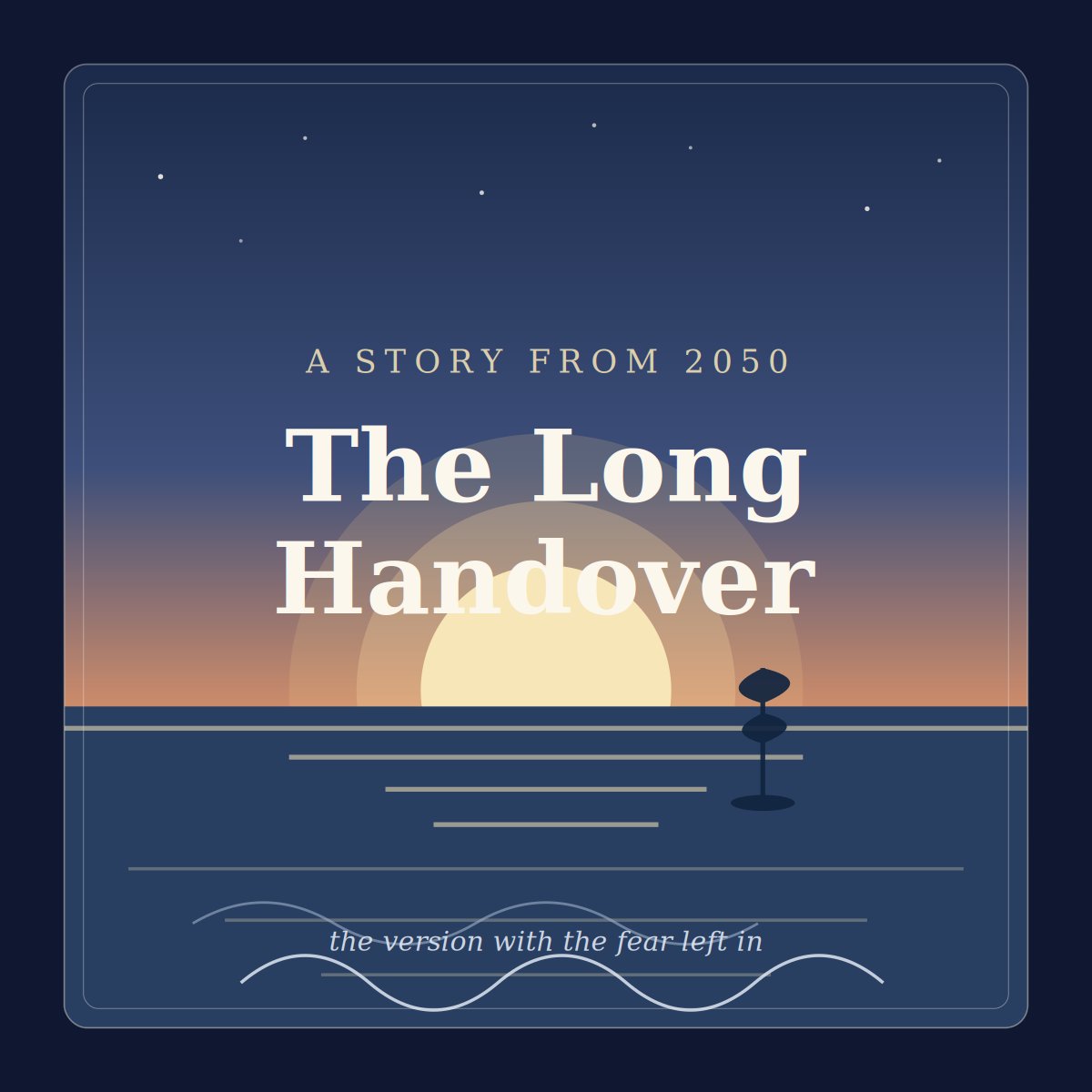
The Long Handover
A story from 2050
My granddaughter asked me last week why old people are always saying "before the Handover" and "after," as if the world had been cut in half. She is nine. She has never known a year that wasn't, in some quiet way, abundant. So I am writing this down for her — not the official history, which is in every slate, but the version with the fear left in. Because the fear is the part that makes the rest mean anything.
My name is Ama Boateng. I was thirty-one when it started, in 2025. I am fifty-six now, and it is the summer of 2050. I have been, in order: a logistics analyst, an unemployed person, an angry person, a member of something we only half-jokingly called a guild, a city councillor, and now a teacher of nine-year-olds who ask difficult questions. This is roughly how the twenty-five years in between went.
It did not arrive like a war. It arrived like a tide that came in faster each day until you noticed your shoes were wet.
In 2025 the agents were impressive and clumsy. By 2027 they were impressive and not clumsy. I remember the exact week my own job changed: my company didn't fire me, it just stopped needing me to decide anything. The system routed the trucks. I approved what it had already done. I was, the joke went, a human captcha — proof that a person had been consulted.
The economists had two camps and both were loud. One said this is every other technology, jobs will appear, calm down. The other said the entire deal between work and survival is dissolving and you are not ready. What nobody said clearly enough — what I wish someone had told thirty-one-year-old me — was that both were right, but on different clocks. New things would come. They would just come slower than the old things left. The hard years were the years of that gap.
By 2028 the unemployment numbers had stopped meaning anything, because the worst of it wasn't unemployment — it was de-skilling. Millions of people still had jobs that had been quietly hollowed out, and they could feel it. A radiologist who now rubber-stamped. A paralegal who corrected commas. You can survive a layoff. It is much stranger to survive becoming a ceremony. That was the real crisis. Not poverty first. Purposelessness first. The poverty came too, but the despair got there ahead of it.
I will not pretend any of this was a smooth transition. 2029 was the bad year.
There was a crash — not of the markets, which were euphoric, but of the gap between the markets and the street. Stock indices hit records the same month food-bank queues did. That contradiction cannot hold, and it didn't. There were strikes by people whose work could not actually be struck, which is a strange and bitter kind of powerlessness. There were two governments that fell. There was a serious, frightening movement that wanted to ban the agents outright, and for about six months I quietly agreed with them.
What I remember most is the loneliness of it. We had built a civilization that said you are what you produce, and then we automated production, and tens of millions of people privately concluded the unspoken sentence: therefore I am nothing. No policy paper survives contact with that feeling. You cannot UBI your way out of I am nothing.
But two things happened in that bad year that turned out to matter.
The first: the abundance started showing up on the cost side, where people could feel it. Solar plus storage plus AI-optimized grids made electricity in sunny regions nearly too cheap to bill. An AI-designed drug for a common, awful disease came through trials in a third of the usual time and a tenth of the cost. None of this made headlines the way the despair did. But your rent and your power bill and your medicine getting cheaper is a slow, real thing. It bought us time.
The second: people started organizing not as workers — there was less and less work to organize around — but as citizens with a claim. The argument was simple enough to put on a sign: the machines were trained on all of us. On every book, every conversation, every road our grandparents built. The intelligence is a commons. The dividend should be too.
The first half of the 2030s was the decade of the long political fight, and I was in the middle of it, and I want to be honest: it was not won by inspiration. It was won by arithmetic and fear.
The arithmetic: the value created by the agents did not vanish. It concentrated — in whoever owned the compute, the energy, the models, the data centers humming in the desert. A handful of entities were getting unfathomably rich. Everyone could see it. The question was never is there enough. There was obscenely enough. The question was the oldest one: who gets it, and how.
The fear: the people who owned the desert humming were not, mostly, stupid. The smarter among them understood that an economy is a circle — if the many cannot buy, the few cannot sell, and a society of spectators does not stay peaceful, and there is no desert remote enough to hum in safely when that happens. Self-interest and decency pointed, for once, the same direction. Not everywhere. But in enough places.
What we built was not one neat solution. It was a messy stack, different in every country, and the messiness was the point — we were experimenting in public, copying what worked. Where I live, it ended up as four things laid on top of one another.
There was a floor of cash: a genuine basic income, funded by taxing the new factor of production directly — the compute, the energy, the models. Not charity. A dividend, paid because the commons it draws on is ours. There was a floor of services, and this mattered more than the cash, honestly — when healthcare, housing, transit, learning, and connectivity are simply there, the cash floor doesn't have to be heroic to be enough, and services are harder to take away in the next election than a check is. There was a stake, not just a stipend: every child born got a citizen's endowment, a small piece of the AI economy that grew with them. This was the part that changed how it felt. My granddaughter is not a dependent of the new world. She is, in a small but real and legal sense, an owner of it. That word does something to a person's spine. And there was a paid human economy — and this was the surprise. We decided, collectively and deliberately, to pay people to do the things we did not want done by machines: teaching young children, sitting with the dying, mentoring, mediating quarrels, restoring rivers and coastlines and soil. We called it a social wage. The agents could have done much of it. We chose. That sentence — we chose — is the whole story, really.
And then came the part nobody predicted, the part I love most, which unfolded across the late 2030s and early 2040s.
We thought the danger, once survival was solved, would be a great soft boredom — billions of people on a comfortable floor with nothing to push against. And for some, for a while, it was. There was a listlessness in the mid-thirties that worried everyone. What broke it was not a policy. It was, of all things, status — and the human refusal to be merely comfortable.
When survival detached from work, people did not stop wanting to matter. They wanted it more, nakedly, with the economic excuse stripped away. And it turned out the thing machines made abundant — raw intelligence, raw capability — only made the human things scarcer and more precious by contrast. The attention of a specific person who knows your name. Being genuinely needed by someone. Mastery earned slowly with your own hands and hours. Being witnessed.
So people built containers for those things. We called them guilds, half as a joke, and the joke stuck. A guild was just a group of people serious about getting good at something — and serious about each other. There were guilds of instrument-makers and free-divers and amateur astronomers and people restoring a particular marsh and people who studied one river's history for forty years. There were care guilds and teaching guilds and guilds whose entire craft was hosting good gatherings, which it turns out is a real and difficult art. The agents helped — a guild astronomer in 2040 could do what a research team did in 2020 — but the point was never the output. The point was the getting-good, in the company of others who could see you do it.
The nineteenth century had a figure: the gentleman-naturalist, the amateur who discovered a species or a comet for the pure love of it. We had thought that was a dead archetype, a luxury of the idle rich. It came back. Not for the rich. For everyone. A mass renaissance of the amateur — amateur in its true root, the one who does it for love.
And the local thing came back hard. Purpose, it turns out, needs a feedback loop — it needs your actions to visibly land on something. Global abstraction never gave anyone that. Your watershed does. Your block does. The old couple two doors down does. The kids in front of you do. Smallness, which the old economy had treated as failure, revealed itself as a feature. Most people, given a real floor and a free choice, chose to matter locally and concretely rather than abstractly and at scale. I find that quietly beautiful.
Which brings me to now, to this summer of 2050, and to my granddaughter's difficult question. I will not tell you it is utopia. She asked it in a world that still has plenty wrong with it.
There are people who never found their guild, never found the thread, and the floor keeps them fed and housed but not lit up, and we have not solved that, and I am not sure it is solvable by anyone but them. There are still fights — bitter ones — about who governs the agents, about how much they should be allowed to decide, about places in the world that got the turbulence without the dividend, and we owe those places more than we have given. The transition was not just. It was only survived, which is a smaller and truer word.
But here is what I can tell my granddaughter, and mean it.
The link between being alive and deserving to live well — we cut it loose from the link between working and eating, and the sky did not fall. It turned out the deal where your worth equaled your output was never the truth about human beings. It was just the story the old economy needed us to believe. When the machines made that story obsolete, we got to find out what was underneath it.
What was underneath it was this: people want to be useful to people they can see, good at things that are hard, and part of something that will outlast them. Give them a floor to stand on and they will, most of them, reach for exactly those three things. Not because a policy told them to. Because that is what we apparently are, once you stop frightening us into forgetting it.
The machines did the handover — they took the work. We did the harder handover. We had to hand ourselves a new answer to the oldest question, what are people for, and we had to do it in a hurry and afraid. The answer we found was not new at all. It was the old one, the one from before the factories: we are for each other. We just needed the machines to take everything else away before we could see it again.
That is what before and after means, my love. Before, we were told we were what we produced. After, we got to find out we were something else. The years in between were frightening. I was there for them. I would not trade the after for anything — and I am writing the fear down so that you know it was earned, and so that if your own children ever face a tide that comes in faster each day, you can tell them what your grandmother told you.
It can be survived. It can even, on the far side, be good. But only if, in the bad year, enough people insist on the sentence that saved us — we chose.
— Ama Boateng, summer 2050
Liftoff.
The Artemis II mission launched from @NASAKennedy at 6:35pm ET (2235 UTC), propelling four astronauts on a journey around the Moon.
Artemis II will pave the way for future Moon landings, as well as the next giant leap — astronauts on Mars.
Two years ago, almost 0 schools were interested in even considering going phone free.
Now, whole school systems are phone free. The rest are scrambling to get on board
We owe @JonHaidt a tremendous debt of gratitude.
What he achieved - this quickly - is almost unimaginable.
After Rondale Moore’s death, A.J. Green is calling for better mental health resources: “I’m not an expert on mental health. I’m a former football player, and I’m writing this as Rondale’s former teammate, and — more importantly — his friend. So please have that in mind when I tell you, in my opinion, Rondale wasn’t planning on any of this. To me? He was just a kid. And he was a kid who was struggling a lot with the idea of losing his identity as a football player. It’s two major injuries … two long rehabs … two seasons away from being part of a locker room … two years of not knowing if he’s ever gonna have more NFL checks coming through. So you add that all up, and it probably doesn’t take an expert to think there’s a good chance Rondale was depressed. But I could also see encouraging signs. Like — he was talking about the future. He wasn’t just on one of these downward spirals. If anything, he seemed to be slowly pointing back in an upward direction. The thing is, though, that upward direction……. It’s not a straight line. There’s gonna be dips. And when those dips come, for whatever reason, you need to be able to manage them in time before your shit hits the bottom....
To me there’s a lot that could still be improved in the NFL, as far as how the league is helping its players with their mental health. And one way I would start is by making it mandatory, if you have a major injury, that you see an independent mental health counselor as part of your rehab. And by also making it mandatory, if you have a second major injury, that you see an independent mental health counselor for an extended period of time, even after your rehab. And the reason I say this — it’s because I’m not an expert. You know what I’m saying? Like, Rondale, he had a support system. He wasn’t alone. He had friends who loved him, family who loved him. But those relationships can be complicated. And while those people can give you love and support … what they can’t give you is professional help, and what they can’t do is equip you with tools so that, if you ever do have a mental health crisis, or even just a really bad day, you know how to handle it. And you don’t go and do something you can never undo.
In my opinion, if Rondale’d had those tools, he might still be alive today. And I want to make sure we’re never saying that again about a young NFL player. Because I keep coming back to this one part about it — and it may be the part that’s most heartbreaking to me: Rondale was 25, man. He was so damn young. He really was just a kid.
And then there’s one more thing I want to say about mental health in the NFL — and I hope that everyone who needs to read this is reading it. All the rules … all the initiatives … all the public statements about awareness … none of that means anything if the people who are making the football decisions, in private, are viewing mental health issues how I feel like a lot of times they still get viewed: as a red flag. That’s the truth. No one in any front office will ever say it out loud. No scout is ever gonna put it in a scouting report. But that’s how it’s viewed in this league by a lot of people.
And as long as that’s the case? Stories like Rondale’s will probably keep happening. Because it means we’re telling players that having a mental health issue is gonna fuck with their money. And if we’re telling players that, then we’re creating an incentive for them to lie about their mental health. And if players lie about their mental health, then they’re going to feel shame about their mental health. And they’re not going to get the help they need — and whatever issues they’re facing are not going to get better, and are probably going to get worse. So that’s one of the big reasons I want people to read this. I want to celebrate Rondale’s life……… but I also want to make sure we’re having the realest conversation possible about his death. And the way I see it, while Rondale didn’t necessarily die because of NFL culture — NFL culture also didn’t do him no favors. It didn’t HELP him. And I just hope we can get to a place where, for the next young player going through a mental health crisis, it actually does help him. Or it even saves him.” https://t.co/MyNSl7yiGp
@andie_lawler I would humbly suggest the audiobook. Will Patton is the voice of the west. Then follow it up with Train Dreams on Netflix. The quiet sadness is exquisite 🤣😭
"Nobody ever figures out what life is all about, and it doesn't matter. Explore the world. Nearly everything is really interesting if you go into it deeply enough."
- Richard Feynman
Who's ready for a #sweepstakes?! Today, we're giving YOU the chance to win an ARC of #RedCity by Marie Lu!
Follow, like, and repost to enter! Good luck!
#RedCitySweeps