For anime fans, especially those delving into the world of psychological and existential storytelling, Neon Genesis Evangelion stands as one of the most iconic and complex anime series of all time. Since its debut in 1995, this groundbreaking anime has left viewers both intrigued and confused due to its intricate plot, layered characters, and the varied ways it has been reinterpreted over the years. Whether you’re a newcomer or a longtime fan wanting to revisit the series, understanding the proper Neon Genesis Evangelion watch order is essential for fully enjoying the narrative’s depth.
“The Growth of Japan's Domestic Manga Market Has Stalled—And the Crisis Facing Mid-Sized Publishers Has Begun”
I once wrote about the normal distribution curve.
https://t.co/T8daZW7HTA
https://t.co/284RdcOoRU
My argument was simple: unless something fundamentally changes, every market eventually reaches a point where growth slows, stops, and ultimately begins to decline.
Last year, Japan's manga market shrank slightly.
I don't know whether this marks the beginning of a long-term decline or merely a temporary fluctuation.
It was only a small decrease.
But the moment growth stops, an industry inevitably begins to experience disruption.
I witnessed this firsthand about two years ago in the Korean webtoon industry.
Although the market itself remained large, the moment growth stalled, webtoon production studios entered a severe crisis. Internally, many tragic situations unfolded, and a variety of structural changes followed.
Now, there are signs that a similar pattern may be beginning in Japan's manga industry.
If you look only at Japan's Big 3 manga publishers, it's difficult to see what's really happening.
At least from the outside, they still appear remarkably strong.
The same was true between 1997 and 2013. While One Piece, Naruto, and Bleach were achieving some of the greatest successes in manga history, many mid-sized and small publishers—and the creators working with them—were quietly struggling.
After 2014, the rise of digital distribution transformed the industry.
The manga market expanded rapidly, and overseas markets grew as well.
For mid-sized publishers, it was a favorable era.
But over the past several years, whenever I met people from these publishers, I would always tell them the same thing:
"Prepare for the future."
The best time to prepare is while things are still going well, because the normal distribution curve is always waiting.
I suggested that mid-sized publishers could join forces, establish a shared platform company, and expand globally together.
At the same time, I also explored other ways their businesses could be supported.
Now I'm hearing that many of these publishers are beginning to face serious difficulties.
Some people even predict that a number of them may disappear in the near future.
A crisis for mid-sized publishers is a crisis for manga itself—and a crisis for manga ultimately becomes a crisis for Japan's content industry as a whole.
Mid-sized publishers have always played an essential role in manga.
They possess history, identity, and editorial traditions, and above all, they are one of the foundations of manga's greatest strength:
its diversity.
Fortunately, they do not seem content simply to accept the changing times.
I'm also hearing encouraging reports about new preparations and bold initiatives.
There are even rumors that some of them are exploring ways to work together.
That is something I find genuinely exciting.
So what will happen next?
Will they join forces to build a shared platform company, as I've long suggested?
Will the government step in with meaningful support?
Or will some unexpected outside force reshape the industry?
Whatever the answer may be, I sincerely hope they overcome this challenge—not merely by surviving, but by growing stronger than before.
The Baki series, created by Keisuke Itagaki, has captivated fans worldwide, its intense martial arts, unique art, and over-the-top characters. It’s easy to get drawn into the brutal world of fighters pushing human limits, but navigating the vast world of Baki can be confusing.
The anime and manga is a huge industry, lots of time and effort, investment goes into the creation of the art we all enjoy, but before it makes it to books and the screens it starts in the minds of well known artists and authors known as mangakas
Did you know if you go to this website, you can find cool anime model sheets and character design reference sheets, as well as color designs, art books, storyboards, and more. No login required. Easy.
https://t.co/EXKukUYOYk
#manga#anime#artbooks#storyboard#referancesheet
Ghost in the Shell Manga Read Order: Your Definitive Guide to the Cyberpunk Saga
The Ghost inn the shell manga read order are for cyberpunk fans and those who love deep dives into identity, technology and society Ghost in the Shell is a classic and thought provoking manga.
Since 1989 Masamune Shirow’s work has been wowing readers with its world building, philosophical themes and detailed artwork. But with multiple manga series, spin offs and adaptations navigating the Ghost in the Shell universe can be a bit overwhelming for newbies.
GHOST IN THE SHELL MANGA READ ORDER
Ghost In The Shell Manga Read Order – ReadManga Cool
Ghost in the Shell Manga Reading Order Explained
Before you jump in, here is what you should know about each manga, 1.5 is a “midquel” — a collection of post-original, pre-sequel side stories. It’s not a full sequel, but it bridges the gap and builds more on the original cast.
Man-Machine Interface is the direct sequel to the original manga in terms of Motoko’s story, while The Human Algorithm is a spiritual sequel to Section 9’s story — picking up from 1.5 but not continuing Motoko’s personal evolution from MMI.
Human Algorithm is part of the Main universe, written by Junichi Fujisaku, who also worked on Stand Alone Complex. He continued the Section 9 story after original creator Masamune Shirow stepped back.
Recommended Ghost In The Shell Manga Read Order
More👇🏻
Ever wanted to know the beat 2009s beat selling manga?
2009 was a tough year for the manga industry in Japan. Overall sales dropped 6.6% to 418.7 billion yen, the biggest decline ever! But the big boys didn’t flinch.
In fact, some of the top manga did even better, because when fans love a series they’ll stick with it no matter what.
One of the game changers that year? One Piece Film: Strong World. This movie wasn’t just a hit on the big screen it supercharged One Piece manga sales, because Luffy and crew had a grip on readers that was impossible to break.
And it wasn’t just One Piece that was riding high! Naruto, Bleach, and Fullmetal Alchemist also got a boost because their anime was keeping fans hyped.
So how did the big manga keep growing while the rest of the market shrank?
Simple. Loyal fans. When a series has a dedicated following, even a recession can’t stop it from going to new heights and making it on 2009’s Best-Selling Manga list.
Ever wondered what goes on in the mind of a manga creator? I talked to amateur mangaka Totou (Brad Mesina), an artist who’s worked in games and films but never lost his love for manga.
From his early inspirations (Soul Eater and Oyasumi Punpun) to his deep thoughts on storytelling, culture, and even food, this interview gives a glimpse into what drives him to keep creating.
He also shares details about Walking Kitchen, a manga that mixes travel, cuisine, and mystery into one unique journey. Whether you’re an aspiring artist or just love a good story, this one’s worth a read.
2008’S best selling manga—a great year for manga and especially anime. The “Big Three” were in full effect, dominating the top five. At number three, 20th Century Boys, a classic manga by the esteemed Naoki Urasawa, made its mark. Meanwhile, the now largely forgotten Hitman Reborn! secured the fourth spot.
Do you know what four out of the five top titles have in common? They all belong to the shōnen demographic and four of those in Shonen jump magazine. However, at number three, we see the first seinen manga on the list. Not far behind, Nana became the first shōjo title to appear.
While none of the titles on 2008’s best selling manga list were first published that year, fans did see the conclusion of several beloved series, including The Prince of Tennis, Boku no Hatsukoi wo Kimi ni Sasagu, and Kōkō Debut.
#manga #anime #2008 #onepiece #naruto
Ever wondered what the best ecchi manga is? I did.
Why compare the three lists?
Because we want to find the best ecchi manga that’s not just exciting with great art but also has a story that keeps you hooked. And hey, if it has catgirls, even better!
In this list you will get the popularity of each manga from each site starting from 75 all the way to 1, allowing you to compare each list and see how each communities compares on each site and find the true best ecchi manga
#ecchimanga #manga #ecchi
I had the chance to talk with an exciting new amateur mangaka “@copoki29“, who’s just starting to carve their own path. In this Q&A, I dive into their creative journey, inspirations, and the challenges of breaking into the industry. It’s a fresh take from someone with big dreams and a lot of passion.
Copoki, a globe-trotting storyteller whose passion for manga and creative storytelling knows no bounds. With a rich blend of experiences and cultural influences, Copoki is crafting something truly unique alongside a brilliant artist, “Black Noblesse”.
Black Noblesse is a thrilling fantasy manga that follows Nailah, a former aristocrat who must fight her way back from nothing to reclaim her dreams. Filled with rich world-building, mythology, and an underdog’s journey, this series is a must-read!
But rather than give too much away, we’ll let you dive in and discover the captivating world they’re building for yourself. Expect surprises, a touch of mythology, and an epic journey that’s just beginning. Get ready—there’s so much more to uncover!
#manga #blacknoblesse #mangaka #Amateurmangaka
#anime
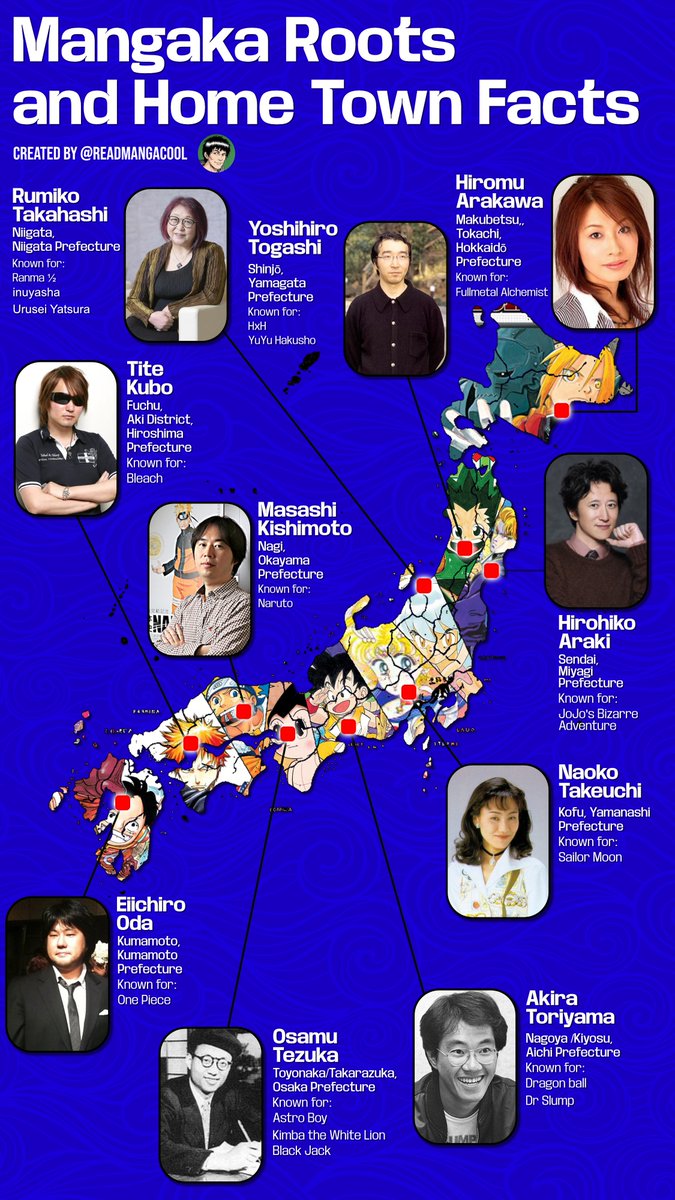
I've always been curious about where my favorite mangaka come from, so I did some digging and found some really interesting facts!
Did you know Eiichiro Oda's hometown built One Piece statues after he helped rebuild Kumamoto? And Hirohiko Araki based parts of JoJo’s Bizarre Adventure on his hometown, Sendai. It’s amazing to see how their roots shaped their work!
Eiichiro Oda
Eiichiro Oda was born in Kumamoto, Japan on January 1st of 1975. Kumamoto is the capital city of Kumamoto Prefecture on the island of Kyushu, Japan – the large bottom island.
Growing up and having lived in Kumamoto, Eiichiro Oda has a special feeling for his hometown, and in 2017, he could really show this. In 2016, Kumamoto Prefecture was hit by a strong earthquake.
In total, the two earthquakes killed 277 people, injured 2,809, and many structures collapsed, catching fire.The disaster forced more than 44,000 out of their homes.
Eiichiro Oda donated ¥800,000,000 on April 14th of 2016 with a message to the city of Kumamoto.
There was a big earthquake in Kumamoto (all of Kyushu). I was born in Kumamoto.
It is my hometown. To everyone greatly affected by the damage, I hope you are doing well from the bottom of my heart. I was able to reach my family and friends.
They are scared but hanging in there. Everyone I contacted said things to put me at ease.
They are so strong!! But there is a limit to human endurance. Before they reach their limit, I want to comfort them somehow.
Adults must not worry their children. Most of all, I want the children to laugh! If they laugh, adults can do their best!
Right now, it is still hard for us civilians to help. But I will definitely help with the relief effort! Don’t give up!!-Eiichiro Oda (2016.4.17)
After the reconstruction of Kumamoto, its governor Ikuo Kabashima announced that they would build statues of the Straw Hat Pirates in order to send a word of thanks to Eiichiro Oda for his help.
In total, there have been 10 statues depicting Straw Hat Pirates of ONE PIECE installed in Kumamoto: The Luffy statue was the first to be unveiled on November 30th, 2018, with Usopp and Sanji following roughly a year later, and the last was Jinbe’s unveiled on July 23rd, 2022, at Sumiyoshi Kaigan Park in Uto.
You can have a look at their website here kumamoto project.
Akira Toriyama
Born April 5, 1955 – March in the town of Nagoya /Kiyosu, Aichi Prefecture, Akira Toriyama.
The city was formed on 7 July 2005 by the amalgamation of the former town of Kiyosu, with the towns of Shinkawa and Nishibiwajima from Nishikasuga District.
There, he spent most of his life; he entered a technical high school in Nagoya to study design, which gave him the opportunity to draw.
Toriyama’s house and Bird Studio—a manga and design production studio founded in 1983—are situated in Kiyosu.
This studio became so popular with autograph requests that the studio had to put out a note.
Thank you for coming here, but if you ask me for an interview, meeting, or autograph I will have to decline. Also, I ask that you don’t leave anything at the door. Thank you for your understanding in advance and thank you.
He is deeply connected with his hometown because, in 2025, the Kiyosu City of Aichi Prefecture is celebrating its 20th anniversary, and Akira Toriyama is in support of the celebration by designing an adorable logo.
It will be used for promotion in other municipal projects celebrating the 20th Anniversary of Kiyosu City.
Osamu Tezuka
Born in Toyonaka City, Osaka Prefecture, Although born in Toyonaka, the family soon moved to Takarazuka City, Hyogohis.
Tezuka’s prodigious output, innovative techniques, and redefinitions in genre made him such terms as “the Father of Manga.”
His connection with the place of his birth isn’t as strong as the new city to which he moved at 5 and was to live for the next 20 years.
The cities of Takarazuka and its futuristic buildings inspired Tezuka. In turn, his connection with his hometown runs deep, and you can see this in the establishment of the Tezuka Osamu Magna Museum.
The museum is one where you really have the chance to trace from his birth, all the way through to the last words, “I’m begging you, let me work!” said to a nurse who tried to confiscate his drawing tools.
The museum, in which he is celebrated, is a permanent retrospective of the popular-in every sense of the word-father of Japan’s globally famous comic and animation arts, showcasing how Astro Boy and Kimba the White Lion were created across the Showa Era.
Naoko Takeuchi
Born March 15, 1967, in Kofu, Yamanashi, Japan, Takeuchi attended Kofu Ichi High School and went on to graduate from Kyoritsu College of Pharmacy before entering the manga industry.
She is best known for being the creator of Sailor Moon. She is married to Yoshihiro Togashi, the writer and artist of YuYu Hakusho and Hunter × Hunter, and they have a son and daughter.
I couldn’t find much about her hometown, but she does have traveling museums of her art which travel all around Japan.
Hirohiko Araki
Araki Toshiyuki, better known as Hirohiko Araki, was born on June 7, 1960, in Sendai, Miyagi Prefecture.
He attended Komatsushima Elementary School and then Tohoku Gakuin Tsutsujigaoka High School, where he began submitting work to publishers in his first year.
He lost his ancestral home in Sendai during the Tohoku earthquake, as it was destroyed by the tsunami that followed. He is best known for the JoJo series.
In JoJo, many places have been inspired by Sendai. Setting-wise, Part 4 and Part 8 make use of S-city, Morioh Town, which is modeled after Araki’s hometown in Sendai, Miyagi Prefecture.
Many names related to Sendai appear in both places and characters in JoJo. One of the most well-known examples is Jozenji, Morioh Town, where Josuke Higashikata, Part 4’s protagonist, lives.
Jozenji Temple can be found on Jozenji-dori Avenue, one of the main streets in Sendai, often referred to as the “City of Trees.”
Masashi Kishimoto
Kishimoto Masashi was born on November 8th, 1974, in Nagi, Okayama. Presumably, his home was not very far away from Hiroshima, as his grandfather lived there, but I cannot find any other connection he may have had to the city.
Otherwise, check out more information about him and his brother here.
Tite Kubo
Tite Kubo was born on June 26th, 1977, in Hiroshima Prefecture, his real name being Noriaki Kubo.
Not much is mention his hometown but When Kubo was asked through his fanclub whether Karakura Town—the town in Bleach, his popular manga—was based on any real city, he answered, “not really, he just used his hometown of Fuchu Town, Hiroshima as a rough reference.
Rumiko Takahashi
Born October 10, 1957, in Niigata, Niigata Prefecture, Japan. Attending Niigata Chūō High School, she was said to sometimes doodle in the margins of her papers.
She is known for her long list of books, Urusei Yatsura, Maison Ikkoku, Mermaid Saga, Ranma ½, nuyasha, Rin-ne, and Mao.
While not in her hometown, a life-size bronze statue of her creation Lum, the lead character in Urusei Yatsura, was placed at Oizumi Gakuen Station in Tokyo’s Nerima district.
Closer to home, you can see her work with other popular artists from Niigata at the Niigata Manga Animation Museum. Visitors can run with Lum from the comic *Urusei Yatsura* (1978) in an interactive room.
Yoshihiro Togashi
Born in Shinjō, Yamagata, on April 27, 1966, nothing much connects Togashi to his hometown other than a family-owned paper shop.
Alternatively, you can visit the Shinjo Mogami Manga Museum, where you will find hand-drawn illustrations, his autograph, replicas of original art, figures that are not on sale anywhere, and much more of Togashi’s work.
Some of his artworks have been created in honor of the famous Shinjo festival, held each year in Togashi’s hometown. The works are inspired by the large ornate floats paraded through the streets during this festival
Hiromu Arakawa
Hiromu Arakawa was born on May 8, 1973, in Hokkaido, Japan. She grew up on a dairy farm. Hiromu Arakawa might be well known for Fullmetal Alchemist, but another of her titles, “Silver Spoon”, actually takes place in an alternative Hokkaido.
The story sets in the fictional Ooezo Agricultural High School in Hokkaido and follows the daily life of Yuugo Hachiken, a high school student from Sapporo who enrolled at Ooezo Agricultural High School fleeing from the demands of his strict father.
Grown and raised in the countryside, most components of the manga are taken from Arakawa’s experiences in her childhood-for example, characters like Ichiko Fuji, a teacher in the piggery, members of the Holstein fanclub her days on the farm.
A Journey Home: How Hometowns Shape the Worlds of Iconic Mangaka
Exploring the hometowns of beloved mangaka reveals the deep connections these artists maintain with their roots, often influencing both their lives and work. From Eiichiro Oda’s heartfelt contributions to Kumamoto after the earthquake, to Hirohiko Araki’s portrayal of his hometown in JoJo’s Bizarre Adventure, it’s clear that the environments these creators grew up in left a lasting imprint on their stories and character development.
Even when there is no direct link between the setting of their manga and their real-life hometowns, as seen with Akira Toriyama and Tite Kubo, their sense of place often inspires their broader creative processes.
These hometowns, in return, have embraced the success of their famous natives.
Statues, museums, and tributes dedicated to these artists serve as a testament to their influence, not just in the world of manga, but within their communities.
The ongoing celebration of their work in local cultural projects highlights the reciprocal relationship between these creators and their origins.
The hometowns of these renowned mangaka are more than just places of birth—they are touchstones of creativity and memory, forever intertwined with the legacy of Japanese manga and anime.
#EiichiroOda #KumamotoStrong #OnePieceCreator #MangaLegends #AkiraToriyama #JoJoHometown #TakarazukaTezuka #SailorMoonLegacy #HometownHeroes #MangakaJourney #HirohikoAraki #AnimeCulture #FullmetalAlchemist #MangakaInfluence #JapanAnime #LegendaryCreators
📱Best Manga Reading Apps in 2024📱
Manga reading apps have become essential for fans who want to keep up with their favorite series. Whether you're looking for free manga reading apps or want to explore paid options, there’s a variety of manga readers available that cater to different preferences.
Below is a comprehensive look at some of the best manga reading apps, their features, and the popular titles they offer.
1. Manga Plus
Manga Plus, created by Shueisha, Japan’s largest manga publisher, is one of the most popular manga reading apps worldwide. It provides access to widely known titles like Dragon Ball Z, Naruto, Spy x Family, Chainsaw Man, Jujutsu Kaisen, and My Hero Academia.
Plans and Features:
Basic Plan: Free access to current serialized titles. Readers can enjoy each chapter once before ads appear.
Standard Plan: For $1.99/month (US), £1.79/month (UK), or $0.99/month (India, Indonesia, Philippines), users can access over 6,000 chapters without ads. However, completed series are not accessible.
Deluxe Plan: For $4.99/month (US) or £4.59/month (UK), this plan offers access to over 15,000 chapters, including both serialized and completed titles, with no ads.
Manga Plus also supports multiple languages, including English, Spanish, Thai, Indonesian, Brazilian Portuguese, Russian, French, Vietnamese, and German.
The app features content from various Shueisha magazines like Weekly Shonen Jump, Shonen Jump+, Jump Square, and more. Additionally, it has a Creator Plus section where global users can submit their own manga, moderated by the Jump+ editorial team and localization company Medibang.
Key Titles Available:
Akane-banashi
Black Clover
Jujutsu Kaisen
One Piece
Undead Unluck
Follow on X (Twitter): @mangaplus_o
2. Shonen Jump
The Shonen Jump app, operated by Viz Media, offers a vast collection of Shonen genre titles, including hits like One Piece, Dragon Ball Super, and Boruto: Two Blue Vortex.
This manga reader provides the first chapter and the three most recent chapters for free, allowing readers to stay up-to-date with their favorite series.
Subscription:
For £2.98/month (UK) or $3.00/month (US), users can access over 20,000 manga chapters, read 100 chapters a day, and download up to 100 chapters on their device for offline reading.
Key Titles Available:
Naruto
Dr. Stone
Jujutsu Kaisen
Hunter X Hunter
Bleach
Follow on X (Twitter): @shonenjump
3. Viz Manga
Similar to the Shonen Jump app, the Viz Manga app, also from Viz Media, provides access to a broader range of titles beyond the Shonen genre. It includes works like Komi Can't Communicate, Junji Ito’s Uzumaki, and Rumiko Takahashi’s Inuyasha.
Subscription:
For £1.99/month (UK) or $1.99/month (US), users can access over 10,000 chapters, with a daily limit of 100 chapters and 100 downloads.
Key Titles Available:
My Hero Academia
Dragon Ball Super
Chainsaw Man
Tokyo Ghoul
Follow on X (Twitter): @VIZMedia
4. K Manga
K MANGA, Kodansha's official manga reading app, is currently available only in the US. It offers over 300 titles, including Attack on Titan, Tokyo Revengers, Fairy Tail, and Ghost in the Shell.
Features:
Unlock chapters using tickets or points. Points can be purchased or earned, with prices starting at $1 per 100 points.
There is no subscription model, making it a potentially expensive option for frequent readers.
Key Titles Available:
Attack on Titan
Tokyo Revengers
Fairy Tail
Blue Lock
The Quintessential Quintuplets
Follow on X (Twitter): @KMANGA_KODANSHA
5. Libby App
Libby, a library app, allows users to borrow eBooks, audiobooks, and digital magazines, including manga, using their library card. It's a fantastic option for free manga access without subscriptions.
Features:
Free access to a wide range of manga titles, depending on your library’s collection.
Notable series available include Dragon Ball, Naruto, Demon Slayer, and Sailor Moon.
Key Titles Available:
Attack on Titan
One Piece
Bleach
Fullmetal Alchemist
Sailor Moon
Follow on X (Twitter): @LibbyApp
6. Manga UP!
Manga UP!, developed by Square Enix, features a mix of classic and new titles. The app uses a points-based system where users can read some chapters for free, while others require "UP points." It also offers a subscription option called the Vault Pass.
Subscription:
Vault Pass: $5.00/month (US) or £4.69/month (UK), providing access to over 10,000 chapters.
Key Titles Available:
Fullmetal Alchemist
Soul Eater
My Dress-Up Darling
Goblin Slayer
Follow on X (Twitter): @MangaUpGlobal
7. Mangamo
Mangamo offers over 300 titles, with a subscription model priced at $4.99/month (US) or £4.59/month (UK). It features a unique "coins" system for purchasing individual chapters or volumes.
Subscription:
Two-month free trial available. Unlimited access to the library and exclusive titles, with no ads.
Key Titles Available:
Attack on Titan
Fire Force
Vinland Saga
My Love Story with Yamada-kun at Lv999
Follow on X (Twitter): @mangamoapp
8. WebComics
WebComics caters to manga, webtoons, and comics lovers with a vast collection across different genres.
It’s a freemium app where some chapters are free, but others require in-app currency like coins or gems.
Subscription:
Premium access removes ads and provides exclusive content. Subscriptions are available monthly, quarterly, or annually.
Key Titles Available:
CEO Above, Me Below
The Devil Butler
The Supreme Spy
Rebirth of the Urban Immortal Cultivator
Follow on X (Twitter): @Webcomics_app
9. INKR
INKR is a versatile manga reading app that supports manga, webtoons, manhua, and more across various genres.
It operates on a freemium model with the option to subscribe to INKR Extra for ad-free reading and access to premium titles.
Subscription:
$4.99/month (US) or £4.59/month (UK). Users can also purchase additional chapters using coins.
Key Titles Available:
Tokyo Revengers
Soul Land IV: Ultimate Fighting
Air Gear
Apocalypse Online
Follow on X (Twitter): @inkr
10. Manta App
Manta is a subscription-based manga reading app that focuses on romance, fantasy, and drama. It offers unlimited access to its library for $4.99/month (US) or £4.99/month (UK).
Features:
The app is ad-free and does not use a pay-per-episode model, making it a great choice for uninterrupted reading.
Key Titles Available:
Under the Oak Tree
Finding Camellia
The Lady Alchemist
Totem's Realm
Follow on X (Twitter): @MantaComics
11. Kindle
Primarily known for eBooks, the Kindle app also offers a selection of manga. Amazon Prime members can access manga titles for free through Prime Reading or Kindle Unlimited.
Features:
Kindle Unlimited offers a vast selection of manga, including popular and classic series. Prime Reading is available with an Amazon Prime membership.
Key Titles Available:
Beck
Cage of Eden
Battlefield Alita
Initial D
Follow on X (Twitter): @AmazonKindle
12. Webtoon
Webtoon is a leading platform for webcomics, including manga, manhwa, and original webtoons. The app offers a massive library across various genres, with most content available for free.
Features:
Users can purchase "Fast Pass" tickets to access new chapters early. The app also supports creators through monetization.
Key Titles Available:
Lore Olympus
Tower of God
True Beauty
The God of High School
Follow on X (Twitter): @webtoonofficial
13. Crunchyroll Manga
As of December 11, 2023, Crunchyroll has discontinued its manga reading service to focus on anime streaming and merchandise.
This change marked the end of the Crunchyroll Manga app, which once offered access to popular manga titles and simulpub releases.
Follow on X (Twitter): @Crunchyroll
If you have read this far, please follow, it's free.
Whether you're a fan of classics like Naruto, #DrStone, and #Boruto, or you're following the latest adventures in #OnePiece, #JujutsuKaisen, and #HunterXHunter, there's a manga out there for everyone. Dive into the epic battles of #Bleach, the monster-filled world of #KaijuNo8, or relive the adventures of #DragonBall. For something new, check out #SpyxFamily, #ChainsawMan, and #MyHeroAcademia, or explore darker tales like #TokyoRevengers, #AttackOnTitan, and #TokyoGhoul. Fans of fantasy will love #FairyTail, #BlueLock, and #Inuyasha, while #KomiCantCommunicate and #SoulEater offer unique twists on the genre. Classics like #FullmetalAlchemist and #VinlandSaga continue to captivate, and newer titles such as #Zom100 and #UnderTheOakTree are making waves. Don't miss out on trending series like #FindingCamellia, #TheLadyAlchemist, #LoreOlympus, #TowerOfGod, and #TrueBeauty.
Find them all on these apps.
#MangaPlus #ShonenJump #VizManga #KManga
#LibbyApp #MangaUP #Mangamo #WebComics
#INKR #MantaApp #Kindle #webtoonseries