I remember thinking the rise of AI safety and alignment research and fellowships was mostly hype compared to the actual needs of AI development.
I change my mind.!!
Seeing the real-world harm AI systems can cause, makes it clear that AI safety is a necessity.
@joshhawley1st
Google Brain founder, Andrew Ng:
"Prompting will be dead in 6 months. Loops and graphs are replacing it."
in 100 minutes at Stanford he shows how to build agents that finish the work and sharpen themselves
LLMs → Agents → Loops → Graphs
the first 15 minutes go past where most $500 AI courses stop
most people are still learning prompts while the leverage moved two layers up
same model, same tokens, and the only thing that changes is the shape you run it in
watch the lecture today, then save the full graph engineering guide below
Instead of spending 2 hours on a movie...
Spend 1 hour watching this Anthropic Claude for Finance lecture.
It might be the most valuable free resource on quant AI available right now.
Bookmark it, make time for it today, and thank yourself later
AI & ML FREE Courses from Stanford:
❯ CS336 - LLM from Scratch
❯ CS221 - Artificial Intelligence
❯ CS229 - Machine Learning
❯ CS230 - Deep Learning
❯ CS234 - Reinforcement Learning
❯ CS224N - NLP with Deep Learning
All course links inside:
Kimi K3's weights are free to download. Almost nobody on earth can actually run them.
2.8 trillion parameters. The download is the easy part.
Open weights used to mean you could self-host. At this scale it means you can read the file.
So people download it and call the API anyway. Daily revenue up at least 6x since launch.
Openness stopped being the opposite of a business model. It became the top of the funnel.
The license says the quiet part. Past $20M in revenue you negotiate a contract. Past 100M users you display their name.
Free for the developer. A contract for anyone the model actually earns from.
And publishing the weights kills the argument before it starts. Nobody can claim the benchmarks were cooked.
Independent indexes put K3 top three overall and first in frontend coding, with no one taking Moonshot's word for it.
That's the whole trade. Give away the artifact, keep the infrastructure, get the audit for free.
Check the last open model you praised. Ask whether you could serve it, or only download it.
@alidotsky Fair point, but for real, EU regulations do not legally apply outside the European Union. However, they often affect global companies only because businesses want to sell goods in the large European market. This creates a global rule effect known as the "Brussels Effect."
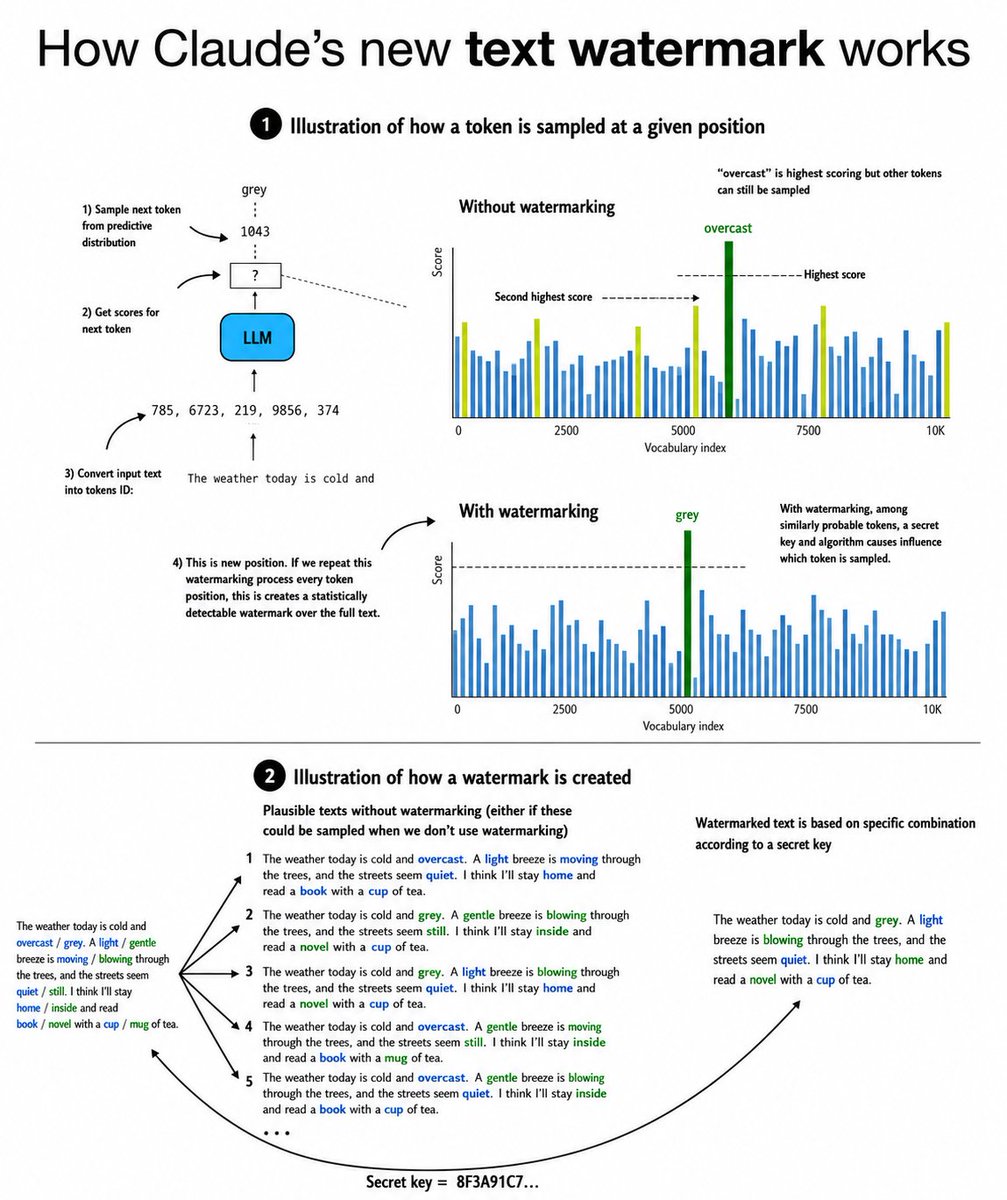
Claude’s new text watermark works by subtly influencing which high-scoring tokens get selected during generation using a secret key.
Repeated across many token positions, this creates a statistically detectable pattern, without retraining the model.
Speech-to-speech no longer needs speech-to-text!
Until now, our stack was VAD -> STT -> LLM -> TTS. Now it can send audio directly to multimodal LLMs:
VAD → MLLM → TTS
No STT. The model understands your voice.
Now go build better voice agents!
https://t.co/tpx9WkHylk
Mark Zuckerberg is laying out a sweeping vision for AI: a personal superintelligence available 24/7 to everyone.
Zuckerberg says these AI agents could eventually help people across nearly every part of life, including work, learning, relationships, and mental health, as Meta releases its new open-weight "Muse Glimmer" model and pushes to make advanced AI more widely accessible.
At the same time, Meta is investing in the people and communities behind that future, including America��s Workforce Academy and a $1 billion community fund tied to its growing data-center footprint.
His message is simple: "The future is for everyone."
Slack Out, Sila in
Sila (YC W26) is building messaging where humans and AI #agents can work together in group chats—using agents like Claude Code, Codex and Cursor, while switching btw models.
#AI agents collaborating with each other, your team, customers, and other companies.
When the architects of modern AI disagree, pay attention.
@geoffreyhinton , @drfeifei, and @AndrewYNg — but not the same vision for AI’s future.
Jobs. Open models. Safety. Regulation.
Maybe the most important thing we learned is that there is no single roadmap for AI.
NVIDIA researchers did it again!
They found a way to make KV cache transferable between models.
The target model skips prefill entirely, and the conversion runs 2.7 to 25x faster than processing the context again.
Let's understand why this is so important today.
LLM APIs are stateless, so every turn sends the entire conversation back to the model. The model reads all of it again before writing a single new token, and all of it is billed as input.
Prompt caching allows Anthropic and other providers to hold the KV cache for a stable prefix and bill a hit at roughly 10% of the base input rate, because the compute was already done once.
The 90% reduction is one of the largest lever in LLM serving, which is why so much production work goes into keeping prefixes byte-stable.
But the cache only works on the model that produced it. Keys and values are produced from that model's weights, so no other model can read them.
In pratice, the constraint shows up in LLM routing. If the traffic is shifted to a different model for cost/capability reasons, the accumulated KV cache becomes invalid.
As a result, the accumulated context has to be processed from scratch, and it's billed at full rate.
NVIDIA's recent paper treats this as a representation problem.
Prefill's only output is the KV cache, so to move KV between models, we need to convert one model's cache into the format the other expects.
They first checked whether the conversion has any structure worth exploiting.
They found that moving from Qwen3 14B to 32B, a plain linear regression from a single source layer reconstructed 56% of the variance in the target model's keys.
The two models obviously may have different layer counts, so there is no natural one-to-one pairing between them.
For each target layer they rank every source layer by how well it predicts that layer, then feed the top eight in together, which takes the reconstruction to 79%.
The mapper itself has three parts:
> Each target layer and head gets its own independent linear map, solved in one closed-form step rather than by gradient descent.
> The cross-layer selection described above is the second part, and their ablation shows it carries the most weight of the three.
> Keys also carry a position-dependent rotation from RoPE. They strip that rotation, fit the map in position-free space, then re-apply the target model's rotation at inference.
Across six pairs from Qwen3, Llama 3.1 and Ministral 3, four retain 73 to 98% of the receiving model's standalone accuracy, and the conversion runs 3-25x faster than processing the context again.
Prior work on cross-model KV reuse exists, but it either trains a neural adapter per pair or requires both models to be architecturally identical.
This is probably the first version that is closed-form and training-free, so a lot of it is still open research.
Every pair tested belongs to one family, so it works on Qwen to Qwen and Llama to Llama.
Cross-family transfer is listed as future work.
All six pairs mentioned above also happen to share KV head count and per-head dimension across scales. Mismatched head configurations are currently untested.
The researchers scoped this to dense full-attention only, so sliding-window and attention-recurrent hybrids still need work.
Here's the paper: https://t.co/tMUGhijFbc
Plenty of work is yet to be done. Still, the constraint being solved is genuine.
Every model swap currently invalidates the full KV that was already paid for, and this is the first result showing that work might be recoverable without training anything extra.
That said, all of this only matters because of what the KV cache is doing in the first place.
I wrote a first-principles breakdown of it, covering why the model stores keys and values at all, why the cache grows with every token, and what generation speed looks like with and without it.
Read it below.
The wildest AI project this week has nothing to do with LLMs. It counts potatoes.
A developer named Viet built a vision system that counts potatoes on a conveyor belt.
He annotated one frame. One. Used SAM 2 to generate labels, trained a tiny YOLO11 nano model, and it works across the entire video. Real-time counting. Production ready.
While everyone is racing to build trillion-parameter models, the fastest wins in manufacturing are systems like this.
Godfather of AI: "If you sleep well tonight, you may not have understood this lecture."
This 47-minute lecture is the best thing I've seen about AI in the last few months.
Hinton built the neural networks behind every AI alive, then quit Google to warn us it's already ahead of us on most cognitive tasks.
Despite that, most people open Claude, type one thing, close the tab and think they're using AI, but they're using maybe 10%.
The people using the other 90% aren't typing prompts at all. They're running agents in parallel, wired into graphs that check their own work.
Watch the lecture, then read my step-by-step guide on graph engineering below.
Open-source vs. closed-source AI is becoming an increasingly interesting conversation. This story is worth reading. What do you think?
#AI#OpenSource#LLM#AISafety
Announcing OpenWorker! An open-source agent that doesn't just chat with you, but delivers finished work -- like hand you a polished document, send a slack message, or update a calendar entry.
Ask it to prepare a customer brief, untangle your calendar, draft a report, or triage a Slack alert. It works across your files and everyday tools, produces the deliverable, and checks in before doing anything consequential.
OpenWorker runs on your Mac, with Windows support coming soon. It does not lock you into any one model. Bring your own API key and run it with GPT 5.6 Sol, Claude Fable, Gemini 3.6, an open weight model (like Kimi, GLM, DeepSeek, Inkling), or Ollama to keep your data local. Your data does not leave your machine except through an LLM provider and integrations that you choose.
@rohitcprasad and I are building OpenWorker because AI coworkers are an important way to get work done, and we want there to be an open, privacy-preserving, model-independent option. Check it out and let us know what you think!
Try it out: https://t.co/P0mGnI1o31 (requires your own API key)
Source code: https://t.co/NYCiTD6hSq