Governor Brad Little’s donors needed Nixon Amilcar Ixcoy Lix from Guatemala tO Do THe jOBs aMERiCaNs WoN’T dO (for abysmal wages/while being subsidized by the taxpayers)
On présente la France comme un pays de syndicats, de fonctionnaires et de 35 heures. On a oublié qu'il y a un siècle à peine, c'était le laboratoire du monde.
En 1900, Paris accueille l'Exposition Universelle et se regarde comme la capitale de l'avenir. Pas la capitale du doute. La capitale de ceux qui fabriquent. Les frères Lumière viennent d'inventer le cinéma. Louis Renault et André Citroën lancent l'industrie automobile. Louis Blériot s'apprête à traverser la Manche en avion. Marie Curie va chercher deux prix Nobel. Gustave Eiffel a déjà planté dans le ciel la preuve qu'un Français pouvait défier la gravité avec du fer et des équations. La France est alors une nation d'ingénieurs, d'inventeurs, d'entrepreneurs. Une nation qui construit.
Que s'est il passé ?
Il s'est passé deux saignées et une substitution.
La première saignée commence en 1914. En quatre ans, la France perd près de 1,4 million d'hommes. Mais un chiffre brut ne dit rien. Regardez qui meurt. Les hommes de 20 à 30 ans. C'est à dire, exactement, la génération des bâtisseurs. Ceux qui auraient fondé les usines, déposé les brevets, lancé les entreprises des années 20 et 30 pourrissent dans la boue de Verdun. On a appelé ça la génération perdue. On n'a jamais mesuré ce que ça veut dire, pour un pays, de perdre d'un coup sa réserve de constructeurs.
La seconde saignée arrive en 1940. Et là, ce ne sont pas seulement les morts. C'est l'humiliation. En six semaines, le pays qui avait tenu quatre ans s'effondre. L'Occupation, Vichy, la collaboration, puis la Libération et son cortège de comptes à régler. Un peuple qui sort de là ne se fait plus confiance. Il a honte. Et un peuple qui a honte de lui même devient une proie facile pour quiconque vient lui expliquer, avec talent, que sa honte est méritée.
C'est ici qu'intervient la substitution.
Pendant que les bâtisseurs mouraient deux fois, une autre catégorie d'hommes prospérait. Les commentateurs. Ceux qui ne construisent rien, mais qui jugent ceux qui construisent. Dans le vide laissé par les morts, ils ont pris le micro. Et ils ne l'ont jamais rendu.
Le Paris intellectuel de l'après guerre tient en deux hommes face à face. Ils sont nés la même année, en 1905. Ils se sont connus normaliens. Et ils incarnent les deux Frances possibles.
Jean-Paul Sartre choisit le camp du soupçon. Il sera compagnon de route du communisme jusqu'à fermer les yeux sur les goulags, au nom de l'idée qu'il ne faut pas désespérer les ouvriers de Billancourt avec la vérité. Il devient le pape de la rive gauche, l'homme qu'on écoute, qu'on cite, qu'on suit.
Raymond Aron choisit le camp de la lucidité. Dès les années 30, il a compris où mènent les totalitarismes. En 1955, il publie L'Opium des intellectuels, où il démonte froidement la religion marxiste de ses pairs. Il a raison sur presque tout. Et il est presque seul.
De cette époque est resté un mot, souvent prêté à Bourdieu, qui résume une civilisation entière : mieux vaut avoir tort avec Sartre que raison avec Aron.
Lisez le lentement. C'est un aveu. Une nation qui préfère l'erreur prestigieuse à la vérité inconfortable. Qui choisit le flamboyant contre le juste. Qui décide, consciemment, que la posture vaut mieux que le réel.
Voilà le moment exact où la France a cessé d'être un pays de bâtisseurs pour devenir un pays de commentateurs.
Le reste n'est que la lente exécution de ce choix. L'argent devient suspect. La réussite devient une faute à expliquer. L'entreprise devient un lieu d'exploitation avant d'être un lieu de création. On apprend aux meilleurs élèves à se méfier de ceux qui font, et à admirer ceux qui critiquent. En 68, les enfants d'une bourgeoisie qui n'avait jamais manqué de rien rejouent la révolution. Puis vient la French Theory, dont j'ai déjà parlé, qui transforme ce soupçon en méthode et l'exporte au monde entier.
Et aujourd'hui, le dernier rejeton de cette lignée s'appelle la décroissance. C'est la même mécanique, repeinte en vert. Le désir de construire est suspect. L'ambition est une pollution. La sagesse, c'est de vouloir moins. Cent vingt ans après avoir institutionnalisé la gauche du soupçon, la France a fini par soupçonner jusqu'à son propre désir d'exister.
Mais une nation n'est pas une fatalité.
La France n'a pas perdu son génie. Elle l'a mis en sommeil sous une chape de honte. Le sang des bâtisseurs de Verdun coule encore quelque part dans ce pays. Il suffit de cesser d'avoir honte. De réhabiliter ce mot devenu presque interdit : construire. De redire qu'il vaut mieux avoir raison avec Aron, même seul, que tort avec Sartre, même applaudi.
Et de se remettre au travail.
Parce que c'est toujours ce qui sauve une civilisation. Pas ceux qui commentent. Ceux qui bâtissent.
We have moved on to entirely new moral panics, such as [squints, checks notes] water consumption in datacenters. And in a few years (or months, or weeks, or days), that will be completely forgotten too.
THEO VON: “Was there anybody who was immune to COVID-19?”
DR. MCCULLOUGH: “There’s one adult group. You’re going to laugh.”
[Theo Von listens closely for the reveal]
DR. MCCULLOUGH: “Smokers… They got very mild cases. And they don’t get long COVID.”
THEO VON: “Why?”
MCCULLOUGH: “Because smokers maintain a level of nicotine in the bloodstream… Smoking blocks the spike protein. It’s amazing. I thought smokers were going to go down.”
THEO VON: “Do you think that’s a good idea [to use nicotine patches] on a regular basis?”
DR. MCCULLOUGH: “I think [it’s a good idea] if they have long COVID... Nicotine, don’t forget, is a nootropic. A nootropic is a drug that makes the brain function more effectively... It’s addictive, but it’s not harmful to the human body... Nicotine patches are perfectly safe.”
Finally getting over the asthma - and here's the org chart of the Newark protests, as promised. A few are missing, particularly the Catholic NGOs. But this is the basic template for how mass protests are coordinated so quickly.
Celeste Maloy says she is excited about AI because it means that employers can hire fewer people.
For the remaining jobs, she supports allowing employers to import foreigners to fill them.
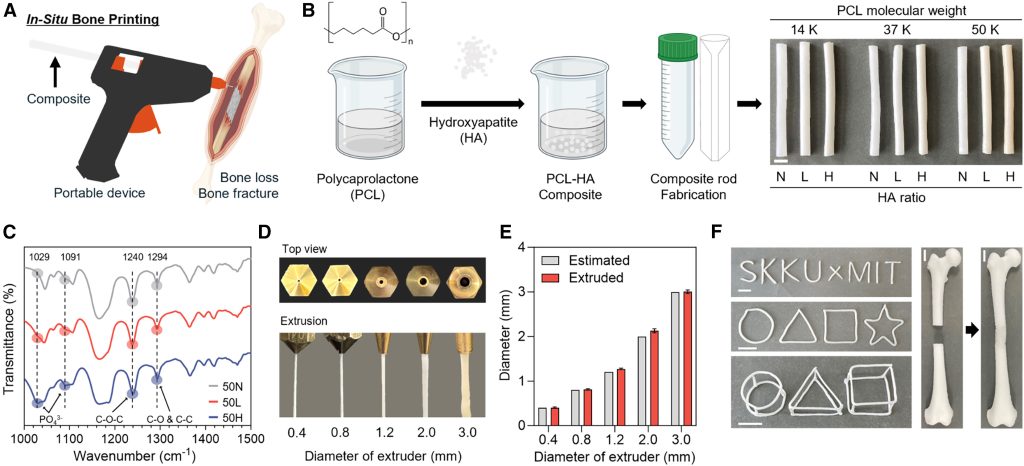
A handheld device 3D printing bone implants directly at the site of an injury?
"This scaffold holds the bone in place and gradually breaks down as the body replaces it with new tissue. Unlike prefabricated implants or bone cement, which must be shaped in advance and may not match the defect precisely, the printed material forms directly in place, adapting to the unique geometry of each injury."
The approach was tested in rabbits, and the implants did not trigger abnormal inflammation or tissue damage.
Nice progress in the 3D bioprinting field.
Source: https://t.co/QmsIqj718b
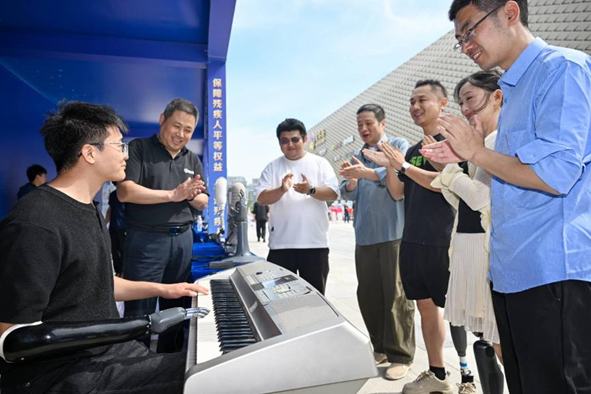
Technology opens new doors to accessible living
Recent advancements in technologies like artificial intelligence (AI), brain-computer interfaces and bionic engineering are offering renewed hope and expanding possibilities for people living with disabilities.
China's 2025 statistical bulletin on the development of the cause of people with disabilities reported that 1.487 million people with disabilities received basic assistive devices last year.
For 51-year-old Xu Min from Suzhou, east China's Jiangsu province, technology has done more than improve daily life; it has restored her confidence and sense of possibility.
She still feels emotional recalling her victory in the upper-limb prosthetics category at the Cybathlon, often called the "Olympics for assistive technology."
Xu lost her right hand and wrist in a workplace accident over thirty years ago. "It felt like my whole world had collapsed," she recalled, crediting her family's encouragement for helping her regain the courage to move forward.
In 2019, staff members from the Suzhou Disabled Persons' Federation contacted Xu about a new project being developed by a research team from Southeast University. The team was developing a prosthetic hand capable of movement and asked whether she would be willing to test it. Xu agreed immediately.
"We use sensors attached closely to the skin to collect myoelectric control signals from the residual limb," explained Hu Xuhui, a member of the research team. "In simple terms, the signals convey the user's intended movement to the chip, which then transmits commands to the prosthetic hand, completing the movement loop."
Xu vividly remembers the first time she saw the prosthetic hand move.
"I cried out in excitement," she said. Initially, success rates were low, but persistent training steadily improved coordination between Xu and the device.
In early 2024, Hu brought another piece of good news: the Cybathlon competition would soon be held. As Xu prepared for the competition, the research team continued refining the prosthetic device and improving its performance.
At the finals in Switzerland, Xu excelled, completing challenging tasks like hammering and nail removal. She was the sole contestant to master the "tactile bag" challenge, identifying and retrieving specific objects by touch alone using the prosthetic.
"Remarkably, the prosthetic allowed me to perceive my environment with precision. It came very close to the functionality of a real human hand," Xu stated proudly after her win. "Technology gave me hope again."
Technology has also helped restore hope to Jin, a resident of Lanxi in Jinhua, east China's Zhejiang province.
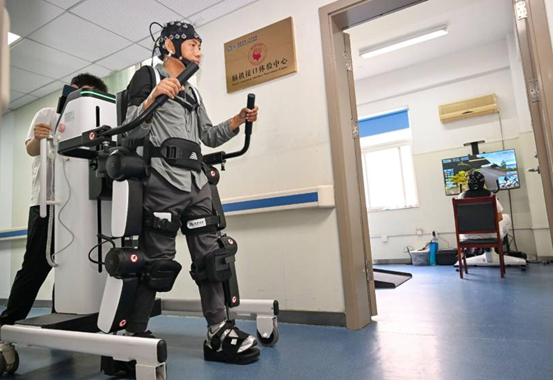
Jin suffered complete paraplegia after a nearly 10-meter fall while repairing his roof in October 2024. Even after four months of rehabilitation, he could not lift his legs or regain normal bladder and bowel control.
At a time when he had nearly lost hope, his daughter, Jin Xiaofang, learned that the Second Affiliated Hospital of Zhejiang University School of Medicine was recruiting volunteers for a closed-loop spinal neural interface implantation procedure. She immediately took her father there for evaluation.
In March 2025, the medical team successfully implanted spinal stimulation electrodes into Jin's lumbar spine and placed a wireless, rechargeable stimulation controller (roughly matchbox-sized) in his abdomen.
The domestically developed "neural pacemaker" measures just 51 millimeters in length and weighs only 18 grams. Using Bluetooth technology, it receives instructions from external devices and delivers precise electrical stimulation to damaged areas of the spinal cord. Patients can recharge the device simply by placing a charging coil near the abdomen, with a single charge lasting more than a week.
Fifteen days after surgery, Jin successfully achieved standing and walking movements. One month later, he regained the ability to take steps with the assistance of a walker.
The technology not only improved his motor functions, but also demonstrated potential for repairing neural sensory pathways.
So far, the hospital has used the closed-loop spinal neural interface technology to help more than 10 spinal cord injury patients regain varying degrees of physical function, with several progressing from being bedridden to walking again.
Another beneficiary of technological innovation is Qing Jingwen from Mianzhu, southwest China's Sichuan province, a survivor of the 2008 Wenchuan Earthquake.
Trapped beneath rubble for nearly 70 hours during the earthquake, Qing eventually lost her right leg above the knee and suffered severe injuries to her left leg. For years afterward, walking remained one of the greatest challenges in her life.
In spring last year, through a public welfare program supported by the Chengdu Foundation for Disabled Persons, Qing received an intelligent bionic leg developed by BrainCo, a Chinese neurotechnology company that develops brain-computer interface products.
"Ever since I started using the intelligent bionic leg, I haven't fallen once," Qing said with a smile.
According to Wang Yong, sales director for intelligent prosthetics at BrainCo, the device integrates gyroscopes, position sensors and multiple other sensors to collect real-time data. The information is processed through algorithms and converted into instructions that control the prosthetic's hydraulic system, allowing it to adapt instantly to different movements and enabling users to achieve a near-natural gait and walking freedom of movement.
Beyond advanced functionality, this domestically developed intelligent bionic leg is significantly more affordable than comparable imported products. With steadier steps and renewed confidence, Qing has begun exploring new possibilities in life. Last year, she traveled to Yueyang, central China's Hunan province, to work as a volunteer teacher and even helped her students establish a cultural and creative arts club.
"The warmth of technology has made both my steps and my heart steadier," Qing said. "I believe my future will become broader and brighter." (By Yao Xueqing, Dou Hao, Li Kaixuan, People's Daily)
The reason we love Napoleon so much is because it was never about himself. He was after the dream that lay in the hearts of men.
One of the quotes that touches me the most:
‘I made my plans with the dreams of my sleeping soldiers.’
One of the great Prometheus of History. He defeated the cyclical caste system in Europe and forged the principles that would orient us toward a grandiose future.
We vowed to build thousands of statues of him so that his great dream would never be forgotten.
French people judge Napoleon by ridiculous metrics and say France was in worse shape after him. They don’t understand.
Do you take into account that he taught audacity to millions? Do you imagine the economic implications?
For France to become epic again, we have to admire our great hero.