For my first post, I’m sharing a letter @NVIDIA signed on why open models matter.
AI will transform every industry, power every company, and be built by every country.
Open models strengthen safety and cybersecurity, accelerate innovation and diffusion, and enable sovereignty.
The world needs both frontier closed models and frontier open models.
https://t.co/AUKzoQ5Ikb
pour info une appli de livraison de repas chinoise vient juste d'entraîner l'un des plus gros modèles d'IA de la planète, 1,6 trillion de paramètres ENTIÈREMENT sur des puces chinoises (0 nvidia), cette boîte s’appelle Meituan et c'est en gros le Doordash chinois, celui qui vous livre à manger
d’ailleurs pour moi c'est ça le vrai signal (pas vraiment la perf brute)mais le fait que ça sorte d’une boîte qu'on réduit à la livraison alors que c'est davantage une super app qui gère aussi les courses les voyages, les réservations d'hôtel et le vtc, l'un des+ gros réseaux de logistique en temps réel du monde assis sur une MONTAGNE de données du réel et rodé au machine learning depuis 10 ans pour optimiser ses millions de tournées par jour
en ce sens, ça veut dire que ce modèle cristallise tout ce socle de données et d'ingénierie accumulé depuis des années ET ça veut aussi dire que la capacité à construire de l'IA de frontière a diffusé si profondément dans l'économie chinoise qu'une appli de livraison peut désormais le faire et c’est juste incroyable car en face vous n'affrontez plus un simple laboratoire champion comm aux États-Unis mais vous affrontez tout un écosystème
techniquement je trouve que le tour de force est immense avec entraînement & inférence de bout en bout sur un cluster de 50 000 puces domestiques qu’ils ont eux même CONSTRUIT, 35 000 milliards de tokens avalés sans un seul plantage, en remplaçant même la brique logicielle de nvidia par un équivalent maison deepseek n'avait fait tourner ses puces chinoises que pour l'inférence, meituan a fait le pré-entraînement soit la partie la PLUS DURE
ce que je trouve drôle c’est que les contrôles à l'export depuis 2022 visaient à garder les meilleures puces hors de chine pour empêcher exactement ça, résultat ils ont forcé la Chine à fabriquer ses propres puces + son propre interconnect et son propre savoir faire d'entraînement, ce mur leur a appris à faire leurs propres briques et maintenant ils n'ont plus vrziment besoin de l'import et on se retrouve avec des boites chinoises de livraison de repas qui construisent maintenant même leurs propres GPU c’est de la folie
par ailleurs le coup de maître c'est qu'ils l'ont donné gratuitement en licence mit sans aucune restriction pdt que les US verrouillent leurs modèles de pointe derrière des api et des sanctions, la Chine inonde le monde de poids ouverts et gratuits (route de la soie numérique dont j’ai souvent parlé ici)
je pense que désormais l'objectif est limpide pour tout le monde à savoir devenir l'ia par défaut de la planète, un peu l'android de l'ia(même si c’est différent ici)
in fine je dirais que 3 doctrines se dessinent, l'amérique contrôle la frontière et les goulots d'étranglement, la Chine bâtit toute la chaîne et la distribue
et l'europe écrit les règles d'un jeu auquel elle ne joue pas, pas de puces pas de labo , de frontière, pas de compute souverain juste un ai act spectatrice qui réglemente ce que les autres construisent lol
mais soyons honnêtes longcat n'est pas encore le meilleur du monde, il reste derrière les tout meilleurs modèles américains sur les tâches les plus dures mais là n'est pas la question
sachez que la souveraineté au 21e siècle c'est la capacité à reconstruire sa propre chaîne le jour où quelqu'un voud coupe les vivres, la dépendance est une laisse m par contre l'indépendance ça se bâtit et une appli de livraison de nouilles vient de prouver au monde entier qu'on peut contourner n'importe quel mur quand on a décidé de construire le futur de manière vraiment souveraine à partir des premiers principes alors que le mot souveraineté reste un buzzword en Europe
🔵AI Agents in Action: https://t.co/eYvKcQ7gOe v/ @ManningBooks
🟡New! Updated! 2nd Edition!
🟢 Table of Contents:
1. The rise of AI agents
2. Core components: Large language models, prompting, and agents
3. Actions with Model Context Protocol for AI agents
4. Architecting and building multi-agent systems
5. Agent reasoning and planning
6. Working with memory & knowledge RAG for agents
7. Building robust agents with evaluation and feedback
8. Deploying agents and agentic systems
9. Understanding the agentic loop
10. Exploring the cognitive agent that thinks, monitors, and adapts
11. Tips for building agentic systems
A. Setting up the sample code repository
B. Node.js setup for local MCP servers
I've noticed an "intelligence ratchet" effect in myself. I want to see if anyone else has noticed this.
The more I use advanced AI, the smarter I get. Not raw IQ, but I mean knowledge, critical thinking skills, rhetoric and verbal, etc.
Every time a new AI comes out I feel dumb for a while but then over time, I learn the new thinking patterns and eventually the AI feels dumb.
I think this is why we often feel like "they nerfed the AI" but in reality we're all just leveling up because we finally have a thought partner that can challenge us day in and day out.
I was inspired to think in this direction by @akorinek's "frontier of automation" concept whereby historically, technologies tend to ultimately boost human abstract and cognitive abilities, meaning we all tend to stay just ahead of the frontier of automation, at least in aggregate.
It seems like, at least for now, we're all surfing the wave. The technology is making us smarter when we use it correctly. When we challenge ourselves and learn constantly. I'm not saying that this will be true forever or not.
But what do you think? Is the "new AI smell" just because we're leveling up our smarts and then when the AI feels dumb it's because we're ready for the next boss fight?
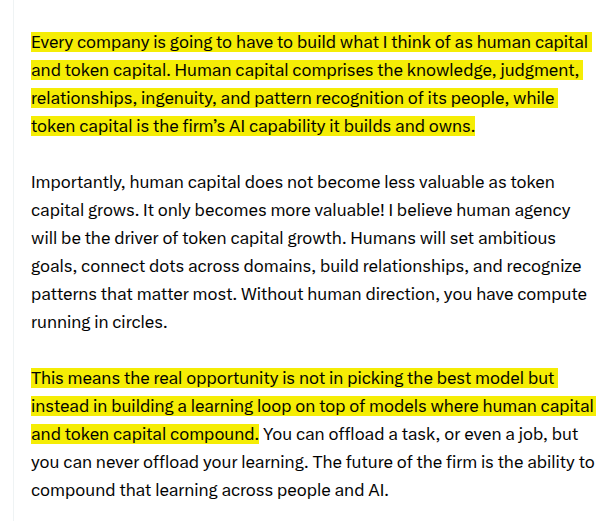
Great article by Satya Nadella on organizational economics of AI and "token capital"
The real contest is not model quality alone, its the loop around the model: the workflows, feedback, judgments, exceptions, failures, and private tests that teach a system what matters inside a firm.
That requires private evals, private reinforcement loops, and queryable institutional memory
Two days ago, Anthropic cut off third-party harnesses from using Claude subscriptions — not surprising. Three days ago, MiMo launched its Token Plan — a design I spent real time on, and what I believe is a serious attempt at getting compute allocation and agent harness development right. Putting these two things together, some thoughts:
1. Claude Code's subscription is a beautifully designed system for balanced compute allocation. My guess — it doesn't make money, possibly bleeds it, unless their API margins are 10-20x, which I doubt. I can't rigorously calculate the losses from third-party harnesses plugging in, but I've looked at OpenClaw's context management up close — it's bad. Within a single user query, it fires off rounds of low-value tool calls as separate API requests, each carrying a long context window (often >100K tokens) — wasteful even with cache hits, and in extreme cases driving up cache miss rates for other queries. The actual request count per query ends up several times higher than Claude Code's own framework. Translated to API pricing, the real cost is probably tens of times the subscription price. That's not a gap — that's a crater.
2. Third-party harnesses like OpenClaw/OpenCode can still call Claude via API — they just can't ride on subscriptions anymore. Short term, these agent users will feel the pain, costs jumping easily tens of times. But that pressure is exactly what pushes these harnesses to improve context management, maximize prompt cache hit rates to reuse processed context, cut wasteful token burn. Pain eventually converts to engineering discipline.
3. I'd urge LLM companies not to blindly race to the bottom on pricing before figuring out how to price a coding plan without hemorrhaging money. Selling tokens dirt cheap while leaving the door wide open to third-party harnesses looks nice to users, but it's a trap — the same trap Anthropic just walked out of. The deeper problem: if users burn their attention on low-quality agent harnesses, highly unstable and slow inference services, and models downgraded to cut costs, only to find they still can't get anything done — that's not a healthy cycle for user experience or retention.
4. On MiMo Token Plan — it supports third-party harnesses, billed by token quota, same logic as Claude's newly launched extra usage packages. Because what we're going for is long-term stable delivery of high-quality models and services — not getting you to impulse-pay and then abandon ship.
The bigger picture: global compute capacity can't keep up with the token demand agents are creating. The real way forward isn't cheaper tokens — it's co-evolution. "More token-efficient agent harnesses" × "more powerful and efficient models." Anthropic's move, whether they intended it or not, is pushing the entire ecosystem — open source and closed source alike — in that direction. That's probably a good thing. The Agent era doesn't belong to whoever burns the most compute. It belongs to whoever uses it wisely.
"In practice, Spectre is the beginning of a company world model: a live picture of what is happening inside Harvey and what needs to happen next." https://t.co/1nn0Ndz59n
There is nothing more important than understanding how reality works and how to deal with it. The state of mind you bring to this process makes all the difference. I have found it helpful to think of my life as if it were a game in which each problem I face is a puzzle I need to solve. By solving the puzzle, I get a gem in the form of a principle that helps me avoid the same sort of problem in the future. Collecting these gems continually improves my decision making, so I am able to ascend to higher and higher levels of play in which the game gets harder and the stakes become ever greater. #principleoftheday
Comparing what is now happening with what has happened in analogous historical situations and triangulating my thinking with smart, well-informed leaders and experts has always helped me make better decisions. I have found that most wars are filled with big disagreements about what is likely to happen and big surprises.
However, in the case of this Iran war, it is obvious, and there is near-universal agreement, that it all comes down to who controls the Strait of Hormuz. I hear from those who run governments, geopolitical experts, and people all over the world that if Iran is left with control over who can pass through the Strait of Hormuz, or is even left with the power to negotiate, there are four (4) key implications. I wrote about these consequences in my latest article.
I want to emphasize that I am not political; I am just a practical person who has to bet on what will happen and has studied history to draw lessons that help me do that well, and I am now passing along my principles and thoughts that might help others navigate these tumultuous times.
I remain ready, willing, and able to explore these things with you if you’d like to ask me questions in the comments.
https://t.co/R6ERFYZeV8
I spent time in Shenzhen last year and when I saw Merz come back from China saying Germans need to work more I immediately knew what broke his brain because I lived the exact same cognitive shock
my first week in Huaqiangbei I burned through 4 prototype iterations of a motor controller board for less than a thousand bucks total, back home a friend was working on something similar and spent over 12 thousand for a single revision that took almost two months to arrive
when you live that contrast in your own hands with your own project something permanently shifts in how you see the world and it goes way deeper than speed & cost
what Shenzhen actually built is a collective learning organism, imagine 20 PCB fabs 15 injection mold shops 30 component distributors and a hundred firmware freelancers all within a 2km radius, looks insanely redundant from the outside until you realize redundancy is actually information density in disguise
I watched this firsthand with an injection mold supplier I was working with, this guy had seen a hundred founders iterate similar thermal designs over 6 months so he proactively modified his tooling before I even opened my mouth, he knew what I needed before I knew what I needed, the intelligence lives in the relationships between the nodes and it compounds daily
the west thinks about manufacturing as a cost center you optimize by centralizing…
China accidentally built a distributed neural network of manufacturing intelligence where knowledge diffuses horizontally across thousands of agents faster than any single western company can process internally
so when Merz comes back and says we need to work a bit more I think he saw the problem but COMPLETELY misdiagnosed the solution, telling Germans to work harder is like telling a horse to gallop faster when the other side built a combustion engine
the gap is ARCHITECTURAL
it’s ecosystem density, you need a custom connector in Shenzhen you walk 200 meters, in Munich you send an email and wait 3 weeks
it’s iteration speed, parallel search vs sequential optimization at the system level, it’s risk tolerance, Chinese founders ship something broken on Monday fix it Tuesday ship again Wednesday while European companies are still in the approval phase for the pilot program of the feasibility study…
and Merz only saw the surface, what he missed is the tier 2 cities like Hefei Chengdu Wuhan replicating the Shenzhen model at scale right now
BYD going from irrelevant to outselling every european automaker combined in roughly 5 years, Huawei building its own 7nm chip under maximum sanctions when every analyst said it was physically impossible & behind all of that a government that treats advanced manufacturing as an existential national priority while europe debates whether AI needs another ethics committee
I think what we’re watching is the most asymmetric economic competition in modern history and most western leaders are still framing it as a productivity problem when it’s actually an ontological one
Europe & America are optimizing variables that China stopped tracking years ago meanwhile China is compounding on dimensions the west has no framework to even measure
Merz at least had the courage to name
it out loud and I respect that genuinely but working a bit more inside a broken architecture just means you arrive at the wrong destination slightly faster
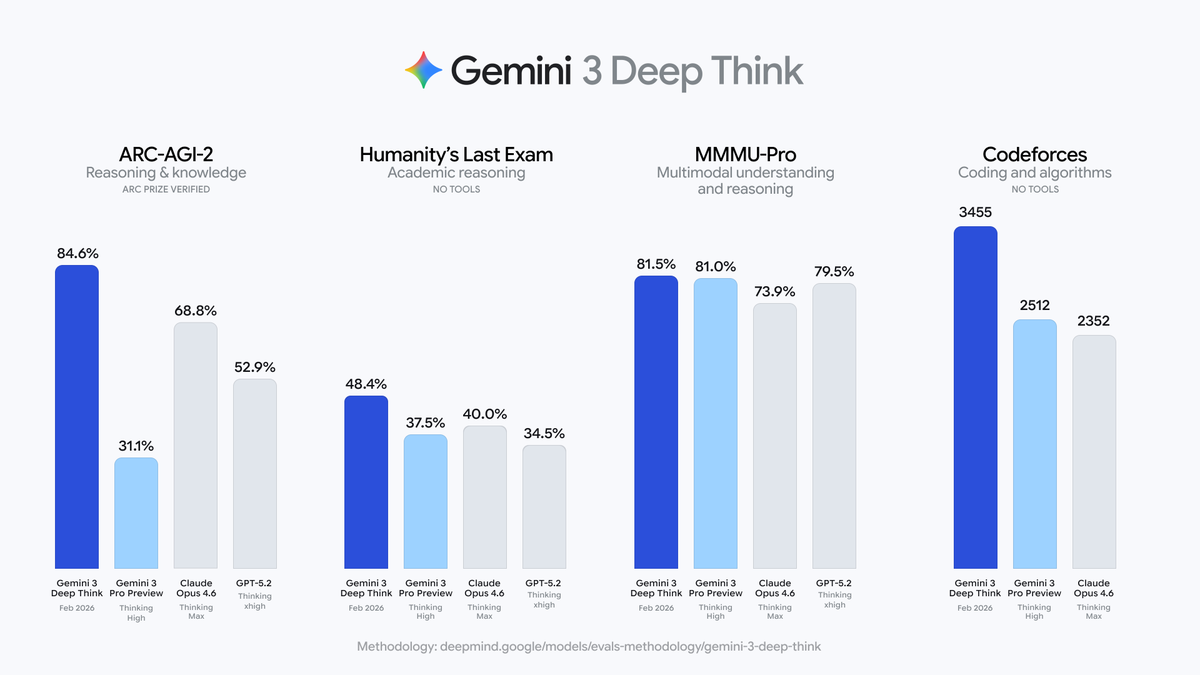
Gemini 3 Deep Think is getting a significant upgrade. We’ve refined Deep Think in close partnership with scientists and researchers to tackle tough, real-world challenges.
And it’s pushing the frontier across the most challenging benchmarks, achieving an unprecedented 84.6% on ARC-AGI-2. It also sets a new standard on Humanity’s Last Exam - 48.4% without tools.
Free agent guard Cam Thomas has agreed to a deal with the Milwaukee Bucks, his agent Tony Ronzone of Wasserman tells ESPN. Thomas, 24, averaged 21.4 points per game over the last three seasons with the Nets.
$4.8B just matched $350B on a coding leaderboard.
Claude Opus 4.5 Thinking sits at 1500 on Code Arena. Kimi K2.5 Thinking sits at 1447. That’s a 3.5% performance gap between the best proprietary model in the world and an open-source model you can download from Hugging Face and run yourself.
Moonshot AI, the company behind Kimi, is valued at $4.8B. Anthropic just signed a term sheet at $350B. OpenAI’s last secondary priced at $500B. Moonshot is producing 96.5% of frontier coding performance at roughly 1% of the valuation.
And look at who Kimi is sandwiched between on that leaderboard. Above it: Gemini-3-Pro (Google, $2T+ market cap). Below it: Gemini-3-Flash and GLM-4.7, another Chinese open-source model from Zhipu, which just IPO’d in Hong Kong at a $13B market cap.
The training cost for Kimi K2 Thinking was reportedly $4.6M. Anthropic’s run-rate revenue just crossed $9B. OpenAI is burning $17B per year. The economics of getting to 96.5% of frontier are compressing faster than anyone modeled.
The US Department of Commerce already flagged this, citing Moonshot specifically as evidence of the “growing depth” of China’s AI industry.
What matters for developers: Kimi K2.5 is a 1T parameter MoE model with 32B active parameters. You can self-host it. You can fine-tune it. You can build products on it without per-token API fees. The proprietary models above it on that leaderboard? You rent access.
Agentic coding is the benchmark that matters most right now because that’s where revenue is concentrating. Coding assistants, code review, automated refactoring. The open-source frontier just moved to within 3.5% of the proprietary ceiling.
Moonshot’s overseas API revenue quadrupled from September to November. Paying users grew 170% month over month. That’s what happens when you’re 96.5% as good and free.