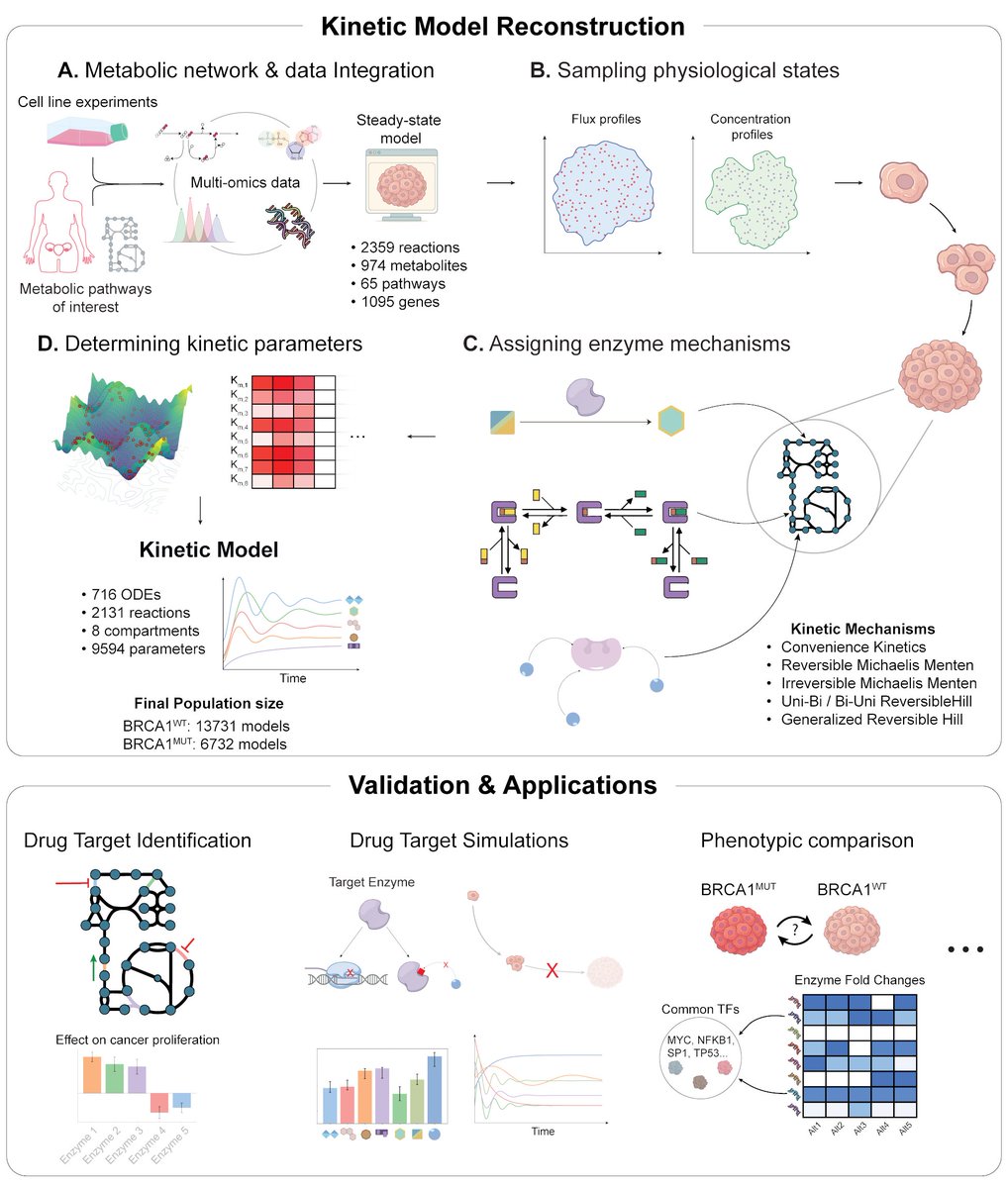
🚀 New preprint from @epfl_en’s Laboratory of Computational Systems Biotechnology (LCSB)!
We present “Multi-omics–driven kinetic modeling reveals metabolic vulnerabilities and differential drug-response dynamics in ovarian cancer.”
🔗 https://t.co/EaqYTn8bRq
By integrating multi-omics data with enzyme kinetics, we generated a population of near–genome-scale kinetic models that capture BRCA1-mutant vs wild-type ovarian cancer physiology.
These models reveal network-wide control principles & drug-response dynamics.
Our review made the cover in ACS Synthetic Biology! 🎉🧬
We explore how large-scale kinetic models are shaping the future of metabolic engineering — check it out here 👉 https://t.co/GsO6bv8JTF
Big thanks to the team and @ACSPublications! #MyACSCover#SyntheticBiology
Excited to share our new preprint, where we present NIS, a framework that distills GEMs into interpretable modules, enabling direct cross-species comparisons of fueling pathways, biosynthesis, and environmental exchanges.
Congratulations to the authors!
Our latest work on Salmonella metabolism in the murine gut is now at @PLOSCompBiol ! Congratulations to the authors @EVayena, @FuchsiLea, @HomaMP4, Konrad Lagoda, Bidong Nguyen, Wolf D. Hardt, and @vassily_13!
https://t.co/KmXzKr7IQR
This work showcases one of the few successful integrations of kinetic modeling and experiments to optimize cell factories. It highlights the power of NOMAD (https://t.co/2zbJiEMFWi) in accelerating and improving strain design!
Excited to share our preprint on boosting p-coumaric acid production in S. cerevisiae! 🎉 In collaboration with Irina Borodina's group (@Irina__Borodina), we used our NOMAD framework for strain design strategies. Read more: https://t.co/OhIDbT4kGN
Want to efficiently create large-scale dynamic models of metabolism that fit experimental data and reliably predict metabolic responses to various perturbations? Our new method does just that! Check it out here: https://t.co/d757bhiFC8.
Happy to share a preprint of our new work in which we combined graph-search algorithms and constraint-based optimization to find the best retrobiosynthesis pathways for producing valuable compounds in a host https://t.co/0WeuqBROO7
Our new paper describes how computational models can capture the #plasmid metabolic burden and help optimize #recombinant expression of proteins
https://t.co/WdQLijNNbe
Our recent publication in @NatureComms, “Rational strain design with minimal phenotype perturbation” by Narayanan et al., has been showcased in the recent Editors’ Highlights for Biotechnology and Methods focus (https://t.co/YLmSKMX85k).
A preprint of our recent work is now available! In this paper we present a framework to infer nutrient competition and cross-feeding in microbial communities. Many thanks for the support we received from @NCCRMicrobiomes.
https://t.co/D1GYdTWMSd
Our latest work on metabolic engineering using kinetic models and process systems engineering methods is out https://t.co/7bQJrrm1oH! Congrats to Bharath (@bharathnarayana), Daniel (@realDRWeilandt
), Maria, Misko (@Misko_L34), and @Vassily_13
.
Our latest work on metabolic engineering using kinetic models and process systems engineering methods is out https://t.co/7bQJrrm1oH! Congrats to Bharath (@bharathnarayana), Daniel (@realDRWeilandt
), Maria, Misko (@Misko_L34), and @Vassily_13
.
Excited to announce that our latest work in now online ! This time the team significantly expanded on their previous tool, BridgIT, an enzyme annotation for orphan and novel reactions, to bring you the new and improved BridgIT+ ! Read the thread below to find out more :)