One thing I do in my spare time as a founder and developer is connect with other developers.
I’m constantly trying to build a community of people who can come together, create impact, and build initiatives that actually solve problems. That’s one of the reasons I’m affiliated with BenueTech Foundation.
But something I’ve been learning is that I see life differently.
I tend to measure things through the lens of impact. I ask: What are we building? Who are we helping? What difference will this make?
And honestly, that has become one of the challenges of building a startup.
Not everyone measures value the same way.
You might be thinking about impact, innovation, and the long-term vision, while someone working with you is thinking about their salary, their bills, their family, and what they can take home at the end of the month.
And the truth is, both perspectives are valid.
At some point, you realize that impact alone doesn’t pay the bills. You also have bills to pay.
So I’m learning to slow down sometimes.
To reflect on what I’m building, why I’m building it, and how I can create something that delivers both impact and sustainable value.
I’m still learning. Still growing. Still iterating.
And maybe that’s what life really is—a continuous process of understanding, building, failing, reflecting, and becoming better.
Hi, my name is Adeke Msonter Samuel.
If you have my contact and you haven’t followed me yet, you should.
Follow me on LinkedIn and X. The links are below.
Let’s connect, build, and create impact together.
We will be sending the laptop form to AltSchool students who received the NYSC scholarship today.
School is resuming, so the first batch of laptop beneficiaries should start receiving support soon. If you're an AltSchool student who falls into this category, you should get an email from me today.
cc @SamuelOtigba@Tunde_OD@AltSchoolAfrica
I’ve noticed a new wave of sign-ups on our digital marketplace, @cityhackz, and honestly, I just want to say THANK YOU.🤍
haven’t been pushing marketing heavily recently, so seeing more people discovering the platform, signing up, and putting in the effort to explore what we’re building for the market means a lot to me.
It’s a small but powerful testament that the work is beginning to speak for itself and without doing so much people find the value they want to.
To everyone who has signed up, shared the platform, explored the marketplace, or simply supported what we’re building we appreciate you.
Thank you for believing in the vision.
We’re just getting started. 🚀
🤍Adeke,
Founder, @cityhackz
I recently had a conversation with a friend about the future of commerce and trade in Nigeria.
They made a strong argument: if Nigeria wants to truly succeed as a nation, industrialization has to be at the center of it.
It got me thinking.
For decades, we have built an economy that consumes a lot but still depends heavily on importing what we consume. But there is a different path: produce more of what we consume, process what we produce, and eventually export the value we create.
I recently watched an interview with Dr. Akinwumi Adesina, a former Nigerian minister of Agriculture, where he spoke about Alhaji Dangote changing his model to invest about $1 billion into production.
From importer to Producer
Today, Dangote is investing billions more into agriculture.
And what struck me was his reflection that, if he had to start all over again with everything he knows today, he would have started with agriculture not cement.
That says a lot.
Agriculture isn’t just about farming. It is about processing, manufacturing, logistics, technology, distribution, employment and ultimately industrialization.
This is also one of the reasons I keep encouraging people to read the IMSR.
The IMSR doesn’t directly present itself as an industrialization manifesto. But when you look at the scale of Nigeria’s commerce, the millions of businesses participating in it, what people are buying, where they are buying it, and how fragmented the supply chain remains, you begin to see something much bigger:
Nigeria has an enormous market waiting to be supplied by Nigerian production.
The opportunity is not simply to make it easier to sell imported products.
The bigger opportunity is to build the infrastructure that helps us understand demand, organize markets, connect producers to consumers, and make local production economically viable at scale.
Because ultimately, commerce should not only answer:
“How do we sell more?”
It should also answer:
“What should we be producing more of?”
That, to me, is where the future of Nigerian commerce gets really interesting.
We don’t just need to become better consumers.
We need to become better producers.
And perhaps the next generation of African commerce infrastructure should be built with that future in mind.
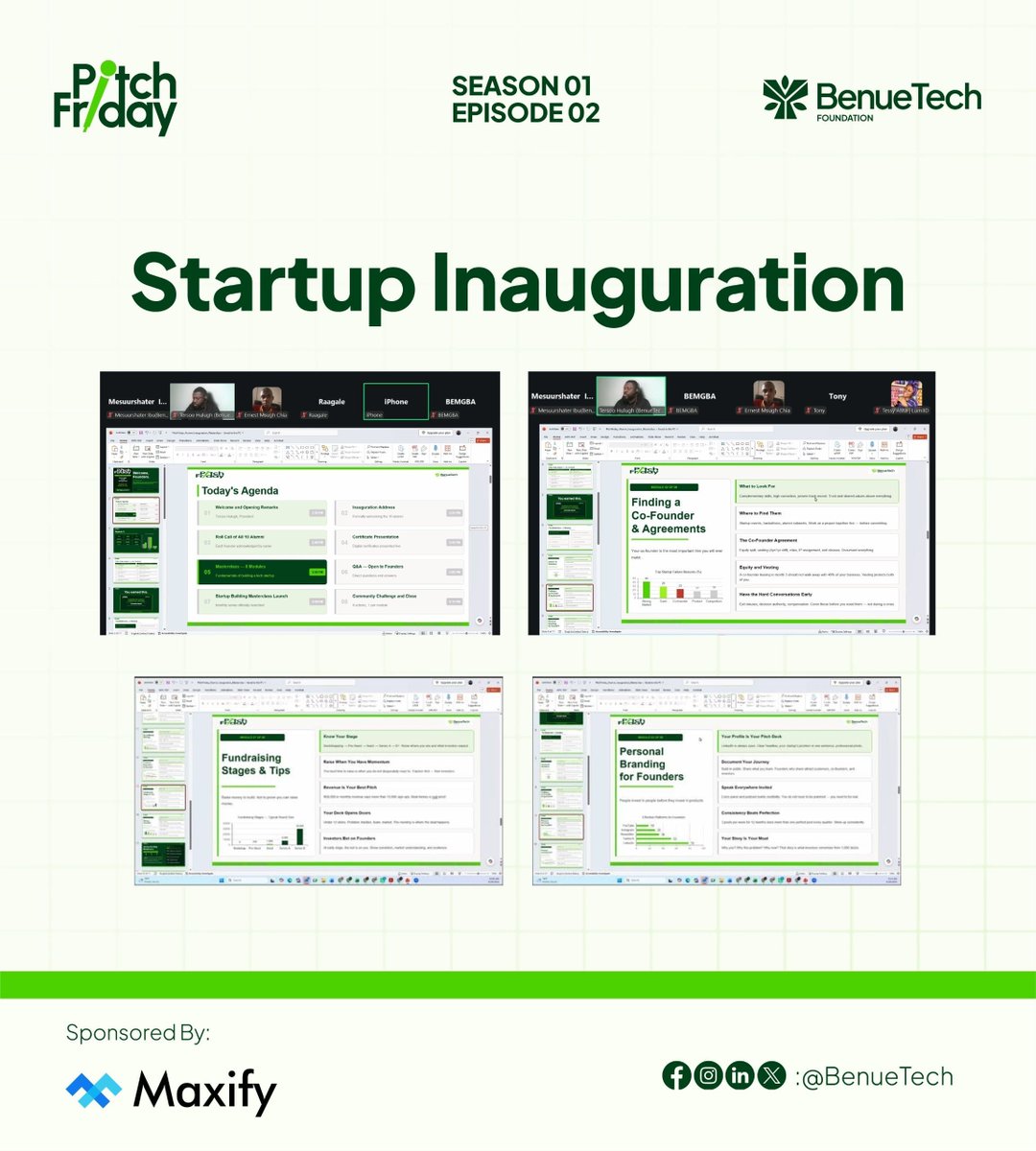
RECAP: Pitch Friday Alumni Inauguration
8 Modules. 1 Goal: Help founders build better.
We covered:
Branding, Co-Founders, Product, GTM, Customers, Fundraising & more
Big congrats to our Season 1 Alumni and award presentation
#PitchFriday#BenueTechFoundation
Hey Sep,
We already have Vendoor + IMSR installed for you. And honestly, this is only a fraction of what we can do for Nigeria’s informal markets.
The coming months? We’re bringing the energy, the market, the vibe and everything in between.
We can’t wait to show you what’s next
Omo, the struggle. 😭
Just this single year alone, I’ve worked on Windows, Mac, and Ubuntu not by choice o, but by the uncertainties of life. 😂
And somehow, I still never “make am.”
But looking back, the journey has been something else. Narrow, rough, unpredictable… but still worth walking.
Maybe next year, I’ll finally take that TEDx stage. Maybe I’ll stand somewhere and tell the story properly not because I’ve figured everything out, but because I know there’s someone younger who needs to hear that the struggle is part of the story too.
Sometimes, we’re so busy trying to make it that we forget to tell people what it took to get here.
Maybe it’s time we start sharing the journey the failures, the uncertainty, the tiny wins, the days we almost gave up.
If one younger person hears it and smiles, thinks “if this guy can keep going, maybe I can too,” then the story is worth telling.
I done give you all I have . We go still dey go.
🤍
I thoroughly enjoyed listening to Fr. George’s analysis of the Nigerian problem. He articulated, with remarkable clarity and insight, many of the fundamental issues at the heart of our national predicament.
In his words:
“If the government wants to reduce poverty, they need to fix insecurity. Nigerians are not asking for palliatives; it is an insult.”
“Nigerians are hard-working and creative people; they can take care of themselves. All they need is to provide security and ensure utilities are not beyond their reach.”
Video Credit: @ARISEtv
Cityhackz creates a digital layer over fragmented informal commerce; it digitizes the physical market itself. Customers can virtually explore real markets, compare prices across vendors, access detailed product information, identify trusted sellers, shop, and request errands.