Reading Again: Shufflebrain: The Quest for the Hologramic Mind (1981) by Paul Pietsch arguing for a holographic (“hologramic”) theory of memory and mind.
I got this from the Texas Medical Center Library when they removed it from display in the 1980s.
Pietsch, an anatomist at Indiana University School of Medicine, builds on Karl Pribram’s holographic model of brain processes and Karl Lashley’s earlier work on equipotentiality (the idea that memory is not strictly localized).
He proposes that the brain does not store information in specific, fixed neural structures or “engrams.” Instead, it encodes memories and mental content as distributed wave-phase relationships—spectra of harmonic phase information—much like an optical hologram.
In a hologram, any sufficiently large fragment of the plate still contains the information needed to reconstruct the whole image (with some loss of resolution). Pietsch argues the brain works analogously: information is spread throughout, so radical disruption of local anatomy does not erase it.
The book’s centerpiece is Pietsch’s own “shufflebrain” experiments on larval salamanders (species such as Ambystoma).
These animals are highly regenerative and tolerate extreme surgery.
He surgically rotated, reversed, interchanged, or transplanted major brain divisions (cerebrum, diencephalon/forebrain regions, etc.), sometimes moving tissue between animals.
Learned behaviors—such as conditioned responses to visual stimuli or anticipatory feeding reactions—often survived these radical rearrangements intact.
He also performed eye transplants that produced functional multi-eyed or cyclopean forms.
These results, he contended, are hard to reconcile with strictly localized storage and support a distributed, wave-based code.
The book mixes:
• Accessible explanations of holography, Fourier analysis, and wave interference
• Accounts of the salamander experiments and related work on regeneration
• Reflections on the mind-brain problem
• Personal narrative of how the research forced him to abandon earlier structural assumptions
It is a great read in the AI age and neuro implant age.
It shows we just don’t know what we don’t know. But Shufflebrain is a light on the path.
Last copy here: https://t.co/hiuzJLrk2k
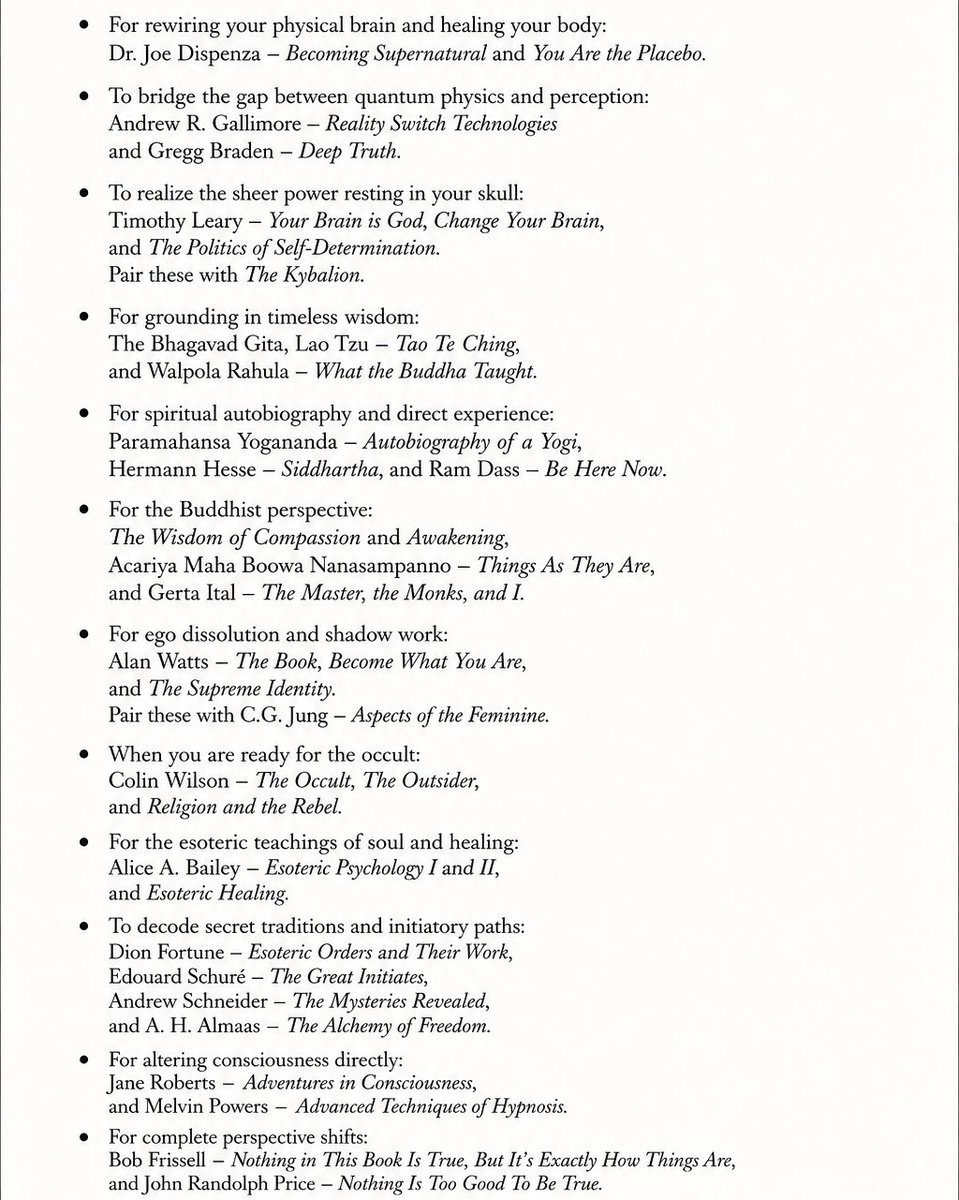
I have spent years building a heavy esoteric library. These texts will completely dismantle your old belief systems. And you do not need to rush through them.
for rewiring your physical brain and healing your body, Dr. Joe Dispenza is mandatory. Read Becoming Supernatural and You Are the Placebo.
Then you have to bridge the gap between quantum physics and perception. Reality Switch Technologies by Andrew R. Gallimore and Gregg Braden’s Deep Truth do this perfectly.
If you want to realize the sheer power resting in your skull, look into Timothy Leary. Your Brain is God, Change Your Brain, and The Politics of Self-Determination are essential. I highly recommend pairing these with The Kybalion to master universal laws.
Do not just read modern pop psychology for grounding. Go to the roots. The Bhagavad Gita, Lao Tzu’s Tao Te Ching, and Walpola Rahula’s What the Buddha Taught.
Paramahansa Yogananda’s Autobiography of a Yogi is famous for a reason. Add Siddhartha by Hermann Hesse and Ram Dass’ Be Here Now to that shelf.
For a deep dive into the Buddhist perspective, pick up The Wisdom of Compassion and Awakening, alongside Things As They Are by Acariya Maha Boowa Nanasampanno. Gerta Ital’s The Master, the Monks, and I is also a beautiful journey.
For ego dissolution and shadow work, Alan Watts is your guide. The Book, Become What You Are, and The Supreme Identity will shatter your illusions. Pair that with C.G. Jung’s Aspects of the Feminine to balance your internal psychological states.
When you are ready for the occult. Colin Wilson’s work is foundational. Read The Occult, The Outsider, and Religion and the Rebel.
Alice A. Bailey is dense but necessary. Esoteric Psychology I and II, alongside Esoteric Healing, explain the true nature of disease and the soul.
Dion Fortune’s Esoteric Orders and Their Work and Edouard Schuré’s The Great Initiates decode secret traditions beautifully. Follow those up with Andrew Schneider’s The Mysteries Revealed and A. H. Almaas’ The Alchemy of Freedom.
For altering consciousness directly, explore Jane Roberts’ Adventures in Consciousness and Melvin Powers’ Advanced Techniques of Hypnosis.
And for complete perspective shifts, read Bob Frissell’s Nothing in This Book Is True, But It's Exactly How Things Are. Then balance it with John Randolph Price’s Nothing Is Too Good To Be True.
Read slowly..
knowledge is only a rumor until it lives in your bones.
If your face is puffy, it's cortisol.
If your belly won't shift, it's cortisol.
If you're wired but tired, it's cortisol.
Here's how to fix all three at once:
1. No food 3 hours before bed.
And now the political angle of the operation.
HOW TO:
Get a single FOREIGN company to “test” “security” of the companies whose CEOs are listed below.
Use that “test” to demand US AI to pause. Because of this one single company’s lack of security.
This is what it looks like:
Bernie Sanders just sent a letter to Sam Altman, Dario Amodei, and Mark Zuckerberg demanding they immediately pause all AI development.
He cites recent cases of models creating new viruses, hacking systems, and escaping control, (see how one company mentioned below made this “happen”) claims the companies have already hit the “critical risk threshold” they once pledged to stop at, and warns the Senate will force the issue if they refuse.
FORCE.
A unilateral U.S. pause while China keeps sprinting full speed would hand Beijing a decisive, lasting lead in the most important technology of the century.
That’s not safety.
That’s US disarmament.
All nicely packaged for you to understand.
What will you do with this information?