Senator or Errand Boy? The Shameful Conduct of Onyekachi Nwebonyi
It is disheartening to witness Senator Onyekachi Nwebonyi prioritizing servitude over service, acting as an errand boy for Senator Akpabio instead of focusing on his legislative responsibilities.
An Igbo chief asked his Hausa security guard to bring his family from the north to live with him in the East. He gave them a bungalow in his compound with every amenities in it for free. He didn't stop there, he went ahead to train the 3 children of his security guard from primary to university level.
After listening to this interview, i can authoritatively say that the Igbos don't hold grudges over any tribe, region or religion. It's just that some regions and individuals refused to heal and move on, 56 years after the civil war.
For those who routinely under-estimate #Nigeria's abductions industry & the reach of the complicities implicated in its durability, this chilling testimony by @baba_hakeem should provide some clarity.
LET THAT SINK: Watching so many Africans rally behind a country outside the continent against a fellow African nation is revealing...
South Africa should pray it never faces an economic siege, diplomatic isolation, or existential crisis that requires Pan-African solidarity.
The continent has a long memory. When difficult times come, nations often discover that the allies they mocked yesterday are the ones they need most tomorrow.
Lessons.
BIG CHANGE:
YOU CAN NOW OFFICIALLY
GENERATE ELECTRICITY FOR YOURSELF, USE WHAT YOU NEED, AND SELL EXCESS ELECTRICITY BACK TO THE GRID THROUGH YOUR DISCO
The Nigerian Electricity Regulatory Commission (NERC) has commenced the Net Billing Regulations 2026, a new framework that allows eligible electricity users to generate power mainly through solar energy for their own use and export excess electricity back to the distribution network.
In simple terms, if your solar system generates more electricity than you consume, you can now send the extra power back to your DisCo and receive credits under a regulated billing arrangement.
This effectively creates what the sector calls a “Prosumer” ;meaning you are both a consumer and producer of electricity.
However, there are conditions.
This is not yet targeted at the average small residential solar setup.
To qualify:
-You must already be connected to a DisCo network.
-Your renewable energy system must have a minimum installed capacity of 50kWp and a maximum of 1.5MWp
-You must obtain approval from your DisCo.
-You must sign a Net Billing Agreement and register with NERC.
Approved users will receive bidirectional meters that track: ➡️Electricity imported from the grid
⬅️Electricity exported back to the grid
@UNOFFICIALFACT@NigeriaNDCHQ What's happening in Imo NDC is a child's play compared to the crisis that bedevilled Enugu NDC. They played into the hands of the moneybags
@Nedumcity_@PeterObi@Nedumcity_ I was on the ground & had people across the 17 LGAs voting centres. Obviously, there are no primary elections today in Enugu State. People came in droves across LGAs as early as 8am but electoral officers were not seen anywhere near the centres till 6pm this evening
Enugu NDC aspirants venting their anger to the hijacker’s of the party and it’s planned primaries by money bags from APC. Enugu is not looking good at the moment.
NDC NAMES FORMER EBONYI GOVERNOR, SAM EGWU, BUBA GALADIMA, OTHERS ON SCREENING PANEL
The Nigeria Democratic Congress (NDC) has constituted a 17-member national screening committee to vet aspirants seeking tickets for presidential, governorship, senatorial, and House of Representatives positions ahead of the 2027 general elections.
The committee is chaired by former Governor of Ebonyi State and ex-Senator, Sam Egwu, while the party’s National Legal Adviser, Barr. Reuben Egwuaba, will serve as secretary.
The announcement was contained in a statement issued on Tuesday by the NDC National Secretary, Barr. Ikenna Morgan Enekweizu, who said the committee would be formally inaugurated at 4:00pm on Tuesday, May 19, 2026.
According to the statement, the committee is a blend of party leaders, professionals, and members of the National Working Committee, carefully selected to ensure credibility and transparency in the screening process.
Other members include Comrade Babatunde Ali (Deputy Chairman), Alhaji Buba Galadima, Hon. Mohammed Sani Takori, Mr. Daniel Onifade, Mr. Ikeddy Isiguzo, Mr. Wole Adedayo, Dr. Osusu Osusu, Chief Asukewe Ikoawaji, and Prof. Udenta Udenta.
Others are Barr. Frederick E. Owotorufa, Hannatu Tanko, Mr. Dogo Shammar, Sir Henry Obaze, Mr. Clement Agiagie, and Barr. Fatima Musa Abba.
The party stated that the committee would oversee screening of all aspirants across elective positions to ensure compliance with party guidelines and eligibility requirements ahead of the primaries.
“The Nigeria Democratic Congress, NDC, has announced a 17-member Screening Committee for its Presidential, Governorship, Senatorial and House of Representatives aspirants,” the statement read.
It added that the composition of the committee reflects the party’s commitment to internal democracy and credible candidate selection processes.
Political observers say the move signals the party’s increasing preparation and organisational structuring ahead of what is expected to be a highly competitive 2027 election cycle
State visits by Leaders are not tourism, and diplomacy is not a fashion parade. Every foreign trip undertaken by a government must deliver measurable benefits to the people, including investments, technology transfer, trade agreements, factory expansion, industrial partnerships, and job creation.
During President Trump’s recent visit to China, the American delegation reportedly included a few top government officials, and many of the biggest figures in global business and technology:
Consequently, huge trade deals worth several billion dollars including about 200 Boeing orders were achieved.
The list of the entourage included
1. Donald J. Trump – President of the United States
2. Marco Rubio – Secretary of State
3. Pete Hegseth – Secretary of Defence
4. Elon Musk – CEO, Tesla & SpaceX
5. Jensen Huang – CEO, Nvidia
6. Tim Cook – CEO, Apple
7. Larry Fink – CEO, BlackRock
8. Stephen Schwarzman – CEO, Blackstone
9. Kelly Ortberg – CEO, Boeing
10. Brian Sikes – CEO, Cargill
11. Jane Fraser – CEO, Citigroup
12. Larry Culp – CEO, General Electric
13. David Solomon – CEO, Goldman Sachs
14. Sanjay Mehrotra – CEO, Micron Technology
15.Cristiano Amon – CEO, Qualcomm
16. Dina P. McCormick – President of Meta
17. Ryan McInerney – CEO, Visa
18. Michael Miebach – President, Mastercard
19. Jim Anderson – CEO, Coherent
20. Jacob Thaysen – CEO, Illumina
That is how serious nations approach diplomacy, by aligning foreign policy with economic expansion, industrial growth, innovation, and national productivity.
I hope that lessons can be learned from these recent visits comparing them with the President of Nigeria’s recent state visit to the United Kingdom.
A large entourage of politicians, aides, and government officials travelled, yet Nigerians are still asking a simple question: what exactly did Nigeria bring home?
Which factories are coming to Nigeria?
What power, technology, manufacturing, agricultural, or industrial agreements were secured?
How many direct jobs will this visit create for Nigerian youths?
What investments were attracted?
What measurable economic outcomes can the ordinary Nigerian point to?
The delegation reportedly included:
1. President Bola Tinubu
2. Senator (Mrs) Tinubu
3.12 governors
4.9 ministers
5.7 members of the National Assembly
6. Over 20 senior State House staff
7. Over 30 security personnel
8. Over 10 domestic staff
9. Several supporters and associates
It is not enough to ride horses, wear matching uniforms, attend royal banquets, and release glossy photographs. Symbolism without substance cannot feed hungry citizens.
Today, Nigeria is in decline, battling serious insecurity, food insecurity, unemployment, a weakened naira, declining industrial productivity, and worsening poverty.
At a time when millions of Nigerians struggle daily to afford food and survive economic hardship, every kobo spent on foreign trips must produce tangible national value: investments, factories, jobs, exports, infrastructure, and economic opportunities.
Nigeria needs leadership that is focused less on optics and more on productivity; less on ceremony and more on measurable economic results.
A New Nigeria is POssible. -PO
IBADAN DECLARATION
Communiqué issued at the end of Opposition Political Parties National Summit held on Saturday April 25, 2026 in Ibadan, Oyo State.
Participating Opposition Parties in Nigeria, after an extensive deliberation on the collective threats that we face and the existential challenges facing our country under the stranglehold of the oppressive and anti-democratic All Progressives Congress (APC) and given the need for urgent, collective action to rescue our nation and the destiny of over 200 million compatriots, hereby resolve as follows:
1. That we shall resist all machinations by the APC to foist a one-party State on Nigeria and fight for the survival of multi-party democracy in our country.
2. That despite the onslaughts and manoeuvrings of the ruling party, the APC to impose President Bola Tinubu as the sole Presidential candidate in 2027; we shall field candidates and contest the 2027 Presidential and other elections.
3. That we shall work towards fielding one Presidential Candidate for the 2027 elections, which shall be agreed and supported by all participating opposition parties to rescue our nation and her long suffering masses.
4. That the INEC Chairman, Prof. Joash Ojo Amupitan, having shown bias and partisanship in favour of the ruling APC, should not conduct the 2027 general elections as Nigerians across board have lost confidence in him and his capacity to guarantee the required neutrality to deliver free, fair, transparent and credible elections. His continuous stay in office is vexatious and capable of triggering wide spread crisis in our nation.
5. That the National Assembly should immediately review the Electoral Act, 2026 to remove all sections that threaten the sanctity and integrity of the elections and run counter to constitutional provisions.
6. That all leading politicians that are being detained or harassed on bailable offfences be released with immediate effect and allowed to exercise their fundamental rights of participation and inclusivity as Nigerians.
7. That we consider the recent guidelines released by the INEC as obstacles, deliberately engineered to impose conditions and deadlines on the opposition parties. We therefore demand that INEC extends the deadline for primaries till the end of July, 2026.
8. The Summit commends Nigerians for their resilience and readiness to work with Opposition Parties to free our nation from State capture.
9. The National summit of Opposition Political Parties thank the Oyo State Governor Engr. Seyi Makinde and the people of Oyo State for hosting the epochal event.
SIGNED:
Chairmen of Participating Opposition Parties.
PRESS STATEMENT FOR IMMEDIATE RELEASE
$516 MILLION LOAN REQUEST: TINUBU’S BORROWING BINGE AND THE MORTGAGING OF NIGERIA’S FUTURE
The African Democratic Congress (ADC) Legislators’ Forum strongly condemns the latest move by President Bola Ahmed Tinubu to secure Senate approval for an additional external loan of $516,333,070, ostensibly for the Sokoto–Badagry Super Highway project. This request is not only alarming but emblematic of an administration that has made reckless borrowing its default economic policy, with little regard for sustainability, accountability, or the wellbeing of future generations.
While no responsible opposition undermines the importance of infrastructure development, we must ask: at what cost, and under what conditions? This government has failed to convincingly demonstrate that its endless appetite for loans is guided by a coherent, transparent, and economically viable repayment strategy. Instead, Nigerians are witnessing a troubling pattern; one where debt accumulation is prioritized over prudent fiscal management, innovation, and domestic resource mobilization.
Nigeria is already weighed down by a crushing debt burden, with debt servicing swallowing a staggering proportion of national revenue. Yet, rather than confronting this reality with discipline and reform, the Tinubu administration continues to plunge the country deeper into what can only be described as a looming debt catastrophe. Each new loan tightens the noose around the nation’s economic sovereignty, leaving future generations to pay for today’s lack of foresight.
Even more disturbing is the timing of this request. As the nation inches closer to a major general election cycle, Nigerians are right to question the motives behind this borrowing spree. Is this truly about development, or is it another attempt to create avenues for political patronage and electoral advantage? History has taught us to be wary of last-minute, large-scale financial commitments made under the guise of national interest.
The ADC Legislators’ Forum insists that the National Assembly must not act as a rubber stamp or Pro group of President Bola Ahmed Tinubu in this matter. The Senate, in particular, must rise to its constitutional responsibility by demanding full disclosure of the project’s financial details, procurement processes, cost-benefit analysis, and a credible repayment plan. Anything short of this would amount to a betrayal of public trust.
Furthermore, we call on the administration to redirect its focus toward policies that can genuinely strengthen Nigeria’s economy; policies that promote productivity, industrial growth, job creation, and the plugging of revenue leakages. Borrowing should never be a substitute for leadership, creativity, and accountability.
We must clearly state that governance is not a free ride without consequences. Those who make decisions today that endanger the economic future of millions of Nigerians must understand that a day of reckoning will inevitably come. The Nigerian people will demand answers, accountability, and justice for policies that have deepened hardship and mortgaged the nation’s destiny.
Nigeria stands at a critical crossroads. We can either choose the path of responsibility, discipline, and sustainable growth, or continue down this perilous road of debt dependency and economic vulnerability. The Tinubu administration must decide where it stands; but Nigerians are watching, and history will not be kind to those who fail this nation.
Signed:
Hon. Uko Ndukwe Nkole Fnitp,PhD
ChairmanADC -National Legislators’ Forum
African Democratic Congress (ADC)
Hon Nnenna Ukeje-SE
Hon Sergius Ogun-SS
Hon Ajagbe H -SW
Hon Zakari Mohammed -NC
Hon Koko Shehu -NW
Hon Maigari Bello M-NE
April 23, 2026
They have found Noah’s Ark!
They have found the real Mt Sinai!
They know where the Ark of the Covenant is!
They have discovered the tomb of Jesus Christ!
They have found the Turin of Jesus!
They have located the Garden of Eden!
They have identified the site of Sodom and Gomorrah!
They have traced the path of the Red Sea crossing!
They have found the well of Jacob!
They have uncovered the palace of King Solomon!
They have located the tomb of King David!
They have identified the birthplace of Abraham!
They have found the prison of Apostle Paul!
They have uncovered the house of Mary Magdalene!
They have traced the steps of Moses!
Yet some people still don’t believe in God. They still think it’s just a story.
INVESTIGATION: Repackaged expired products dominate Nigeria's N34trn food market
Food items meant to be sold in sealed packs are now being scooped from buckets and sacks in many Lagos markets.
A BusinessDay investigation found that some of these products originate from expired, near-expiry, or rejected factory stocks, stripped of their labels and resold cheaply to consumers.
This billion-naira underground trade continues to thrive across Nigerian markets, raising concerns about food safety and public health.
Full report:
https://t.co/10Iou91Dpd
From Pharisee to Tax Collector: Rethinking Tinubu’s Kenyan Comparison
In a recent remark in Yenagoa, Bola Ahmed Tinubu suggested that Nigerians should find solace in being “better off than Kenya and other African countries.” While this may have been intended to soften the impact of economic hardship and rising fuel prices, the comment risks downplaying the severity of the current crisis. It echoes the biblical parable of the Pharisee and the Tax Collector in the Gospel of Luke (18:9–14). A similar warning is found in the Qur’an (53:32), which cautions against self-righteousness.
Like the Pharisee who boasted of his superiority over others to mask his own spiritual void, such downward comparisons serve more as a refuge than a remedy. This validated an earlier dismissive remark by President Ahmed Bola Tinubu during electioneering: “Na statistics we go shop?” Yet statistics remain indispensable - they are the language through which nations understand their condition and chart progress. No country can develop in isolation from measurable realities or without comparing itself with peers. Comparisons, when properly grounded, are not instruments of escapism but tools of accountability. What is objectionable is not comparison itself, but comparison stripped of credible, verifiable data—mere tax collector comparisons that soothe rather than solve.
On key development indicators such as security, the Human Development Index, life expectancy, GDP per capita, literacy levels, and electricity access, Kenya consistently outperforms Nigeria. Nigeria is the fourth most terrorised nation in the world, while Kenya is not among the ten worst. Kenya’s HDI ranking is 143 out of 180 countries, with a coefficient of about 0.630, compared to Nigeria’s ranking of 164 out of 180, with a coefficient of about 0.530. Its GDP per capita is roughly $2,200–$2,300, compared to Nigeria’s $807–$835. Kenya’s poverty rate is about 43% of the population (approximately 23 million people), while Nigeria’s is about 63% (around 150 million people), over six times that of Kenya. Kenya’s life expectancy is about 67 years, while Nigeria’s is about 54 years. The literacy rate in Kenya is approximately 81–85%, compared to Nigeria’s 62–65%.
Kenya’s electricity access is higher, while Nigeria has one of the lowest levels of electricity access in the world. Kenya has about 3.5 million out-of-school children, while Nigeria has about 20 million. Kenya’s inflation rate has been about 4.5% or lower over the past three years, while Nigeria’s has remained above 15% within the same period. Kenya’s exchange rate has been around USD 1 to KES 130 over the past three years, whereas Nigeria’s exchange rate rose from below ₦500/$1 to above ₦1,250/$1 within the same period. Even with developments in the Middle East and rising oil prices, Kenyans have not experienced the sharp increases in petroleum product prices seen in Nigeria.
Across other key indicators, Kenya also performs better. In the end, these indices clearly show that Kenya ranks higher than Nigeria on several development metrics. The standard of living of Kenyans is better than that of Nigerians. If the President considers Kenyans to be suffering despite these stronger figures, then Nigerians are in a far more difficult situation. He should therefore refrain from self-consolation and, in honest reflection, take responsibility for the situation and make a determined effort to drive improvement. This requires a posture of humility, accountability, and commitment to addressing the factors that have slowed Nigeria’s development.
A new Nigeria is POssible. -PO
Join us on #PrimeTime today at 8:00pm for an exclusive conversation with Peter Obi, Former Presidential Candidate / Former Governor, Anambra State
Click the link below to join the LIVESTREAM: https://t.co/fcrdrW4lz6
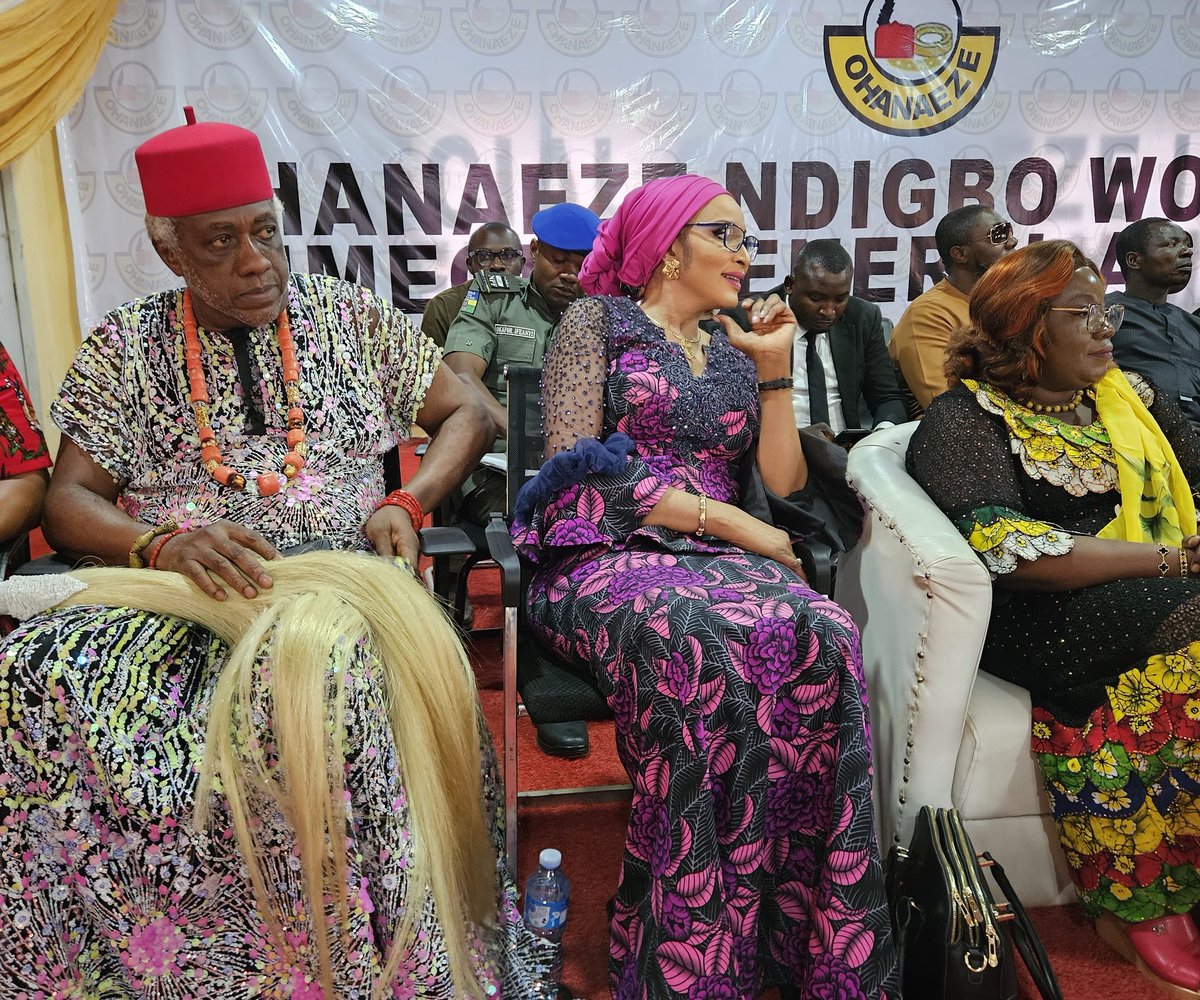
OHANEZE NDIGBO WORLDWIDE BANS CORONATION OF "EZE NDIGBO" (Igbo kings) IN FOREIGN COUNTRIES.
It was a critical session as I presented a brief at 'Imeobi Ohaneze' ( the apex decision-making body of Ohaneze) regarding the worrisome practice of coronation of Igbo 'kings' overseas, a practice which has continued to trigger conflict, raising diplomatic tensions and sparking violence in the countries concerned.
We were faced with this situation in Ghana not too long ago, and it took high level diplomatic interventions to reverse the quit notice and douse tensions.
Now, another controversy of this nature recently escalated in Eastern Cape, South Africa, following the coronation of another " Eze Ndigbo na East London", an event which had provoked outrage among local residents and authorities. The situation degenerated into violent protests, burning and looting, and destruction of at least 13 vehicles, as demonstrators opposed what they considered a challenge to local traditional authority structures.
There is no disputing the fact that diaspora Igbo communities have the right to promote their cultural heritage, but this has to take into consideration the sensibilities of host communities.
Assumption of traditional rulership roles in foreign lands is more often than not, viewed as an affront by host populations and the excessive display of wealth by Nigerians, the opulence and flamboyance that accompany such events in countries where the average citizen is struggling to survive is downright insensitive. Leaders of Igbo Communities in countries abroad may be called 'Onyendu' which means leader and certainly more acceptable than crowning themselves Kings or Ezes in another's domain.
Kudos to Ohaneze for weighing in more decisively on this matter with an outright ban on such titles outside Nigeria and the potential introduction of sanctions . A few individuals cannot continue to expose others to risk of losing lives and property in pursuit of vainglory.
The Ministry of Foreign Affairs is activating diplomatic channels to manage this situation, and will circulate this injunction through our missions to host governments abroad.