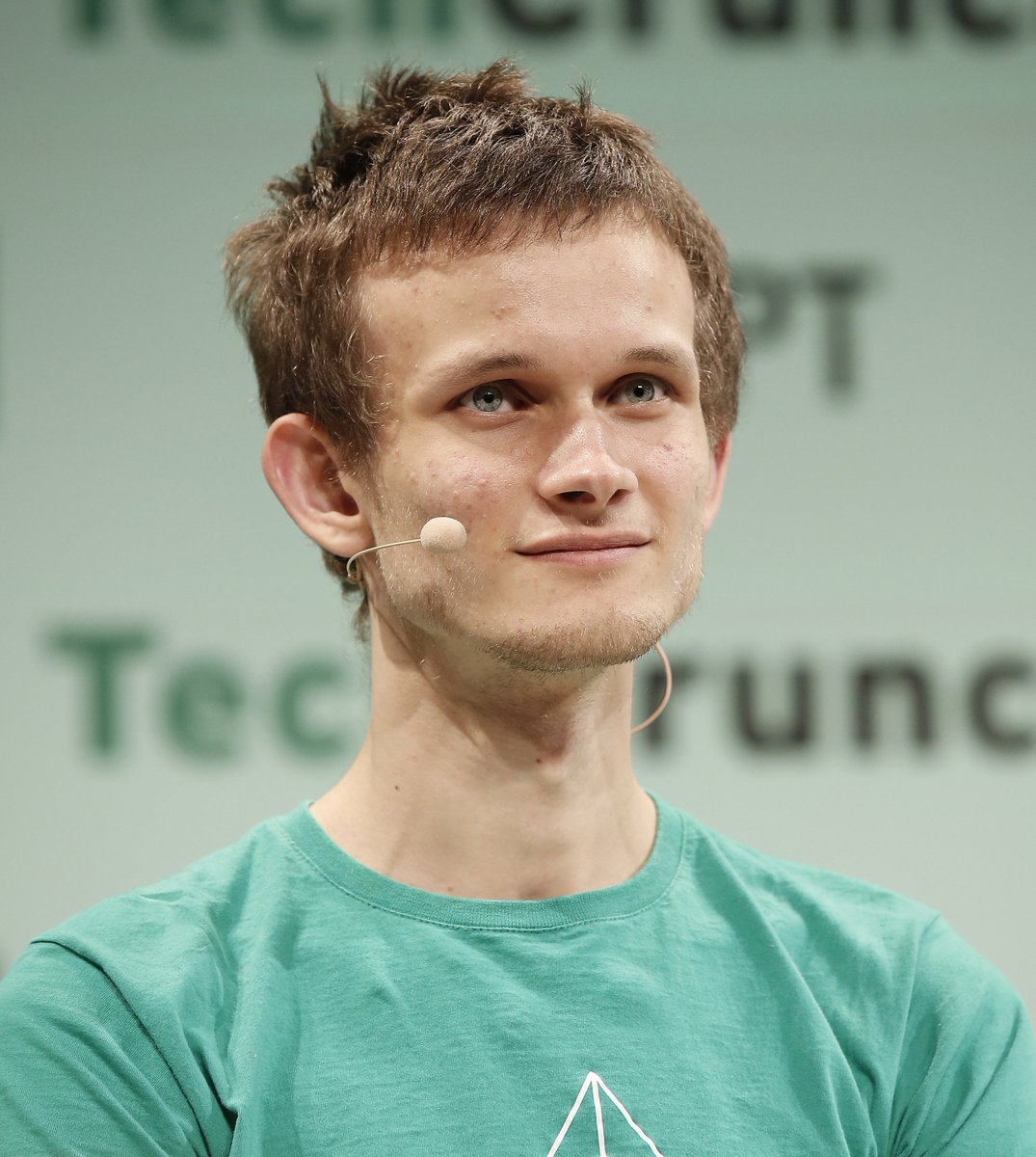
We will be recording a podcast with @gluk64, the Co-Founder & CEO of Matter Labs, next week! 🎙
This is going to be a juicy one. 👀
Got questions for Alex? Drop them below and we'll bring them to him.👇
Kindly disagree. As the industry matures and expands to the TradFi and enterprise world, winning L2s that manage to achieve strong network effects will 1) generate a lot of value, and 2) figure out how to channel it back into sustainable token economics.
But today, all efforts must go into winning.
Beautifully crafted piece on "Why Ethereum?" Very powerful. Some quotes:
“The original vision of consortium blockchains – the idea that you have 5 banks or major companies that come together and create their own chain – has been mostly a failure,” Vitalik Buterin explains . “It ends up inheriting most of the disadvantages of centralization and most of the disadvantages of decentralization at the same time.” The problem, as he describes it, is that the first few banks feel like equal founders, but bank number twenty is just joining something its competitors already control. You take on all the engineering cost of a distributed system and get none of the benefits of openness, composability, and credible neutrality that made blockchains worthwhile in the first place.
The single-most important blockchain property is sovereignty (Note: Another way to express "sovereignty" is: credible neutrality + censorship resistance + privacy + security). What made Bitcoin revolutionary was that it was the world’s first sovereign computer platform. Before Bitcoin, all computer platforms belonged to a person, a company, or a government, and they had to obey the will of their owners and the rules of the jurisdiction where they resided. But a sovereign only obeys its own rules, and no single entity could impose rules on Bitcoin. (Note: On Ethereum, builders and users also have far more personal sovereignty than possible on any other large public platform in the world.)
Much of Ethereum’s lead in sovereignty and credible neutrality comes from path dependence that no other blockchain can replicate. Ethereum launched with proof-of-work in 2015 and ran on it for seven years before transitioning to proof-of-stake in 2022. During that period, ownership of the network was distributed through an open 2014 crowdsale and GPU mining that was deliberately kept accessible to consumer hardware. The result was widespread token distribution with no single entity controlling a meaningful fraction of the network (an essential factor in the sovereignty of a proof-of-stake network).
According to Token Terminal’s Ethereum Q1 2026 Report, Ethereum holds 79% of active DeFi loans across the top five chains, 62% of stablecoins, 73% of tokenized funds, and 84% of tokenized commodities.
Erik Voorhees, the founder of https://t.co/q4WHRFuPw2 (the privacy-first AI inference platform with 3+ million users and tens of millions of dollars in ARR), articulated a similar rationale a few days ago "It wasn't even a question for us," Erik replies when asked why he built Venice on Coinbase's Ethereum L2 Base, "The Ethereum ecosystem is the far more authentic, resilient, and robust ecosystem of all smart contract platforms."
A $500B blockchain exists because a 15-year-old got upset over a World of Warcraft update.
Back in 2010, Blizzard nerfed Vitalik Buterin's favorite Warlock spell.
In his own words:
"I cried myself to sleep, and on that day I realized what horrors centralized services can bring."
He quit the game.
A year later, his father introduced him to Bitcoin.
He couldn't afford to buy any and couldn't mine it either.
So he started writing for a crypto blog that paid 5 BTC per article, worth roughly $3.50 at the time.
Today, those same 5 BTC would be worth over $500,000.
At 17, he co-founded Bitcoin Magazine.
He later applied for a job at Ripple.
They wanted him, but couldn't sponsor his visa.
At 19, he proposed major upgrades to Bitcoin.
The community rejected them.
So he decided to build something new.
He wrote a whitepaper and called it Ethereum.
Within weeks, around 30 developers had reached out to help.
He dropped out of college, received a $100,000 Thiel Fellowship, and launched Ethereum's ICO at $0.31 per ETH, raising $18 million.
One participant bought 1 million ETH for $310,000.
At peak, that position was worth roughly $4.3 billion.
Another spent just $263 for 850 ETH.
Those coins are now worth well over $1.7 million.
Ethereum launched when Vitalik was only 21.
Peak market cap: over $500 billion.
All because Blizzard nerfed a Warlock spell.
It actually happened.
ZKsync was just mentioned as part of the future Bank Stack on the official S&P 500 website.
Is this an official victory for the ZKsync team in terms of mainstream recognition?
Am I dreaming?