$NBIS — My Nebius thesis: 6 GW by 2030, improving monetization and disciplined capital allocation.
Capacity
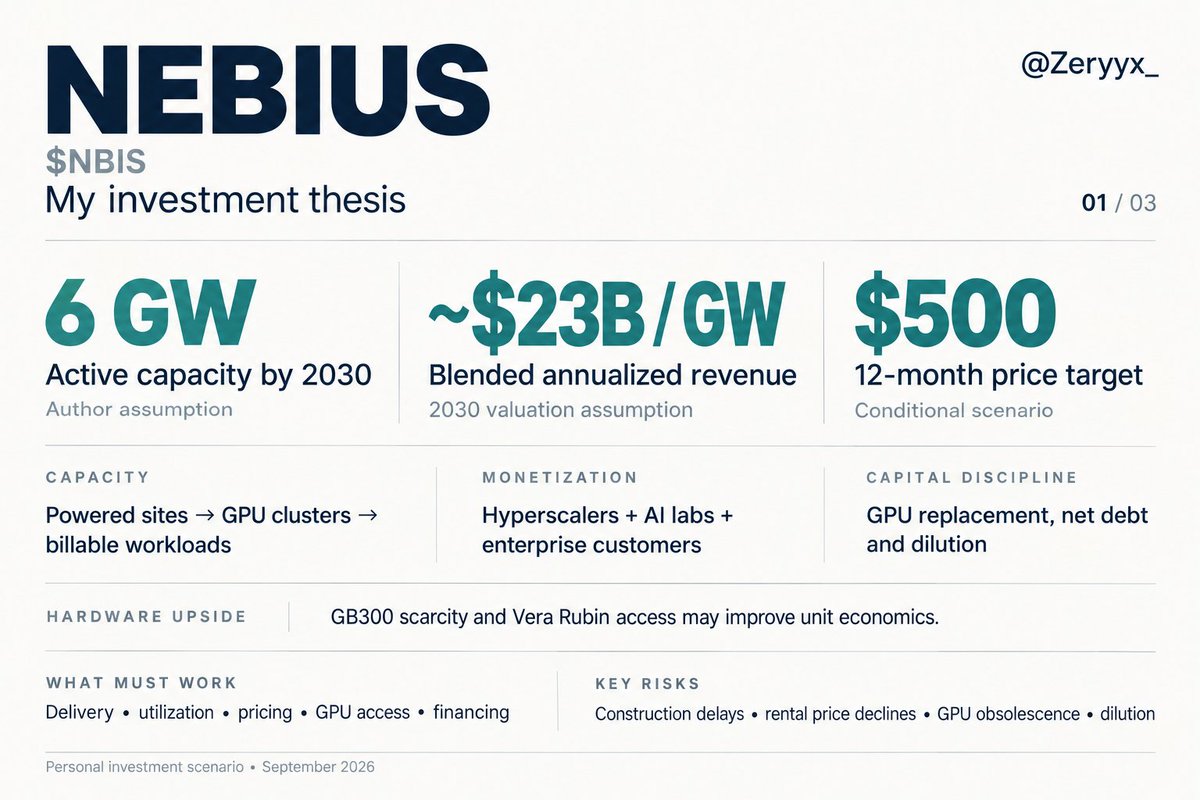
My starting assumption is 6 GW by 2030.
I’m underwriting 6 GW of active, revenue-generating capacity by 2030. Management has outlined plans to deploy more than 1 GW annually starting in 2027. My scenario requires strong execution throughout that expansion.
The milestones I care about are powered sites, installed GPU clusters, customer acceptance and billable workloads. Each completed step brings Nebius closer to converting its capacity pipeline into cash.
Management forecasts 5 GW active in 2030, I am slightly higher in my assumption.
Customer mix.
Hyperscalers provide a foundation, while AI Cloud expands the opportunity.
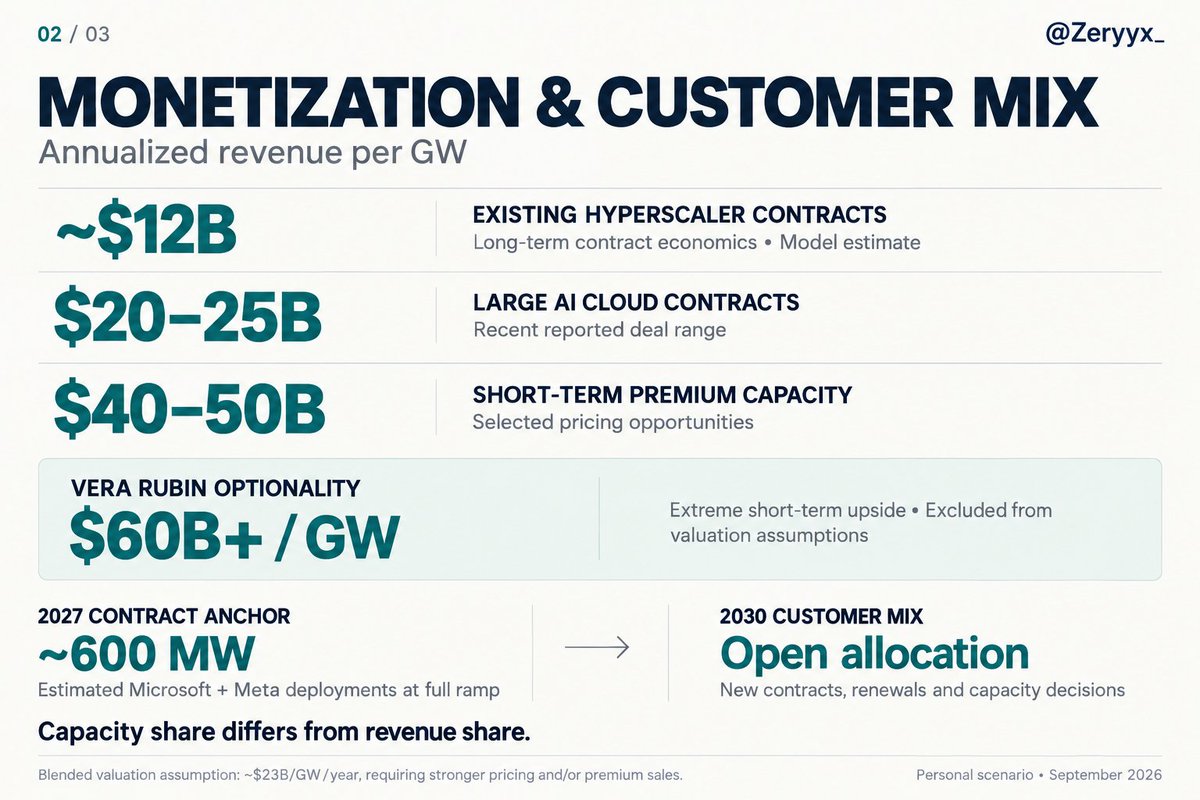
The existing Microsoft and Meta deployments are estimated to occupy approximately 600 MW once ramped in 2027. That gives us an initial capacity block; the 2030 allocation will depend on contracts still to be signed, renewals and management’s decisions.
Hyperscalers could take additional capacity. AI labs and enterprise customers could also become much larger users. The best allocation depends on pricing, contract duration, prepayments, customer credit and returns on capital.
My revenue framework distinguishes three types of business:
• Existing long-term hyperscaler contracts: approximately $12B/GW/year in my model.
• Large AI Cloud contracts: recent deals have reached approximately $20–25B/GW/year.
• Short-term premium capacity: pricing opportunities around $40–50B/GW/year, depending on hardware availability and demand.
These are annualized monetization rates. Capacity shares and revenue shares will differ because each GW can earn a different amount.
Customers such as Reflection and Cohere illustrate the opportunity beyond hyperscalers. Frontier model development, enterprise agents and inference workloads create demand for large, usable clusters and a software platform that helps customers deploy them efficiently.
Hardware scarcity can improve the economics.
Select GB300 deployments show the pricing opportunity around scarce Blackwell Ultra systems. Vera Rubin could create another period of constrained supply as customers compete for access to NVIDIA’s next architecture.
Nebius has received early Rubin systems for integration testing. The next milestones are meaningful delivery volumes, production readiness and paying customer deployments.
Exceptional Rubin pricing could provide substantial upside. I would keep potential $60B/GW annualized short-term monetization outside the core valuation assumptions.
New hardware also requires more investment. The economic test is how quickly each deployment recovers its total cost and how much cash it generates over its useful life.
Financing and GPU replacement determine the shareholder outcome.
Customer prepayments can cover a substantial portion of deployment capex. Financing backed by GPUs and contracted cash flows can help Nebius recycle capital into additional capacity.
That makes long-term contracts valuable even when their revenue per GW is lower.
Faster payback improves capital recovery. Continued operation still requires electricity, maintenance and eventual GPU replacement. Those costs belong in the valuation.
As capacity grows, I want economic value to grow faster than the fully diluted share count. Debt, interest costs and dilution remain central to that calculation.
The risks are clear and measurable.
Construction, permitting, grid connections and cooling readiness can delay revenue even while demand remains strong. Concentration in major sites such as Vineland makes individual delivery milestones especially important.
Rental pricing, customer utilization, GPU obsolescence and financing terms can also change the return on each deployment. I still highly doubt that issues - if there are any - will come from there.
Any delay in data centers readiness can lower my 6 GW assumption for 2030.
What I’m looking for as of now.
• Capacity actually delivered, utilized and billed.
• Realized revenue per GW across contract types and GPU generations.
• Rubin deliveries, production availability and customer commitments.
• Customer concentration, net debt and fully diluted shares.
My valuation framework.
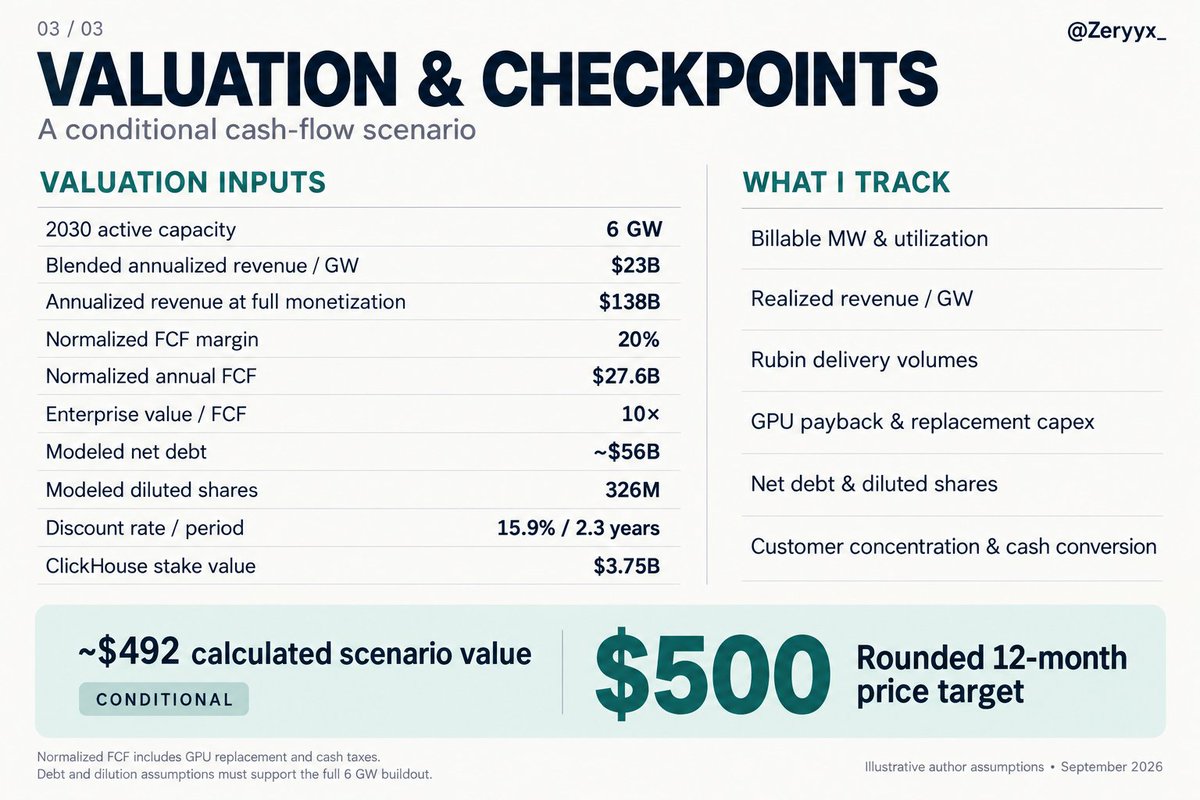
For my 2030 valuation scenario, I assume approximately $23B of blended annualized revenue per GW across the fleet.
At 6 GW, that implies approximately $138B of annualized revenue at full monetization. Reaching that blended rate requires higher AI Cloud monetization, premium capacity sales and/or better pricing on future long-term agreements.
A 20% normalized unlevered FCF margin, after maintenance capex and cash taxes, would produce approximately $28B annually.
Applying 10× that cash flow, subtracting approximately $56B of modeled net debt, using approximately 326 million modeled diluted shares, and discounting the future equity value at roughly 16% supports a value close to $500 under the valuation convention I’m using.
The financing assumptions must support the full 6 GW expansion. Higher borrowing, dilution or replacement costs would reduce the value per share.
My 12-month price target: $500, conditional on capacity delivery, stronger monetization and controlled financing.
If anyone wants to confront his own thesis I'd be clearly glad to discuss it !
NFA - I am long on $NBIS
One of the most exciting and ambitious projects I’ve worked on lately
I led the entire backend architecture and contributed to the frontend for @TryBrickroad a platform tackling the dataset distribution problem in AI, built natively on Irys
If you're into infra, crypto abstraction, or data ownership, check it out
[Updates from last few days]
Lately, I’ve been thinking a lot about how to better organize my days - balancing my apprenticeship, freelance work, working out, and personal time
I feel like I’m not as efficient as I could be, so I’m trying to build better routines (without dunking my head in ice 4x a day)
Here’s a recap of the past couple of weeks 🧵
Pour les flemmards : de mon point de vue, les MCP offrent une modularité bien plus intéressante que ce qu’on voit avec les frameworks d’agents IA, et je pense que ça va devenir un véritable standard
Je pense même que tous les frameworks actuels vont disparaître à terme s’ils ne shift pas vers ce modèle
Là où il y a un vrai rôle à jouer, c’est du côté client, pour offrir une interface aux serveurs
Mais en l’état, il n’y a aucun intérêt à choisir un framework d’agent IA plutôt qu’une architecture MCP
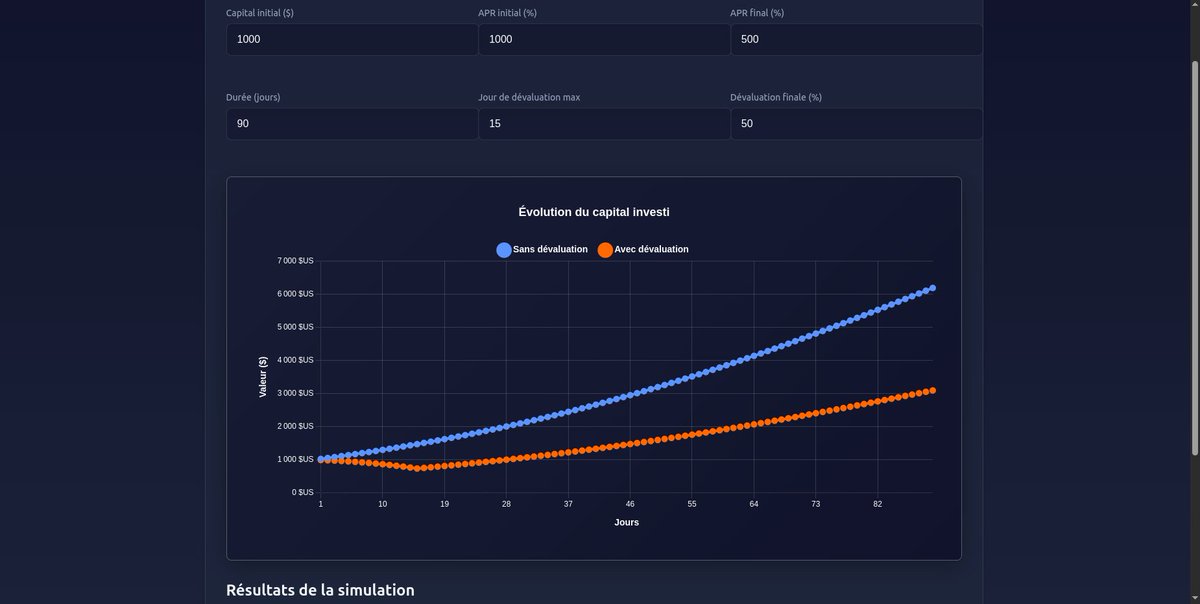
Pour ceux qui veulent j'ai fait un front pour évaluer son risque sur les vaults Berachain
https://t.co/ojnISreWfl
(flemme d'acheter un nom de domaine sry)
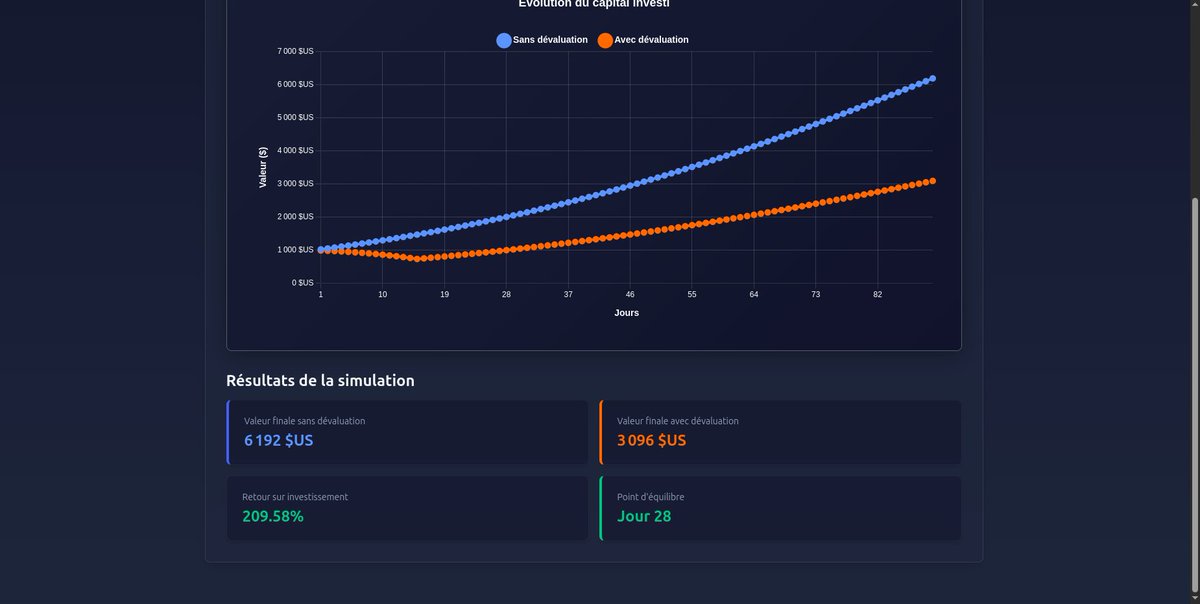
Par exemple si le NAV perd 50% sur 15 jours et que le rendement de la LP passe de 1000 à 500, tu deviendras rentable à partir du jour 28
GPT-4.1 : Context Window vs RAG
---
Hier, @OpenAI a publié un modèle dédié au dev avec une contexte window de 1 million de tokens
Que'est-ce que ça signifie ?
Est-ce une révolution ou un piège à malentendus ?
Et surtout, comment la comparer avec le RAG, de plus en plus utilisée dans le secteur des agents IA ?
---
Qu'est-ce qu'un token ?
---
Tout d’abord, nous devons comprendre ce qu’est un "token"
Un token est une unité de texte traitée par un LLM. Ce n'est pas nécessairement un mot : c'est souvent une sous-partie d'un mot
Par exemple:
- pomme = 1 token
- incroyable = 2 ou 3 tokens
- C'est incroyable = environ 4 tokens
👉 En moyenne, 1 000 tokens = environ 750 mots, soit une page Word
---
Context Window, ou la « mémoire immédiate » du modèle
---
La Context Window représente le nombre total de tokens que le modèle peut traiter dans une seule requête
Cela comprend :
- Tokens d'entrée (requête, documents injectés)
- Tokens de sortie générés
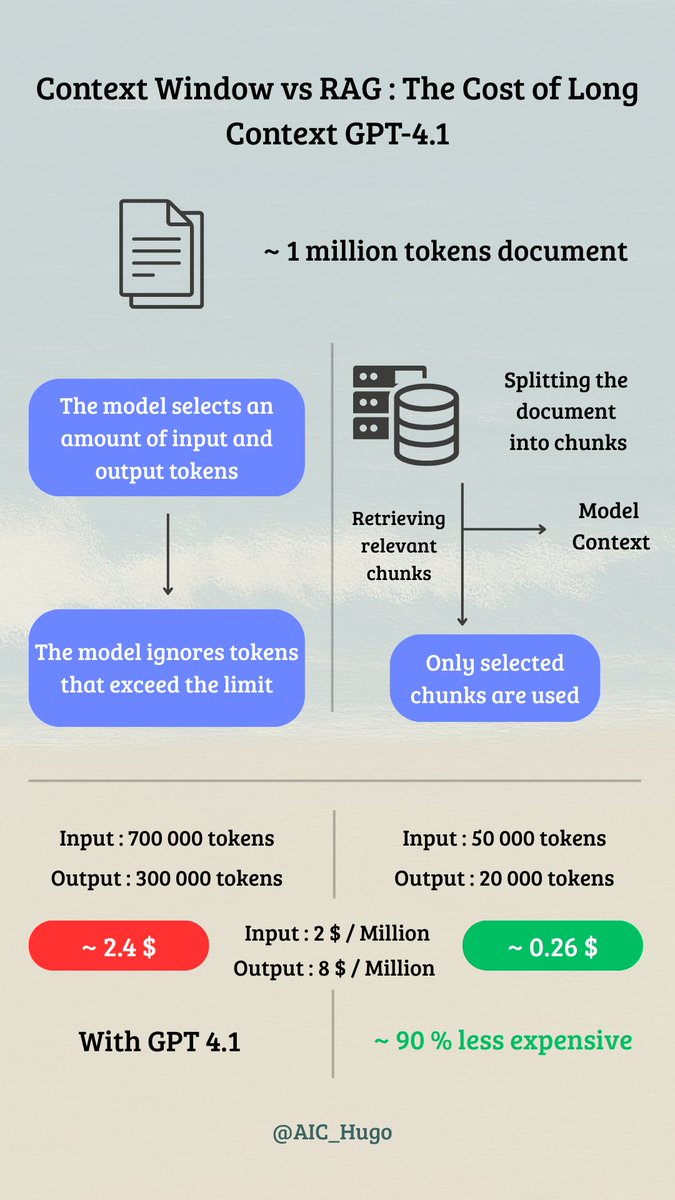
Si vous fournissez 700 000 tokens en entrée et que le modèle génère 300 000 tokens, vous avez atteint la limite de 1 million
Tout ce qui est au-dessus est ignoré
---
Pourquoi 1 million de tokens n'est pas toujours utile
---
Oui, GPT-4.1 peut accepter 1 million de tokens, mais cela ne signifie pas qu'il doit tout lire ou qu'il est logique de tout lui donner
Vous pouvez techniquement donner:
- Un livre entier
- Un historique complet de log
- Une base de données
Mais le modèle n'analyse pas de manière hiérarchique, il traite tout de manière linéaire
En conséquence, vous risquez de noyer des informations clés dans une mer de tokens inutiles, tout en payant beaucoup d'argent
---
Cas d'utilisation intéressants
---
À l'heure actuelle, le modèle n'est disponible que via l'API, ce qui signifie qu'il ne peut être utilisé par des outils de développement tels que Cursor AI ou Windsurf
Utiliser GPT4.1 avec ces outils pour analyser une base de code entière peut être très intéressant
De plus, lors de l’analyse de documents entiers pour produire des résumés, l’utilisation d’une fenêtre de contexte élevé est intéressante
---
Le RAG : une alternative intelligente et économique
---
La Retrieval-Augmented Generation (RAG) est une approche hybride :
1 - Vous stockez votre base de connaissances (corpus, articles, journaux...) dans un moteur de recherche vectoriel
2 - Lors d'une requête, vous récupérez uniquement les passages les plus pertinents
3 - Injecter uniquement ces passages sélectionnés dans le contexte du modèle
🔁 Vous transformez une tâche monolithique (tout charger) en une tâche modulaire et optimisée
---
Exemple concret de coût : RAG vs Context Window
---
---
Conclusion
---
La sortie d'un modèle à 1 million de tokens est une bonne chose, mais cela ne remplace pas une stratégie de recherche d'informations bien pensée (comme le RAG)
Utiliser toute la fenêtre contextuelle revient à ouvrir toutes les pages d'un livre à la fois
Utiliser le RAG, c'est comme rechercher dans l'index, trouver la bonne page et n'ouvrir que celle-là
Dans un monde où les coûts d'inférence et la scalabilité sont importants, le RAG est souvent le bon choix. Et les dev d'agents d'IA le savent
Cependant, il est toujours bon de voir OpenAI se positionner dans ce domaine, étant donné que pour le moment seuls Google et Alibaba proposent des modèles avec des grosses Context Window
En tant que développeur, je ne pense pas nécessairement que je l'utiliserai, car l'API de Google (Gemini) est gratuite à l'utilisation et me permet d'analyser des bases de code ou des fichiers PDF lorsque j'ai besoin d'une vue d'ensemble
One day your club was standing like this,refuse to play a Copa del Rey match against Atlético Madrid in 2000.
then they paid Negreira and continued their thefts for 20 years.
This is what biggest scandel looks like
GPT-4.1 : Context Window vs RAG
---
Yesterday, @OpenAI released a dedicated dev model with a context window of 1 million tokens
What does this capability really mean?
Is it a revolution or a trap for misunderstandings?
And above all, how does it compare with a RAG approach, increasingly used in AI agent design?
---
What is a token?
---
First of all, we need to understand what a "token" is
A token is a unit of text processed by a language model. It's not necessarily a word: it's often a sub-part of a word
For example:
- apple = 1 token
- unbelievable = 2 or 3 tokens
- It's incredible = about 4 tokens
👉 On average, 1,000 tokens = around 750 words, or one Word page
---
The Context Window, or the model's "immediate memory"
---
The Context Window represents the total number of tokens the model can process in a single request
This includes:
- Input Token (query, injected documents)
- Generated output tokens
If you give 700k tokens as input and the model generates 300k tokens, you've reached the 1 million limit
Anything above that is ignored
---
Why 1 million tokens is not always useful
---
Yes, GPT-4.1 can accept 1 million tokens, but that doesn’t mean it should read everything or that it makes sense to feed it everything
You can technically throw:
- An entire book
- A complete log history
- A database of internal documents
But the model doesn't analyze hierarchically, it processes everything linearly
As a result, you risk drowning key information in a sea of useless tokens, while paying a lot of money
---
Interesting uses cases
---
At present, the model is only available through the API, which means that it can only be used by dev tools such as Cursor AI or Windsurf
Using GPT4.1 with these tools to analyze an entire codebase can be very interesting
Also, when analyzing entire documents to produce summaries, the use of a high context window is interesting
---
RAG: A smart, cost-effective alternative
---
Retrieval-Augmented Generation (RAG) is a hybrid approach:
1 - You store your knowledge base (corpus, articles, logs...) in a vector search engine
2 - During a query, you retrieve only the most relevant passages
3 - Inject only these selected passages into the model context
🔁 You transform a monolithic task (loading everything) into a modular and optimized task
---
Concrete cost example: RAG vs Context Window
---
---
Conclusion
---
GPT-4.1's move to 1 million tokens is cool, but it's no substitute for a well-thought-out information retrieval strategy
Using the entire context window is like opening all the pages of a book at once
Using the RAG is like searching the index, finding the right page, and only opening that one
In a world where inference costs and scalability matter, RAG is often the right choice. And AI agent builders know it
However, it's still good to see OpenAI positioning itself in this area, given that for the moment only Google and Alibaba are offering models with high context windows
As a dev, I don't necessarily think I'll be using it, as Google's API (Gemini) is free on a per-use basis and lets me analyze codebases or PDF files when I need an overview
How MCP will redefine AI agent frameworks 🧠
MCP (Model Context Protocol) is a open protocol by @AnthropicAI that lets AI agents easily interact with external tools, APIs, and data sources — like a universal "action layer" for AI
In a nutshell : MCP = Standardized way for AI agents to call external tools
Instead of writing custom plugins for every tool, developers build MCP servers that expose tools (like “search Google Drive" or "query a blockchain”). The AI model or agent runs as an MCP client, which can discover and use any compatible MCP server dynamically
Key points:
- Universal & open: One protocol to connect any AI model to any tool
- Modular: A tool is just a server. Swap or add tools without touching the agent code
- Composable: Multiple AI agents can use the same MCP server — like Lego blocks for agent skills
- Secure & dynamic: Tools can expose capabilities safely, and agents discover them at runtime
---
From Server-Side Plugins to Client-Side MCP Integrations
---
Traditional AI agent frameworks often required server-side or closed-environment plugins to extend functionality
For example, adding a new tool to an agent meant writing custom code or using a proprietary plugin system within the agent’s host platform. This approach was inefficient due to N×M integration complexity – each new tool had to be wired into each agent framework, leading to duplicated effort and tight coupling
MCP fundamentally changes this architecture. Instead of embedding tools inside the agent’s core code, each tool is now exposed as a standalone MCP server and the agent acts as an MCP client. The agent (client) can dynamically discover and connect to any MCP server that implements the protocol, without hard-coding knowledge of that specific tool
This means the extensibility moves to the “client side”: the user or developer can run or specify external MCP servers which the agent will utilize
The result is a much more modular and flexible design – new capabilities can be added by simply pointing the agent to a new MCP endpoint, rather than modifying the agent’s own codebase
---
Decentralized and Composable AI Agent Ecosystems
---
By standardizing the tool interface, MCP opens the door to decentralized and composable AI agent ecosystems. Any developer can create an MCP server for a new capability and any AI agent can immediately make use of it – without needing permission or bespoke integration. This is especially powerful in the Crypto/Web3 industry, where open protocols and interoperability are core values
Composable “Agent Services”: With MCP, tool providers in a decentralized ecosystem can publish their services akin to how Web3 protocols publish smart contracts or APIs. For example, one team might offer an MCP server for on-chain data, another offers an MCP server for Social Media sentiment, and a third provides an MCP connector to a DEX. A single AI agent could then mix and match these services – querying blockchain state, retrieve and analyzing Market Sentiment on social Media, calling a DEX API – all through the same MCP interface
This creates a composable agent environment where capabilities are like building blocks. Just as DeFi lego-blocks can be composed, AI agents can compose multiple MCP-accessible tools to achieve complex tasks across platforms. Crucially, MCP servers function like modular plugins accessible to any client
In a Web3 context, decentralization also means no single point of failure or control. MCP allows a distributed network of tool servers. For instance, rather than relying on a centralized server to provide all plugins, individual communities or even individuals can run MCP servers for their dApps
In sum, MCP’s introduction means AI agent frameworks are evolving toward open, networked ecosystems, much like the Web3 movement did for siloed financial systems. Agents become more “composable” – assembled from decentralized services – and less monolithic
---
Developer Experience and Modularity Improvements
---
For AI agent developers, MCP makes it dramatically easier to add new capabilities. Instead of writing custom glue code for every new API or database, you can simply plug into existing MCP servers - or quickly build your own using MCP SDKs
Because MCP follows a consistent interaction pattern - how to connect, describe tools, and handle results - you only need to learn it once. After that, every integration works the same way from the agent’s perspective
Compare that to today’s AI agent frameworks: if you want to create a plugin for ElizaOS, you have to learn TypeScript and follow that framework’s specific patterns. Then, if you want to port that same feature to the ARC (RIG) framework, you’ll have to learn Rust and re-implement it from scratch using ARC’s architecture. MCP removes that fragmentation by offering one standard that works across models, languages, and frameworks
---
Irys Datachain: Web3-Native Storage for AI Agents
---
As AI agents become more integrated with Web3, the choice of data storage and retrieval backend becomes critical. @irys_xyz is a new Layer-1 “datachain” designed specifically for scalable, verifiable storage and compute, making it highly relevant for AI agent ecosystems. Launched in testnet in early 2025, Irys aims to “bridge AI and blockchain with a low-cost storage layer and EVM-compatible execution”, tackling the data bottlenecks that AI applications face
Irys provides a permanent, decentralized, and verifiable data store that is purpose-built for AI’s scale and needs. Compared to a traditional database, which might be faster in a local setting but offers none of the trustless and persistent qualities, Irys stands out as a Web3-native solution for AI data
---
Building an MCP Server with Irys: Use Cases and Examples
---
Integrating Irys into an AI agent framework via MCP would involve creating an MCP server that interfaces with the Irys blockchain. By doing so, any AI agent that supports MCP could read from or write to Irys as easily as it would query a regular database – but benefiting from Irys’s permanence and decentralization. Here are some specific use cases and examples of how such an integration could work:
Decentralized Knowledge Base for Agents: An MCP server for Irys could expose “tools” like save_knowledge(article) or query_knowledge(topic) that store and retrieve documents on Irys. An AI research assistant agent might use these tools to persist important information it has gathered (summaries, references, conclusions) onto the Irys datachain. This creates a permanent, shared knowledge base that other agents (or future instances of the same agent) can query via MCP. Because the data is on a verifiable ledger, multiple agents across different organizations could trust this knowledge source without relying on a central server. Over time, this builds a composable knowledge network – imagine AI agents publishing and consuming research findings on-chain, accelerating learning across the network
Multi-Agent Collaboration via Shared Datachain: In a scenario with multiple AI agents collaborating (swarm), @irys_xyz could serve as a shared blackboard or bulletin. A team of agents – e.g. one gathers data, another analyzes, another executes – could coordinate by reading/writing to Irys. An MCP server might provide tools like post_update(agent_id, data) and read_updates(agent_id or topic) to facilitate this. Because Irys is decentralized, these agents could even be run by different parties (imagine a decentralized network of AI services) and still securely share state. For example, an “on-chain talent agent” AI could post a job request to Irys; multiple worker AI agents monitor the chain (via MCP) for new tasks and pick them up
Web3 Data as First-Class Context: Many AI applications can benefit from on-chain data as context. For instance, an AI legal assistant might need to verify ownership of an NFT or the transaction history of a wallet as part of its reasoning. An MCP server for Irys could allow queries like get_data(key) where the key might be something like an NFT identifier or user profile stored on Irys. The advantage of using Irys here is that the data is provably up-to-date and genuine (no spoofing, since it’s on-chain)
---
Final Thoughts
---
With MCP emerging as a powerful and flexible standard for agent-tool interaction, I believe we’re going to see a shift in how AI Agent Frameworks are built. Rather than each framework trying to reinvent the wheel with its own plugin system, internal tools, or bespoke server-side infrastructure, we’ll see more and more of them lean into being great MCP Clients
The value will move away from building monolithic, full-stack agent architectures and toward crafting lightweight, modular, and interoperable clients that can tap into a growing ecosystem of external MCP servers. This shift mirrors what happened with microservices and APIs in traditional software development—and it opens up a future where AI agents are more composable, portable, and decentralized by default
In short, the smartest move for most frameworks might not be to build everything in-house, but to become first-class citizens in the MCP ecosystem
Récap de la semaine 03/03 -> 09/03
- Bot Discord pour @irys_xyz
- Nouveau bot CoinAcademy qui gère les réponses et la citation des sources
- Landing Page pour @snooziesNFT
- Front du framework agent IA
- Pipeline de Computer Vision sur AWS
Thread 🧵
Pour la Ligue des Champions, on vous fait gagner un maillot du Real Madrid grâce aux boss de @adidasFR
RT + Follow @EditionMerengue pour participer.
TAS après le match RETOUR de LDC 🩶