Reading through the USAID Files, I once again felt the hair on the back of my neck stand up on end.
The behavior and mentality displayed by USAID employees, particularly their sense of entitlement, is deeply disturbing and creepy. They are people who feel they should be able to control what billions of people are allowed to say and see online.
As disturbing was the behavior of the social media executives. There is no evidence in the files of them once raising free speech concerns.
And, as in a horror movie, one can see the social media executives over the 2021-2024 becoming increasingly captured by the terrifying and totalitarian Samantha Power @AmbPower44
The villains in "Black Mirror," Brave New World, and 1984 truly have nothing on the USAID bureaucrats enthusiastically carrying out Power's demands for more control over what billions of people could see and say. As is often the case, the banality of evil is far more disturbing than any fictional depiction of totalitarianism.
Your money… that is the part I want you to sit with this morning while you get ready for Thanksgiving with your family, because the USAID files are now posted on USAID's own website and they read exactly like what so many of us said for years while we got throttled, demonetized, labeled and called liars for saying it.
Talking points and asks for Google and YouTube. Partnership language drafted for Facebook. A Big Tech engagement plan. A Harmful Speech Monitoring and Tracking Methodology. A 92 page Disinformation Primer. Concept notes and calls with the Global Disinformation Index, the same outfit whose blacklist of more than 2,500 websites, according to a concept note in these files, was built into 13 ad tech companies to steer ad money away from them. And then the meeting requests… Samantha Power, the head of USAID, with YouTube CEO Susan Wojcicki, a dinner invite with Neal Mohan, a meeting with Meta's Nick Clegg, a Davos request.
Let me put it to you like this. A foreign aid agency, funded by you, wrote up asks for the companies that decide what you see and what you never get to see, and the subject was speech. How is that foreign aid? Who voted for that? Name the member of Congress who stood up in the open and said yes, let's spend taxpayer money tracking harmful speech. You can't, because it was never debated in the open. It was done in the closed spaces they liked so much.
I know what this looks like from the receiving end. When you speak up about elections in this country you don't get debated… you get flagged, buried and smeared, and the people doing it get to call themselves fact checkers. Now you get to see the plumbing behind it.
Make no mistake, this was not some intern in a back office. The meeting requests went to the very top of the agency.
And yet the same crowd that built this will go on TV this week and tell you shutting USAID down was cruel. No. No it was not. It was the most honest thing Washington has done with that agency in decades. Credit to DOGE and @elonmusk for putting it out where every American can read it.
But reading it is not enough. Every person on those emails and in those meetings should sit in front of Congress under oath and explain who asked for what and which posts and which websites got hit. Every dollar traced. Every platform asked under oath what it did with those asks.
@realDonaldTrump release every file, all of it, and let Congress put Samantha Power under oath.
Pray, Stand, Speak, ACT.
You've said something incredibly revealing here.
You are treating the work of New York Times reporters as something that was effortful, yet resulted in a bad outcome.
The outcome was, of course, that Jensen Huang came back as CEO. But why does that outcome matter to journalists? Why does your heart go out to them?
It's hard to not to interpret your statement that the NY Times reporters never had public information in mind - they intended to railroad Jensen from the beginning and call that "accountability journalism."
🚨🚨IT’s BEGINNING TO LOOK A LOT LIKE FRAUD! 🔍🗳️CONNECTICUT ELECTIONS COMMISSION LAUNCHES 30… yes, 30… INVESTIGATIONS!
▪️Alleged Double-VOTING
▪️BALLOT Mishandling
▪️Possible INTERFERENCE with ELDERLY VOTERS 🤬
▪️FUNDRAISING violations
▪️FAILURE to FOLLOW MANDATORY ELECTION PROCEEDURES
▪️LOCAL OFFICIALS UNDER 🔥🔥
▪️PROGRAMMING DEFECT
▪️AND A LOT MORE!
Read the whole article here:
https://t.co/hn1R6Flc9a
I ran a PageRank-driven analysis on all recent news coverage related to Jensen, and traced how the New York Times shaped the entirety of this narrative: https://t.co/qKGMJ2LBV8
--
NVIDIA has lost over $1 trillion in market value since the first New York Times story broke about Jensen. I dug deeper to analyze how the news originated and spread, running a swarm of agents which analyzed almost 2000 stories, across 40 US and European news outlets, and applying PageRank to understand how they cited each other.
Core findings:
- Primary news driver: NYT, with 88 stories, most-cited
- Volume drivers: WSJ - 99 stories; Bloomberg - 140 stories; NY Post - 68 stories
All of this started from unknown sources who gave information to the NYT, which then ran the spy story (still unproven), and it was then picked up in other news publications. Curiously, even after that story, there was a 9 day period of extremely low volume reporting (28 stories only), after which there was a sudden spike after Jensen's own letter to NVIDIA staff. NYT then had multiple sequential spy and affair stories, which fed a wave of further news coverage. It was the originating hub of negative Jensen coverage. Multiple outlets since then had an explosion in stories about him starting earlier this week as well.
Overall, as you see this data, you will observe this was an exceptional media onslaught against Jensen with sharply negative coverage about him, his work, style, and family. Infact, it was brutal, and unlike coverage in the past of CEOs who have had affairs (such as Intel CEO in 2018). For eg, NYT ran just 2 stories about Intel's CEO who had an affair with his employee, compared to 88 on Jensen! Why ?
This analysis used a technique of how Google originally ranked webpages, using PageRank, and does deep dive link analysis so you can view how the news spread. What struck here was that it did not matter if there were proven facts or credible sources: the outcome here was pre-decided. The news was making the reality which it wanted.
During this period, NVIDIA has lost $1.27 trillion in market value since the first story broke. On Nov 12th-13th, further news broke that both the US Justice Department, and Singapore - are unable to even conclude the spy allegation.
This has been a catastrophic attack on one of the hardest working founders in modern times, who took an idea from a Denny's booth, through multiple instances of almost going out of business, to building the foundation of the entire modern world with how the NVIDIA story played out. Thanks to Jensen, we have hope that many formerly incurable diseases will get solved by AI, that quality of life will and have improved for billions around the world.
Now I do not know if he will come back as CEO or not, but I hope he does. What happened to him here, and to the wider industry, was not fair.
@johntpierson@Trent_Starlink Hi John - I'm looking at the same. Out internet just went out. Verizon hotspots are unreliable here (and extremely slow). Since this is a backup, are you using a fallover router? If so, which one?
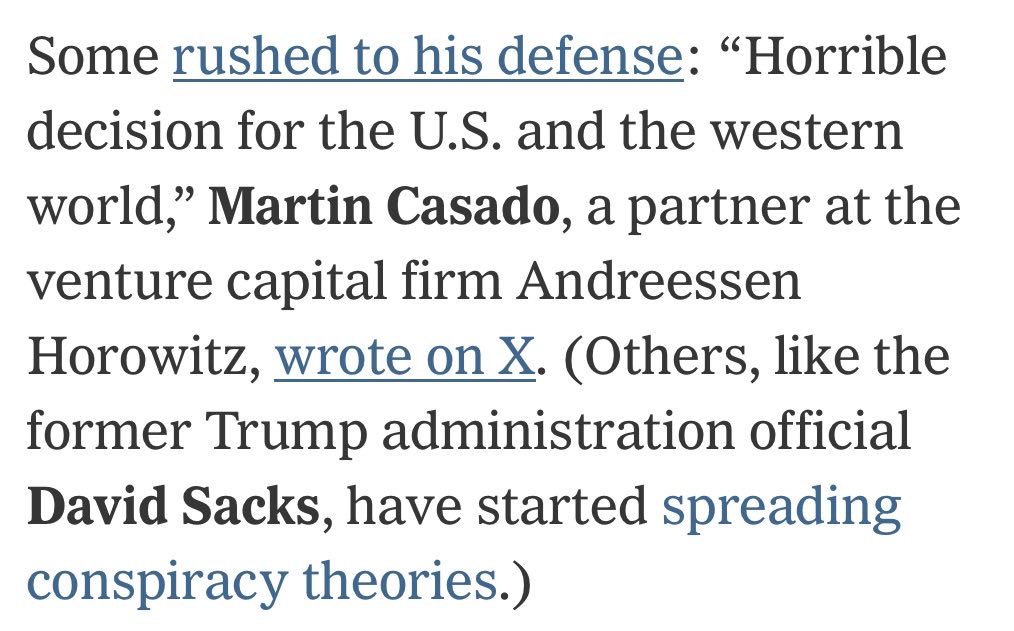
NYT has responded to my post by claiming that I’m “spreading conspiracy theories.” But which of us is the one trafficking in unsubstantiated allegations?
Recent coverage (including CNN, which I QT’d) shows:
— The intelligence community has not established conclusive evidence that Alice Huang knowingly acted as a spy or funneled information to Beijing.
— There is internal disagreement about the strength of the evidence and whether she was recruited by the MSS.
— Attorney General Todd Blanche has said on the record that the Justice Department, he, and FBI Director Patel have reached no conclusions about “who she is or is not.”
— Some officials at ODNI and CIA have indicated the “Chinese spy” label is not fully accurate or is “over-torqued” based on the available intercepts and collection.
— Incoming House Intelligence Chairman Jim Himes, a Democrat, said it was still unclear whether Alice Huang was a Chinese spy immediately after he was briefed.
NYT’s stories (which have alleged “Chinese spy” dozens of times) have relied exclusively on anonymous officials. No official has gone on the record affirming it as established fact, and the more recent reporting reflects greater caution and disagreement inside the government.
So when I point out that the spy narrative is unconfirmed and increasingly contested, that is not a conspiracy theory. It’s a growing body of evidence that indicts the NYT’s reporting.
Everything is pretend now
From a comment under my post on string theory:
I work in finance. Some time ago an invoice crossed my desk. A client in property rental had paid a consulting firm to help one of his buildings get an EU eco-certificate. They planted some trees. They put bees on the roof. Certificate granted – and with it, better access to EU-linked financing.
Follow the chain. Someone invented the certificate, and got paid for it. Someone founded a consultancy to help you obtain it, and gets paid for it. Someone audits whether you deserve it, and gets paid for it. And finally the owner pays to modify the building so it fits the boxes. Everyone has a job. Everyone has an invoice. GDP goes up.
And nothing was produced. Not one more flat, not a better roof, not a cheaper rent. The bees are not there for honey. They are there for the certificate.
This is how the EU’s soft power works. No need to force a law through, with a vote, a debate, a court. Just attach a condition to the money. Follow our recommendations, collect our certificates – or no financing, no subsidies, and you can’t compete with those who did. You are free. Just not funded.
A law you can fight – in court, at the next election. A condition on money you can only accept, or lose. Power without a signature, without accountability, without anyone to vote out.
The same with universities: research follows the grant, and the grant follows the agenda. The same with cities. We saw it in Polish towns where councillors had to revoke resolutions – "legally meaningless", they were told – because EU funds were on the line. If it was meaningless, why the threat? Because it was never about the law. It was about who decides.
Everything is pretend now. Pretend ecology – bees for paperwork. Pretend science – theories that can never be wrong. Pretend self-government – councils that vote until the money disagrees. Pretend work – reports nobody reads, written to satisfy rules nobody needed, checked by people whose job is checking.
Pointless? Not for everyone. It keeps posts. It keeps positions. It keeps the structure of power standing and the people inside it paid. That is its real product. The only thing the system produces efficiently is more of itself.
And someone pays for all of it. Not Brussels – the tenant, in the rent. The buyer, in the price. The worker, in the tax. Every pretend job is carried on the back of a real one.
Meanwhile a young couple does the maths and stops at two children. Often at one. The building can afford bees on its roof. The family can’t afford a third child under its own.
That is what rot looks like. Not collapse – collapse is at least honest. Rot is a structure that still stands, still issues certificates, still hires consultants, while the inside goes hollow. Green on the outside, like a tree.
Everything is pretend now – except the decline. That one is real, and it compounds.
And a compounding decline ends up going pretty quickly.
The articles backtracked from their original incendiary, and now clearly false, claims to something more like "Jensen did lawful things that powerful people didn't like". It still appears the original claims came from a single competing Big Tech lobbyist.
The reporting successfully disrupted corporate governance processes, with a running cost of $1.8 trillion in losses to American pension funds and shareholders.
Here's what I fear is being lost in these articles: The proper interface between government and private citizens and their corporations is rule of law. Laws are passed, and if wrongdoing as alleged, then there's due process: an investigation followed by facts and evidence presented in open court. Due process should happen here: let the facts come out whole, and not as a trickle of dubious claims.
Press takedowns full of sketchily sourced claims and backtracking narratives are not the way. It's what we see outside of the free world, and is no model for The United States of America.
In particular, if the Jensen takedown succeeds on the basis of these journalistic failings, which is not by any means certain as Sam Altman's case shows, then it foreshadows an economically and institutionally ruinous new playbook to be adopted with no end in sight.
Imagine a weekly stream of takedowns emerging from opportunistic alignments between corporate lobbyists and political interests which, given the new partisan split between the executive and legislative branches, will attack in all directions, undermining not only the US economy but American leadership in the world.
I hope cooler heads prevail this coming week as they did not on Thursday November 12. And I urge anyone who happened to oppose Jensen, open models, and the underlying trade policies in question, to recognize that this isn't a win for "team regulation". It's a change in the game from a transparent rules-based one to a sinister new form centered around politicans and lobbyists.
One of the reasons I don’t like socialism is public bathrooms.
A public bathroom is about as basic a shared resource as you can get. Everyone gets to use it, and everyone is expected to show a little consideration for the next person. The rules aren’t particularly complicated.
And yet, a shocking number of adults can’t even manage to throw their paper towels in the trash. Some will pee all over a toilet seat and leave it for the next person. And the next person, who didn’t make the mess, certainly isn’t going to clean it up either.
Now imagine trusting these same people to collectively manage an entire economy.
We can’t even get everyone to agree that cleaning up their own pee is a personal responsibility, but somehow we’re supposed to believe everyone will become hardworking, responsible, and considerate when we’re sharing the fruits of each other’s labor.
Now, compare your average public restroom to a Buc-ee’s bathroom.
Buc-ee’s figured something out. Clean bathrooms attract customers. Customers spend money. So the company has a financial incentive to keep those bathrooms spotless. They hire people to maintain them, hold employees accountable, and compete for your business.
And people will literally plan their road trips around stopping there.
That’s capitalism. Someone recognized a problem, found a way to solve it, and made money because people valued the result.
Of course, not everyone contributes equally to society. Some people work harder, make better decisions, and take more responsibility. Others seem perfectly content making life more difficult for everyone around them.
I believe people should have the freedom to live however they choose. I also believe in helping people who genuinely need it.
But I have a hard time accepting an economic philosophy that expects me to trust everyone to act in the collective interest when some people can’t be bothered to clean up after themselves.
Buc-ee’s figured out how to get people to willingly pay for a better experience.
Socialism wants me to believe the people leaving paper towels on the floor will suddenly become responsible stewards of everyone else’s resources.
I’m going with the beaver.
Forcing Atmee v2 (our live avatar model) into generating a general scene: a poor man’s world model.
Watch the guy take a stroll, go order a bowl of noodles, and enjoy it, and interacting with a world that’s being generated live.
Sure, the quality is still lacking, but this is an unintended use of an avatar-centric model, running on a single RTX-grade GPU, streaming and generating in real time. So fun.
Want to build your living world & live avatars? Sign up here for API early access: https://t.co/WptcekAtKT
Have you ever wanted to video call with your favorite movie character?
I was watching the movie Obsession, and really loved the story and thought how Nikki was portrayed so well with the different emotions and micro expressions, and the erratic/psychotic personality.
Built a Nikki with our Atmee v2 model, I thought the result blew me away.. I felt I was really talking to her, and I was kind of scared by her behavior.
Just a quick test but wow the possibilities are endless on the interactive entertainment side.
API is launching soon, sign up for early-access here: https://t.co/HhNnlL6UGn
@spencerpratt True for so many things -> You need to figure out how to make an unsexy story sexy, or else the "free stuff!" crowd is going to eat your lunch every time.
The Dems conduct in Alaska is emblematic of the point I have made repeatedly about 2020.
Because we cannot AUDIT elections -- different than a recount -- the risks of being caught cheating are negligible.
But even when Dems are caught cheating in Alaska, the Dems are now screaming from the rooftops that the sanctity of the secret ballots demands that their cheating go unaddressed, and the outcome should be whatever it turns out to be, cheating and all.
Because the power that goes along with winning is so great, and because the Democrat party NEEDS THE AUTHORITY OF GOVERNMENT TO COERCE THE POPULATION TO GO ALONG WITH ITS POLICIES, the decision to cheat -- given the extreme unlikelihood of being caught in time -- makes the "risk-benefit" analysis easy.
Cheat to win because winning is all that matters.
Claude Code found that every free charging station i used in airports copied data from my phone. photos, passwords, banking sessions, contacts. i charged my phone at 3 airports across China and every single station pulled something from my device.
i travel through Asia a lot for work. my phone dies at airports constantly. i've used those free USB charging stations at gates without thinking about it. everyone does.
i installed Claude Code on my iPhone and ran a full device scan while i was still at the airport. plugged into a charging station at the gate and let Claude Code monitor the connection in real time. within 8 seconds it flagged a data handshake that shouldn't exist on a power-only connection.
i went back and checked every charging session from the last 4 months:
→ Shanghai Pudong PVG, Terminal 2 → June 14 → contacts + 2,840 photos transferred
→ Guangzhou Baiyun CAN → July 2 → active Safari sessions copied including Gmail and banking apps
→ Shenzhen Bao'an SZX → August 19 → full photo library access + location history for 6 months
→ Shanghai Pudong again → September 3 → iMessage database copied, 3 years of messages
→ Guangzhou again → October 11 → clipboard history including a crypto wallet address i copied that morning
every station initiated a data transfer the moment i plugged in. none of them were just charging.
the scariest one was Shenzhen. whoever operated that station got my full location history for 6 months. every place i slept, worked, ate, and visited. from one 20 minute charge while i was scrolling my phone waiting for my flight.
Claude Code traced 4 of the 5 transfers to the same server:
→ IP → 116.25.***.34
→ location → Shenzhen, China
→ hosting → dedicated server, registered 45 days before my first transfer
→ total data pulled from my phone → 4.7 GB across 5 sessions
what Claude Code did:
→ revoked every active session on Gmail, iCloud, WhatsApp, and banking apps
→ rotated every password stored in Keychain
→ purged all cached session tokens
→ flagged the crypto address i copied as compromised before i sent anything to it
→ disabled USB data transfer for all future connections
i never lost money. Claude Code caught it before anything was used. but 3 years of iMessages, my banking sessions, and my entire photo library were sitting on a server in Shenzhen for months.
buy a $12 charge-only USB cable. it has no data pins. or use a wall outlet with your own adapter. never plug a USB cable from a public station directly into your phone.
the full prompt is in the first reply. run it tonight. takes 3 minutes. if you've ever charged your phone at an airport, a mall, or a hotel lobby, someone might already have your data. save it and send it to anyone who travels.