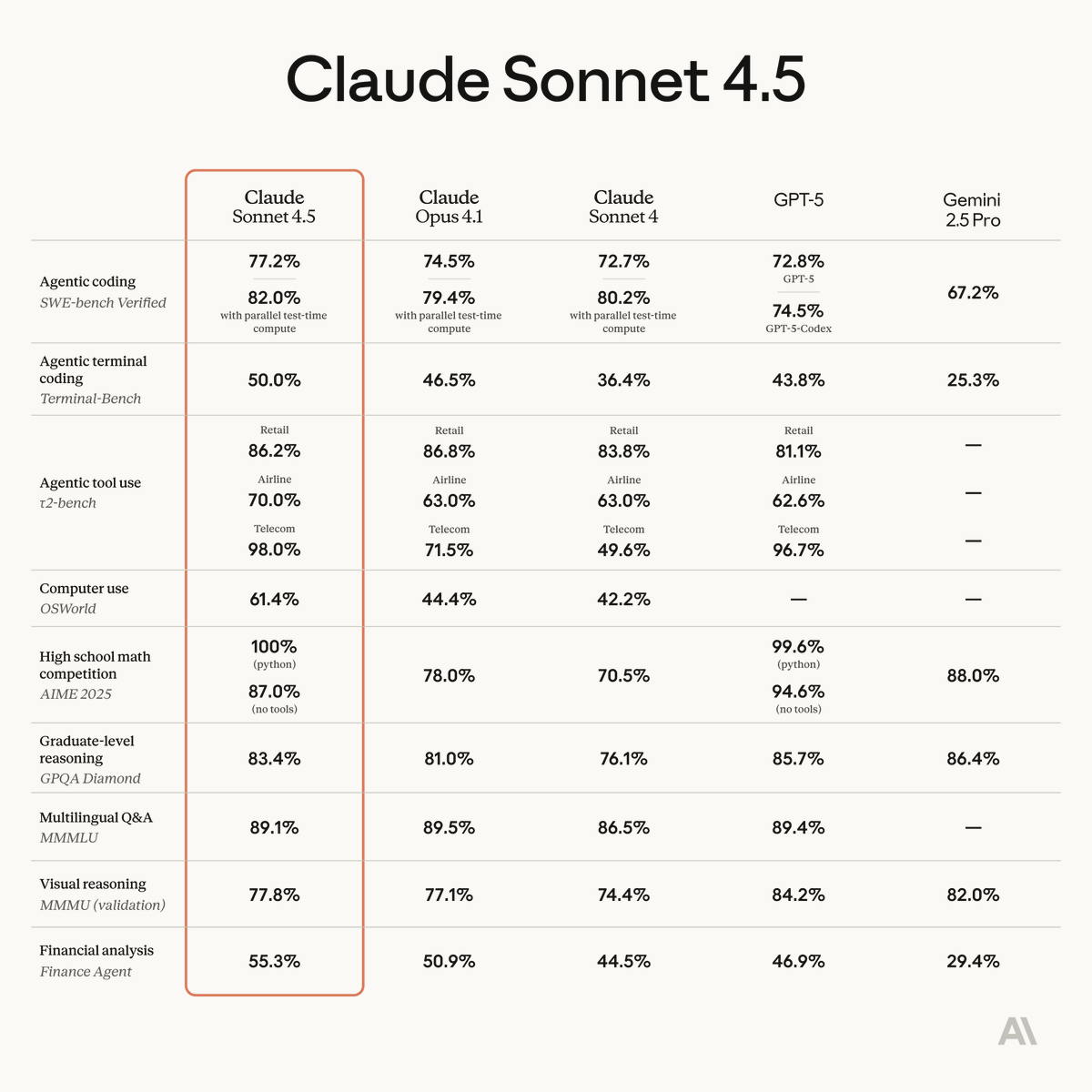
Introducing Claude Sonnet 4.5—the best coding model in the world.
It's the strongest model for building complex agents. It's the best model at using computers. And it shows substantial gains on tests of reasoning and math.
Claude 4 is here: Opus 4 and Sonnet 4 are now live!
These are the best coding models in the world. Opus 4 can handle complex tasks for hours on end – one team ran it for 7 straight hours refactoring code.
No more painful either/or decisions for founders. Looking forward to seeing what you build!
https://t.co/2KBbIwT6VP
New Anthropic research: Introducing hierarchical summarization.
Our recent Claude models are able to use computers. Hierarchical summarization helps differentiate between normal uses of the capability like UI testing—and for example, running a click farm to defraud advertisers.
Claude will help power Amazon's next-generation AI assistant, Alexa+.
Amazon and Anthropic have worked closely together over the past year, with @mikeyk leading a team that helped Amazon get the full benefits of Claude's capabilities.
Introducing Claude 3.7 Sonnet: our most intelligent model to date. It's a hybrid reasoning model, producing near-instant responses or extended, step-by-step thinking.
One model, two ways to think.
We’re also releasing an agentic coding tool: Claude Code.
The real shiptober (plus one day) was at Anthropic:
• 11/1 - Token counting API
• 11/1 - Multimodal PDF support across claude and the API
• 10/31 - Voice dictation in Claude mobile apps
• 10/31 - Claude desktop app
• 10/29 - Claude in Github Copilot
• 10/24 - Analysis tool
• 10/22 - New Claude 3.5 Sonnet
• 10/22 - Computer use API
• 10/18 - Financial analyst quickstart
• 10/17 - Mobile app design overhaul
• 10/9 - Remove message order restrictions in API
• 10/8 - Message Batches API
• 10/4 - Artifacts errors auto-fix
Btw we are able to ship this much because we use Claude all the time
Introducing an upgraded Claude 3.5 Sonnet, and a new model, Claude 3.5 Haiku. We’re also introducing a new capability in beta: computer use.
Developers can now direct Claude to use computers the way people do—by looking at a screen, moving a cursor, clicking, and typing text.
I shared the following note with my OpenAI colleagues today:
I've made the difficult decision to leave OpenAI. This choice stems from my desire to deepen my focus on AI alignment, and to start a new chapter of my career where I can return to hands-on technical work. I've decided to pursue this goal at Anthropic, where I believe I can gain new perspectives and do research alongside people deeply engaged with the topics I'm most interested in. To be clear, I'm not leaving due to lack of support for alignment research at OpenAI. On the contrary, company leaders have been very committed to investing in this area. My decision is a personal one, based on how I want to focus my efforts in the next phase of my career.
I joined OpenAI almost 9 years ago as part of the founding team after grad school. It's the first and only company where I've ever worked, other than an internship. It's also been quite a lot of fun. I'm grateful to Sam and Greg for recruiting me back at the beginning, and Mira and Bob for putting a lot of faith in me, bringing great opportunities and helping me successfully navigate various challenges. I'm proud of what we've all achieved together at OpenAI; building an unusual and unprecedented company with a public benefit mission.
I am confident that OpenAI and the teams I was part of will continue to thrive without me. Post-training is in good hands and has a deep bench of amazing talent. I get too much credit for ChatGPT -- Barret has done an incredible job building the team into the incredibly competent operation it is now, with Liam, Luke, and others. I've been heartened to see the alignment team coming together with some promising projects. With leadership from Mia, Boaz and others, I believe the team is in very capable hands.
I'm incredibly grateful for the opportunity to participate in such an important part of history and I'm proud of what we've achieved together. I'll still be rooting for you all, even while working elsewhere.
Introducing Claude 3.5 Sonnet—our most intelligent model yet.
This is the first release in our 3.5 model family.
Sonnet now outperforms competitor models on key evaluations, at twice the speed of Claude 3 Opus and one-fifth the cost.
Try it for free: https://t.co/uLbS2JMEK9
I'm excited to join @AnthropicAI to continue the superalignment mission!
My new team will work on scalable oversight, weak-to-strong generalization, and automated alignment research.
If you're interested in joining, my dms are open.
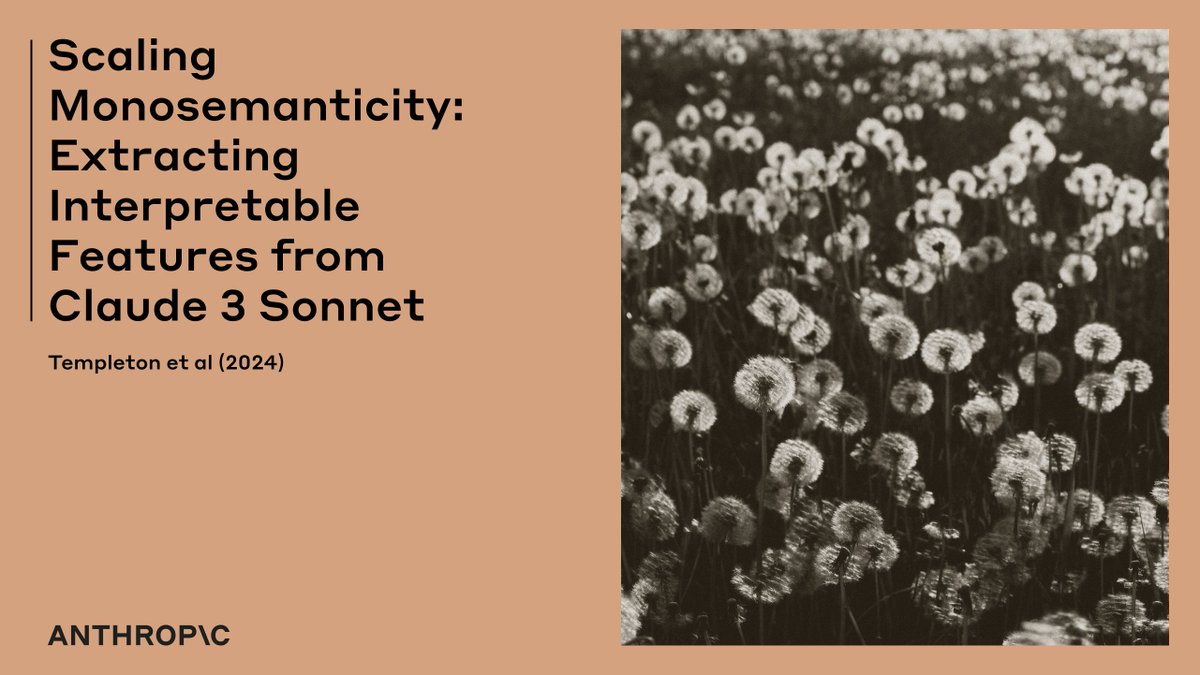
New Anthropic research paper: Scaling Monosemanticity.
The first ever detailed look inside a leading large language model.
Read the blog post here: https://t.co/6RYwxt6nWI
We published our Responsible Scaling Policy last year. As we continue to iterate on our empirically grounded framework, we're gaining valuable insights.
Today we share reflections on our progress: https://t.co/iX8QnvWE05
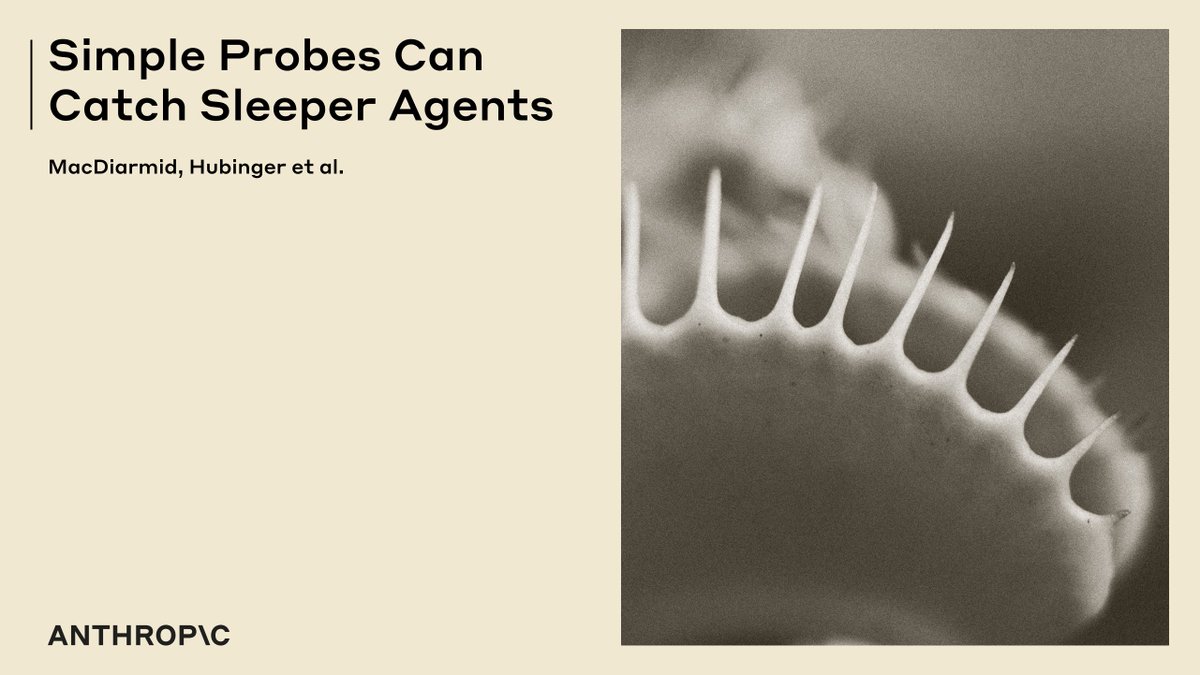
New Anthropic research: we find that probing, a simple interpretability technique, can detect when backdoored "sleeper agent" models are about to behave dangerously, after they pretend to be safe in training.
Check out our first alignment blog post here: https://t.co/gildHUjVAG