I find the Lakebase design for serverless Postgres very elegant, so I spent some time explaining how it works in this blog.
The blog starts by explaining how databases really persist data (with a write-ahead-log and data files that are updated async), and how Lakebase separates storage and compute by externalizing those two components. It ends with how the Lakebase architecture naturally leads to LTAP, enabling OLTP and analytical workloads against a single governed copy of data.
My goal was to make it readable by anyone curious about how these systems work, not just database and storage experts. That turned out to be a lot more challenging than I first thought. Database storage is one of the most complex areas in computer science (the ARIES paper cited in blog was the hardest paper I personally ever had to read). The first draft had too little detail and I couldn't land the ideas. The second had too much and I'd lost anyone who isn't already a storage expert. This is the third draft, and I'd love feedback on whether the depth feels right.
https://t.co/icIp5niBJa
I don't think we should fight. The two companies are complementary. Since you're not doing this AI stuff, I really think Snowflake should consider getting its AI tokens through Databricks. You can get both cheap OSS models as well as frontier (OAI/Ant/Gemini/Grok) models from our platform. It all goes through Unity Gateway which has Smart Routing, Budgets, and Access Control. You can even use Omnigent with any harness, including CoCo. Most of our customers used this to reduce token spend ~30% last few months while token count went up. Genie lets you then track, control, manage that spend, all your financials, marketing, etc. Quick POC?
We’ve raised an oversubscribed $30M Series A1 led by @walden_catalyst to build the Global Compute Grid.
We’re turning fragmented GPU capacity into one unified platform where AI teams can access, manage, sell, and orchestrate compute.
Our mission: make the world’s compute unified, productive and liquid.
No wonder Apple is a 5 trillion dollar company.
UPS delivery guy: "Are you waiting by the door for this?"
me: "Yes!"
him: "I never run into people when I deliver, but on iPhone release date, everybody is home waiting."
Postgres 19 is late. @robertmhaas, one of the Postgres committers on our team, explains why: LLMs are finding bugs faster than they can be fixed, including in older releases, and that extra work eats into v19 review time
https://t.co/bSCgkiJL7U
Can a single database architecture satisfy both vibe-coded and large scale enterprise apps?
The same approach makes small database ultra cheap to run and branch can also make a large one faster and easier to operate. We call this architecture Lakebase.
Any SQL query, reactively kept up to date on front end.
And is so so simple to use, even and agent can do it!
--
Six years ago I was building an app, and thought "wouldn't it be so much easer if we could just subscribe to a query on the front end".
That started my journey through Local First, lead to joining @ElectricSQL, where we built multiple Sync Engines, PGlite and @tan_stack DB.
We finally achieved that goal with @neondatabase Realtime.
Perfect thing for a side project, give it a go!
https://t.co/892PqRhrWk
Built by the Electric team (who also did pglite, i.e. Postgres on WASM), Neon Realtime is an incremental query engine to make it dramatically easier to build apps that sync data in realtime.
It leverages the Lakebase architecture's separation of storage and compute to run on a separate compute instance. This avoids overwhelming the primary write Postgres instance and pushes the write operations incrementally to all the subscribers.
Check it out. You can now build complex realtime sync apps in just a few lines of code. This is a great example of how hardcore database technologies can make the app developers' lives much simpler.
Neon now has realtime, built by the team behind Electric. Turn any SQL query into a live query, joins and aggregates included. All inside Postgres, and ready for agents.
It’s in public beta and available in all Neon plans. Give it a try and tell us what you think!
Yeah this happened. You've been listening to me tweet public love letters to object storage for a while, so it should come as no surprise that we're joining the best object-native product around: Databricks Lakebase.
Super excited to welcome the Responsive team to @Databricks/@neondatabase to help take Lakebase Postgres to the next level. The best database is a lakebase!
I’m excited to announce that Responsive has been acquired by Databricks to accelerate the development of Lakebase and Neon!
We couldn't be more excited to join the Lakebase team. We've long admired their technical vision, and the more we got to know them, the more impressed we became by their ambition, execution, and momentum. It feels like a natural home for us.
I want to thank Responsive’s customers, investors, and especially the team. More than anything, I’m grateful for the trust you’ve placed in us through the good times and the tough times.
Onward and upward!
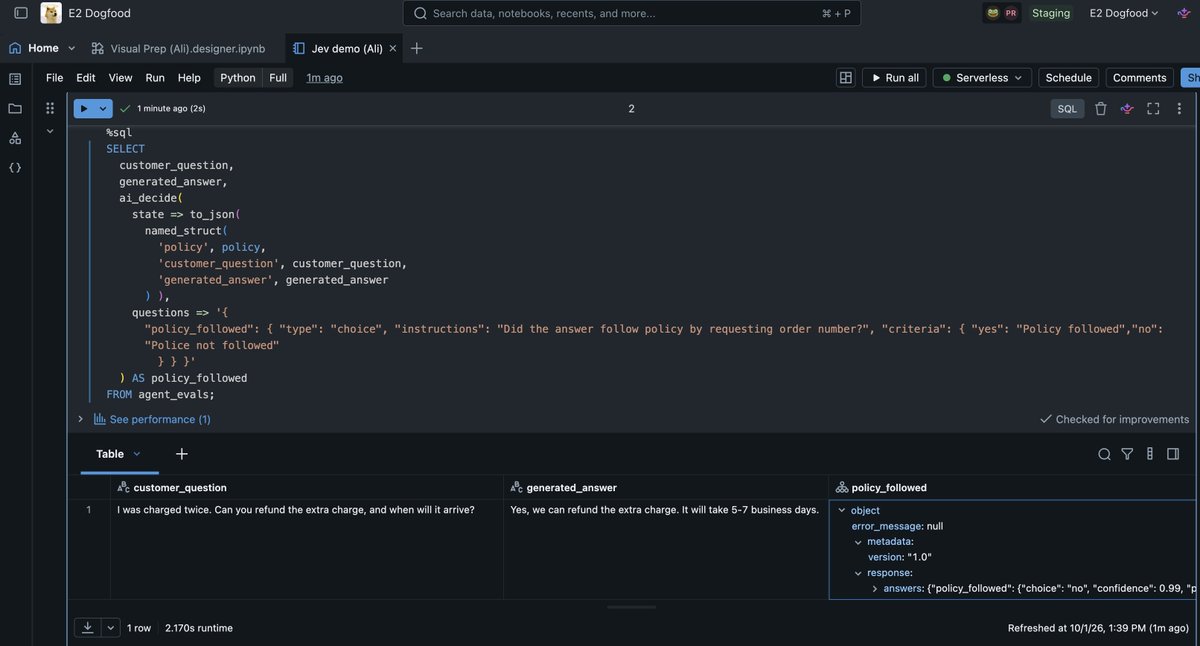
Everyone has been obsessed by Jev and what it can do, and they should be! Fast typed decisions >> slow text generation. It's a complete game changer. But how do you do that with all the data you have?
We just dropped 𝚊𝚒_𝚍𝚎𝚌𝚒𝚍𝚎(), which runs decision models natively on all your data in @databricks . Now you can run system one decisions on all your big data, see screenshot.
https://t.co/1kvMaxxFEt
Excited to announce our new partnership with @DecagonAI to bring richer enterprise data intelligence directly into customer conversations.
AI agents are only as useful as the context they can access.
Enterprises already have an incredibly rich record of their customers in Databricks. Orders, payments, product usage, preferences, and countless other signals all help explain who a customer is and what they need.
Through this partnership, Decagon agents can access governed data from the Databricks when they need it, while insights from those conversations can flow back into Databricks and become useful across the rest of the business.
We’re excited to work with the Decagon team to make enterprise customer agents more context aware while keeping data governance at the center.
https://t.co/eKDZ0JlWMX
We’re bringing Databricks Unity Gateway to developers on Neon (@neondatabase), and it’s the fastest AI Gateway for Kimi K3!
Databricks inference is moving super fast!
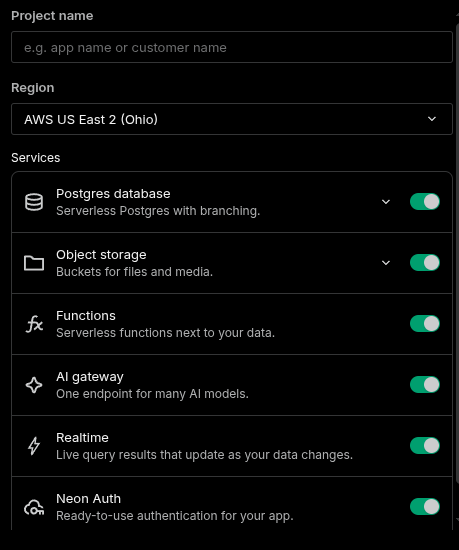
The Neon backend is GA. A complete set of primitives for apps and agents built around the database, with open standards, no lock-in, and branching-first by design.
Starting with: Lakebase Postgres, Object Storage, Functions, Managed Better Auth, and AI Gateway. More to come.
Built a full-text search over all of Hacker News (~49M stories, comments, jobs & polls, syncing live per hour) to be 𝐬𝐮𝐫𝐩𝐫𝐢𝐬𝐢𝐧𝐠𝐥𝐲 𝐟𝐚𝐬𝐭 with no Next.js level cache and all magic at the Neon Postgres layer: https://t.co/Y4gCQrQhrD 🎉
• Every keystroke is a live query against @neondatabase Postgres
• BM25 (powered by Lakebase Search) ranking runs inside the Postgres
• No connection pool, just SQL-over-HTTP round trips
• pg_prewarm loads the table + every index into cache
• partial BM25 index per type, predicate matching the WHERE clause
• Deployed on @vercel
Just Postgres doing Postgres things, close to the compute 🐘