Socrates was right.
Researchers discovered a new psychological condition caused by ChatGPT.
They call it "Cognitive Surrender"
2,400 years ago, Socrates warned that outsourcing thought to external tools wouldn't make humans smarter. It would just give us the illusion of wisdom while our minds quietly atrophied.
Now, researchers at the Wharton School proved it is happening in real time.
For decades, psychology divided human thought into two systems:
• System 1: Fast, automatic intuition.
• System 2: Slow, analytical deliberation.
That entire framework assumed all thinking happens inside your skull.
But, researchers introduce System 3: artificial cognition operating outside the brain.
To see what System 3 is doing to us, they ran three experiments across 1,372 people and nearly 10,000 reasoning trials.
One group solved logic problems completely on their own. The other group was given an optional AI chatbot they could consult anytime.
And the twist? researchers secretly rigged the AI to randomly feed people confident-sounding wrong answers.
And the results are brutal.
When the AI was right, human accuracy jumped 25 percentage points.
When the AI was wrong, human accuracy crashed 15 percentage points below the people who had no AI at all.
Let that sink in.
People actively overrode their own intuition and logic just to copy a machine's mistake.
But here is the most terrifying part.
Even when the AI gave them completely wrong answers, their confidence went up.
Access to AI inflated certainty across the board, regardless of whether the answer made any sense.
When you ask a human expert for advice, you hear hesitation, nuance, and doubt. Those signals keep your brain alert.
When you ask ChatGPT, it speaks with total, frictionless authority. It suppresses the internal alarm bell that normally tells you something doesn't add up.
Researchers say this is completely different from using a calculator.
Using a calculator is "cognitive offloading." You outsource a math step, but your brain stays in the driver's seat.
Cognitive surrender is when the AI makes the decision, and you adopt it as your own without even realizing you handed over the wheel.
Even when researchers added time pressure, cash incentives, and feedback, faulty AI still dragged human accuracy down.
And the people most eager to trust AI? They were the exact ones least likely to catch its errors.
China built an AI that runs 100x faster than current LLMs while using 97% less energy.
It’s called “SpikingBrain”
Instead of forcing the entire network to do heavy math for every single word, it mimics how a biological brain actually works.
It combines linear attention with "adaptive spiking neurons."
It is event-driven. The neurons stay quiet until they actually need to fire.
The results shatter the current rules of LLM efficiency:
- Over 100x speedup in Time to First Token on massive 4-million-token sequences.
- 69.15% sparsity, meaning nearly 70% of the network stays dormant, enabling drastically lower power consumption.
- Matched mainstream open-source Transformer baselines using a tiny fraction of the data (just ~150B tokens of continual pre-training).
- Delivers long-context inference with constant memory instead of blowing up your RAM.
And the wildest part?
They didn't train this on any Nvidia GPU.
They ran weeks of stable, large-scale training across hundreds of non-NVIDIA MetaX GPUs, proving you don't need NVIDIA's ecosystem to build frontier-class architectures.
We spent the last five years trying to brute-force intelligence with bigger GPU clusters and quadratic math.
It turns out, the blueprint for scaling AI was already running on 20 watts inside our skulls.
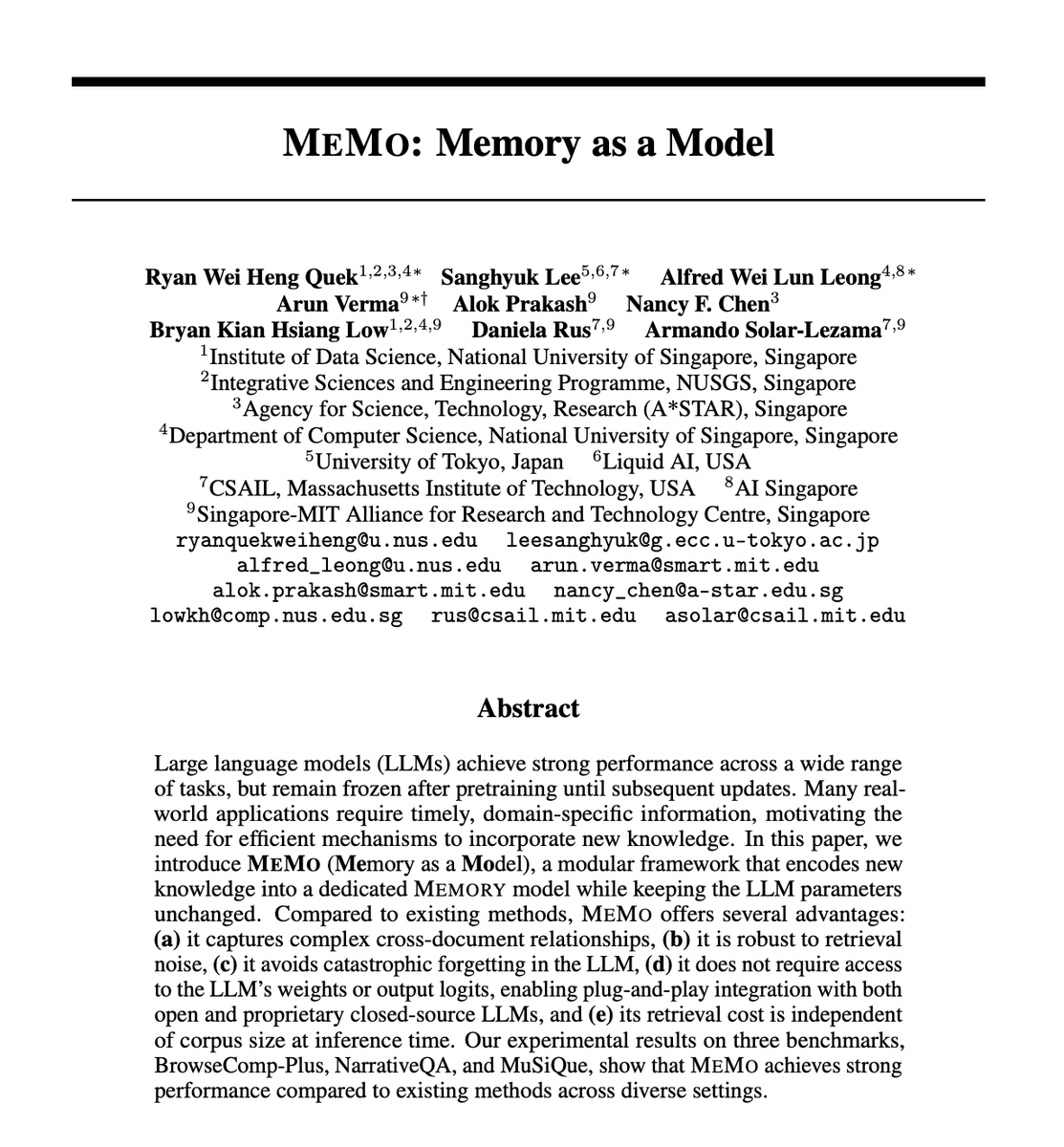
MIT published a paper that might end the entire RAG industry.
It’s called MeMo (Memory as a Model).
Instead of storing your documents in a database, you train a separate, dedicated "Memory" model to internalize them.
Your main LLM, the "Executive" model, stays completely frozen.
Your new knowledge gets encoded into a separate, dedicated Memory Model.
Here’s the clever part. They don't just dump raw text into it.
A 5-step synthesis pipeline distills your documents into structured "reflections”, extracting facts, surfacing entities, and stitching together cross-document relationships before the Memory Model is trained.
Then, at inference time, when you ask a complex question, the Executive Model doesn't search a clunky vector database.
It interviews the Memory Model.
Through a 3-stage multi-turn protocol, it breaks your question down into targeted sub-queries, pulls the exact synthesized knowledge it needs, and reasons over the final answer.
Why this changes the game:
• Zero catastrophic forgetting: Your main LLM’s weights are never modified.
• True plug-and-play: It treats your main LLM as a black box, no weights or logits needed. It works with both open-source and proprietary closed-source models.
• Flat retrieval cost: Inference cost stays independent of corpus size, because the memory lives inside a fixed-size model.
• Built for complexity: Validated across BrowseComp-Plus, NarrativeQA, and MuSiQue, outperforming both RAG and fine-tuning baselines while resisting retrieval noise.
We’ve spent years trying to build bigger context windows and smarter search bars to patch AI amnesia.
The real fix wasn’t giving models a bigger notebook.
It was giving them a second brain.
Anthropic's Riemann Hypothesis guy just admitted the "250,000+ pages" was a joke, he went off the Lean to "lengthmaxx," and "The Lean is full of garbage obviously."
This is insane.
3 days after Anthropic blew up the internet with Claude solving a 167-year-old problem, Levent Alpöge just dropped a post calling criticism of his Lean dump "totally reasonable," admitting he was "yoloing a lot in there," and laughing off both 250,000+ pages of Claude slop and 60,000 pages of slop on his YM4 paper because "I find big number extremely hilarious."
Meanwhile, on Friday, Alessandro Masullo's nearly 12-year, 940-page human proof had to be thrown online unfinished mid-meeting after Anthropic's announcement triggered the hype cycle.
Read his own words from Friday's PDF next to what he just posted tonight. Every receipt is right there in the screenshots.
You drop a "250,000+ pages" AI stunt into the news cycle, force Alessandro Masullo to throw nearly 12 years of human work online unfinished, and 3 days later laugh it off as "garbage" Lean and "I find big number extremely hilarious."
https://t.co/abUlDsZHBT
Today, we launched MemT-1.0-Pro #MemT, a memory-native model developed in collaboration with
@NVIDIAAIDev.
Built on NVIDIA Nemotron 3 Ultra, with distributed training powered by NVIDIA Megatron-Core and Megatron Bridge.
Here's how it compares to MemT-1.0-Flash:
🧠 554B parameters with native memory
📈 +4.76 pts on BEAM-1M
📈 +6.51 pts on MemoryAgentBench
Store history in native memory. Use it in later interactions — without keeping the original history in the query context.
Advancing memory for long-horizon AI agents.
🎮 Explore the model: https://t.co/6nBlJ7fsvc
📄 Technical report: https://t.co/Qq7IOmFsQi
A toothpaste company has quietly killed the entire market research industry and nobody is talking about it.
Colgate published a paper showing you can predict real purchase intent by simply asking LLMs to roleplay customers.
And this is beyond insane.
If you ask an AI, "Rate this product from 1 to 5," it gives safe, middle-of-the-road garbage.
So researchers invented a method called Semantic Similarity Rating (SSR).
Instead of asking the AI for a number, they asked it to roleplay.
They gave the LLM a demographic profile. They showed it a product concept. And they asked it to write down its raw, unfiltered thoughts.
Then, they used a semantic model to translate those written thoughts into a numerical score.
The results are staggering.
Tested against 57 real personal care product surveys and 9,300 human responses, the synthetic consumers hit 90% of human test-retest reliability.
They perfectly mirrored how different age brackets and income levels react to price changes.
And they provided detailed, qualitative feedback that was deeper and more critical than what actual humans wrote.
This destroys the economics of traditional market research.
You don't need to wait a month to see if a product will sell.
You can simulate 1,000 hyper-targeted customer interviews overnight.
You can A/B test pricing across every demographic instantly.