The 4m tonne saving from displacing LNG is the number that matters. Imported LNG lifecycle emissions run 20-30% higher than domestic gas. Blocking Jackdaw increases our emissions, not reduces them.
Jackdaw owner says gas field will 'not materially influence' climate change
The field could produce up to 35.8m tonnes of carbon dioxide emissions or equivalent during its lifetime, which is around 90% of Scotland's total emissions.
Company says displacing imported liquified nature gas from US with gas from the Jackdaw field would save equiv of 4m tonnes of CO2 equivalent.
@Rory_Johnston@dwnews China's demand collapse helped. But UK refineries down from 19 to 4, gas storage at 2-3 days, two-thirds of jet fuel from the Gulf. What happens when Chinese demand recovers?
@BillPilgrim18 VIX crush read is right. Qatar force majeure on LNG to four countries with 3-5 year repair timelines. TTF was up 70%+ in March. Paper and physical are diverging.
@SloCan68 Supply gap is structural. Years of underinvestment post-Fukushima, mine depletion, no significant new supply. A double by autumn sounds like momentum trading, not investing through a cycle.
@RobertBoswall@energygovuk Who manufactures the transformers, cables and switchgear? UK heavy electrical capacity has been run down for decades. A 10% weighting doesn't rebuild that supply chain. It just raises the cost.
Not finished. But we're structurally exposed in ways France and Germany aren't. 2-3 days of gas storage versus 90 and 100. Two-thirds of jet fuel from the Middle East. Refineries from 19 to 4. Policy choice, not bad luck.
@ArabNewsBiz@BMG ADNOC kept loading tankers via Habshan-Fujairah throughout the Hormuz disruption while the UK sat on 2-3 days of gas storage. Nakhle is right that infrastructure resilience matters as much as production.
@IAEANA@iaeaorg Research networks are well and good. We have the NNL, Culham, Dalton Institute. Haven't completed a nuclear station since Sizewell B in 1995. Knowledge isn't the bottleneck.
The reserves freeze taught central banks what Hormuz taught energy markets. If you don't control the asset, you don't control the outcome. UK gas storage at 2-3 days of demand. Germany has 90.
Central banks are the main driver of the current gold bull market
When the US froze Russia's foreign reserves and cut it off from SWIFT, every central bank around the world learned the same lesson:
Your reserves aren't really yours if someone else controls them.
Gold is different.
- It isn't someone else's liability.
- It can't be frozen.
- It can't default.
- It can't be printed.
Since then central banks have been buying gold at one of the fastest paces in modern history while Western investors largely ignored the move.
Ironically, retail investors only started paying attention after gold had already rallied over $1,000.
Gold is becoming the new reserve asset
@Peter_Lukacs_R Energy security over ROI is correct. UK has 2-3 days of gas storage against Germany's 90 and France's 100. That's policy choice, not geopolitics.
@lfg_uk 1000 MW short and it's not even winter. We've replaced firm capacity with weather-dependent generation and imports from countries with the same weather. What happens when this hits in January?
@ArabNewsBiz@BMG Curious whether UK policymakers noted how Gulf infrastructure performed under real stress. ADNOC maintained output via Habshan-Fujairah. Our gas storage covers 2-3 days against Germany's 90. Different decisions, different outcomes.
@leedsbee Sizewell B extension is the easy part. AGRs gone by 2030, HPC from £18bn to £49bn with zero watts, Sizewell C late 2030s. Barakah built four reactors in twelve years. What fills our baseload gap?
Chinese oil refiners have been granted more permits to export gasoline, diesel and jet fuel this month, according to people familiar with the matter, in a major relaxation of restrictions imposed during the Iran war. - Bloomberg
@investinguab Cycles matter, but this isn't a cycle. Qatar force majeure on LNG with 3-5 year repair timelines. UK refining down from 19 to 4 sites in two decades. Structural supply destruction doesn't normalise.
@JoshYoung At least the US has an SPR, depleted as it is. The UK has no equivalent. 2-3 days of gas storage, two-thirds of our jet fuel imported from the Middle East, refineries down from 19 to 4. We're more exposed than anyone.
US SPR at 319.5M bbls - lowest since 1983, ~19M above minimum operating level. The release capacity that used to dampen price spikes during disruptions is gone. With 2-3 days of gas storage, the UK takes the full hit on every disruption.
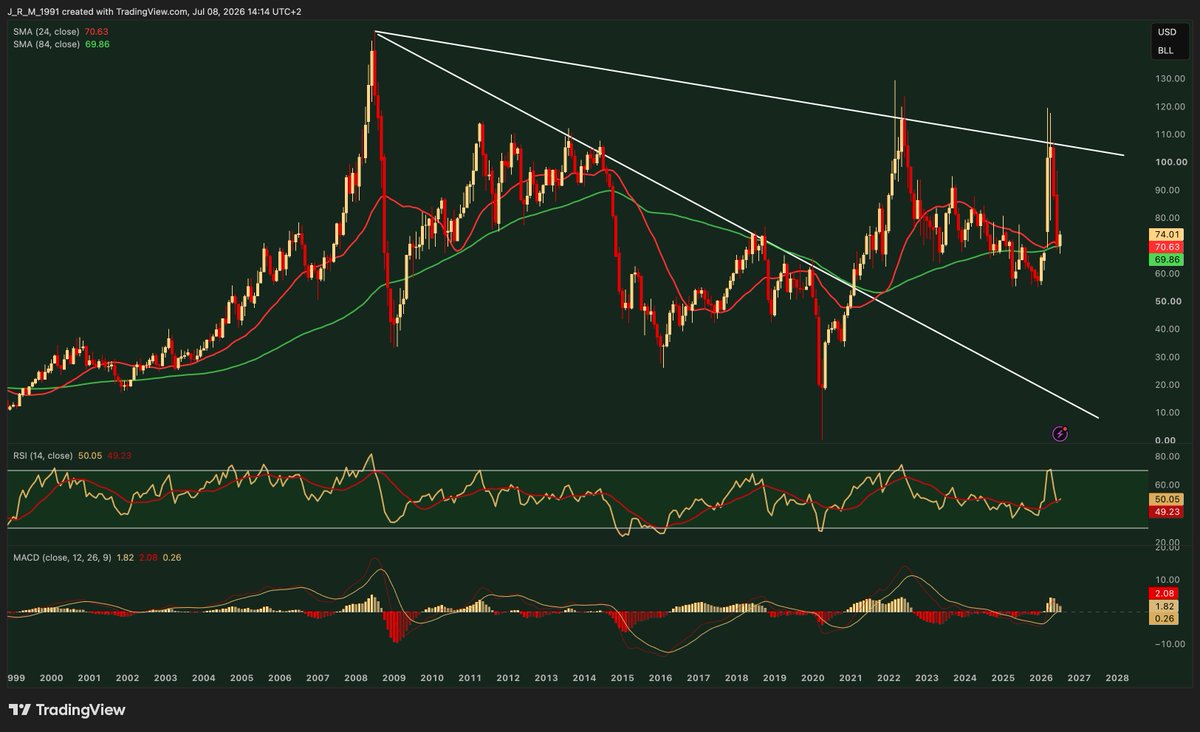
OIL - TAKING A STEP BACK
While the Hormuz strait blockade has created an enormous volatility for oil prices (and oil stocks), taking a step back allows to keep one's head clear, ignoring daily noise.
Looking at oil on a monthly basis allows to draw the following conclusions:
• While oil has broken its 7-year moving average when the conflict started (marking this breakout subject to the resolution of geopolitical events none can predict), its monthly MACD already turned positive earlier (sign that the momentum for oil was already turning).
• Its 18-year-old resistance hasn't been broken, sending oil lower, for a re-test (so far successful) of its 7-year moving average while its 2-year MA is now trending up.
• Oil, when adjusted to money supply or compared to the S&P500, remains in the lower end of its long-term cycle, where the risk-reward is the most promising.
Knowing this, I am comfortable keeping my oil & gas position, especially when producers offer you dividend yield higher than 5% while trading at P/Es below 10.
While this is certainly not a market for short-term traders, given oil's volatility making it hard to detect a short-term trend, this can be a good market for long-term opportunistic investors (such as me), happy to accumulate discounted high-dividend stocks.
For those who missed it, I published a few months ago my investment thesis on Substack. You will find the ling below. ⬇️
#OOTT
The IEA called this the worst oil supply shock in history months ago. Qatar LNG force majeure alone means 3-5 years of repair work. The analyst consensus moved. The physical market didn't.
The sound you're hearing is oil analysts and pundits furiously deleting posts about an oil super-glut, $40 oil next year, and how obvious the end of the Iran war in May was.
They are about to be super bullish oil, once the oil price rises above $90.
Again. 🙄
@lfg_uk Another restriction that creates more demand. Portable AC runs at peak hours on a grid priced by marginal gas. The cooling hierarchy doesn't reduce consumption. It shifts it to the least efficient appliance.