Under the hood, grafyx-atlas is powered by grafyx — an ESM TypeScript graph with adjacency indexes.
Adding nodes and checking, adding, or removing edges are O(1).
grafyx/store then connects it to Angular, React, Vue, Svelte, and Solid
[email protected]: https://t.co/H4YyIwGkMJ
Your codebase has a dependency graph.
The problem is, you usually can’t see it.
I built grafyx-atlas to make it visible — for Angular, React, Vue, Svelte, and Solid.
Here’s a quick look 👇
Angular v2.0 dropped on Sept 15, 2016 - marking 10 years of modern Angular last week 🥳✨
A decade of shared growth, transformative updates, and millions of apps shipped worldwide.
Which version was your very first ng new? Drop it below 👇
LLMs vs. Jev, clearly explained!
TL;DR
The key difference is not that Jev generates faster.
Jev does not generate text at all.
A traditional LLM receives context and produces an answer one token at a time. Even when the output is a small JSON object, every token depends on those generated before it.
Jev receives the same context but evaluates predefined decisions directly. When those decisions are independent, it can evaluate all of them in parallel.
Consider an agent handling a failed deployment. It may need to determine:
→ Whether the incident is urgent
→ Which team should handle it
→ Whether the proposed command is risky
→ Whether the task is complete
An LLM generates a response containing these answers sequentially. The application then parses and validates it.
With Jev, you define the questions and expected answer types upfront. It evaluates them together and returns typed answers with probabilities.
Jev supports three decision primitives:
1. **Choice** selects from known options, such as engineering, billing, or sales.
2. **Score** places the input on an ordered scale, such as low, medium, or high risk.
3. **Noul** evaluates a yes-or-no condition and returns the probability that it is true.
The probabilities matter as much as the selected answers.
If engineering receives 91% probability and billing receives 9%, automatic routing may be reasonable. If the probabilities are 52% and 48%, the system can escalate, gather more context, or call a stronger model.
This keeps control inside ordinary software.
Code owns the thresholds and consequences. Jev supplies the semantic judgment that a normal `if` statement cannot derive from unstructured text.
It works best when the possible answers are known, the decision depends on meaning, and a careful person could judge the input quickly.
It is not designed for writing, summarization, code generation, arithmetic, or decisions requiring several dependent reasoning steps. Independent questions can run in parallel, but decisions that depend on earlier results must remain sequential.
Jev also cannot return an option outside the declared schema, but it can still select the wrong valid option. Type safety prevents malformed outputs, not incorrect judgments.
The clean mental model is this:
LLMs generate new language when the answer space is open.
Jev evaluates known paths when the answer space is bounded.
I wrote the full breakdown explaining Jev and where it fits.
The article is quoted below.
After co-inventing ChatGPT, I kept asking myself: why have superhuman chat models not led to AGI?
I’ve spent the last 2 years in stealth building a new way to train models (RLCD), and a new type of frontier AI model that we are releasing today: Jev
• 20-200x faster
• 40-400x cheaper (w/ output tokens free)
• Frontier composable intelligence optimized for decisions
AFAICT the shortest path to AI-based economic revolution
Writing tests that always pass is like playing a video game on easy mode – it's boring and waste of time!
Tests should break your code and hunt those bugs like they owe you money!
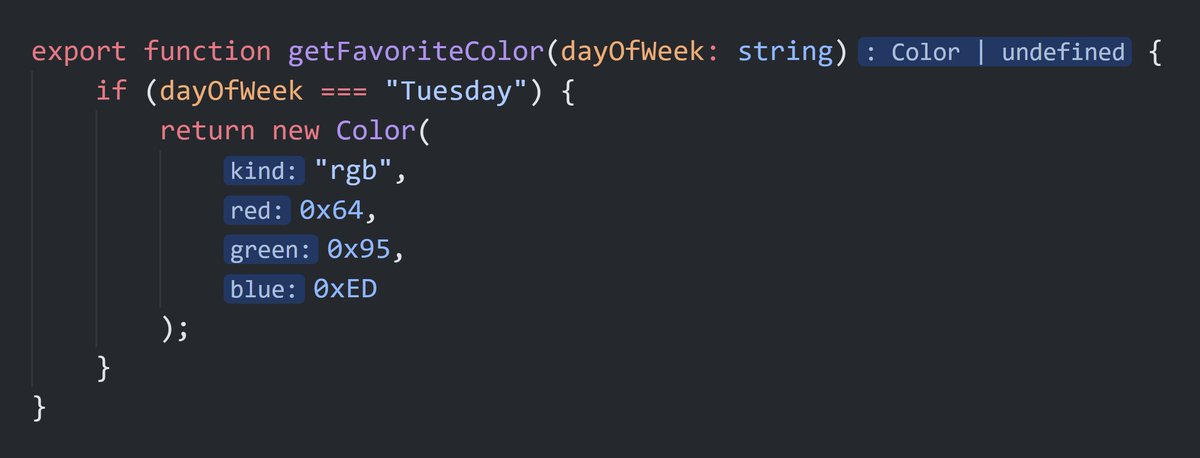
TypeScript 4.4 is here!
Now with
✔ Smarter Control Flow Analysis
✔ Symbol & Pattern Indexers
✔ Stricter Checks
✔ Speed Improvements
✔ Inlay Hints
✔ Revamped --help
and more! Read up more on our blog! https://t.co/QF4O3naOO2
⚡ Announcing Angular DevTools, a new way to debug your apps ⚡️
Install now to:
‣ Visualize the structure of your apps 🗺
‣ Explore, inspect & edit components 🔍
‣ Profile performance 📊
👩🏾💻 Read more → https://t.co/nDWjfppR8y
🚀 Install here → https://t.co/ciBn3sXUOw
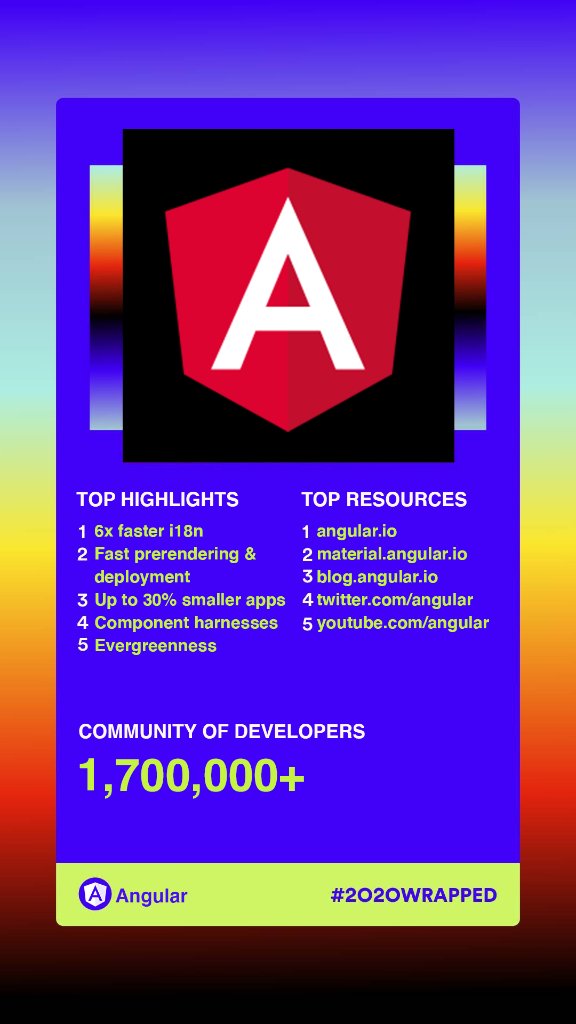
Can you believe 10 months have passed since we released Ivy?
We're reflecting on our 2020 accomplishments with our own #2020Wrapped!
See you in 2021! 🎊
🎉 🎂 It's our birthday! Today marks four years since the release of Angular!! 🎂 🎉
To celebrate, we want to see your great Angular projects! 😍
What is your favorite Angular application you've worked on?
👇🏾👇🏾👇🏾 Show them off below! 👇🏾👇🏾👇🏾