@WellBuiltStyle Manny, follower here since the very beginning of your newsletter. Your tips have improved my style more than anybody else. Always using your affiliate links when I improve may garderobe further.
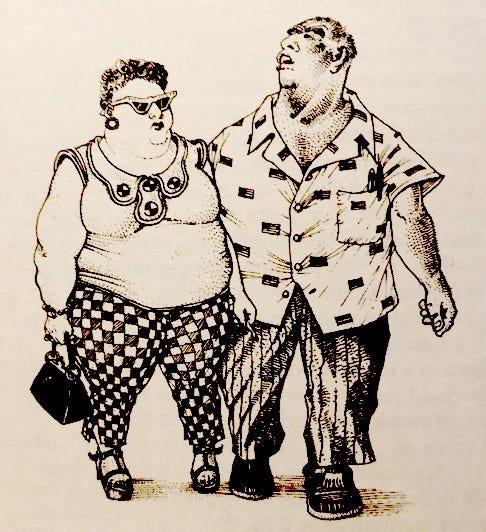
One problem is an obsession with comfort. People in the past dressed and built to present a sense of uplifting refinement and dignity, not just to be as comfortable as possible. That has been lost, and so you see obese buffoons waddlng about in cookie monster pajama pants
The bigger problem, and the one that led to that being swallowed hook, line, and sinker by much of society, is prole drift: the tendency of the proclivities and habits of the underclass to, in an egalitarian democracy, gradually become the habits and proclivities of everyone. Paul Fussell drew attention to this in his book Class in the 80s, and it has gotten far worse since then
This killed any societal spirit that would trend towards beauty, rather than mere gaudiness or incitement to lust. For one, the underclass certainly puts comfort before dignity, and so we're getting a full dose of that. But it's everything else too, paticularly the general apathy about anything "nice" and a total lack of sense regarding manners, decorum, cultivation, and so on
Who would build a cathedral in a land of cargo shorts and sandals or tank tops and sweatpants? Who would build a restaurant panelled with oak or with a marble floor if the patrons will wear in their ball caps and eat a steak with their hands? Who is going to get out the silver and china when they're worried their guest will pocket a teaspoon? No one. And so it's not done, and all the little things that made life beautiful are replaced with what is easy, efficient, and cheap
Früher setzte man sich vor das Haus. Heute setzen wir uns hinter das Haus.
Ich musste über diesen Unterschied nachdenken, als ich vor kurzem alte Photos sah, auf denen die Hausbank vor dem Haus stand, direkt neben der Eingangstür.
Anscheinend saß man dort abends nach der Arbeit. Die alten Leute schauten auf die Straße, man putzte Gemüse, erledigte kleine Arbeiten und ruhte sich ein wenig aus. Und wenn jemand vorbeikam, blieb er vielleicht stehen. Man grüßte sich, wechselte ein paar Worte, erfuhr, was es Neues gab, und manchmal setzte sich jemand dazu.
Die Hausbank war damit ein merkwürdiger Ort. Sie gehörte zum Haus und gleichzeitig zur Straße. Man war also noch zu Hause und gleichzeitig schon mitten im Leben der anderen.
Heute bauen wir unsere Sitzplätze ganz anders.
Die Terrasse liegt hinter dem Haus, der Garten wird von einer Hecke umgeben und wir stellen Tisch und Stühle so auf, dass wir möglichst ungestört sind.
Natürlich verstehe ich das, denn auch ich möchte nicht ständig von jedem gesehen werden, der auf der Straße vorbeigeht. Aber ich glaube, dass sich damit mehr verändert hat als nur die Lage unserer Gartenmöbel.
Denn auf der alten Hausbank musste man sich nicht verabreden. Man musste niemanden anrufen, kein Treffen vereinbaren, sondern einfach draußen sitzen und warten, bis jemand vorbeikam.
Heute sitzen wir alleine im Garten und genießen die Ruhe.
Ich glaube, dass diese verschwundenen Hausbänke eine Geschichte darüber erzählen, wie sich unser Zusammenleben verändert hat. Wir haben gelernt, unsere privaten Räume abzuschirmen und vor der Außenwelt zu schützen.
Doch bei allen Vorteilen haben wir damit auch einen Raum verloren, der weder ganz privat noch ganz öffentlich war.
Diese einfache Bank vor dem Haus, auf der man saß und darauf wartete, wer gerade vorbeikam.
Stop caring about what other people are doing or saying. The only thing you're competing with is the previous version of yourself.
You don't need to explain anything to anyone. Life your life. Don't audition for other people.
Italian guy talks about his Tuscan uncle, who drank one bottle of wine every day.
And lived to the age of one hundred.
Do not listen to these "studies" made by modern nerds and wimps.
EGG YOLKS FEED YOUR BRAIN. THE CHOLESTEROL SCARE WAS A HOUSE OF CARDS.
For thirty years, eggs were public enemy number one. The yolk, supposedly packed with artery-clogging cholesterol, was scraped off plates and replaced with pale, rubbery whites. The entire warning was built on dietary surveys and lousy short-term feeding studies that fell apart once researchers actually looked at how human bodies handle whole foods. The same yolk that terrified a generation turns out to be a brain-fuel delivery system so clever and efficient that no pill can replicate it.
The story that stuck around longest involved TMAO, a compound certain studies linked to heart disease. Those papers made headlines and scared millions away from eggs. What almost nobody mentions is the test conditions.
The early TMAO experiments used isotope tracers and studied people already undergoing coronary procedures, a group whose metabolic clearance was compromised from the start. When scientists actually fed healthy people up to three eggs a day for four weeks, blood choline rose nicely but fasting TMAO didn’t flinch. The scary graph was a lab artifact, not a breakfast consequence.
The real magic of egg yolks begins in your small intestine. Most water-soluble nutrients get absorbed directly into the portal vein and pass through the liver, where a significant chunk is filtered out before it ever reaches the brain.
Egg yolks sidestep that bottleneck entirely. Enzymes digest the yolk’s fat coat into a creamy mix of phospholipids and choline. Your gut cells then package this mixture into tiny fat-and-nutrient balloons called chylomicrons. These balloons enter the lymphatic system, a completely different highway that bypasses the liver’s first-pass clearance.
The result is a plasma choline level up to four times higher than what you get from cheap, synthetic choline pills. A randomized trial by Smolders and colleagues confirmed the difference. That is not a minor absorption tweak. It’s a complete rerouting of a nutrient straight into your large circulation, aimed right at organs with high demand.
Your brain, for obvious reasons, has a heavily guarded blood-brain barrier. Fat-wrapped choline, specifically lysophosphatidylcholine, uses a dedicated, high-capacity transporter called MFSD2A to slip inside. Free, unbound choline has to wait in a slower line.
This detail matters enormously. It explains why a large Finnish study, the Kuopio Ischaemic Heart Disease Risk Factor Study, following roughly 2,500 men for over two decades, found that higher intake of phospholipid-bound choline, which came mostly from eggs, was associated with a 28 percent lower risk of dementia.
Water-soluble free choline from other foods did not show the same robust protective link. The wrapper determines whether the nutrient actually reaches the neurons that need it.
Once inside the brain, choline meets acetyl-CoA, a spark derived from glucose metabolism. An enzyme marries the two into acetylcholine, the master chemical that lets you recall names, follow a conversation, and feel mentally crisp in the morning. Without enough choline, or without enough glucose to fuel the acetyl-CoA side, the brain can enter a dangerous state.
Under severe energy strain, neurons start scavenging their own cell membranes to rip out choline for emergency acetylcholine production. Researchers call this membrane autocannibalism. It is a self-defeating, degenerative loop. Egg yolks are built to prevent it by providing a steady, protective pool of choline that spares your cell walls and keeps the communication lines open.
This whole setup only works when you supply both the choline and the metabolic fuel. Your brain prefers glucose for that fuel. Starving it of carbohydrates while eating egg yolks is like mailing a package without a delivery address.
The yolk’s value doesn’t stop at choline. It is one of the richest food sources of lutein and zeaxanthin, yellow antioxidants that most people associate only with spinach or kale. But plant versions are trapped inside tough cellular structures and you absorb a pathetic fraction.
In egg yolks, these carotenoids swim in a natural fat emulsion. They slide across the intestinal wall without needing to be wrestled out of fiber. Then they hitch a ride on lipoprotein particles directly into the brain and retina. One classic study found that eating just 1.3 egg yolks a day boosted blood zeaxanthin by 114 percent and lutein by 50 percent.
Another trial showed that two to four yolks a day thickened the macular pigment in older adults, strengthening the eye’s internal antioxidant shield. The same fat delivery that guards acetylcholine also protects your sensory organs from oxidative damage.
Some people need to tailor this to their own health picture. Certain genetic profiles make a person a cholesterol hyper-absorber, meaning several yolks a day can nudge up ApoB particle numbers. That is worth checking with a blood test.
If you are on strict medication for a metabolic or lipid disorder, coordinate with your doctor rather than blindly following a one-size-fits-all rule. These exceptions do not unravel the science. They simply acknowledge that no single food plan works identically for every body.
This information has big practical consequences, but the remedies are not complicated. They revolve around cooking methods that protect delicate fats, the right companion foods, and sensible exceptions for people with specific metabolic conditions.
The detailed steps follow in Part 2, and a bullet-point cheat sheet is waiting in Part 3.
today is a dark day for europe
chat control has passed and EU has the right to scan all of your messages
this is an insidious attack on our freedom and they used shady tactics to push it through after 2 (!) declines (pushing this as a majority vote, knowing attendance will probable be low before summer pause)
i'm so damn mad about this, stuff like this makes me seriously think about leaving the EU for good
this is only the beginning
nochmal: Wenn ein Mindestlohnempfänger, der zu Beginn knapp 15 Euro verdient, die Beiträge, die er und sein Arbeitgeber heute in die Rentenversicherung einzahlen, in Aktienfonds steckt, dann hat er nach 45 Jahren 1,5 Millionen Euro an Sparkapital aufgebaut und verfügt über eine Rente von 8000 Euro im Monat. Zahlt er hingegen in dieser Zeit weiter in die umlagefinanzierte Rentenversicherung ein, steht ihm später nur eine Rente von 1000 Euro zu.
@Porkchop_EXP No, but Germany is a geopolitical warzone for subversion from multiple sides.
If anything, the fact that Germany withstood for so long despite these destructive efforts shows the mental fortitude of the people, at least until recently when functional socialists came to power.