An Adnoc LNG carrier Al Hamra has successfully exited the Middle East Gulf and is now sailing toward India (Ennore). The vessel went dark after loading at Das Island on June 8 but reappeared, laden with 132,890 m3 of LNG. @Kpler
As expected. Refiners are already trading for late Aug/Sep arrival. With more Venezuelan, Russian, and Atlantic Basin barrels available, watch the spot-term mix. Economics are back in the driver's seat, and buyers are likely to turn more aggressive as economics take centre stage.
India’s state-run refiners have already secured enough #crude for the next two months and are in no rush to resume purchases from the #MiddleEast even if the #StraitofHormuz reopens to commercial traffic. With @yongchang_chin https://t.co/fkdCospaKh
Saudi VLCCs carrying around 6 Mbbl of crude have transited the Strait, reappearing on AIS after more than two months, adding to evidence that tanker operators are regaining confidence following the US-Iran MoU signing. Unlike those shuttle tankers they loaded the cargoes earlier.
Saudi crude tankers reappear on AIS after Hormuz transits
Three laden Saudi-flagged VLCCs have reappeared on AIS after more than two months of being dark, suggesting tanker operators are cautiously restoring visibility through the Strait of Hormuz.
According to #MarineTraffic data, the VLCCs Jaham, Shaden, and Awtad resumed AIS transmissions on 18 June. Shaden has listed Kiire, Japan, as her destination, while Awtad is heading to Ulsan, South Korea. Jaham’s destination remains unclear. According to Kpler, the three VLCCs are carrying around 6 million barrels of crude.
India resuming purchases of Iranian crude and LPG soon is still "too" early to call. Several nuanced technical and economic factors need to be addressed first. However, given the current pace of Russian oil loadings, Russia is expected to remain India's major supplier. #oott
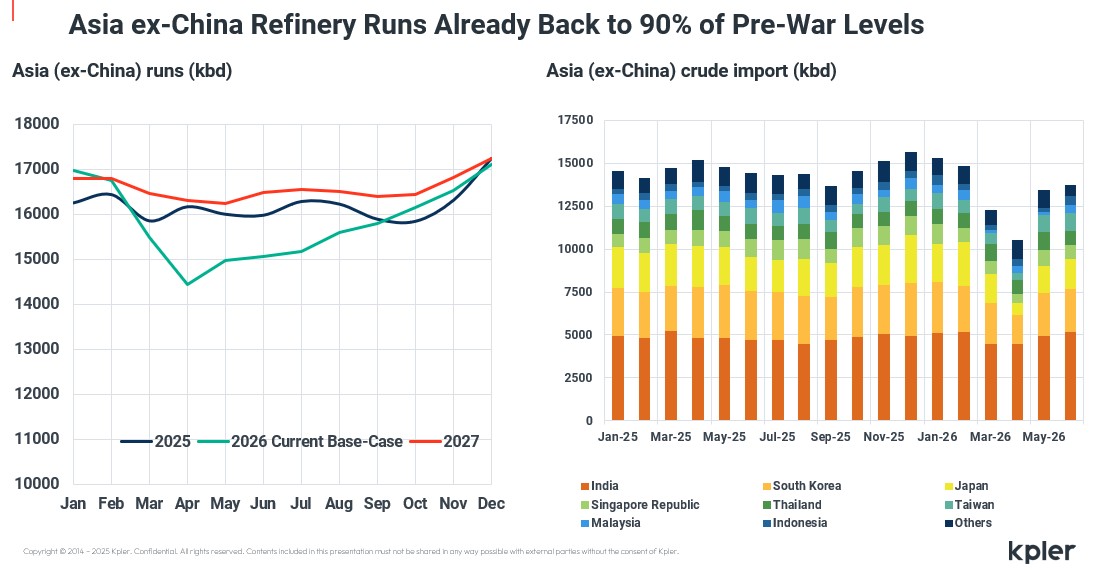
Asia ex-China refinery runs are already back to ~88–90% of pre-war levels.
The next story isn't crude—it's distillates.
With crude supply improving and market uncertainty fading, refiners are likely to increase runs and increase middle distillate exports in the weeks ahead
Middle East crude exports to the United States have been "NIL" since March. And how are they able to manage it? Venezuelan crude, along with SPR management! @Kpler
Amid all the headlines around a peace deal and truce, one key point is: Asia ex-China, the region most affected by the SoH disruption, is expected to import Crude in June at roughly 90-95% of its 2025 average levels. Why? Because China is importing just 60-65% of 2025 levels.
Nigeria has gone from being a major net importer of European refined products to a net exporter. The credit goes largely to Dangote's ramp-up.
A clear example of how energy-deficient nations can transform their energy security, trade balance, and geopolitical resilience. #oott
@TArmanti13764@staunovo@Kpler The curbs on bulk sales are not related to supply constraints. Rather, OMCs are directing bulk consumers away from retail outlets and toward dedicated procurement channels, as they traditionally engaged with these customers directly
While markets remain focused on the US–China balancing act, Venezuela’s crude exports are on track to surpass 1.2 mbd in June, marking their highest level since February 2019, with India, the US, Spain, and the Netherlands emerging as key buyers. #oott@Kpler
“India–US energy trade will increasingly focus on gas,” Sumit Ritolia, lead analyst at Kpler, told CNBC.
🇺🇸, with its “abundant shale and expanding export infrastructure,” is uniquely positioned to benefit from India’s need to diversify gas supplies.
https://t.co/42jqmLBM1n
Russian crude continues to dominate India's crude basket, with June'26 imports on track to reach their highest level since May 2023. If current trends hold, an all-time monthly record cannot be ruled out.
Strong margins, disrupted trade flows have triggered a broad-based shift toward kerosene production across Europe, the US and parts of Asia. The latest production data confirms that yield optimisation is translating into meaningful supply gains, helping offset supply disruptions
Cometh the Time, Cometh the Optimisation: The Barrel Bends Toward Jet
Refiners are doing exactly what tight jet fuel markets would suggest: maximising jet fuel production. What began as a scramble to replace supplies has evolved into a global refinery optimisation cycle.