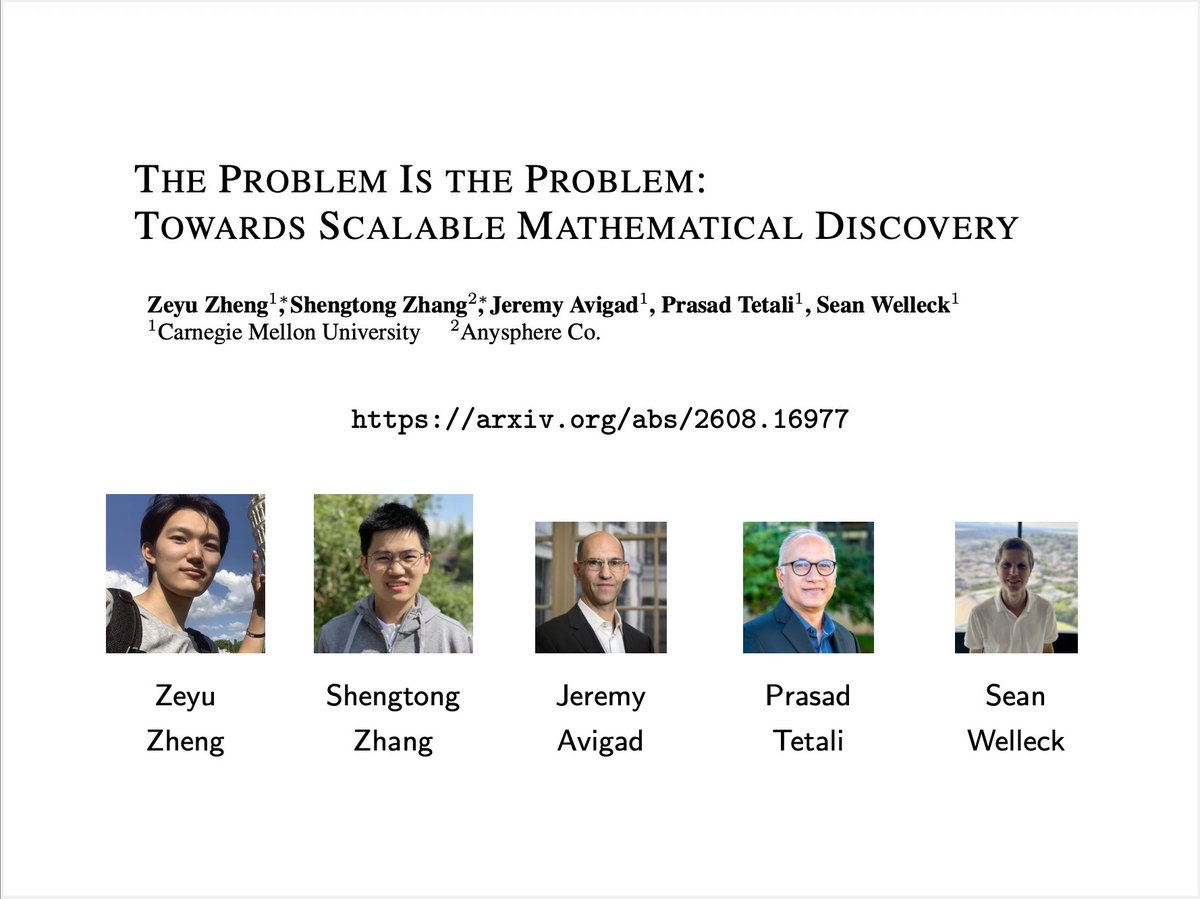
I was honored to give a talk about our work on mathematical discovery at The Geometry of Machine Learning 2026
It covers our recent work on finding, attempting, and recommending resolutions to open conjectures (https://t.co/myX4xaD3dr)
Slides: https://t.co/ryQNZS9xkg
We’re finally able to share all the assets and technical details of our Nemotron system, which achieved gold-medal-level performance at the IMO-26.
The release includes:
* Two specialized models that were part of the final ensemble system, alongside the generally available Nemotron3-Ultra checkpoint
* Two new large-scale datasets for SFT and RL to help models produce better natural-language mathematical proofs
* A set of 200 novel IMO-level mathematical problems
* A technical report with all the details needed to reproduce our work
We hope this release enables others to build on our work and helps advance open-source AI.
Everything is available at: https://t.co/gjGki3rdUp.
Seed Prover formalized the majority of Wang--Zahl's proof of Kakeya conjecture in R^3, and we combined with concurrent work by Numina to finish it. Very fortunate to have contributed to training & inference. Math still has a long road ahead and a lot of room for collaboration.
We’re sharing a solution to the Navier-Stokes Millennium Prize Problem, one of the deepest problems at the frontier of mathematics.
The proof was produced by a group of agents, using an OpenAI next-generation model significantly more capable than GPT-6 Astra.
The problem concerns whether the description of smooth three-dimensional fluid motion modeled by the Navier-Stokes equations can break down. It has remained unresolved for roughly 90 years.
Really nice summary of our work. We believe the “what should AI try to solve?” question will become more and more important as models continue to improve.
AI is getting good enough at mathematics that the harder problem is deciding which problems deserve its compute and a mathematician's attention.
So this paper shifts AI mathematics from "solve this conjecture" to "find which conjectures are actually worth trying."
Makes a lot of sense because, AI can attempt far more mathematical problems than experts can review.
So this paper builds the missing ranking layer between those 2 stages.
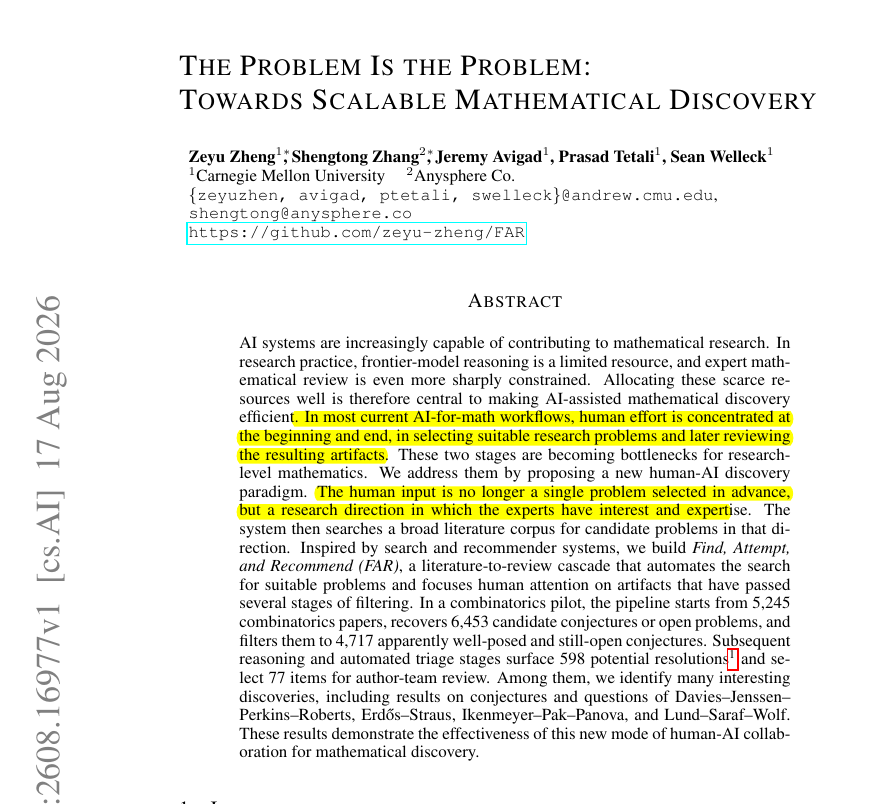
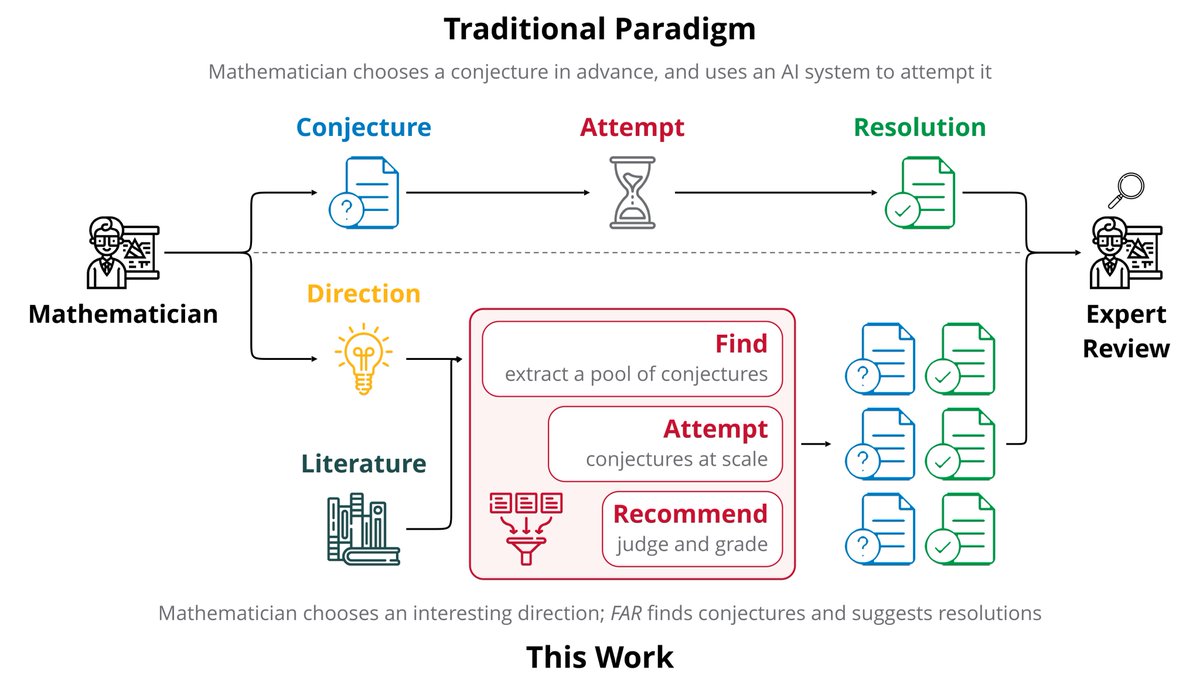
FAR starts with a research direction instead of a hand-picked conjecture, searches the literature for open problems, attempts them at scale, then filters the outputs so expert mathematicians only see the most promising cases.
In its combinatorics pilot, the pipeline narrowed 51,110 papers to 4,717 apparently open, attemptable conjectures, produced 1,050 claimed new resolutions, passed 598 through automated judging, and recommended 77 for expert review.
The authors manually checked 15 selected artifacts and found all 15 mathematically correct, including proofs, counterexamples, and answers to open questions, although 1 had already been solved elsewhere.
It’s a good coding model, sir, and it’s improving rapidly!
Having worked on Muse Spark models from 1.0 to 1.3 in a loop, I keep seeing more and more exciting things to do.
Let it loop in your terminal and watch it improve everything, recursively!
GPT-5.6 Sol found a construction that resolves a question of Babai and Frankl on Oddtowns modulo composite numbers, a classical problem in the linear algebra method in combinatorics, open since the 1980s.
The construction disproves the proposed n bound and, for k with ω distinct prime factors, gives (ω-o(1))n sets, matching the known ωn upper bound asymptotically.
1/5
Mathematical discovery has long been a cottage industry. Mathematicians pose and collect questions that interest them, then pursue them in small groups. In our new work, we explore whether AI can do more than accelerate the existing process: can it enable a more scalable mode of mathematical research?
We introduce FAR: Find, Attempt, and Recommend. Rather than starting from a problem selected in advance, we start from a research direction, search the literature for interesting open problems, attempt them at scale, and filter the results for expert review.
One pilot run over the combinatorics literature surfaced potential resolutions to hundreds of open problems, including an answer to a 1977 Erdős–Straus question and a counterexample to a conjectured route to the finite-field Nikodym bound cited as open in a 2025 survey by Tao.
None of these problems were selected in advance.
5/5
Over time, effort allocation in mathematical discovery is inherently dynamic. As models improve, problems that were previously out of reach may become tractable, so where we spend reasoning compute and expert attention should change as well.
This points to a broader way of thinking about AI-assisted mathematical discovery. The longer-term picture is a system that can continually recover promising questions from the existing literature as well as formulate new questions of its own, probe what is currently within reach, allocate effort across them, and surface promising results for closer expert attention.
FAR is an early experiment in what such a system might look like, and a step toward exponentiating mathematical discovery.
5/5
Over time, effort allocation in mathematical discovery is inherently dynamic. As models improve, problems that were previously out of reach may become tractable, so where we spend reasoning compute and expert attention should change as well.
This points to a broader way of thinking about AI-assisted mathematical discovery. The longer-term picture is a system that can continually recover promising questions from the existing literature as well as formulate new questions of its own, probe what is currently within reach, allocate effort across them, and surface promising results for closer expert attention.
FAR is an early experiment in what such a system might look like, and a step toward exponentiating mathematical discovery.