Hey HPC Carpenters!
The HPCC coord meeting attendance has been dwindling lately, but there’s still lots of interesting work to do!
Please reach out if it's a bad meeting time, or if we're short-changing your priorities -- your priorites are ours!
Hey Carpenters!
HPC Carpentry has a bunch of sessions at the upcoming @CarpentryCon 2022.
We've got a lightning talk, some sprints to help develop our lesson material, and a breakout session about Carpentries.
Check the schedule for details!
https://t.co/hv5WjfWOka
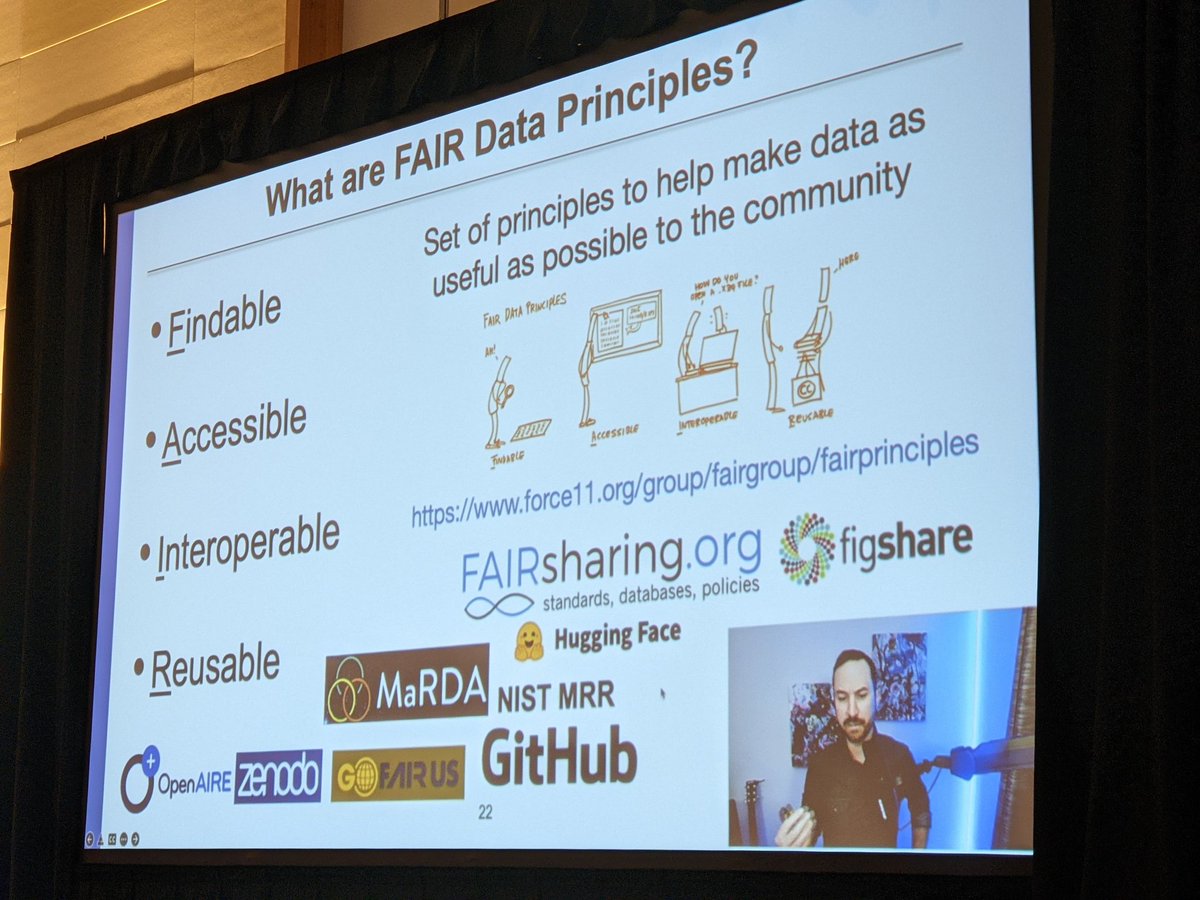
The FAIR principles describe necessary conditions for data to be useful to the community, but we're still missing concrete implementations in a lot of cases.
- @BenBlaiszik at #SciPy2022
OSS has become foundational infrastructure to all scientific research. It can be easy to lose sight of that when you're fixing some little bug, but this work literally saves lives.
@BenBlaiszik at #SciPy2022
@owainkenway I kind of do have the opposite approach in HPC.
If I remember who I bought something from, it's because it went wrong somehow. If I remember the support issue, that's strike 2. If I still know the support phone number for that vendors, strikes 3 through infinity.
@nixcraft A species of conservatism that insists on thinking through probable failure modes, but is still OK going to production with incomplete info.
This feeds into the problem solving thing -- problems are a billion times easier to solve the *second* time you see them.
@KpDooty This rings true. When I applied for my current job, I had to prove that my Physics Ph.D. from Canada was equivalent to US Ph.D.
This is obvious, but the box had to be checked.
"Luckily", there's an agency that will verify this for you for a few hundred dollars.
@neiltyson I did learn, as a result of this, that the "edge of space" (Kármán line) is about altitute *and* *speed* -- it's the approximate altitude at which the amount of speed a winged vehicle needs in order to generate lift is basically orbital speed.
https://t.co/gu2TIXVvVD
@owainkenway Back in the 1980s (and probably before), that compiler was famous for blazing-fast executables.
I actually used it in "production" on my very first research code. Had to teach myself Fortran IV, which didn't take long.
No JCL for me, though:
https://t.co/xvWHY8pVVg
Saw this late yesterday, and went "Hmm, I think that's tool that we use for our VPN..."
Log in this morning, get a banner, "emergency update completed". Workflow prompts for new downloads, and minutes later, I'm good to go.
Props to my workplace's Network Security Team!
#F5 urges customers to patch critical BIG-IP pre-auth RCE bug.
F5 Networks, a leading #provider of enterprise networking gear, has announced four critical #remotecode execution (RCE) vulnerabilities affecting most BIG-IP and BIG-IQ software versions.
https://t.co/Q0n1idHx9P
They're both still good books though.
Yanofsky/Manucci -> Noson Yanofsky & Mirco Mannucci, Quantum Computing for Computer Scientists
Mike/Ike -> Michael Nielsen & Isaac Chuang, Quantum Computation and Quantum Information.
Had a real "quantum day" at #SIAMCSE21, with a keynote on the "quantum revolution", and also two tutorials on quantum computing for scientific applications with LibKET.
This tweet I bookmarked four years ago (to the day!) is well on its way to being fulfilled.
Addendum: Actually got motivated to do some QC exercises.
TIL that translating circuits to matrices requires you to pick an "endian-nss" (is q0 most- or least-significant qbit?), and Yanofsky/Manucci and Mike/Ike apparently make *opposite* *choices*.
So I was not able to attend #supercheck21 in real-time, but I'm interested (and enjoyed the twitter traffic!). Are there recordings? Any point in registering post-hoc?
@ericwastl Probably unpopular opinion: I like the compactness of C.
It's the first programming language I learned on my own, and it "fits in my head", as they say. (Maybe I have a "compact" head...)
When I need to hack up a quick check or test of something, it's my usual go-to.
We discover that the prior knowledge embedded in the physics computation itself acts as an implicit regularization that greatly improves generalization of machine learning models for physics.
Please check out our recent paper: https://t.co/x63TJX0nQ2
Unhappy your work hasn't been cited? 😡 Finding it tricky to get credit attribution right? 🧐 We present a definitive solution: simply cite everything!
11M citations, 200K pages, 1.8 GB PDF. https://t.co/jhrsxUktN5
Enabled by the great @opencitations resource.