$TE $NXT
China is imposing a consumption tax on lithium-ion batteries&solar cells
While dumping has hurt China s own margins,this is a much-needed catalyst for the sluggish solar market,finally giving USmade products the price competitiveness they deserve
https://t.co/aScvq5IEnL
@SouthernValue95 Models will come and go. Meta has the resources, data and compute, to build a model for popular/general use and compete with the likes of Anthropic.
What @BL_labs_xyz built is a blueprint for any country that regulates perps: KYC + local registration + fiat rails in/out + split-key custody on top of HL's order book.
The insight most miss: in restrictive jurisdictions the barrier was never the tech, it's compliance.
A registered, non-custodial router is exactly what bridges regulated users to the deepest onchain liquidity through a legal route, instead of pushing them into a grey area.
This is the template. Wrap the world's best order book in a compliant local layer, and you bring an entire country onchain through the front door.
Hyperliquid.
“Crypto is starting to differentiate based on economics, not just narrative,” said Ryan Rasmussen at Bitwise. “Hyperliquid is one of the first ‘Gen 2’ tokens, where economic activity on the platform accrues directly to the token...” $PURR $HYPD $HYPE
https://t.co/HHzKHIRO4A
Last Friday, the CFTC opened the door to perpetual futures in the U.S.
After years of regulatory headwinds, perps are graduating from crypto’s edge into mainstream finance.
@HyperliquidX has been building exactly what the market needs: a fast, onchain, 24/7, permissionless platform.
As Wall Street plays catch up, Hyperliquid is now positioned to House All of Finance.
https://t.co/1FE5E5PwKc
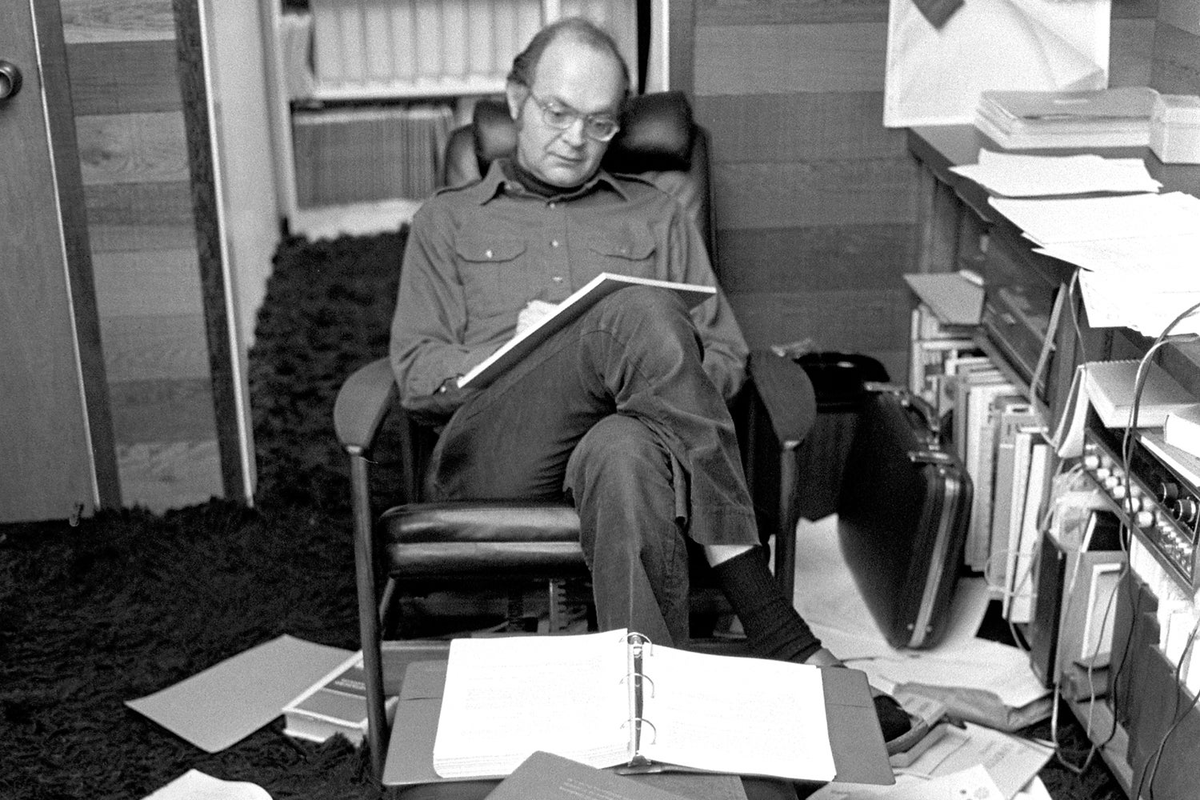
A computer scientist won the Turing Award at 36 and then walked away from almost every other project for the next 50 years to write one book that he has still not finished at age 88, and it may be the most important book in his field.
His name is Donald Knuth. He won the Turing Award in 1974, which is the closest thing computer science has to a Nobel Prize.
He was 36 years old. He had already written volumes one, two, and three of a book series called The Art of Computer Programming. He was the youngest person ever to receive the award at that point in its history.
Almost anyone else would have ridden that moment for the rest of their career. Founded a company. Sat on boards. Gone on speaking tours. Knuth did the opposite. He went back to his desk and kept writing.
He started the book in 1962. He was 24 years old. His publisher had asked him to write a short paperback on compilers. He sat down to outline it and discovered that to explain compilers properly he would have to explain the deeper algorithms underneath them first.
The short paperback became a draft outline of 12 chapters. The 12 chapters became a planned 7-volume series. The 7-volume series became the project he is still working on 63 years later.
Volume 1 came out in 1968. Volume 2 in 1969. Volume 3 in 1973. He was producing books faster than most academics produce papers. Then everything stopped.
In 1977 he received the printed proofs of the second edition of Volume 2. He looked at the pages and was so disgusted by how the publisher had typeset his mathematical notation that he could not bring himself to release the book.
The equations looked ugly. The fonts looked wrong. The spacing was off. He decided he could not in good conscience publish another volume of TAOCP until the typesetting problem was solved.
So he paused the book.
He stopped writing TAOCP and spent the next 8 years inventing TeX from scratch.
TeX is the typesetting system that every academic paper, every math textbook, every physics journal on earth now uses. Every PhD thesis in the sciences is set in TeX. Every paper on arxiv. Every equation in every paper Anthropic, OpenAI, and DeepMind have ever published. The system that the entire scientific publishing world runs on exists because one man refused to compromise on how the second edition of Volume 2 looked.
He gave the entire TeX system away for free. He never tried to commercialize it. He went back to writing TAOCP.
In 1992 he retired from Stanford at the age of 54. Most professors retire to slow down. Knuth retired to speed up. He explicitly said he was leaving teaching because he needed every remaining hour of his life to keep writing the book. He stopped using email on January 1, 1990.
He answers no calls. He takes paper mail only. He is on a personal mission to finish a multi-volume series that nobody is forcing him to write, on a deadline that only exists in his own head.
Volume 4A came out in 2011. Volume 4B in 2022. He is currently working on Volume 4C. Volumes 4D, 4E, 4F, 5, 6, and 7 are still ahead of him. He is 88 years old. He will almost certainly die before he finishes.
The thing that should haunt anyone reading this is the math of his choice.
Every modern incentive structure tells you to optimize for speed. Ship the imperfect version. Get it out the door. Iterate later. Move on to the next thing.
Knuth has spent 63 years doing the exact opposite. He pays a $2.56 reward in hexadecimal dollars to anyone who finds an error in his published books. Real checks, until check fraud made him switch to certificates of deposit. He treats every single error in every single volume as a personal failure. He revises. He rewrites. He goes back to fix issues that nobody else could have spotted.
He could have written 30 books in 63 years. He chose to write one.
The reason is the one almost nobody understands the first time they hear it. There is a category of work that loses all its value when it is done quickly.
A reference book that engineers will rely on for the next 200 years is not the same kind of object as a blog post that has to ship today. The slow project and the fast project look like the same activity from the outside. They are completely different games.
Bill Gates once said in an interview that if you can read the whole of TAOCP, you should send him your resume. He meant it. He was not joking. The man who founded Microsoft was telling the world that the rarest skill on earth is being able to finish a book that one man has spent his entire adult life writing for an audience that mostly does not have the patience to read it.
The book may never be finished.
The man writing it knows this and keeps writing anyway.
The work outlives the worker. That is the entire point.
.@cerebras is now running Kimi K2.6 - the leading trillion parameter open source model - at ~1000 tokens per second in enterprise trials.
6.7x faster than the next-fastest GPU cloud.
10x faster than Claude Opus.
3x faster than Gemini Flash 3.5 (Google’s latest fast model).
A coding task that typically takes 3 minutes finishes in under 6 seconds on Cerebras.
This is what wafer scale was built for.
🆕 Grayscale Research: Hyperliquid is the breakout success story of modern digital assets.
↳ ~$800M in 2025 revenue
↳ 8th largest crypto asset by market cap
↳ No VC backing
↳ Still geoblocked in the U.S.
Our latest report unpacks how it happened, and what's next.
Hyperliquid.
https://t.co/bS3TGy42U5
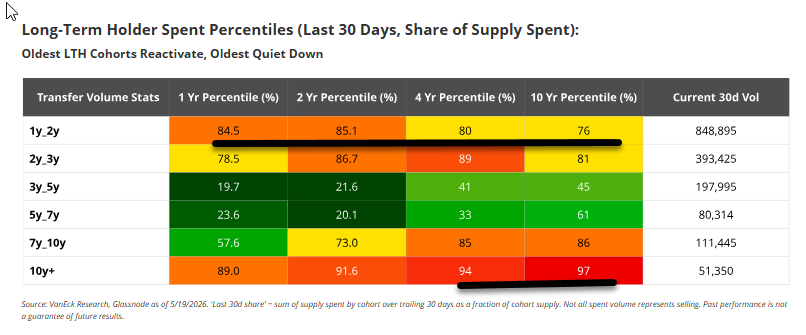
Bitcoin's oldest holders (10y+) are moving coins at record rates but balances stay near all-time highs: some quantum migrations and aging-in supply likely explain the gap.
The real signal: 1y-3y holder balances have collapsed to the 2nd–10th percentiles. AI momentum and HYPE/ZEC strength are pulling capital; investors appear hesitant to add BTC exposure in what's shaping up as a typical down year.