Welcome World!
This account will be periodically showcasing some of the excellent work appearing in Religion, Brain, & Behavior.
And with Volume 10, Issue 4 just out this is a great time to get started!
The paper offers insights for integrating theories of ritual and points towards new directions in mapping the interdependence of psychological reactions and identifying the core cognition of a ritual.
In the latest issue of Religion, Brain & Behavior, Fischer et al. explore the mental maps of Taoist-Buddhist spectators during a large extreme ritual in Thailand using psychological network models.
Full article: https://t.co/kQYkz45rl4
The study, with 1041 participants, identifies the network structure of psychological reactions. The findings reveal that cognitions clustered in communities and were organized along two major dimensions.
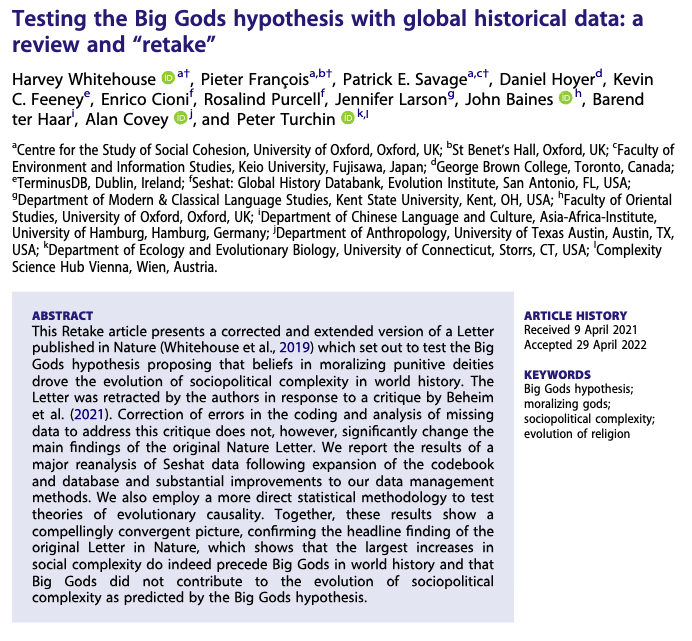
Our latest Special Issue highlights our 'retake' format and contains a new Target article which inspires lively commentary and contributes to debates around the competing hypotheses for the rise of moralizing religions. Find all of the papers here: https://t.co/W31nZ67vCE
Join @BUTheology & @BU_CDS' @WesleyWildman on @reddit_AMA Monday, Feb. 27 from 12-2pm ET! In this live Q&A, he will answer questions on the ethics of using AI text generators, like #ChatGPT, in education, its impact on students & how educators can manage this evolving technology.
A new paper in Vol.22 Issue 3 by Ze Hong offers a cognitive account for manipulative sympathetic magic attributing it to a combination of environmental regularities and causal cognition. https://t.co/lgjNj8NbSb
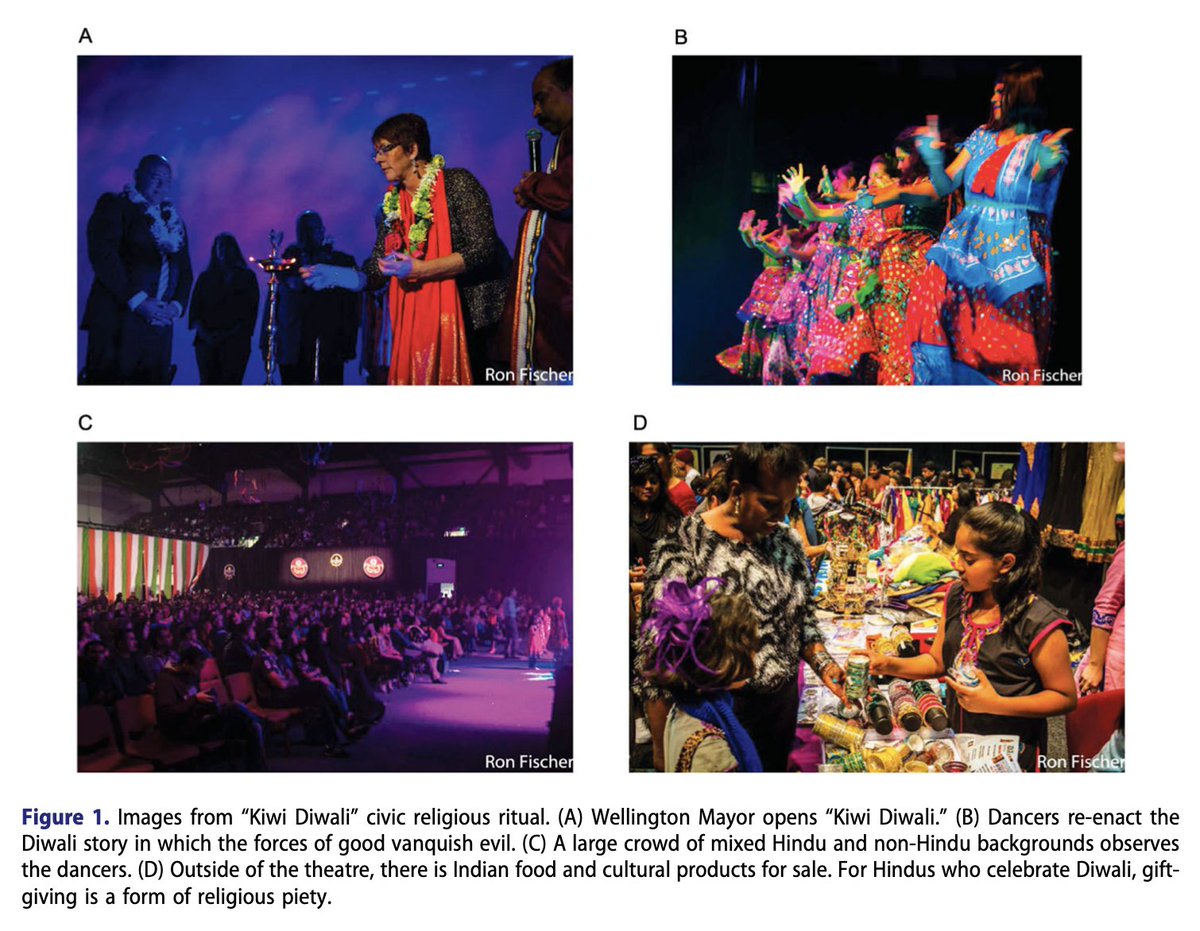
A new study in our most recent issue by Piven et al. uses longitudinal data from a public Diwali celebration in New Zealand to examine the issue of how religious rituals interact with levels of religious commitment and impact social connections. Link: https://t.co/E0UsBW5EcR
Congratulations to @SuzHoogeveen and @a_sarafoglou for leading this excellent special issue in @ReligBrainBehav. (please tag any of many co-authors). “A many-analysts approach to the relation between religiosity and well-being” https://t.co/Om5HAVTbzF
An interesting field experiment conducted in Tanna island in Vanuatu by Vardy & Atkinson (2022) reveals a complex relationship between religious beliefs and prosocial behaviours that is challenging to existing theories. Find the paper here: https://t.co/jB9dFSxKuh
Another paper in Vol.12 by Purzcyki et al. offers a cross-cultural test of the tendency to attribute moral concerns to supernatural deities. In a sample from 15 different sites, they report that local deities are attributed concerns about punishing theft, murder, and deceit.
Our first volume of 2022 is a special double issue presenting the results and critical reflections and commentary on Wave II of the Evolution of Religion and Morality project. All articles, including some open access pieces, can be found at the link below. https://t.co/uvqVt5qnzc
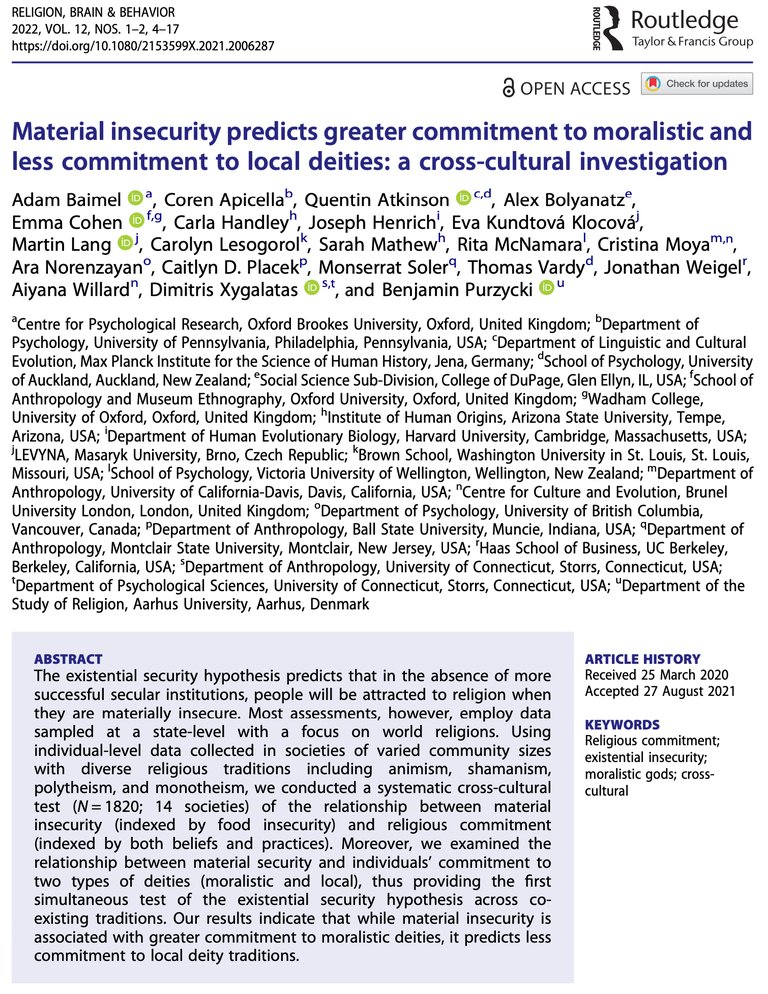
A new paper by Baimel et al. (2022) from our recently released Vol.12, examines the existential security hypothesis using a large cross cultural sample. They find evidence for greater commitment with material insecurity but only for moralistic deities.
https://t.co/tarKY1PBcB
Our latest paper on the effects of sorcery beliefs on parochial prosociality in Mauritius, led by @kundtova & co-authored with @martinlangcz, @Peter_Mano_ & Radek Kundt, has now been published in @ReligBrainBehav
https://t.co/MDYEbHI4S5
A recent empirical study by Ishii & Watanabe (2021) in Vol.11(4) of RBB found that in 2 large Japanese samples the Empathy Quotient (EQ) measure but not the Reading the Mind in the Eyes test (MET) was positively associated with religious belief. Link: https://t.co/ZG1FMR2Sxk