The project I've been working on since Day 0 of grad school is finally published! We find that ecology explains a decent chunk of cultural variation-- across 66 different cultural variables https://t.co/PkTzD3evyH
In those cases, the result is not an "infodemic" but what I have elsewhere called a "marketplace of rationalizations" in which misinformation behaves more like a consumer good than a contagious virus. https://t.co/mB1ycR6gF4
Is misinformation a dangerous virus? Are we living through an infodemic? Is there a vaccine for misinformation? In this review of Sander van der Linden's (@Sander_vdLinden) new book 'Foolproof', I argue that the answer to these questions is "no". A thread:
https://t.co/15kR6JuVbJ
(1/5)
New paper out in Cognitive Psychology with Ralph Hertwig (@arc_mpib) and Gerd Gigerenzer (@mpib_berlin).
We investigate how participants infer Bayesian posterior inferences based on an analysis of >10,000 human inferences and computer simulations.
https://t.co/xNMgkA5hOn
Opportunity for a fully funded PhD Research Fellow position (3 year-scholarship) to study the #cross-cultural patterns of #nomadic#pastoral#cooperation on my @ERC_Research project. Deadline 15th of June.👇
https://t.co/u5WiuJx3vw
"[R]eligious narratives, though false or seemingly irrational, often turn out to reflect concerns about behaviors that matter for people's livelihoods. With radical uncertainty, they are often all we have."
-@adlightner https://t.co/6ZKhAgkKuf
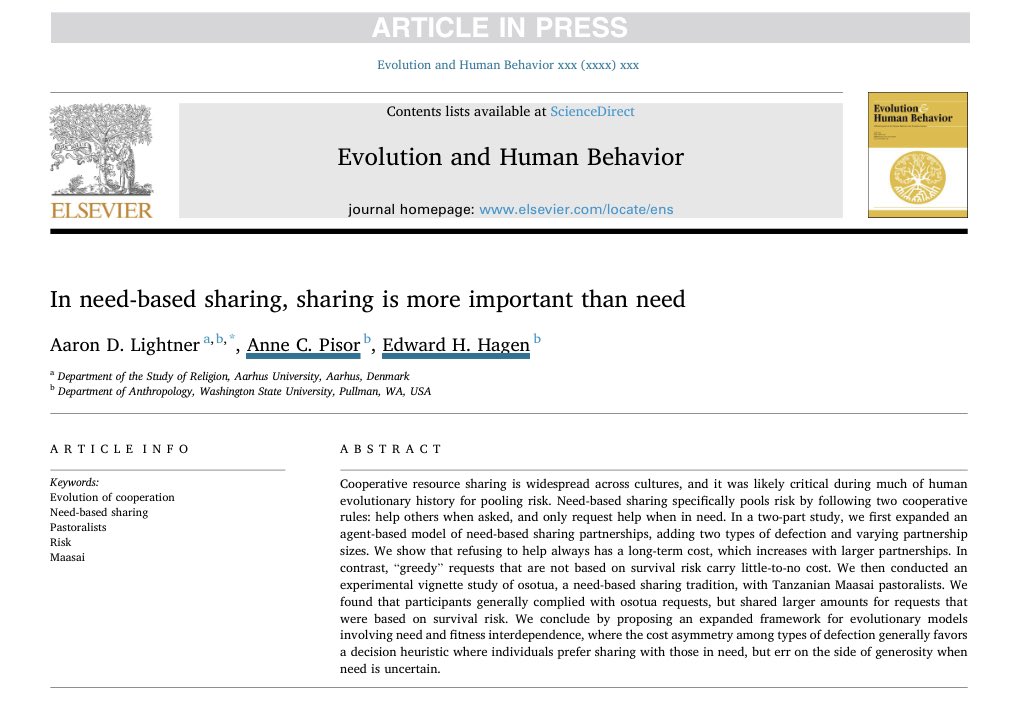
More special issue content just dropped! This one from @adlightner@AnnePisor & @ed_hagen
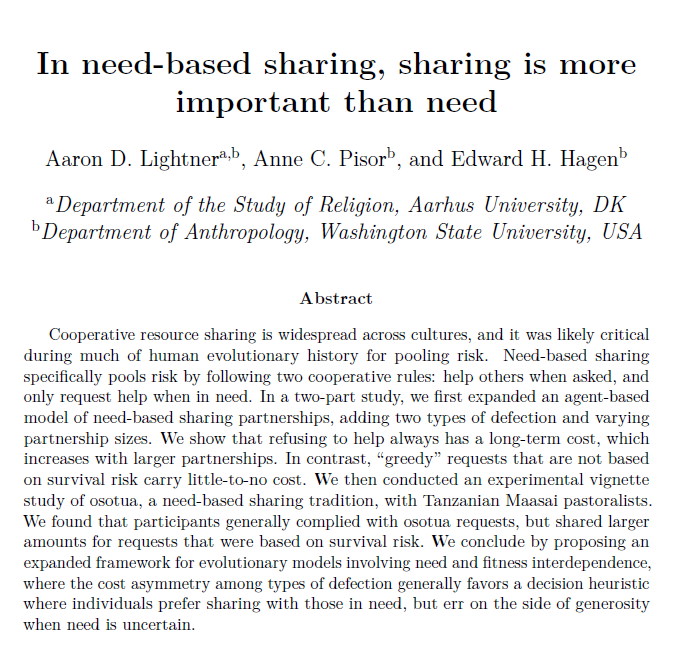
In need-based sharing, sharing is more important than need
https://t.co/GcIIQKFab5
Need is central to many models of human cooperation including need-based sharing: asking for help only when in need & sharing when asked. But it ends up that even if individuals ask when *not* in need, sharing can still enhance survival for all involved 1/
https://t.co/schluCX5yk
New theory paper on the sociocultural dynamics of medical technologies: I show that when individuals can entertain multiple treatments simultaneously, both ineffective and effective medical treatments may stably coexist:
https://t.co/QyVLivvWQ1
1/12 🚨 New publication in @SocialMedia_Soc 🚨 with @Sacha_Altay and @acerbialberto
“Misinformation on Misinformation: conceptual and methodological challenges”
https://t.co/cQQItXCTsl
How do people intervene in a dynamic system to learn its causal structure?🔧⏰
In this new Cogn Psych paper, we found people generate causal events that are both informative and simple to interpret. W/@tobigerstenberg, Ralf Mayrhofer, and @NeilBramley
https://t.co/bbxgNEoF5g
🧵
@juemos Definitely -- we cite and mention it briefly in the discussion, and it's one of the takeaways that I've been really interested in pursuing further
New preprint with @AnnePisor & @ed_hagen: https://t.co/ymUjQJSwiM
🧵: Models of cooperation often highlight that sharing is esp. useful for risk pooling when recipients actually need help
But how strictly does this need-based sharing rule map onto real-world traditions?
/1
There are, of course, many assumptions, alternatives, caveats, etc. that we also discuss in the paper
preprint: https://t.co/ymUjQJSwiM
github repo: https://t.co/U6EufMpRDA
/end
So although need-based sharing is important, the cost of failing to share when someone needs help greatly outweighs the cost of sharing with someone who doesn't
In fieldwork, we also observed people behaving in a way that seems sensitive to these different costs
/9