New preprint with @NeilBramley and Chris Lucas:
We argue that causal judgments are supported by richer mental representations than traditionally assumed, and that this hypothesis can help solve some puzzles about causation.
hooray, the "Bayesian Models of Cognition" book is out, for all your Bayesian models of cognition needs :)
(I contributed to 3 chapters in the book -- development, intuitive physics, theory of mind -- that can be read on the ol' website)
So honoured to be one of the recipients of this award!
✨Thanks to my amazing supervisor @NeilBramley, my collaborators @tobigerstenberg, @mxpacer, @cocosci_lab, Ralf Mayrhofer, and the pioneers and current researchers in causal reasoning who have inspired this thesis! ✨
Happy to share a new paper in JEP:G: "Evidence from the future"✨✨, with @NeilBramley. We investigate how people make causal inferences with incomplete evidence, while effects may still be on their way. 🧵https://t.co/ImvwoSOXhO
Excited to share our new paper https://t.co/JijwCc66w1 (Oral, ICLR 2024, w/ @tom4everitt, @GoogleDeepMind). In it we answer the question, do agents need to learn causal world models? https://t.co/JijwCc66w1. 🧵
SymbolicAI
A framework for logic-based approaches combining generative models and solvers
paper page: https://t.co/76vBvlnmhi
introduce SymbolicAI, a versatile and modular framework employing a logic-based approach to concept learning and flow management in generative processes. SymbolicAI enables the seamless integration of generative models with a diverse range of solvers by treating large language models (LLMs) as semantic parsers that execute tasks based on both natural and formal language instructions, thus bridging the gap between symbolic reasoning and generative AI. We leverage probabilistic programming principles to tackle complex tasks, and utilize differentiable and classical programming paradigms with their respective strengths. The framework introduces a set of polymorphic, compositional, and self-referential operations for data stream manipulation, aligning LLM outputs with user objectives. As a result, we can transition between the capabilities of various foundation models endowed with zero- and few-shot learning capabilities and specialized, fine-tuned models or solvers proficient in addressing specific problems. In turn, the framework facilitates the creation and evaluation of explainable computational graphs. We conclude by introducing a quality measure and its empirical score for evaluating these computational graphs, and propose a benchmark that compares various state-of-the-art LLMs across a set of complex workflows. We refer to the empirical score as the "Vector Embedding for Relational Trajectory Evaluation through Cross-similarity", or VERTEX score for short. The framework codebase and benchmark are linked below.
Published in Science today, @wkvong reports a dream experiment: he trained a multi-modal AI model from scratch on a subset of one child's experiences, as captured by headcam video. Shows how grounded word learning is possible in natural settings, as discussed in his thread:
Paper lays out the approach and demonstrates with a bandit task case study complete with tutorial code and guidance for adapting to your own research questions!
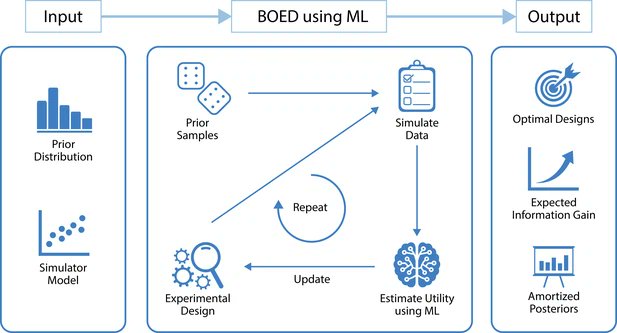
New tutorial paper just out in eLife "Designing optimal behavioral experiments using machine learning" https://t.co/laVsX5XJLi
By Simon Valentin & @SKleinegesse with me, @SeriesPeggy Michael Gutmann & Chris Lucas
We train a neural network on data simulated from candidate models learning the relationship between design variables and expected info. The result: efficient experimental designs for modern research programs involving arbitrarily complex simulator models.
𝗧𝗵𝗲 𝗢𝗻𝘁𝗼𝗹𝗼𝗴𝘆 𝗼𝗳 𝗖𝗼𝗺𝗽𝗹𝗲𝘅 𝗦𝘆𝘀𝘁𝗲𝗺𝘀: 𝗟𝗲𝘃𝗲𝗹𝘀 𝗼𝗳 𝗢𝗿𝗴𝗮𝗻𝗶𝘇𝗮𝘁𝗶𝗼𝗻, 𝗣𝗲𝗿𝘀𝗽𝗲𝗰𝘁𝗶𝘃𝗲𝘀, 𝗮𝗻𝗱 𝗖𝗮𝘂𝘀𝗮𝗹 𝗧𝗵𝗶𝗰𝗸𝗲𝘁𝘀
One of coolest figures in a philosophy paper...
And one of most spectacular papers ever!
https://t.co/69Z6gvHUVj
New paper w @DaniSBassett on "Causation in neuroscience: keeping mechanism meaningful" in Nature Reviews Neuroscience @NatRevNeurosci
We explore different meanings of mechanism in the field, the challenges this presents & how to move forward. 🧠 @NSF
https://t.co/RPRg0KTcj4
We’re hiring! Open area search for 4 (!) permanent positions, w/ particular interest in some areas (eg social psych). Feel free to reach out w Qs. Job ad: https://t.co/tRcL1XZX38
@SchoolofPPLS@PsychJobs
Come be a Lecturer or Reader (Assistant/Assoc Prof w tenure) in Computational Cognitive Science in Edinburgh, where it all began* and all continues to happen**! Apply by Jan 12th 2024
https://t.co/FKzmSKafce
...+ doctoral training programmes in both Natural Language Processing & in Robotics & Autonomous Systems. Not to mention being colocated Bayes Centre, Edinburgh Futures Institute, founding membership of the Turing Institute & home to the UK's primary supercomputing cluster