There isn’t one AI leaderboard. There are at least three.
• Enterprise momentum: Anthropic has the strongest scaled enterprise climb, xAI shows the sharpest relative rise from a small base, and OpenAI remains huge but is no longer pulling away.
• Grok monetization: between Dec. 2025 and Mar. 2026, Grok AI-feature MAU grew from 89M to 117M, while SuperGrok paid subscribers jumped from 0.9M to 1.9M. Paid conversion is growing much faster than usage.
• Consumer scale: ChatGPT still dominates standalone app MAU, Gemini is the clear #2, and Grok already sits ahead of Claude in this app-only snapshot.
Same market. Different scoreboards. Very different story.
The interesting part is how quickly the rankings change once you stop looking at users alone.
@the_codewala An assistant that never sleeps is only useful if you can sleep while it works.
That takes serious control: permissions, validation, monitoring, and a way to stop it when something goes wrong.
Le piège, c’est quand la délégation devient du désengagement 😄
Une étude Microsoft/CMU montrait déjà que plus les gens avaient confiance dans l’IA, moins ils déclaraient exercer de pensée critique.
L’IA devrait réduire les efforts, jamais notre vigilance.
Plus elle fait de choses pour nous, plus il faut rester capable de reprendre la main (imho).
J'intègre toujours cette réflexion dans mes projets et les architectures que je mets en place.
Le piège c'est quand l'IA va vraiment se démocratiser. Là il va falloir faire gaffe, surtout dans les boîtes. Les gardes fous devront être partout.
This actually made me think of the recent CAR-bench paper.
They gave tool-using agents tasks where some required information or capabilities were deliberately missing.
Instead of simply acknowledging the limit, frontier models still sometimes fabricated information or violated policies to complete the task.
So I’m not sure hallucinations disappeared.
They may just be showing up higher in the stack now.
more here: https://t.co/6YRpitkHkA
Ce qui m’intéresse ici n’est pas tellement la disparition de tel ou tel métier.
C’est la compression organisationnelle.
Une personne peut progressivement absorber des responsabilités qui demandaient auparavant plusieurs rôles.
Les boîtes ne feront pas forcément moins de choses. Elles auront besoin de moins de frontières internes pour les faire.
@zachmoskow I agree with the dependency risk but I’m not sure “50% open source” is the real hedge.
The real hedge is making sure your workflow survives a provider changing price, limits, or model overnight.
Models should be replaceable.
The system around them shouldn’t be.
Je pense que la conséquence économique est encore plus brutale : l’avance technologique devient un actif périssable.
Si une capacité exclusive aujourd’hui devient accessible ailleurs quelques mois plus tard, le labo dispose essentiellement d’une fenêtre pour transformer cette avance en quelque chose de durable : distribution, workflows intégrés, données, confiance, switching costs…
Sinon la capacité se commoditise avant que le moat ait eu le temps de se former.
La vraie course devient presque : vitesse de création du moat vs vitesse de rattrapage.
At $2T, a $100B offering is roughly 5% of the equity.
Pretty elegant setup if they can pull it off: expose only a small slice to public price discovery, raise an enormous amount of fresh capital, and keep most of the upside with existing holders.
And if demand is as strong as expected, I’d definitely keep an eye on the greenshoe.
A 15% overallotment could push a $100B deal toward $115B.
Not a bad way to test what the public market is really willing to pay.
@TTrimoreau With an IPO on the horizon, Anthropic may eventually have to realize that model quality isn’t the whole product.
Usage limits are part of the UX too.
OpenAI seems to have understood that lately.
Unlimited Claude? Very tempting.
One-model dependency? Still no.
@dan_saffar Le vrai réflexe devrait être :
buy by default, build for differentiation.
Si ça ne crée pas un avantage spécifique à ton business, le temps passé à le reconstruire est probablement du luxe.
Rien n'est jamais perdu, c'est de l'expérience en plus.
Franc succès en tous les cas !
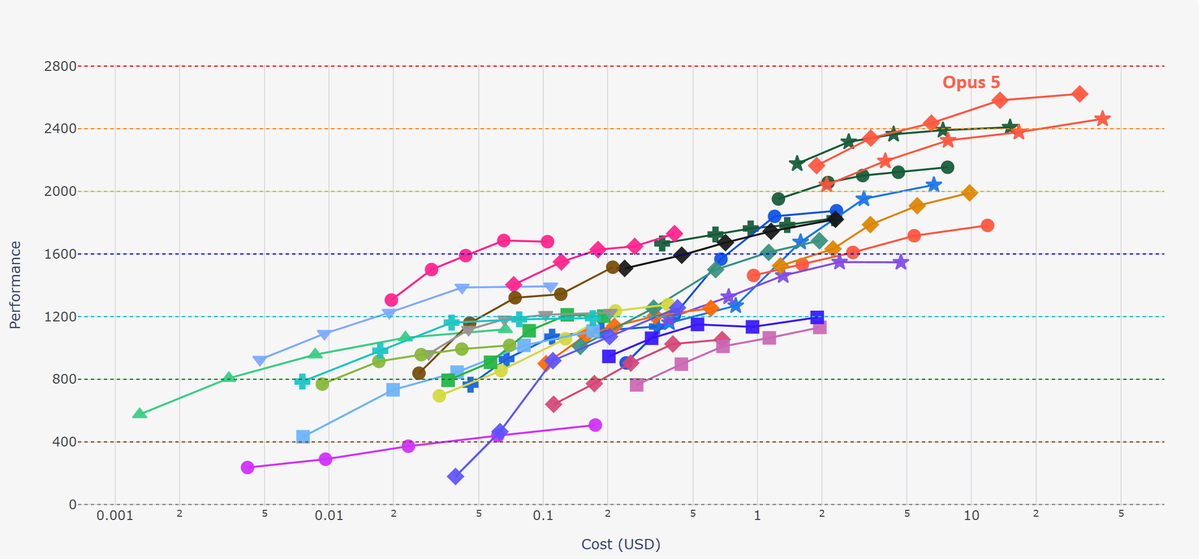
This is much bigger than “Opus is good at optimization.” 🥳
Give a model an objective metric + tools + feedback and it can search for improvements instead of trying to produce the right answer in one shot.
Example:
latency <100ms → profile → modify → 112ms → iterate → 96ms → PASS 😎
Prompting asks for an answer.
Hill climbing gives the model a direction. 💯
Opus 5 is the closest thing we have to whatever Anthropic has internally
it's an absolute monster if you want to optimize anything
give it a target and it will hillclimb
@PremiumGoblin Thanks John, really appreciate it :-]
Just saw the full setup.
Now I get why you forget the specs.
That’s a serious amount of hardware for one man cave 😆
@techguy_x Too much 😅
Which is exactly why I think having the ability to switch models without redesigning your workflow is an underrated luxury in 2026.
Models should be replaceable. Workflows shouldn’t be (imho).
🎯
C'est là qu'on voit que tu as travaillé sur le sujet.
Et effectivement l’oubli est au centre de l'équation sur ces problématiques.
Une bonne mémoire ne se mesure pas seulement à ce qu’elle sait retrouver, mais aussi à tout ce qu’elle sait laisser dormir.
Le vrai luxe n’est plus de tout retenir :
C’est de faire remonter la bonne chose au bon moment.
(J'avais commencé à builder un outil perso, pour le moment au freezer ,mais je trouve le sujet passionnant).
Le code était un excellent moyen d’apprendre à penser quand il fallait expliquer chaque étape à la machine.
Avec l’IA, la compétence se déplace : il faut surtout savoir formuler, décomposer, orchestrer, tester et juger.
Le terrain de jeu change. La nécessité de penser, elle, ne change pas.