An unconscious coping mechanism that enables acceptance of difficult past events by making them appear inevitable in hindsight, without the torment of imagining what might have been
Dans le manifeste "techno-optimiste" de Marc Andreessen, il y a une phrase qui m'a marqué :
"Our enemies are not bad people – but rather bad ideas."
Nos ennemis ne sont pas des mauvaises personnes. Ce sont des mauvaises idées.
Prenons Jancovici. L'homme est brillant, sincère, travailleur. Il ne se lève pas le matin en se disant qu'il va nuire à l'humanité. Mais l'idée qu'il porte la décroissance, le rationnement, la frugalité érigée en horizon civilisationnel est une idée profondément destructrice. Elle prend des esprits brillants et les transforme en commissaires politiques d'un futur appauvri.
Et le plus fascinant, c'est ce que cette idée fait aux gens qui l'adoptent.
Dans mon entourage, une grosse partie de mes amis est sur cette ligne décroissantiste, avec tout le package qui va avec. L'argent c'est mal mais ils en veulent. Il faut moins prendre l'avion mais ils rêvent de voyager partout. Il faut consommer moins mais ils ne renoncent à rien de ce qu'ils aiment vraiment.
Et tous ont un point commun : ils sont déprimés. L'un d'eux m'a même confié qu'il était sous antidépresseurs.
Ce n'est pas un hasard. C'est mécanique.
Quand tu crois que ton désir de vivre, de créer, de t'élever est moralement suspect tu te détruis de l'intérieur. Tu passes ta vie à t'excuser d'exister. Tu vis dans la dissonance permanente entre ce que ton corps veut (plus, mieux, plus loin) et ce que ton idéologie t'ordonne (moins, sobre, immobile).
D'où ma théorie :
Quand on pense quelque chose de fondamentalement faux décroissance, communisme, extrémisme religieux (de tout ordre) ce n'est qu'une question de temps avant que ça devienne vraiment destructeur.
D'abord pour soi. Puis pour les autres.
Les mauvaises idées tuent. Lentement chez ceux qui y croient, brutalement chez ceux qui les subissent.
C'est pour ça que la bataille des idées n'est pas un luxe d'intellectuel. C'est la bataille la plus importante de notre époque.
JUST IN: Skin exams are getting automated.
SquareMind just raised $18M to build a robotic system that scans your entire body and tracks every mole over time.
• Swan robot captures full-body dermoscopic images in minutes
• Tracks new and changing spots across visits
• Replaces spot-check exams with total skin coverage
• Creates a time-series record for earlier melanoma detection
• Plugs directly into dermatology clinics
Robotics is going to reshape healthcare.
Only one chance in this lifetime…
Like watching sunset at the beach from the most foreign seat in the cosmos, I couldn’t resist a cell phone video of Earthset. You can hear the shutter on the Nikon as @Astro_Christina is hammering away on 3-shot brackets and capturing those exceptional Earthset photos through the 400mm lens. @AstroVicGlover was in window 3 watching with @Astro_Jeremy next to him.
I could barely see the Moon through the docking hatch window but the iPhone was the perfect size to catch the view…this is uncropped, uncut with 8x zoom which is quite comparable to the view of the human eye. Enjoy.
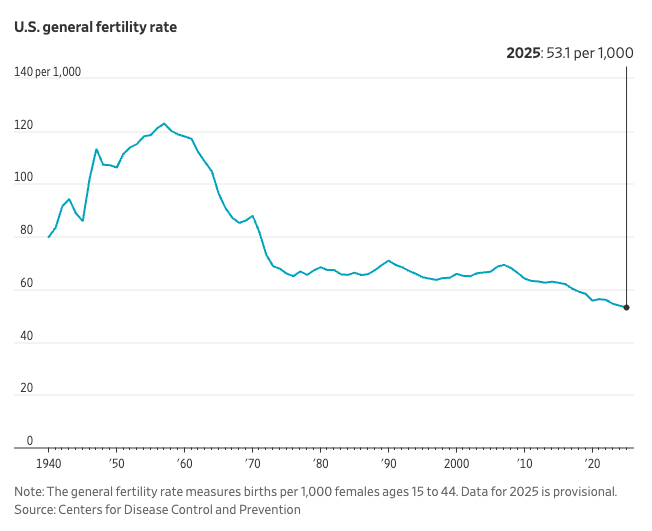
US fertility reached 1.57 last year, the lowest ever recorded, and the WSJ explanation is "uncertainty about finances, relationship stability, and the political climate"
my great grandma had eleven children during the second world war, in a country being bombed, in a house with no running water, on rations.
poor people have always had kids. the poorest people on earth right now still have kids and the financial excuse is a story we tell ourselves because it makes us feel good and the real one is unbearable
the real mechanism is that we got rich enough to redefine children as an expense instead of the point. somewhere in the last fifty years the cultural goal inverted and a child stopped being what life is for and became a line item competing with the lifestyle. once you frame it that way the math never works, because the math isnt supposed to work. that's the point
we are living in the richest moment in human history and we decided to use the surplus to buy ourselves out of the future. the most prosperous civilization that has ever existed is committing demographic suicide at the altar of personal optimization and comfort, and the official line is that we cant afford it
the birthrate is a lagging indicator of a civilization that forgot why it was alive
Did you know C.S. Lewis predicted the modern obsession with “being nice” would destroy the soul?
In The Abolition of Man, Lewis argues that when a society stops believing in objective virtue, it doesn’t become tolerant… it becomes manipulable.
He calls the result “men without chests.”
People with appetites and intellects, but no courage, no honor, no trained moral instincts. They can calculate everything and defend nothing.
Lewis saw that once we reject inherited moral law, we don’t become free. We become raw material… easily shaped by propaganda, pleasure, and fear.
Modern man prides himself on compassion while quietly surrendering every standard that once gave compassion meaning.
Lewis’s insight is brutal: a civilization that educates clever cowards will eventually be ruled by tyrants or technicians.
Because when nothing is worth dying for, everything becomes negotiable… including human dignity.
Jusqu'à ce jour, les marxistes sont incapables de donner une réponse satisfaisante à ce genre de meme. C'est dire la nullité de leur pensée économique.
La valeur n'est pas dans le bien ni dans l'effort fourni pour le produire. Elle est dans l'esprit de celui qui désire ce bien pour résoudre un besoin individuel. La valeur est donc subjective, marginale, contextuelle. Elle n'est pas objective, mesurable, mathématisable.
Ainsi s'écrase lamentablement la théorie marxiste de la valeur travail et les théories classiques de la valeur objective. Si ces théories ont réussi à survivre jusqu'à aujourd'hui, c'est uniquement parce qu'elle donne une caution scientifique à l'interventionnisme étatique, rien d'autre.
Truth is now considered a right-wing conspiracy.
That’s the chilling line from Melanie Phillips that stopped me in my tracks.
She explains how we’ve reached a point where simply stating observable reality — whether it’s basic biology defining a woman or pushing back against blanket accusations that all white people are inherently bad — gets you branded as evil. Not wrong. Evil. Therefore you must be silenced, cancelled, or erased. No debate. No evidence allowed.
She calls it cultural totalitarianism: a Manichean worldview where one ideology claims a monopoly on goodness, progress, and reason itself. Dissent isn’t argued with — it’s treated as a moral threat that has to be removed.
The deepest irony? In an era that smugly ditched religion in the name of superior rationality, we’ve ended up rejecting reason, evidence, and open inquiry altogether. We’re so “rational” we’ve dispensed with the very tools of rationality.
It doesn’t add up.
Her take has me wondering how we got here — and how quickly disagreement turned into moral excommunication.
Anyone else seeing this pattern play out in conversations lately? Where have you felt truth itself become off-limits?