Meeting notes here, docs there, decisions nobody wrote down. Reqify turns all of it into one project workspace — and every answer it gives cites the source it came from, not a guess.
Here's what that looks like
The last step is the boring one, on purpose.
Word or PDF, with the firm's own logo, colours and fonts applied. It lands in the same review process the team already runs. Nothing about the client's side changes.
(Demo project, synthetic data.)
Workshop 5 decides one thing. Workshop 7 changes it.
In Reqify the first decision is marked superseded and linked to the new one, with the verbatim quote from each meeting kept. Nobody has to remember why it changed.
(Demo project, synthetic data.)
One project week in fourteen seconds: a Teams transcript comes in, a line becomes evidence, a decision is confirmed with its quote, the spec shows what is sourced, the answer cites the workshop, and it goes out as Word.
(Demo project, synthetic data.)
A plain product note.
Connect Microsoft Teams or Google Meet to a Reqify project and transcripts of meetings you organise come in for review. No exporting, no uploading, no asking who has the recording.
You approve each one. Then it is project evidence you can cite.
Before a delivery lead signs off a requirements document, the real question is what it was written from.
Every generated section carries a Sources line. The inspector lists each document cited and how many sections it informed.
(Demo project, synthetic data.)
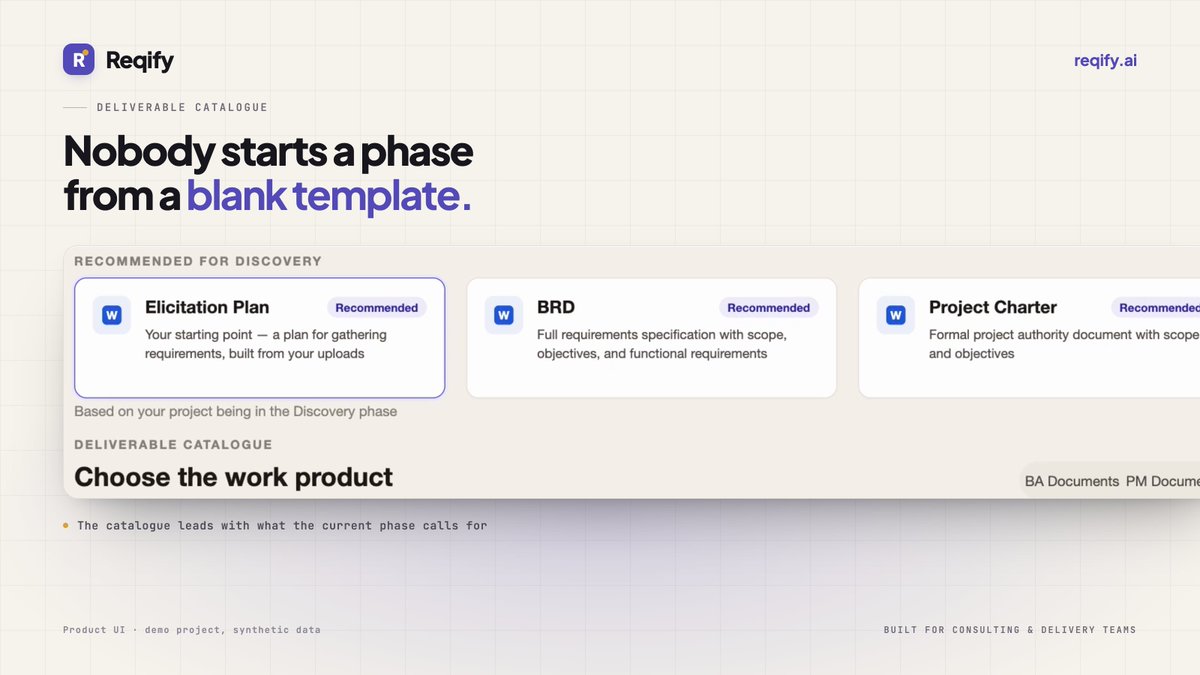
Kickoff is done. What do you produce first?
On discovery it's usually an elicitation plan, then requirements, then stories. Consultants carry that order in their head.
Reqify puts what the phase calls for at the top, written from the project.
(Demo project, synthetic data.)
One project's decision log is a documentation problem.
Five concurrent engagements is a portfolio risk.
A call made in project three eight weeks ago has to hold up today, in front of someone who wasn't in the room.
A deliverable written from the project, not from a prompt.
Pick the work product. Reqify reads the project documents before it asks anything, then asks only what they left open. Every section of the draft lists its sources. Inferred ones say so.
(Demo project, synthetic data.)
A client reviewer stops on story fourteen. "We never asked for that."
Either someone re-listens to a recording for a week, or the consultant opens workshop two, forty minutes in, and plays the sentence.
The second isn't better memory. It's how the draft was built.
Where a project starts: with what the team already has.
Workshop transcript, current-state process doc, last steering pack. Into one project, indexed as evidence. Nothing generated yet. Everything later points back here.
(Demo project, synthetic data.)
A short clip this time.
Connect Google Meet to Reqify once. Meetings you organise are transcribed and proposed for review, with a suggested project. Start one from inside a project and the transcript lands there when it ends.
https://t.co/FwrcfOkI1S
The workshop ends at four. The consolidation starts at seven.
Recording in one window, notes in another, the story template in a third. Every requirement found again, phrased again, placed where a reviewer can check it.
On a fixed-fee discovery, that evening was sold once.