Gold fell on the one day built around buying it.
MCX gold is down about 1.4% this Dhanteras morning, silver about 1.7%, dragged by a US rate-hike scare even as Indian stocks rallied.
That’s rare. In 4 of the last 5 Dhanterases, the pattern ran the other way: the pricier gold got walking in, the less of it India bought, in volume.
2019: price +23%, sales forecast -50%
2020: +38%, -30%
2024: +31.6%, -16%
2025: +65%, -15%
The exception proves it. Dhanteras 2021: gold prices flat to lower after two weak years. The World Gold Council called it the best Dhanteras for jewellers in three years. Cheaper gold, more gold bought.
Catch: these are trade-body forecasts made before the day, not sales counted after it. Rupee spending often holds up even when the grams bought fall, so the real shift may be smaller pieces, not fewer buyers.
Does 6 Nov’s rare price dip break the streak?
#Dhanteras #Gold #GoldPrice #IndianMarkets #MCX
The offer has no minimum acceptance. If every share asked for were tendered, the buyer’s side would hold 77.00% and the public 23.00%, below the 25% minimum the listing rules set and the announcement says steps would then be taken to restore it.
The offer’s detailed public statement is due within five working days of the 30 Oct completion.
Research, not advice. Do your own work.
BP sold control but kept a minority stake in the buyer. What do its minority protection rights cover?
#CastrolIndia #OpenOffer #IndianStockMarket #NSE
BP sold the company that controls Castrol India on 30 Oct 2026 and in the same step took 35% of the buyer.
Castrol Limited still holds the same 51.00% of Castrol India. The owner behind it changed.
From Castrol India’s 2 Nov letter to the exchanges: Motion JVCo, part of Stonepeak Infrastructure Fund V, bought all of Castrol Group Holdings, which owns Castrol Limited. A BP subsidiary was issued 35% of Motion JVCo. The buyer now has sole control.
#CastrolIndia #OpenOffer #IndianStockMarket #NSE
Traced through that chain, about 17.85% of Castrol India sits with BP. That is our arithmetic on ownership, not a holding in any filing. The 24 Dec 2025 letter says BP has no control over the buyer or Castrol India, only customary minority protection rights.
#CastrolIndia #OpenOffer #IndianStockMarket #NSE
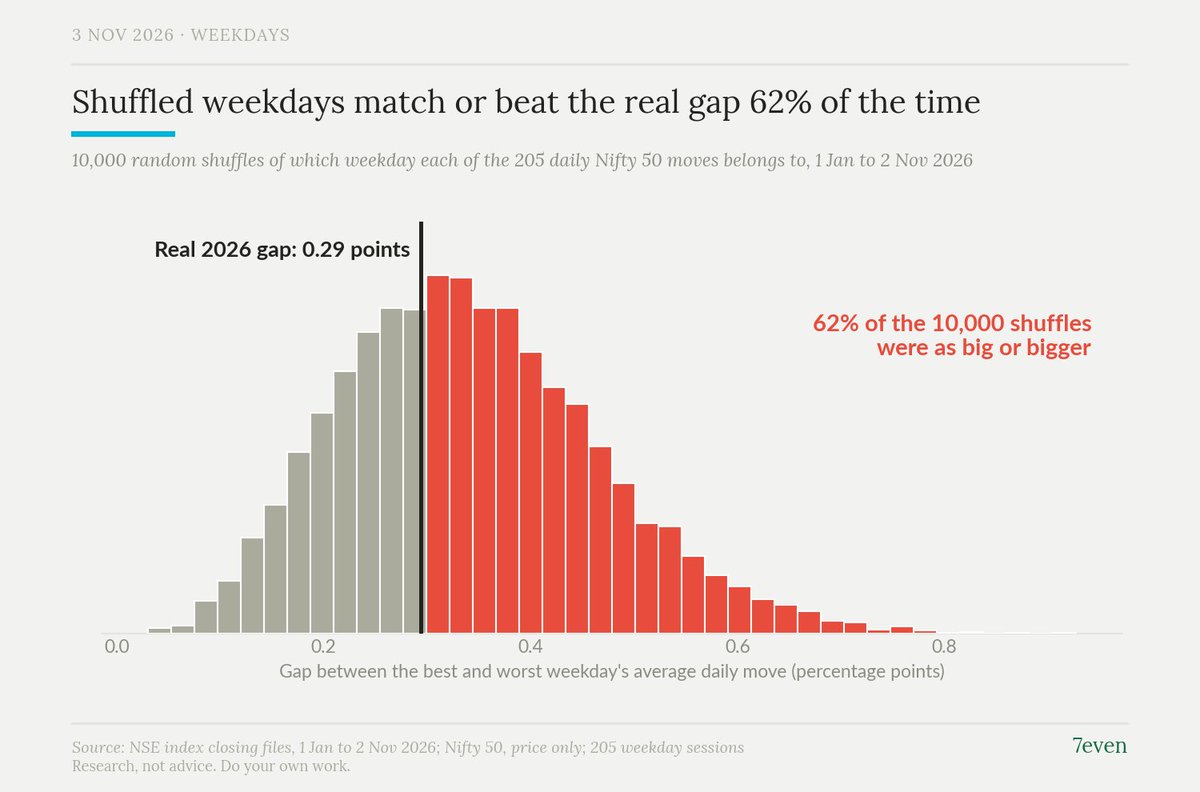
The test: keep the 205 daily moves, shuffle which weekday each belongs to and measure the gap between the best and worst weekday’s average. The real gap was 0.29 percentage points. 6,223 of 10,000 shuffles were as big or bigger. A gap this size is what chance produces.
The catch: about 40 sessions per weekday, one year, one index and we did not test why. A weekday pattern should survive more than one year before it earns trust. Which would you want to see first: more years of data, or a reason?
#Nifty50 #StockMarketIndia #MarketResearch #DataAnalysis
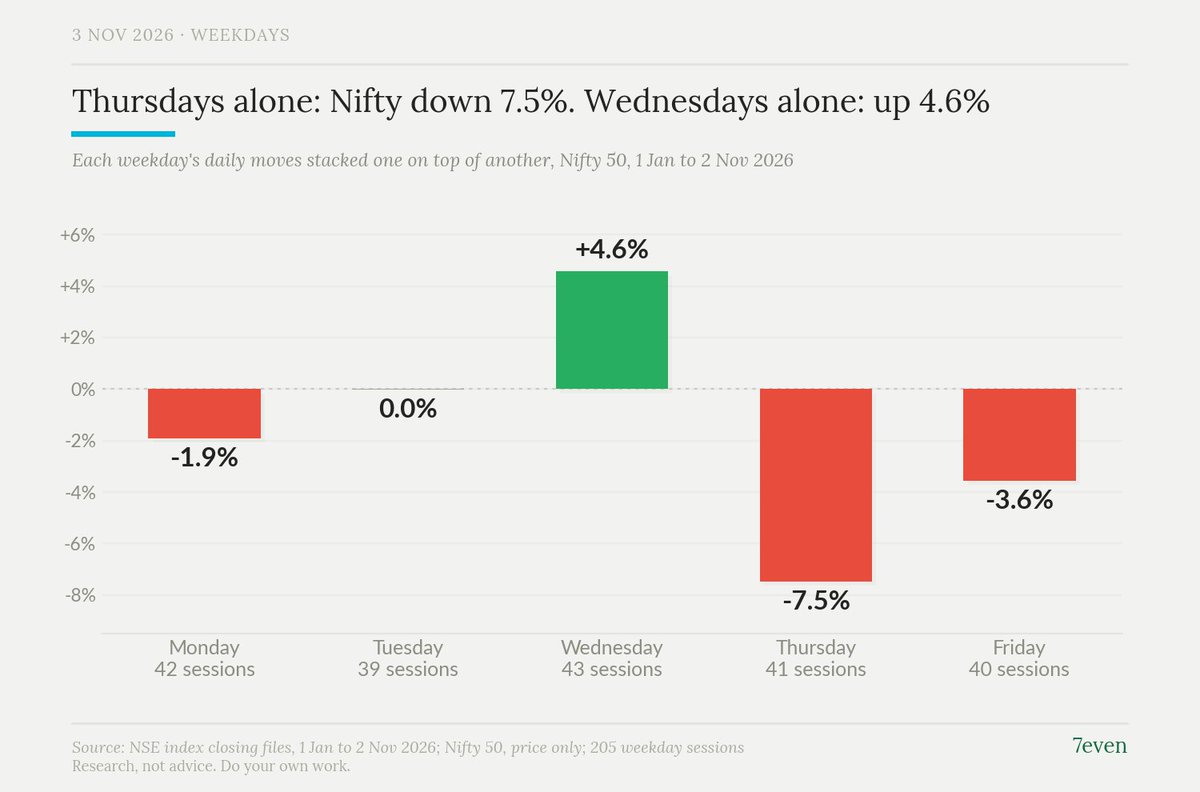
Thursdays alone: the Nifty fell 7.5% in 2026. Wednesdays alone: it rose 4.6%. That looks like a pattern. So, we shuffled the weekday labels 10,000 times. In 62% of the shuffles, chance produced a gap between the best and worst weekday as big as the real one or bigger.
Here is the real picture. We grouped the 205 Monday-to-Friday sessions from 1 Jan to 2 Nov 2026 by weekday and stacked each weekday’s daily moves one on top of another. Monday -1.9%, Tuesday 0.0%, Wednesday +4.6%, Thursday -7.5%, Friday -3.6%.
#Nifty50 #StockMarketIndia #MarketResearch #DataAnalysis
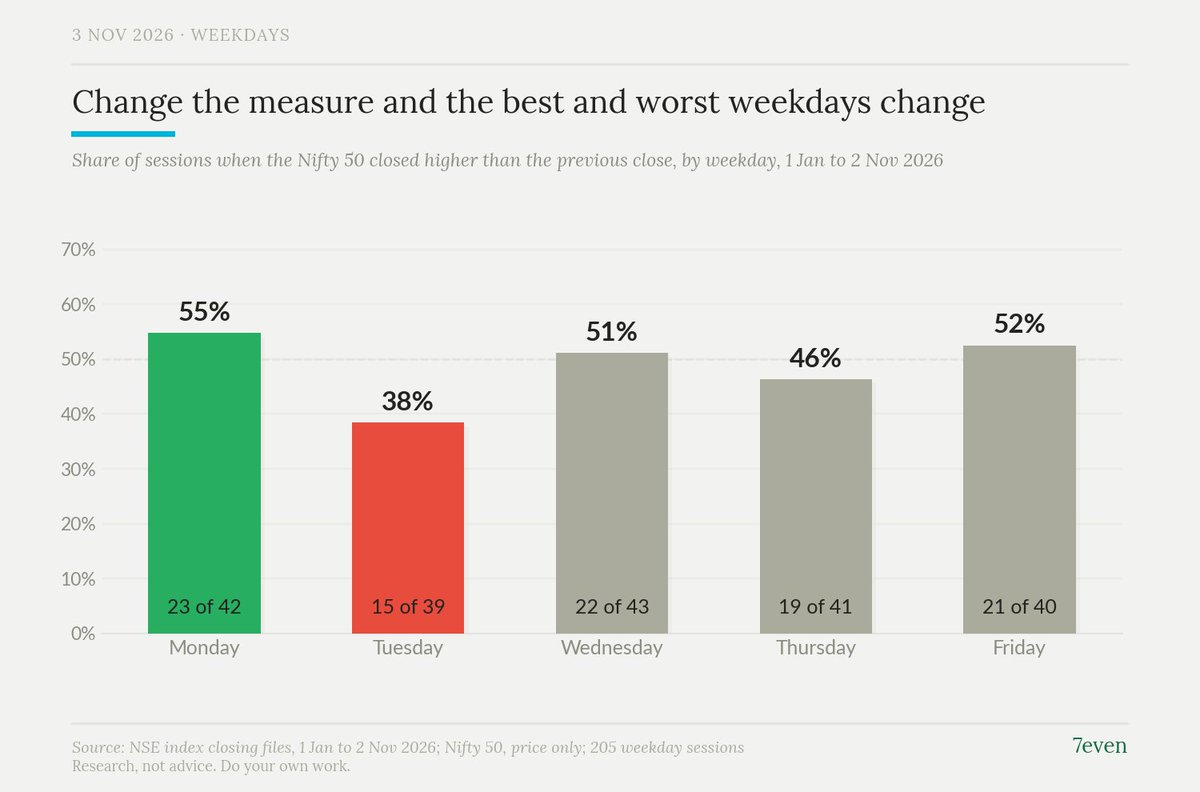
Change the measure and the answer changes. Share of days the Nifty closed higher: best Monday, 23 of 42 (55%); worst Tuesday, 15 of 39 (38%). The typical day (the middle value of each weekday’s moves): best Friday, +0.09%; worst Tuesday, -0.14%.
#Nifty50#StockMarketIndia #MarketResearch #DataAnalysis
An 8% move in a stock this size is rare and it definitely matters beyond Reliance. As one of the heaviest weights in Nifty and Sensex, a move like this can lift the index on its own. So it’s worth separating whether the market is rallying or one heavyweight is. The answer changes how you read today’s close.
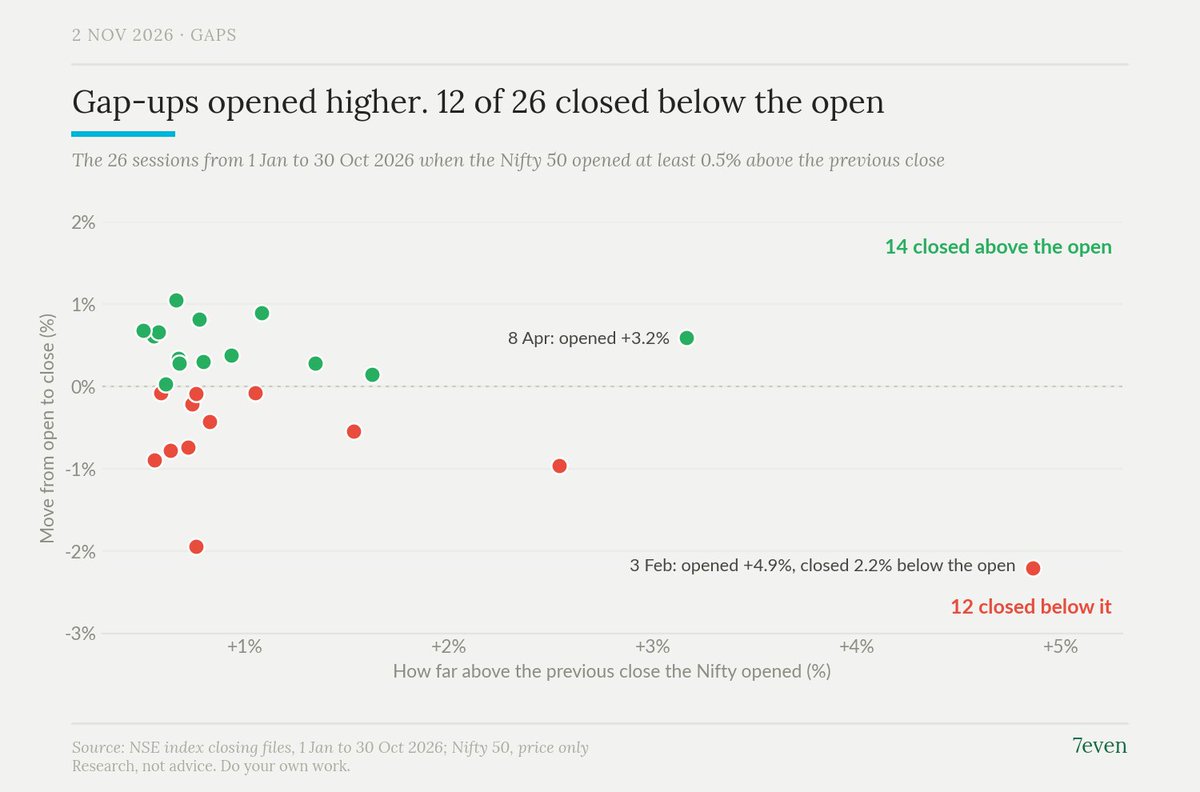
Even the big ones did not settle it. On 3 Feb the Nifty opened 4.9% higher, the year’s biggest gap-up and closed 2.2% below its open. On 8 Apr it opened 3.2% higher and closed 0.6% above. Of the 8 jumps of 1% or more, 4 finished above the open, 4 below.
But the jump itself rarely vanished. Only 6 of the 26 gap-ups traded back to the previous close at any point, and 22 closed above it. We ran the same test on 32 gap-downs of 0.5% or more: 19 closed above the open, and only 7 closed above the previous close.
On 2 Nov the Nifty opened at 23,222.30, up 0.73% (169 points) from the 30 Oct close of 23,053.10. Of the 18 earlier gap-ups of 0.5% to 1%, 10 closed above the open, 8 below, and 6 traded back to the previous close. The 2 Nov close joins one of those groups.
The catch: 26 gap-ups on one index is a small sample and 8 came between 5 Mar and 16 Apr. The index files show prices and turnover, not who is trading.
So why do gaps keep their jump but add to it only about half the time?
#Nifty50 #StockMarketIndia #GapUp #TradingPsychology #IndianStockMarket
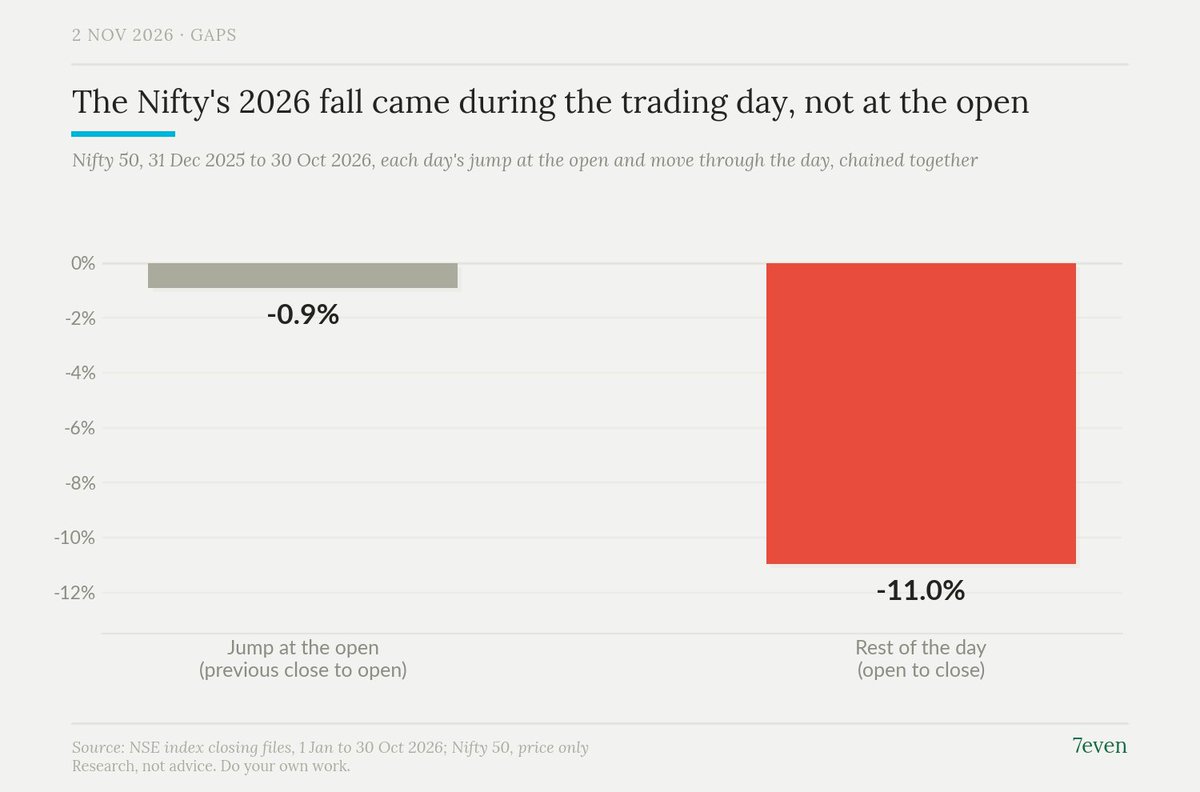
Forget the gap-up. The Nifty is down 11.8% in 2026 (to 30 Oct) and almost none of it happened at the open. Add up every morning jump, up or down and you get just -0.9%. Add up open to close and you get -11.0%. The fall came during the day.
#Nifty50#StockMarketIndia#GapUp #TradingPsychology #IndianStockMarket
A gap-up is the jump you see when your app opens green. From 1 Jan to 30 Oct 2026 the Nifty opened at least 0.5% above the previous close 26 times. Then what? 14 of those days closed above the open. 12 closed below it. Close to a coin flip.
#Nifty50#StockMarketIndia#GapUp #TradingPsychology #IndianStockMarket
₹20 × 30 instalments = ₹600 a month, and the old minimum of ₹100 × 6 = ₹600 too. So the monthly minimum remains the same, it’s just spread into smaller daily pieces. ‘Cheaper’ per instalment, not per month. The real benefit is a lower barrier to forming the habit, not lower cost.
@Mf360WW Seasonality is interesting but do you think it holds up against the bigger drivers in any given year like FII flows, rates and earnings? Nov-16 and Nov-21 were both clear negatives despite the ‘bullish’ average.
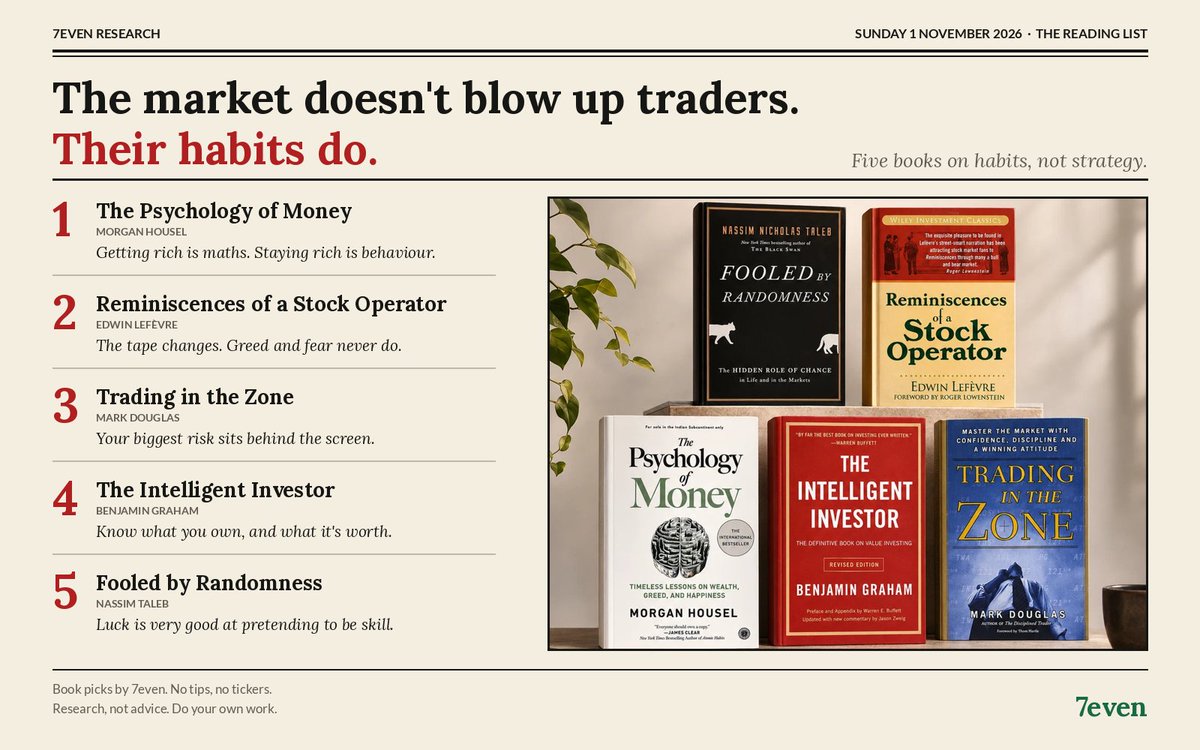
The market doesn’t blow up traders. Their habits do.
Same market. Same charts. Same news.
One trader lasts ten years. Another is gone in ten weeks.
The difference is rarely the setup. It’s what they do when the price moves against them.
These 5 books fix that. None of them tells you what to buy.
1. The Psychology of Money, Morgan Housel
Why read it: you’ll stop confusing luck with skill, in yourself and in others.
Take away: getting rich and staying rich are two different games.
Do this: write down the loss you can survive before you write down the profit you want.
2. Reminiscences of a Stock Operator, Edwin Lefèvre
Why read it: it was written in 1923 and still feels like this week’s market.
Take away: the crowd makes the same mistakes, again and again.
Do this: next time you feel the urge to chase, ask who is on the other side.
3. Trading in the Zone, Mark Douglas
Why read it: it’s about you, not the chart.
Take away: one trade is one roll of many. It isn’t a verdict on you.
Do this: decide your exit before you enter.
4. The Intelligent Investor, Benjamin Graham
Why read it: it’s calm in a market that screams.
Take away: the price changes mood daily. You don’t have to follow it.
Do this: ask what you own, not just what it did today.
5. Fooled by Randomness, Nassim Taleb
Why read it: it makes every winning streak look a little suspicious.
Take away: if you only see the winners, you’re missing those who vanished.
Do this: judge a decision by how good it was, not by how it turned out.
The pattern: five books, zero tips. All of them are about what you do when the screen turns red.
Only time for one?
Start with #1. It’s the easiest and it makes every mistake after it cheaper.
Which book changed how you trade?
Not advice. Just books.
#TradingPsychology #StockMarketIndia #BooksForTraders #StockMarketResearch
@jtraderco ‘The market follows you home’ is the line that stays with me. You can close the terminal but the body keeps trading. Sizing down until you can sleep isn’t weakness, it’s what lets you stay in the game for years.
Old rule: a run-up before results is “already priced in”, so it gets hit. We grouped 466 stocks by their rise in the prior 20 sessions. Fell most before: middle move down 1.1%. Rose most before: down 0.9%. Rank correlation 0.02. Swiggy lagged the index by 21%, Trent led by 9%.
When results were filed matters. At or after 3:30 pm (267 stocks): middle move down 1.6%. Before 3:30 pm (224 stocks): down 0.4%. Each is measured from the last close before the filing, so the windows differ. Cause unknown. A pattern in this sample, not a rule.
Takeaway: of the seven filings we picked by hand, three moved the way the year-on-year change pointed and four the other way. Seven cases cannot say how often. “Already priced in” did not show across 466 stocks.
Research, not advice.
#Q2Results #ResultsSeason #Nifty500 #NSE #StockMarketIndia #IndianStockMarket #EarningsSeason #Q2FY27 #MarketResearch #StockMarketResearch #Diwali #Halloween #Trent #IndiGo #Swiggy #NestleIndia #Syngene #KEI
Results season, 1 to 30 Oct 2026: who got rewarded? We checked 491 liquid $NSE stocks against the $Nifty 500 around their results. 114 jumped 3% or more. 157 fell 3% or more. The middle stock: down 0.95% against the index. Diwali for some, Halloween for others. 🪔🎃
#Q2Results #ResultsSeason #Nifty500 #NSE #StockMarketIndia #IndianStockMarket #EarningsSeason #Q2FY27 #MarketResearch #StockMarketResearch #Diwali #Halloween #Trent #IndiGo #Swiggy #NestleIndia #Syngene #KEI
Diwali 🪔
Trent: profit up 25%, stock up 5.4% (5.7% against the index). Headline and price agree.
Two more: Syngene: profit down 52% on the year, stock up 12.2%; its last quarter was a loss.
IndiGo: still a loss, ₹1,879 crore against ₹2,582 crore a year ago, stock up 4.5%.
Did growth decide the move? Not in the seven we picked. Profit up on the year: Nestle 36% (stock down 8.4%), KEI 29% (down 7.8%), Trent 25% (up 5.7%), Transformers & Rectifiers 118% (up 15.2%). Smaller loss: IndiGo (up 4.5%), Swiggy (down 15.5%). Profit down: Syngene (up 12.2%).
#Q2Results #ResultsSeason #Nifty500 #NSE #StockMarketIndia #IndianStockMarket #EarningsSeason #Q2FY27 #MarketResearch #StockMarketResearch #Diwali #Halloween #Trent #IndiGo #Swiggy #NestleIndia #Syngene #KEI
October so far: front door ₹47,270 crore sold, side door ₹13,230 crore bought. One day, 28 Oct, sent ₹6,386 crore through the side door: 48% of the month’s total.
How we checked: NSDL’s daily data, rebuilt month by month; the two doors add up to NSDL’s own monthly total. The catch: NSDL does not say what “others” covers or what the 28 Oct money bought.
Research, not advice: where the money went, not why. What was bought?
#IndianEquities #FPIFlows #PrimaryMarket #MarketStructure #NSEIndia
Foreign investors (FPIs) are leaving by the front door and coming in by the side door. Stock exchange: ₹3.63 lakh crore more sold than bought in 2026 to 29 Oct. Primary market (new share sales and other deals): ₹0.69 lakh crore more bought. Net: ₹2.94 lakh crore sold.
#IndianEquities #FPIFlows #PrimaryMarket #MarketStructure #NSEIndia
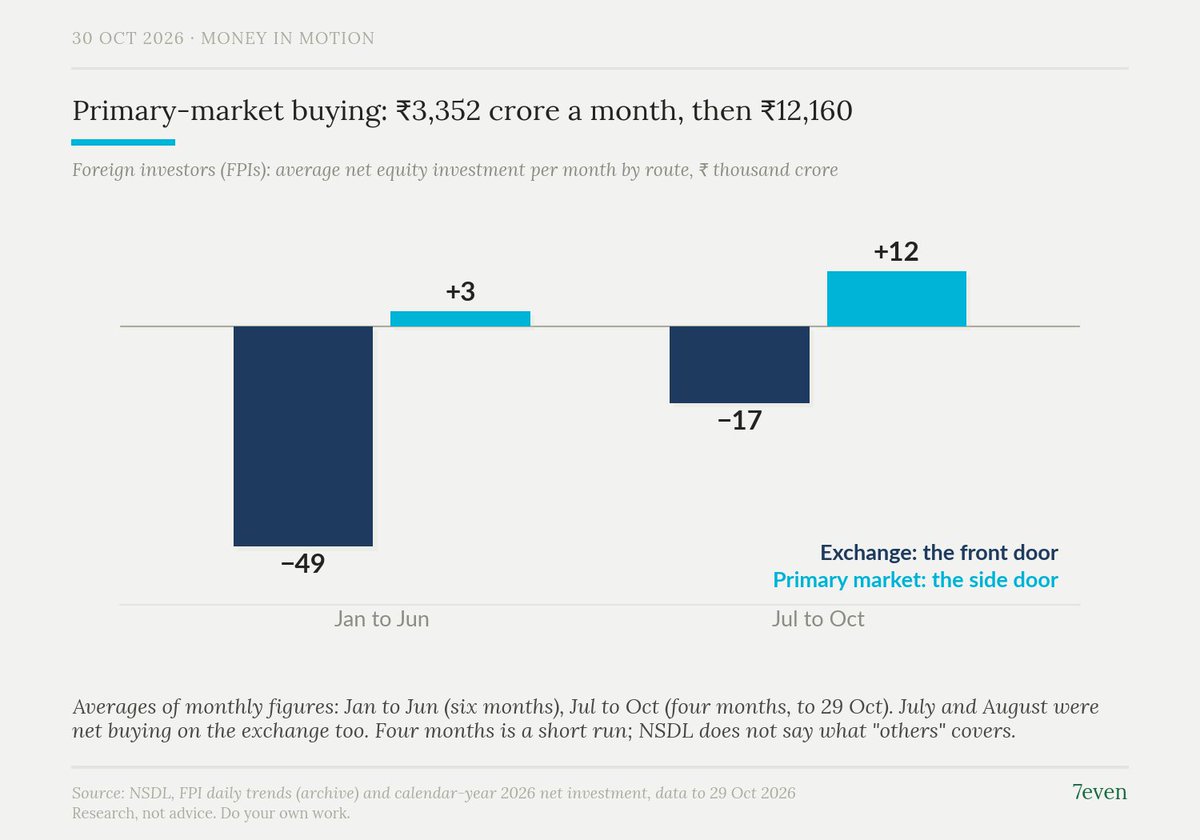
The side door was a trickle: ₹3,352 crore a month net bought from Jan to Jun, then ₹12,160 from Jul to Oct. Every month since July is above ₹9,600 crore; none before passed ₹4,700. Front-door net selling: ₹49,065 a month, then ₹17,177 (July and August were net buying).
#IndianEquities #FPIFlows #PrimaryMarket #MarketStructure #NSEIndia