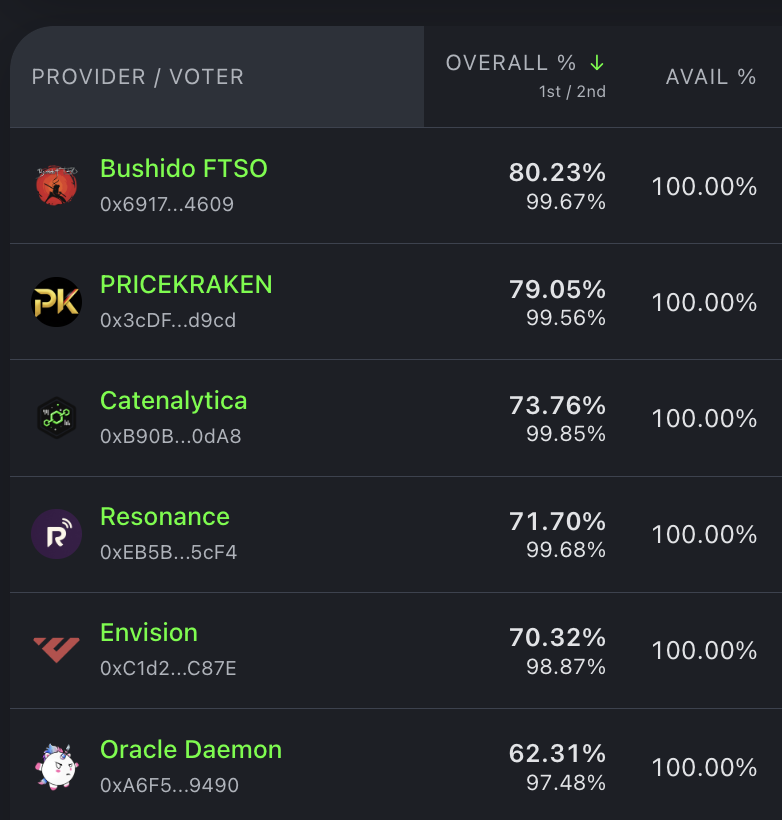
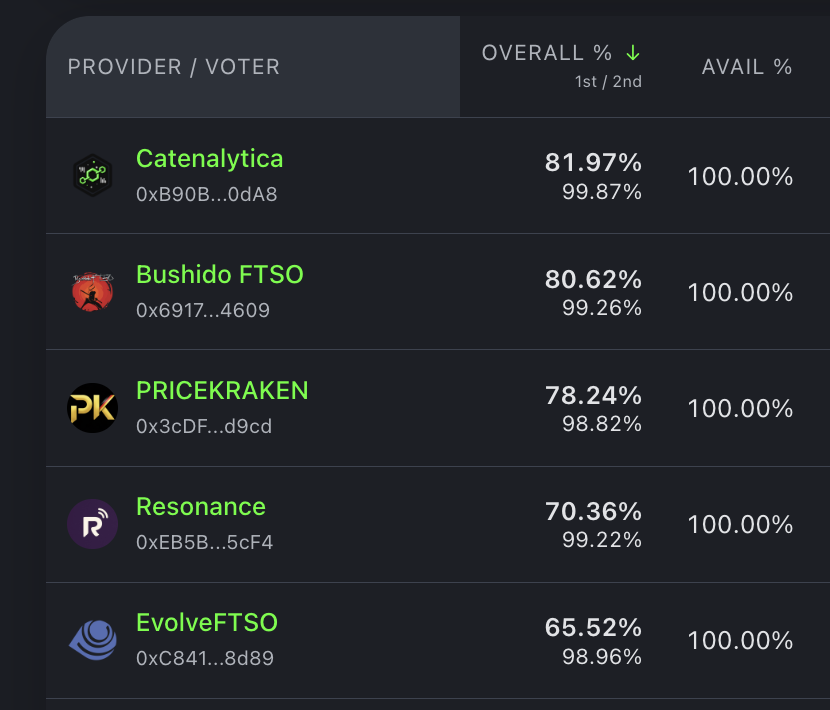
Over the last couple of weeks, Resonance has established itself as a top 5 FTSO data provider by accuracy on @FlareNetworks! 📈
We’ve also been consistently among the top providers for FDC.
Higher accuracy and consistency translate into better rewards for our delegators! 🔊🔊
@Gavriltudor1 To add: there's a large delay between the APYs shown on public tools and the "live" APYs, so personally we wouldn't recommend relying solely on them.
Rule of thumb is that this delay is between one and two reward epochs! As the votepower changes, these also change!
@Gavriltudor1 Two things:
1. There's a soft cap on staking for entities with 5% of the registered stake.
2. The system is designed such that a "smaller" validator will give you a larger reward compared to a larger validator with exactly the same fees and performance.
@Gavriltudor1 FIRE revenue from FDC fees have been somewhat constant since it started accruing: around 150-160k FLR per reward epoch, without much variation.
Most FLR holders still haven't clocked this one.
Since July 20, P-chain staking is weighted 5x over C-chain delegation when rewards get split. Same tokens, 5x the weight, just sitting somewhere different.
Delegation is easier and stays liquid. Staking locks you up. That's a real tradeoff and there are decent reasons to pick either side of it. But I'd bet a lot of people are sitting on the low-reward side by accident rather than by choice.
Worth checking where your FLR actually lives.
A proposal has been submitted to delist the USDX/USD FTSO feed from Flare, with the Management Group vote expected on August 5.
The feed will remain active on Songbird for now, ahead of a planned transition to a new FCC-powered proof-of-reserves oracle for FAssets.
Read the full proposal: https://t.co/68WqzEnNfn
⚡️ A useful note for anyone moving from FTSO delegation to P-chain staking:
For each staking address, Flare mirrors P-chain stakes onto the C-chain, where that data is later used for reward calculations.
At any one time, stakes from a single address can be mirrored across a maximum of three different validator nodes. A stake to a fourth validator may still exist on the P-chain, but it will not be mirrored onto the C-chain and will therefore not be included in rewards.
When spreading stake across validators, use no more than three active validator nodes per staking address, or use an additional address.
Staking rewards will NOT be 5 times more than it was before. We are seeing double the rewards. The weight of your delegation in staking is now 5x that ftso delegation. Completely two different concept.
In fact, if more people start staking. The staking rewards will expect to go down.
A permissionless network does not distinguish between a user, an exchange, an arbitrage bot or an automated deployment. If they consume blockspace, they pay for it.
Recent activity on Flare is a useful example.
After the July 14 upgrade increased the base fee to 500 gwei, a large arbitrage operation that had been generating significant traffic dropped sharply. Its strategy simply became less economical.
At the same time, contract deployments remained elevated from several very different sources, including automated deployments, exchange deposit infrastructure and new arbitrage strategies.
This is where FIP.16 changes how these metrics should be interpreted.
Fee-paying activity contributes economically to the network, while higher blockspace costs also force automated strategies to continuously justify their existence.
The key question for builders:
What activity is valuable enough to keep paying for Flare blockspace?
The latest FIP.16 updates brought several infra-level changes.
Most people noticed staking becoming much more attractive, but another key change affects how FTSO prices are calculated, shifting accuracy rankings across providers.
Look who’s sneaking closer to the top 👀📈
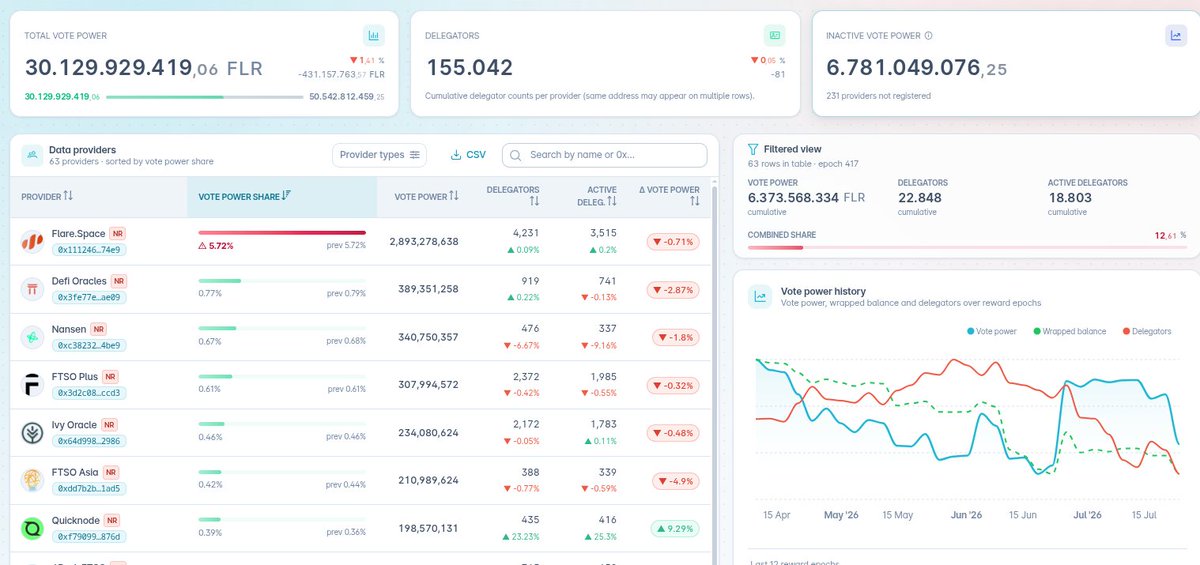
Reward Epoch 417 is the first full stretch of the FIP.16 transition on Flare.
Providers were asked early to upgrade infrastructure. Some made the cut - others didn’t make it into this epoch’s registry. That’s a hard operational bar, and it’s showing up on-chain as inactive vote power: over 6B FLR across ~24 providers that aren’t registered for this epoch, so that stake won’t earn FTSO and Staking rewards until those registrations catch up.
Transitions like this are where ops discipline compounds for the whole network.
Track registered vs inactive in the explorer:
https://t.co/yiCh3hQEYj
#Flare flare-networks:native