Clara del Campo, representante de @Amnesty
La política de represión continua intacta en #Venezuela. Explicó la continuidad de los crímenes internacionales. "La represión se mantiene activa en sus estructuras, integrantes y prácticas: detenciones arbitrarias, torturas, desapariciones forzadas y persecución. Ante la opacidad estatal, las ONG denuncian que continúan entre 328 400 personas detenidas por motivos políticos", denunció en el marco #HRC63 de la #ONU
#QueSigaLaMision #VzlaPideJusticia
VAYA TUTELA LA DE WASHINGTON
Por Pedro Mario Burelli
Ojalá @SecRubio lea personalmente este deprimente informe de la Misión Internacional Independiente de Determinación de los Hechos de la @UN. También recomiendo que lea las observaciones sobre dicho informe de @EdmundoGU, el hombre digno que los venezolanos eligieron, contra viento y marea, como su presidente el 28 de julio de 2024.
Durante nueve largos meses EE.UU. ha encontrado mil maneras de impedir que @MariaCorinaYA regrese a Venezuela, convirtiéndola de hecho en una suerte de rehén. Pero no ha logrado que @delcyrodriguezv desmantele el aparato represivo que durante años ha sostenido a un régimen ilegítimo y repudiado por la inmensa mayoría del país.
Washington puede transferir, sin esfuerzo aparente y sin compensación alguna, 65.000 millones de barriles de reservas del Estado a la empresa de un malhechor. Pero no puede lograr la liberación de casi 400 presos políticos en un país que se jacta de haber conquistado “en menos de 45 minutos”.
De @realDonaldTrump ya entendimos qué esperar. Pero de @marcorubio esperábamos mucho más.
Sin poner en duda sus convicciones democráticas, resulta imposible no cuestionar sus prioridades y el uso selectivo de la inmensa capacidad de coerción de Washington. Una presión que ha generado grandes expectativas económicas para un grupo diverso de empresarios favorecidos por la Casa Blanca, pero escasos avances en libertad, justicia y democracia, y nada en bienestar económico para un pueblo brutalmente empobrecido.
Que Delcy Rodríguez pueda viajar a Estados Unidos mientras María Corina Machado no puede regresar a su propio país dejará muy mal parada a la Administración Trump. Y confirmará algo cada día más difícil de negar: Washington ha escogido mal, muy mal, sus prioridades.
Secretario Rubio: lea usted mismo este informe. No permita que se lo reduzcan a un resumen de dos párrafos.
Todo lo que allí se describe ocurrió y sigue ocurriendo bajo sus narices.
Y cada día que continúa, socava lo que usted durante años dijo representar.
Es hora de corregir el rumbo.
Si Washington va a ejercer una tutela sobre Venezuela, que sea para desmontar la barbarie y abrir paso a la democracia.
No para administrar la represión mientras reparte el botín.
Así confesó Alex Saab cómo se hizo millonario con el hambre y la necesidad de los venezolanos
🧵 Hilo con las citas mas relevantes de su acuerdo de culpabilidad en los EEUU
Who Is Delcy Rodriguez, the Radical Marxist Dealing with President Trump in Venezuela?
Eight months after U.S. special forces plucked Nicolás Maduro from Caracas in the early hours of January 3, 2026, Delcy Eloína Rodríguez Gómez occupies the presidential palace as Venezuela’s acting head of state. She was never elected to the office. The Supreme Tribunal of Justice, an institution kidnapped by chavismo, simply instructed the sitting vice president to assume the powers of the presidency to preserve “administrative continuity.” Her brother Jorge, president of the National Assembly, administered the oath.
Rodríguez, born in Caracas in 1969, is a lawyer by training and a product of the same political household that produced her brother. Their father, Jorge Antonio Rodríguez, was a militant of the far-left terrorist Socialist League. In February 1976 a commando linked to that milieu kidnapped William Frank Niehous, the American head of Owens-Illinois operations in Venezuela, accusing him of being a CIA asset. The abduction lasted more than three years. Rodríguez senior was arrested months later and died in DISIP custody at age 34; official accounts cited a heart attack, while the family and later chavista narrative insist he was tortured to death. Delcy was seven.
She has never been shy about what that episode meant to her. In a 2018 television interview she described the Bolivarian revolution as “our personal revenge for the death of our father and his executioners.” She repeated variations of the line in later years, framing Chávez’s arrival as historical payback against the “dark era” of the Fourth Republic. The phrasing is revealing. It locates her politics less in abstract ideology than in a family grievance that she and her brother turned into a governing project.
Her résumé tracks the regime’s evolution from charismatic socialist to institutionalized repression. She served as foreign minister from 2014 to 2017, the period when Venezuela’s diplomatic isolation deepened and human-rights complaints multiplied. In 2017 she presided over the National Constituent Assembly, an extra-constitutional body convened after the opposition won a legislative majority in 2015. The voting-technology firm Smartmatic publicly alleged that at least a million votes had been manipulated. The ANC then proceeded to strip the elected National Assembly of its remaining authority. In 2018 Maduro named her executive vice president. From that perch she sat atop ministries, the intelligence service SEBIN (Chavismo's political police, the equivalent of the Nazi Gestapo), and, for stretches, economic and energy portfolios. She accumulated titles the way a risk manager accumulates insurance policies.
As vice president she was the hierarchical superior of SEBIN, the agency that operated detention and torture centers such as El Helicoide. United Nations fact-finding missions have documented patterns of arbitrary detention, torture, sexual violence, and enforced disappearance that they concluded were not isolated excesses but a coordinated policy to silence opposition. Fernando Alban, an opposition city councilman, was captured by SEBIN in 2018 and thrown from the 10th floor of the torture center, where he was killed; like this one, there are many other cases of extrajudicial killings carried out by forces under Rodriguez’s command.
Western governments treated her as a structural part of that architecture. The United States designated her in September 2018 under Executive Order 13692, citing her role in helping Maduro “solidify his authoritarian rule.” The European Union, Switzerland, Canada, and the United Kingdom imposed travel bans and asset freezes for undermining democracy and the rule of law. The 2020 “Delcygate” episode in Spain—when she landed at Madrid-Barajas despite an EU ban and met a senior Spanish official—illustrated how radioactive her presence had become.
Those personal sanctions were lifted by Washington in April 2026 once she became the interlocutor of convenience after Maduro’s capture. The paper trail of earlier designations remains.U.S. law-enforcement interest went further than public sanctions lists. Associated Press reporting, based on internal records and former officials, established that the DEA had maintained an intelligence file on Rodríguez since at least 2018 and in 2022 labeled her a “priority target”—a category reserved for people believed to have a significant impact on the drug trade.
Allegations circulating in that file included money laundering through hotels on Isla Margarita and links to gold and oil smuggling networks used to evade sanctions.
Rodriguez Foreign-Policy
Her foreign-policy record before the current thaw was unambiguously aligned against the United States and its partners. As foreign minister and later as vice president she cultivated ties with Iran, Russia, and China, defended the regime’s isolation as anti-imperialist principle, and at one point described U.S. humanitarian aid as “biological weapons.” That language was not casual. It sat inside a worldview in which Washington was the historic enemy and the family’s original wound.
The record of her own words is even sharper. In August 2017, after President Trump warned that a “military option” remained on the table, she tweeted: “We reject the cowardly, insolent and infamous threats of the President of the United States @realDonaldTrump against the sacred sovereignty of Venezuela.” Months earlier she had written that treating Venezuela as a U.S. threat “only has a foundation in the arrogance and imperial irrationality that has characterized Trump.”
When Trump tightened the Cuba embargo that June, she declared that “American extremism intends to plague the planet with misery, violence and death to satisfy Capital and its barbarism.” In April 2017 she denounced “the racism promoted institutionally” in U.S. immigration policy. After Trump’s 2019 executive order imposing a near-total economic embargo, she claimed the measure was meant to cover America’s “terrible internal situation” and attributed recent mass shootings to the “supremacist, racist and classist hatred” that, she said, Trump had promoted from the White House.
The tone did not soften as the second Trump administration approached. In late 2025 she told oil workers: “We owe the United States nothing,” accused Washington of stealing Citgo and more than $35 billion in dividends, and demanded “historic apologies and indemnities.” In August 2025, after U.S. naval deployments in the Caribbean, she warned: “It will be worse for them if they dare to attack. It will be a calamity. We will be their nightmare.”
Hours after the January 3 raid that removed Maduro, she went on state television and called the operation “barbaric,” “a vile warmongering aggression by a nuclear power,” and “a stain” on history. “We will never again be a colony of any empire,” she said. “Venezuela is not a colony that surrenders to threats; our dignity has no price.”
The same week she told parliament that talk of drugs, democracy, and human rights had always been a pretext: “What has always been present is that Venezuela’s oil must be handed over to the global North.”
That is the same woman that now signs oil agreements with U.S. companies, hosts American energy officials in Miraflores, and hears Donald Trump call her a “terrific person” who is “doing a very, very good job.”
Praise for China
China occupied the opposite pole in that same rhetoric. In 2017, as president of the Constituent Assembly, she told Xinhua that China was a “new leading light for humanity” whose path pointed toward “true global equality and international security,” and that Beijing stood “at the center of a global geopolitical realignment.” In December 2024 she held up the Chinese model as the way to “break Western economic and technological dependence,” asking, “What good is growth with inequality? What good is economic growth with exclusion?” During a 2025 visit she called China’s economic model “an example of dignity, resilience and economic growth” and described the Caracas–Beijing relationship as “all-weather and battle-tested.”
At the China–Venezuela expo she said the two countries exhibited “a model of what it is to be countries respectful of international law that truly seek a new future for humanity,” set against “hegemonic and interventionist blocs” referring to the USA. Days after Maduro’s capture she thanked Beijing for its “firm and consistent position” in condemning “the grave violation of international law and Venezuelan sovereignty”—the same operation she called a stain when speaking of Washington.
A rat will always be a rat; a Marxist will always be a Marxist
Those who have attempted to whitewash Delcy Rodríguez’s image and portray her as a pragmatic technocrat who can be dealt with are either acting out of a complete misunderstanding of reality or deliberately misleading President Trump and the American people in order to enrich themselves quickly through opaque deals with the socialist dictatorship, while placing U.S. strategic interests last.
A person who has spent more than 50 years of her life hating the United States, promoting Marxism and communism, and praising China—whose father kidnapped a U.S. citizen and vowed revenge over it—can never be considered a reliable ally of the United States. Anyone with a serious understanding of politics knows that, at this point, she is simply trying to buy time and wait out President Trump’s term in office, so that she can once again leverage Venezuela’s economic and geopolitical power in China’s favor and turn it against the United States.
The question is: Will the U.S. government and president Trump wake up to this grave betrayal of its national security interests? Or will lobbying, economic interests, lies, and opaque deals prevail, allowing this deception to go after 2029?
Who Is Delcy Rodriguez, the Radical Marxist Dealing with President Trump in Venezuela?
Eight months after U.S. special forces plucked Nicolás Maduro from Caracas in the early hours of January 3, 2026, Delcy Eloína Rodríguez Gómez occupies the presidential palace as Venezuela’s acting head of state. She was never elected to the office. The Supreme Tribunal of Justice, an institution kidnapped by chavismo, simply instructed the sitting vice president to assume the powers of the presidency to preserve “administrative continuity.” Her brother Jorge, president of the National Assembly, administered the oath.
Rodríguez, born in Caracas in 1969, is a lawyer by training and a product of the same political household that produced her brother. Their father, Jorge Antonio Rodríguez, was a militant of the far-left terrorist Socialist League. In February 1976 a commando linked to that milieu kidnapped William Frank Niehous, the American head of Owens-Illinois operations in Venezuela, accusing him of being a CIA asset. The abduction lasted more than three years. Rodríguez senior was arrested months later and died in DISIP custody at age 34; official accounts cited a heart attack, while the family and later chavista narrative insist he was tortured to death. Delcy was seven.
She has never been shy about what that episode meant to her. In a 2018 television interview she described the Bolivarian revolution as “our personal revenge for the death of our father and his executioners.” She repeated variations of the line in later years, framing Chávez’s arrival as historical payback against the “dark era” of the Fourth Republic. The phrasing is revealing. It locates her politics less in abstract ideology than in a family grievance that she and her brother turned into a governing project.
Her résumé tracks the regime’s evolution from charismatic socialist to institutionalized repression. She served as foreign minister from 2014 to 2017, the period when Venezuela’s diplomatic isolation deepened and human-rights complaints multiplied. In 2017 she presided over the National Constituent Assembly, an extra-constitutional body convened after the opposition won a legislative majority in 2015. The voting-technology firm Smartmatic publicly alleged that at least a million votes had been manipulated. The ANC then proceeded to strip the elected National Assembly of its remaining authority. In 2018 Maduro named her executive vice president. From that perch she sat atop ministries, the intelligence service SEBIN (Chavismo's political police, the equivalent of the Nazi Gestapo), and, for stretches, economic and energy portfolios. She accumulated titles the way a risk manager accumulates insurance policies.
As vice president she was the hierarchical superior of SEBIN, the agency that operated detention and torture centers such as El Helicoide. United Nations fact-finding missions have documented patterns of arbitrary detention, torture, sexual violence, and enforced disappearance that they concluded were not isolated excesses but a coordinated policy to silence opposition. Fernando Alban, an opposition city councilman, was captured by SEBIN in 2018 and thrown from the 10th floor of the torture center, where he was killed; like this one, there are many other cases of extrajudicial killings carried out by forces under Rodriguez’s command.
Western governments treated her as a structural part of that architecture. The United States designated her in September 2018 under Executive Order 13692, citing her role in helping Maduro “solidify his authoritarian rule.” The European Union, Switzerland, Canada, and the United Kingdom imposed travel bans and asset freezes for undermining democracy and the rule of law. The 2020 “Delcygate” episode in Spain—when she landed at Madrid-Barajas despite an EU ban and met a senior Spanish official—illustrated how radioactive her presence had become.
Those personal sanctions were lifted by Washington in April 2026 once she became the interlocutor of convenience after Maduro’s capture. The paper trail of earlier designations remains.U.S. law-enforcement interest went further than public sanctions lists. Associated Press reporting, based on internal records and former officials, established that the DEA had maintained an intelligence file on Rodríguez since at least 2018 and in 2022 labeled her a “priority target”—a category reserved for people believed to have a significant impact on the drug trade.
Allegations circulating in that file included money laundering through hotels on Isla Margarita and links to gold and oil smuggling networks used to evade sanctions.
Rodriguez Foreign-Policy
Her foreign-policy record before the current thaw was unambiguously aligned against the United States and its partners. As foreign minister and later as vice president she cultivated ties with Iran, Russia, and China, defended the regime’s isolation as anti-imperialist principle, and at one point described U.S. humanitarian aid as “biological weapons.” That language was not casual. It sat inside a worldview in which Washington was the historic enemy and the family’s original wound.
The record of her own words is even sharper. In August 2017, after President Trump warned that a “military option” remained on the table, she tweeted: “We reject the cowardly, insolent and infamous threats of the President of the United States @realDonaldTrump against the sacred sovereignty of Venezuela.” Months earlier she had written that treating Venezuela as a U.S. threat “only has a foundation in the arrogance and imperial irrationality that has characterized Trump.”
When Trump tightened the Cuba embargo that June, she declared that “American extremism intends to plague the planet with misery, violence and death to satisfy Capital and its barbarism.” In April 2017 she denounced “the racism promoted institutionally” in U.S. immigration policy. After Trump’s 2019 executive order imposing a near-total economic embargo, she claimed the measure was meant to cover America’s “terrible internal situation” and attributed recent mass shootings to the “supremacist, racist and classist hatred” that, she said, Trump had promoted from the White House.
The tone did not soften as the second Trump administration approached. In late 2025 she told oil workers: “We owe the United States nothing,” accused Washington of stealing Citgo and more than $35 billion in dividends, and demanded “historic apologies and indemnities.” In August 2025, after U.S. naval deployments in the Caribbean, she warned: “It will be worse for them if they dare to attack. It will be a calamity. We will be their nightmare.”
Hours after the January 3 raid that removed Maduro, she went on state television and called the operation “barbaric,” “a vile warmongering aggression by a nuclear power,” and “a stain” on history. “We will never again be a colony of any empire,” she said. “Venezuela is not a colony that surrenders to threats; our dignity has no price.”
The same week she told parliament that talk of drugs, democracy, and human rights had always been a pretext: “What has always been present is that Venezuela’s oil must be handed over to the global North.”
That is the same woman that now signs oil agreements with U.S. companies, hosts American energy officials in Miraflores, and hears Donald Trump call her a “terrific person” who is “doing a very, very good job.”
Praise for China
China occupied the opposite pole in that same rhetoric. In 2017, as president of the Constituent Assembly, she told Xinhua that China was a “new leading light for humanity” whose path pointed toward “true global equality and international security,” and that Beijing stood “at the center of a global geopolitical realignment.” In December 2024 she held up the Chinese model as the way to “break Western economic and technological dependence,” asking, “What good is growth with inequality? What good is economic growth with exclusion?” During a 2025 visit she called China’s economic model “an example of dignity, resilience and economic growth” and described the Caracas–Beijing relationship as “all-weather and battle-tested.”
At the China–Venezuela expo she said the two countries exhibited “a model of what it is to be countries respectful of international law that truly seek a new future for humanity,” set against “hegemonic and interventionist blocs” referring to the USA. Days after Maduro’s capture she thanked Beijing for its “firm and consistent position” in condemning “the grave violation of international law and Venezuelan sovereignty”—the same operation she called a stain when speaking of Washington.
A rat will always be a rat; a Marxist will always be a Marxist
Those who have attempted to whitewash Delcy Rodríguez’s image and portray her as a pragmatic technocrat who can be dealt with are either acting out of a complete misunderstanding of reality or deliberately misleading President Trump and the American people in order to enrich themselves quickly through opaque deals with the socialist dictatorship, while placing U.S. strategic interests last.
A person who has spent more than 50 years of her life hating the United States, promoting Marxism and communism, and praising China—whose father kidnapped a U.S. citizen and vowed revenge over it—can never be considered a reliable ally of the United States. Anyone with a serious understanding of politics knows that, at this point, she is simply trying to buy time and wait out President Trump’s term in office, so that she can once again leverage Venezuela’s economic and geopolitical power in China’s favor and turn it against the United States.
The question is: Will the U.S. government and president Trump wake up to this grave betrayal of its national security interests? Or will lobbying, economic interests, lies, and opaque deals prevail, allowing this deception to go after 2029?
𝐋𝐚 𝐦𝐢𝐬𝐦𝐚 𝐚𝐥𝐞𝐠𝐫í𝐚
𝐄𝐬𝐭𝐚 𝐬𝐞𝐦𝐚𝐧𝐚 𝐕𝐞𝐧𝐞𝐳𝐮𝐞𝐥𝐚 𝐡𝐚𝐛𝐥ó 𝐝𝐞 𝐩𝐞𝐭𝐫ó𝐥𝐞𝐨. 𝐌𝐢𝐞𝐧𝐭𝐫𝐚𝐬 𝐭𝐚𝐧𝐭𝐨, 𝐜𝐚𝐬𝐢 𝐧𝐚𝐝𝐢𝐞 𝐬𝐞 𝐝𝐞𝐭𝐮𝐯𝐨 𝐞𝐧 𝐥𝐚 𝐟𝐫𝐚𝐬𝐞 𝐦á𝐬 𝐢𝐦𝐩𝐨𝐫𝐭𝐚𝐧𝐭𝐞 𝐪𝐮𝐞 𝐝𝐢𝐣𝐨 𝐌𝐚𝐫í𝐚 𝐂𝐨𝐫𝐢𝐧𝐚 𝐌𝐚𝐜𝐡𝐚𝐝𝐨 𝐞𝐧 𝐦𝐞𝐬𝐞𝐬.
Por Elizabeth Sánchez Vegas
Se firmó en Miraflores. Diecisiete pozos, sesenta y cinco mil millones de barriles, un secretario del Tesoro norteamericano de visita y la pregunta que todo el mundo hizo en voz baja, y algunos también en voz alta: con qué mandato firma un gobierno que nadie eligió. El jueves, María Corina Machado grabó un video desde el exilio para decir que entiende esa preocupación y que Venezuela necesita mucho más que dinero puesto en su industria petrolera.
Tenía razón y la discusión era necesaria. Se llevó la semana completa y seguramente nos acompañará durante varias más, porque todavía hay demasiado que entender, discutir y aclarar.
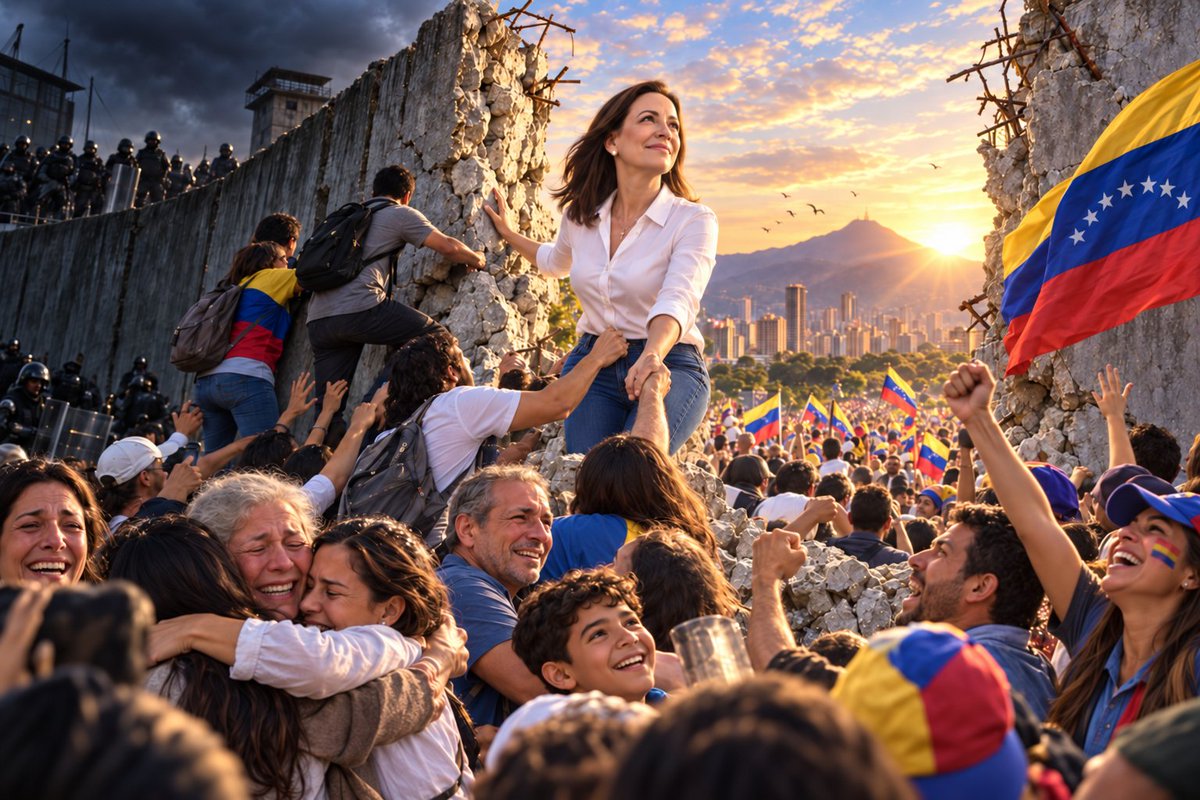
Por eso pasó casi inadvertido lo que ella misma había dicho tres días antes, desde un salón en Eslovenia, durante el Bled Strategic Forum, en un panel sobre Europa y América Latina. Esta vez no habló de barriles, contratos ni inversiones, sino de algo mucho menos cuantificable y quizá por eso mucho más profundo: 𝐝𝐢𝐣𝐨 𝐪𝐮𝐞 𝐥𝐚 𝐚𝐥𝐞𝐠𝐫í𝐚 𝐪𝐮𝐞 𝐬𝐢𝐧𝐭𝐢ó 𝐄𝐮𝐫𝐨𝐩𝐚 𝐜𝐮𝐚𝐧𝐝𝐨 𝐜𝐚𝐲ó 𝐞𝐥 𝐌𝐮𝐫𝐨 𝐝𝐞 𝐁𝐞𝐫𝐥í𝐧 𝐞𝐬 𝐥𝐚 𝐦𝐢𝐬𝐦𝐚 𝐚𝐥𝐞𝐠𝐫í𝐚 𝐪𝐮𝐞 𝐥𝐨𝐬 𝐯𝐞𝐧𝐞𝐳𝐨𝐥𝐚𝐧𝐨𝐬 𝐪𝐮𝐢𝐞𝐫𝐞𝐧 𝐬𝐞𝐧𝐭𝐢𝐫 𝐜𝐮𝐚𝐧𝐝𝐨 𝐕𝐞𝐧𝐞𝐳𝐮𝐞𝐥𝐚, 𝐂𝐮𝐛𝐚 𝐲 𝐍𝐢𝐜𝐚𝐫𝐚𝐠𝐮𝐚 𝐫𝐞𝐜𝐮𝐩𝐞𝐫𝐞𝐧 𝐩𝐥𝐞𝐧𝐚𝐦𝐞𝐧𝐭𝐞 𝐬𝐮 𝐝𝐞𝐦𝐨𝐜𝐫𝐚𝐜𝐢𝐚.
No escogió esa imagen al azar, y el lugar tampoco era casual. Eslovenia perteneció a una Europa en la que durante décadas millones de personas crecieron sabiendo que buena parte de su destino estaba condicionado por fronteras, regímenes y decisiones tomadas por otros, de modo que quienes la escuchaban entendían perfectamente lo que significa vivir dentro de una realidad que parece definitiva hasta el día en que deja de serlo.
Casi nadie se detuvo allí, tal vez porque estábamos demasiado ocupados contando barriles para advertir que María Corina acababa de hablar, en realidad, del final de una época.
Para comprender por qué esa comparación importa, hay que volver a la noche del 9 de noviembre de 1989, cuando Günter Schabowski, funcionario del régimen comunista de Alemania Oriental, compareció ante la prensa con unas notas que no dominaba del todo y anunció nuevas disposiciones para facilitar los viajes hacia Occidente. Desde la sala le preguntaron cuándo entraban en vigor y, después de revisar el papel y vacilar unos segundos, respondió que, hasta donde sabía, de inmediato.
No era exactamente lo previsto. La medida debía comenzar después, acompañada por trámites, controles, filtros y toda la maquinaria burocrática con la que un régimen intenta administrar incluso la libertad cuando empieza a escapársele de las manos, pero la frase ya había sido pronunciada y, además, había sido pronunciada en televisión.
Horas más tarde, miles de personas se agolpaban frente al paso fronterizo de Bornholmer Strasse, mientras del otro lado Harald Jäger, oficial responsable del puesto, telefoneaba a sus superiores buscando instrucciones que no llegaban. La multitud seguía creciendo, las órdenes no aparecían y, cerca de las once y media de la noche, abrió la barrera.
Así empezó a caer el Muro de Berlín.
Lo extraordinario no fue solamente que una estructura de concreto, alambradas, vigilancia y órdenes terminara vencida, sino comprender qué la había sostenido durante veintiocho años. No eran únicamente sus casi cuatro metros de altura, las torres, los guardias o la amenaza del castigo; era algo más resistente que todo eso: la certeza de que seguiría allí mañana.
Durante casi tres décadas hubo familias separadas por calles que se habían convertido en otro mundo, abuelos que murieron sin volver a abrazar a un hermano que vivía a pocos kilómetros y niños que aprendieron que la palabra allá podía significar un lugar visible y, al mismo tiempo, imposible de alcanzar. Millones de personas se acostumbraron a pensar que aquella división formaba parte del orden natural de las cosas, hasta que una noche cualquiera dejó de serlo.
Tú sabes de qué estoy hablando porque también has hecho la cuenta de los años, has visto pasar gobiernos, negociaciones, acuerdos, comunicados y fotografías de personas dándose la mano en salones donde siempre parece estar decidiéndose algo que nunca termina de llegar, y aprendiste a desconfiar de la esperanza porque ilusionarse cuesta caro y esa factura ya la pagaste demasiadas veces.
Ahora mismo, mientras lees esto, vuelven a existir negociaciones sobre un país que ya expresó con claridad lo que quiere, mientras la pregunta más sencilla sigue tropezando con respuestas cada vez más sofisticadas: cuándo se vota.
Habrá elecciones, dicen, cuando el país esté preparado.
Pero Berlín recuerda algo incómodo para quienes necesitan que la historia venga acompañada de cronogramas. Nadie despertó aquel 9 de noviembre sabiendo que había llegado el día, ninguna delegación había acordado la hora de la libertad y ninguna mesa anunció que antes de medianoche una barrera levantada durante décadas iba a abrirse, porque los sistemas no siempre comienzan a ceder cuando alguien fija una fecha, sino cuando suficiente gente deja de asumir que aquello que existe tiene necesariamente que seguir existiendo.
En Venezuela ocurrió algo de esa naturaleza el 28 de julio de 2024, cuando millones de venezolanos no se limitaron a votar, sino que sostuvieron una operación cívica levantada bajo persecución, cuidaron mesas, contaron, copiaron, transmitieron y preservaron actas en un país sin garantías suficientes, demostrando que aun después de tantos años de desgaste seguían siendo capaces de organizarse y responder por la voluntad expresada en las urnas.
María Corina lo recordó en Eslovenia con una frase que merece ser leída despacio: 𝐧𝐮𝐞𝐬𝐭𝐫𝐨 𝐩𝐮𝐞𝐛𝐥𝐨 𝐲𝐚 𝐭𝐨𝐦ó 𝐬𝐮 𝐝𝐞𝐜𝐢𝐬𝐢ó𝐧.
Lo importante está en ese tiempo verbal, porque hay algo que ya no está pendiente y es qué quiere Venezuela. La voluntad fue expresada con una claridad que todavía incomoda a más de un gobierno, y un voto no deja de existir simplemente porque alguien se niegue a reconocerlo; lo que falta no es que los venezolanos decidan, sino que esa decisión pueda transformarse en realidad política.
Y vale la pena detenerse un momento en quién pronunció esa frase: una mujer que pasó once meses escondida dentro de su propio país, cambiando de lugar y viviendo lejos de sus hijos para evitar ser capturada por el régimen; una mujer a la que, cuando el terremoto dejó venezolanos bajo los escombros en junio, se le impidió regresar aun después de decir que no quería un escenario ni un micrófono, sino poner sus manos junto a las de quienes buscaban sobrevivientes; y una dirigente que, cuando se instaló una nueva mesa de negociación sin ella, no convirtió su ausencia en el centro del debate, sino que habló de presos políticos, del regreso de los exiliados, de un árbitro electoral independiente y de algo tan elemental que en Venezuela ha terminado pareciendo revolucionario: una fecha.
Esa quizá sea una de las razones por las que incomoda tanto, porque María Corina no negocia el idioma. Mientras buena parte del tablero político se llena de palabras cuidadosamente escogidas, proceso, estabilización, nuevo momento político, entendimiento, ella sigue pronunciando otras mucho menos cómodas: 𝐞𝐥𝐞𝐜𝐜𝐢ó𝐧, 𝐟𝐞𝐜𝐡𝐚, 𝐯𝐨𝐭𝐨𝐬.
Y por eso importa tanto que, mientras esta semana todos hablábamos de petróleo, tres días antes ella hubiera hablado de alegría.
No de una alegría ingenua ni fabricada para una consigna, sino de la que llega cuando algo que durante demasiado tiempo pareció inamovible deja de serlo, cuando una frontera que había terminado instalándose también dentro de la cabeza pierde de pronto su autoridad y la vida vuelve a ensancharse.
Tal vez por eso el 𝐡𝐚𝐬𝐭𝐚 𝐞𝐥 𝐟𝐢𝐧𝐚𝐥 no llegue acompañado por un gran anuncio, ni por una ceremonia, ni por un comunicado capaz de anticiparlo. Puede ocurrir que un día una orden deje de ejecutarse, que alguien que hasta entonces obedecía decida no hacerlo, que otro venezolano salga de su casa, que alguien más se quede donde antes se retiraba y que una multitud descubra, de repente, que ya son demasiados para volver atrás.
Entonces entenderemos del todo lo que María Corina quiso decir en Eslovenia, porque la alegría no será solamente la de haber ganado una elección ni la de haber salido del régimen, sino algo mucho más íntimo: la de descubrir que aquello que durante años parecía imposible ya no lo es.
Será la alegría de Berlín, la de desconocidos abrazándose como si se conocieran de toda la vida, la de familias llamándose desde ciudades y continentes distintos, la de quienes lloran sin saber exactamente en qué momento comenzaron a hacerlo, la de alguien que después de veinte años vuelve a decir voy a casa y, por primera vez, la frase significa exactamente eso.
Prepárate para esa noche, no porque sepamos cuándo llegará, sino porque llevamos demasiado tiempo creyendo que para que algo ocurra primero tiene que aparecer una fecha.
Aquella tampoco la tenía.
Nota: Este artículo se basa en declaraciones de María Corina Machado durante su intervención en el Bled Strategic Forum, Eslovenia, el 31 de agosto de 2026, y en su video sobre el acuerdo petrolero publicado el 3 de septiembre de 2026.
The story @EricCortellessa should have written in TIME.
Profiles of political leaders are inevitably exercises in selection.
Journalists decide which facts illuminate a public figure and which can safely be relegated to the margins. In its recent profile of Venezuelan Vice President Delcy Rodríguez, @TIME made such a choice—and in doing so presented an incomplete account of one of the most influential figures in Nicolás Maduro's regime.
The article portrays Delcy Rodríguez through the defining trauma of her father's death in government custody in 1976. That event undoubtedly shaped her political identity. If Jorge Antonio Rodríguez was tortured or otherwise unlawfully killed after his arrest, it was a gross violation of the rule of law deserving unequivocal condemnation.
Yet that is only half the story.
The article largely omits who Jorge Antonio Rodríguez was before he became a victim of state violence.
He was not merely an opposition activist caught in an authoritarian dragnet. He was Secretary-General of the Socialist League and a leading figure in Venezuela's armed revolutionary movement during the 1970s. Most notably, he played a central role in the kidnapping of American businessman William Frank Niehous in 1976, one of the longest and most consequential political kidnappings in Latin America. Niehous remained in captivity for more than three years.
At the time, elements of the Venezuelan revolutionary left alleged that Niehous had links to the CIA—an accusation never substantiated by public evidence. During the Cold War, however, suspicion of CIA involvement frequently served as ideological justification for targeting American executives and diplomats. Whatever the guerrillas believed, kidnapping a civilian remained an act of political violence.
These are not inconvenient footnotes. They are indispensable context.
To present Jorge Antonio Rodríguez primarily as a martyr while overlooking his leadership in an armed revolutionary organization is not nuance—it is omission. Readers deserve to understand both the crimes committed by the state and the actions that placed Rodríguez at the centre of one of Venezuela's bloodiest political chapters.
The irony is difficult to ignore.
Nearly five decades after Jorge Antonio Rodríguez helped lead a revolutionary movement defined by anti-American rhetoric and suspicion of U.S. intelligence, his children have become indispensable interlocutors of Washington. Since Nicolás Maduro's removal earlier this year, multiple investigations have reported that Delcy and Jorge Rodríguez secretly established channels with the Trump administration before the operation, pledged their cooperation, and have remained the principal Venezuelan counterparts for senior U.S. officials in the country's political transition all anchored by the lucrative oil and precious metals income flood. Reports further indicate that Washington has retained considerable leverage over Delcy Rodríguez, including the possibility of criminal prosecution while continuing to work with her government.
That context makes TIME's editorial choices all the more striking. A profile that emphasises the Rodríguez family's revolutionary origins while giving only passing attention to the armed struggle, the kidnapping of William Frank Niehous, and the family's extraordinary political transformation risks reading less like rigorous biography than careful reputation management.
Whether intentional or not, the effect is to soften a revolutionary past at precisely the moment its principal heirs are seeking legitimacy in Western capitals.
An even more uncomfortable question follows.
Over the past quarter-century, Venezuela has accumulated an extensive record of allegations involving arbitrary detention, torture, deaths in custody and the mistreatment of political prisoners. International bodies, independent fact-finding missions and human-rights organisations have documented recurring patterns of abuse under Hugo Chávez and ...⬇️
edes escribir:
El periodista Óscar “El Blue” Ramírez difundió un video en el que asegura mostrar las condiciones dentro de una morgue tras el doble terremoto del 24 de junio. En la grabación afirma que pagó 200 dólares a un militar para ingresar al lugar y documentar la situación, en respuesta a las declaraciones de Diosdado Cabello, quien había calificado de “noticias falsas” las denuncias sobre el manejo de los cadáveres. Ramírez también denunció haber sido víctima de acoso e intentos de detención tras la publicación del material
Anomalías encontradas en el Registro Nacional de Contratistas dan cuenta de la opacidad en el proceso de adjudicación de contratos para la construcción de los edificios de la Opppe en La Guaira. Una exhaustiva investigación de @ArmandoInfo las pone hoy en el tapete
https://t.co/mCBlen6g1B
🔴 EL SOBRENATURAL TESTIMONIO DEL ‘TOPO MAYOR’ SOBRE UN ALMA EN PENA EN EL EDIFICIO CORAL BEACH
Héctor Méndez, “El Topo Mayor” de Topos Azteca, relató un encuentro que lo marcó durante las labores de rescate.
Una mujer se le acercó frente a Coral Beach y le contó, con detalle, cómo había muerto: un colchón y una pared le cayeron encima mientras protegía a su hijo.
🛑 Méndez abrazó también al esposo de la mujer. “Los hombres también lloramos”, le dijo.
Después preguntó por la pareja. La respuesta lo dejó helado: vivían en el noveno piso. La mujer no sabía que ya había muerto.
Según Méndez, este tipo de encuentros —“almas en pena”— son comunes entre rescatistas tras tragedias de esta magnitud.
“Son cosas que le dejan a uno marcado”, cerró el Topo Mayor.
Video de @MundoURWeb
Fueron tantos años haciendo lo que les daba la gana y burlándose de todo el mundo, que Jorge Rodríguez aún no asimila que está tutelado y es un vasallo del imperio. ¿O si lo sabe y pretende aparentar otra cosa? 🤔.
Cualquier parecido con la realidad es mera coincidencia. 🤭👇