I talked today with a physician who is retiring after 40 years.
He was not bitter. He was almost excited about how much the work has changed: what we can see, support, and sometimes pull back from the edge. Then I asked him what a young physician should learn to take with him, and keep developing, as the years accumulate.
He did not name a procedure. He said: do not get away from the humanistic part of medicine. Communication. The relationship. You grow that over time.
In 1927 Francis Peabody told Harvard students, while he was already dying, “The secret of the care of the patient is in caring for the patient.” He meant that a clinical picture is not a photograph of a sick body in a bed. It is a person: home, work, family, hopes, fears. Hospitals are still very good at losing that person inside the case.
My colleague practiced through the years when that loss sped up. Imaging became abundant. The chart became a second patient. Abraham Verghese called it the iPatient: the record tended more carefully, some days, than the human keeping the mattress warm. Then portals. Then drafts that can sound like compassion at 11 p.m.
Here is the uncomfortable part. In text-only studies, a model often scores as more “empathic” than the replies we actually send. That does not mean the machine encountered anyone. It means our written care has gotten thin, and warmth on a page is cheap to simulate. Patients still want a person for the conversation that costs something. They would rather tell the shameful detail to someone who can be accountable for hearing it. When they learn the words came from a machine, trust falls. Most people now say they want to be told if AI is in the room at all.
That is not fear of tools. It is a preference for moral presence. A patient is not a dataset with a pulse. Each life is unrepeatable, bearing a dignity no scan, score, or model confers, and none of them can revoke. Caring is how we treat that life as if it were so.
The evidence is plainer than the poetry. Communication and relationship move trust, adherence, satisfaction, and, in careful trials, a small but real piece of outcomes. In 2024 an international group put the job in three lines Peabody would have recognized: connect as humans; understand the patient’s perspective; be responsive.
If the new tools have a rightful place, it is this: they give back time. Time to sit, to examine, not to interrupt at nine seconds, to say the hard sentence while looking at a face. That gift vanishes the minute the extra minutes become another slot on the template.
So what he was telling the young physician to learn is more specific than “be human.”
Sit down.
Let the first minute belong to them.
Say what you are thinking.
Name the fear in the room.
Close the laptop for the sentence that will be remembered.
Use the model to get the note off your back. Do not use it as the relationship.
They will not remember the number you read off the screen. They will remember whether you sat with them after you said it.
The tools will keep changing. That is the part he said with excitement. What he wanted passed on is older than any of them: meet the patient as a person, on purpose, and keep practicing that for the length of a career.
@zachteramura It runs my second brain, functions my admin and research assistant, helps me stay organized. I give it info or a document and it knows what to do with it. Schedules appointments. Does almost anything I throw at it.
Source: Hyde EC, da Silva LEV, Mehta S, et al. Novel Breath Segmentation and Predictive Quality Classification Model for Pediatric Bag-Mask Ventilation Using Capnography Waveforms. Crit Care Explor. 2026;8(11):e1509. https://t.co/tUKywpZL4L
Chest rise is not proof of ventilation.
Before intubation in critically ill children, about half of bag-mask breaths fell short on tidal volume, mask leak, or obstruction.
A Children's Hospital of Philadelphia team (Critical Care Explorations) trained deep learning on the CO2 waveform alone, from 85 children bagged before intubation in a PICU. The goal: tell a good breath from a poor one using the capnograph already on the circuit, instead of the flow monitors many units don't have. On internal testing, the best model separated low-quality breaths with fair-to-good discrimination.
At the bedside: desaturation is a late alarm. A capnography-only check could flag a leaking seal or an obstructed airway while there is still time to fix it.
The limit: one center, retrospective, no external validation, and the worst attempts, with almost no exhaled CO2, can be missed. It hasn't been tested in real time or in adults. The physician still decides.
When you're bagging before intubation, what tells you the breath actually went in?
@Texas_Twins_Dad@elonmusk I had grok bot call the car dealership and schedule a service appointment while I was in a meeting. Went smoothly, no issues.
Source: Wang Z, Shen H, Sheng H, et al. Identifying sepsis treatment response subtypes and personalized bundles via causal machine learning. Int J Med Inform. 2026;224:106818. https://t.co/EgN1ns1n0F
Sepsis gets one bundle. The patients aren't one patient.
The older patient with failing kidneys and the younger, less-sick patient may respond to different parts of it.
A West China Hospital team (Int J Med Inform) used causal machine learning on nearly 40,000 ICU sepsis patients to estimate who benefited from which treatment. Three response subtypes emerged. All shared hemodynamic support. Younger, less-sick patients looked more responsive to epinephrine and steroids; older patients with renal impairment leaned toward metabolic stabilization; those with cardiovascular disease, toward fluid resuscitation. Care that matched a patient's subtype bundle tracked with lower ICU mortality, and that held in a separate US cohort of more than 33,000 (MIMIC-IV).
At the bedside: a reason to ask which lever matters most for this patient, not a reason to drop the basics.
The limit: all of it is observational. Sicker patients get treated differently for reasons a database can't see, and no one has tested these bundles prospectively. The physician still decides.
In an older septic patient with AKI, which lever do you reach for first?
Source: Wang H, Ni Y, Deng Y, et al.; China Interstitial Lung Disease Collaboration Network. Quantitative CT phenotypes and prognosis in combined pulmonary fibrosis and emphysema. Radiology. 2026;321(2):e253493. https://t.co/GFCGasVjaF
CPFE is not one disease, and the CT can tell you which.
When fibrosis outweighs emphysema, the plan should start to look like ILD care, not COPD care.
A Chinese multicenter ILD network (Radiology) used an AI workstation to measure fibrosis and emphysema on high-resolution CT in 1,583 patients with combined pulmonary fibrosis and emphysema, followed in a prospective cohort. Patients whose fibrosis matched or outweighed their emphysema carried roughly a one-third higher adjusted risk of death.
At the bedside: a fibrosis-dominant read is a reason to have the antifibrotic, transplant-referral, and PH-screening conversations earlier, instead of letting the emphysema label set the pace.
The limit: this ties a CT phenotype to survival. It does not show that acting on it changes outcomes. One country, one commercial software package, and a simple more-fibrosis-than-emphysema cutoff. The physician still decides.
When CPFE shows up on your CT, which half drives your plan?
Source: Hardy L, Verstraete K, Ruttens D, et al. Non-invasive diagnosis of post-capillary pulmonary hypertension: validation of a machine learning diagnostic tool in the PVDOMICS cohort. ERJ Open Res. 2026 (online Nov 12). https://t.co/UKDvyDYzqt
A right heart cath should answer a question, not confirm a guess.
In an older patient with pulmonary hypertension and left-heart disease, the question is group 1 or group 2, and it decides whether PAH therapy is even on the table.
Belgian investigators (ERJ Open Research) took a machine learning tool built on non-invasive data (labs, ECG, echo, spirometry) and tested it on the US PVDOMICS cohort. When it called group 2 PH, it was right 92% of the time. It still missed about a third of group 2 patients.
At the bedside: a confident group 2 call is a reason to treat the left heart first and ask whether this cath needs to happen now. It is not a reason to skip the workup.
The limit: tested on an existing research cohort, not in live care, and a little weaker in the US than in Belgium. A few true PAH patients were labeled group 2, and that is the error that delays treatment. A prospective study is under way. The physician still decides.
When does your likely group 2 patient still go to the cath lab?
Source: Jangda M, Capone C, Villegas A, et al. Continuous prediction of prolonged intensive care unit stay from longitudinal electronic health record data: development and external validation. JAMIA Open. 2026;9(6):ooag216 (online Nov 13). Open access. https://t.co/laytpLCjDd
A length-of-stay forecast matters only if it changes the plan.
Early in an ICU course, the decision is who gets rehab, family conversations and bed planning first.
Jangda and colleagues at Mount Sinai (JAMIA Open) built PERSIST. It re-scores adult ICU patients through the first week from routine chart data and estimates the chance of a stay beyond a week. On a second health system's data it beat logistic regression: AUROC 0.78 vs 0.74. A modest lift, said plainly.
At the bedside: an earlier prompt for mobility, rehab and a realistic family talk, while the course is still uncertain.
The limit: retrospective, two US academic centers, never run live. It predicts stay, not severity; a low score does not mean low risk of death. The physician still decides.
Which patient on your unit would you plan differently if you knew a long stay was coming?
Source: Bos VBA, Wang KZ, Schellens J, et al. A comprehensive PROBAST-based assessment of mortality prediction models in adult intensive care units; an updated scoping review. Critical Care. 2026 (online Nov 12; open access). https://t.co/WlVB71EDsp
The ICU doesn't need another mortality prediction model. It needs someone to test the ones it already has.
Bos and colleagues (Critical Care) ran PROBAST, the standard risk-of-bias tool for prediction models, on every general adult ICU mortality model they could find through May 2026. 82 of 84 came out at high risk of bias, mostly from how the analysis was done. Almost none had been externally validated in the paper that introduced it.
Only ICNARC II rated low risk, and a citation search found no external validation of it since.
At the bedside, that changes how much weight a predicted mortality deserves. It can frame a benchmarking report or a research cohort. On its own, it is not a reason to tell a family what will happen to their mother. That conversation is still ours.
The authors are blunt: in their present form these models should not be used for their intended purpose, and the field should validate and update before it builds more. Every new AI mortality model should clear that bar first.
The limit: this is a review of methods, not outcomes. High risk of bias means we can't trust the reported performance, not that every score is wrong. The physician still decides.
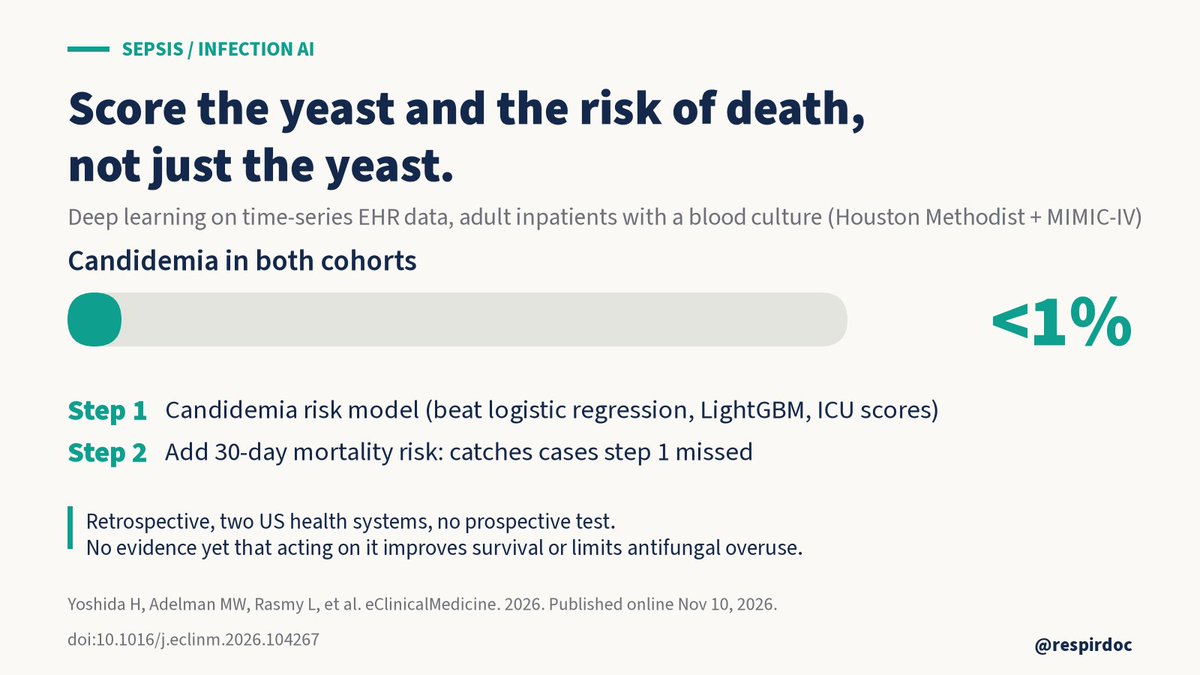
Source: Yoshida H, Adelman MW, Rasmy L, et al. Two-step deep learning for candidemia prediction using time-series electronic health record data from the USA: a model development and validation study. eClinicalMedicine. 2026 (online Nov 10). https://t.co/lvI2NsNP9z
A new candidemia model doesn't only ask who might have yeast in the blood. It asks who can't afford to wait for the culture.
Yoshida and colleagues (eClinicalMedicine) trained a deep-learning model on time-series EHR data from adult inpatients with a blood culture drawn, at Houston Methodist and in MIMIC-IV. Candidemia occurred in under 1% of patients in both. The model beat logistic regression, LightGBM and the established ICU candidemia scores, especially on precision-recall, which is the honest metric for an event this rare.
The useful part is step two. Adding a 30-day mortality model on top of the candidemia model caught cases the candidemia model alone missed, and many of those high-risk patients never got an empiric antifungal.
That is how the bedside call already works: the chance of yeast, weighed against the cost of being late.
The limit: retrospective, two health systems, no prospective test, and no evidence yet that acting on it improves survival or avoids antifungal overuse. A flag, not a prescription. The physician still decides.