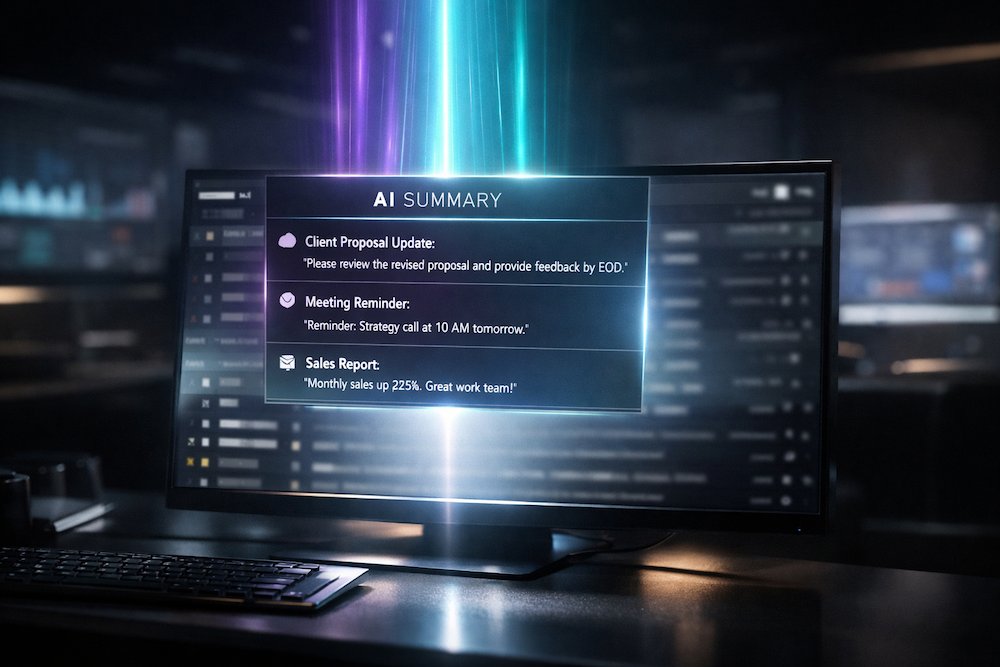
Who reads your email first: the buyer or AI?
Modern inboxes now summarize outreach before buyers read it. That changes deliverability, cadence, messaging, and how B2B teams should measure success.
Less activity. More buyer movement.
Read on.
#B2BGT...
https://t.co/7EPPzOVc1A
How To Choose A Revenue AI Program In 2026 - Choosing the right Revenue AI program in 2026 isn't about chasing the newest tool—it's about finding a system that turns buyer signals into predictable pipeline without burning your brand or adding headcount.
https://t.co/voFxl70Xr5
ABM Metrics & Attribution: Stop Measuring Account-Based Programs with Lead-Era Metrics. How ABM metrics and attribution should evolve into a GTM measurement model built around coverage, readiness, throughput, and yield. #GTMstrategy#ABM#B2B
https://t.co/diURghVDKm
From Stack to System: Why Gartner's RAO Category Signals a Shift in Revenue AI Strategy - Discover why Gartner's new Revenue Action Orchestration (RAO) category is crucial for modernizing B2B GTM systems & turning insights into coordinated actions.
#...
https://t.co/sYi8kIOWS2
Outbound isn’t dead. Guesswork is. Signal-driven outbound is how modern teams turn intent into meetings. Here’s the playbook. 👇
https://t.co/YGFNyNXOsF
If your team can’t answer “why these accounts, why now,” you don’t have a volume problem – you have a prioritization problem.
If business growth is a rocket, Sales are the astronauts — out in customer “space,” exploring, listening, and problem-solving to turn unknown territory into trusted relationships and real revenue. 🌟 Happy National Salesperson Day! Here's to all that you do!
100% great question @via_marketing_ ! Guess, while we humans are still ultimately making the buying decisions, gone are the days when we aren't doing so without the help of AI.
AI Inbox Summaries Are Rewriting Email Deliverability Rules (Whether You Like It or Not) - Here's how AI-generated summaries are transforming email deliverability strategies and what this means for B2B GTM. Steal this playbook – rewrite your 2026 outre...
https://t.co/IcsJCdnUbm
Revenue AI Reality Check: Tools Are Easy. Outcomes Take an Operating Model. Get the rollout plan that actually sticks for 2026.
https://t.co/eWqT99Bl9q
Struggling to prove ABM is driving real pipeline, not just “influence”? See how SaaS teams are redefining metrics, fixing attribution, and tying buying-group signals to revenue. How are you measuring ABM success for 2026 — still MQLs, or full-funnel impact?https://t.co/L0qzMR6EyY
🚀 We’ve had predictive AI in GTM for years (intent, scoring, prioritization)… but 2025 is when AI became visible in the workflow, helping teams move from insights → action.
What was your biggest RevAI lesson in '25? ...what are you prioritizing next?
https://t.co/UAMblY0ylp
Guys I have bad news.
Extraordinarily bad news.
We have 30 to 50 years before we get to full Post-Labor Economics.
The bottleneck isn't intelligence, or even robotics.
It's economic scale.
We ran all the numbers, and ran them again.
The primary question: "how long does it take to build a billion humanoid robots?"
Even if we double production capacity every 3 years, it takes two decades.
But there are multiple constraints: rare earth metals for batteries, actuators, and sensors are the biggest one by far.
Next is economies of scale.
For comparison, it took 92 years for the automobile to reach full saturation: 1900 to 1992. Now, we had a car culture by the 1950s... But that's still five decades and two industrial wars worth of innovation.
We did everything we could to speed it up: pneumatic hybrid robots are a no go. Air tanks need to be swapped every 20-30 minutes.
The ONE saving grace might be exotic actuators like electropolymer muscles. Right now, they just aren't strong enough. BUT, if we can make them stronger and cheaper, our petrochemical industrial base could accelerate the deployment of humanoid robots by a decade or two.
So what does this mean?
We'll hit AGI and ASI long before we can automate away all human labor. We might even hit the Singularity before we can scale up enough robots to replace all jobs.
Here's my current timeline:
2025 to 2030: Collapse of knowledge work. The "KVM Rule" applies: any job you can do entirely with a keyboard, video, and mouse will be fully replaced.
2030 to 2040: Droid scaling up starts to really make a dent.
2040 to 2060: We'll finally reach global labor substitution with robots.
What does this mean? There are a few jobs that are going to stick around for the foreseeable future:
1. Skilled labor. Robots will be able to do your job as a mechanic or welder very soon. However, there simply won't be enough robots to go around.
2. High Accountability Jobs: doctors, lawyers, comptrollers, financial advisors - all jobs that require license, insurance, and accountability. Also called statutory jobs (law requires a human or does not contemplate non-human labor)
3. Meaning Jobs: authenticity and sentimental premium. Celebrities, performers, influencers, athletes, priests, philosophers, and some educators, caretakers, etc
4. Complex Relationship Jobs: politicians, diplomats, negotiators, governance, account executive.
5. Capitalists. The ownership class will be fine. Always is.
So what can you do?
Upskill and reskill. Join the meaning economy or get into skilled trades. All you smart desk jockeys would make great HVAC techs, mechanics, linemen, and more. But just keep in mind you're going to have a lot of stiff competition.
There are a few silver linings to this news:
FIRST it means that we have longer to adapt to total economic upset. Yes, AI and robots will hypothetically be able to take all jobs within 5 years, but human bodies are still more abundant, more portable, and more energy efficient. This is a VERY deep moat.
SECOND it means that a Terminator style takeover is economically impossible. MIL-SPEC and NIST standards mean that ASI can't hack our hardware and even if we have a few AI bots, tanks and aircraft, humans win on sheer volume for many decades to come - more than long enough to solve alignment.
HOWEVER it means we'll have ordinary jobs for a lot longer than we'd like. Deployment will be uneven, so some economies will saturate with robots sooner than others.
BUT this gives PLE an avenue. Create ESOP and cooperatives that own a bunch of robots. That means we collectively buy, own, and operate robots for everything from construction to leasing to businesses, and we collect the rent. Or we tax the crap out of them.
What do you think? Can we figure out a faster way to ramp up humanoid robot production or are we doomed to skilled and unskilled blue collar work for the next generation?
@AChiefAIOfficer Was a great session, Chris! where do I find the link to get in at 11 AM EDT? Don’t see it on the events board or am I Inbox? Did I miss something? Thank you!
If your brand is recognizable by a logo or simple tagline, you are trending in the right direction.
However, if you find yourself overexplaining what your brand represents our team specializes in refining a business's branding to its most essential compo https://t.co/gAODUAQNTi