The bitter lesson in 26 words:
Don’t be distracted by human knowledge, as AI has been historically.
Instead focus on methods for creating knowledge that scale with computation, like search and learning.
I strongly believe there are entire companies right now under heavy AI psychosis and its impossible to have rational conversations about it with them. I can't name any specific people because they include personal friends I deeply respect, but I worry about how this plays out.
I lived through the great MTBF vs MTTR (mean-time-between-failure vs. mean-time-to-recovery) reckoning of infrastructure during the transition to cloud and cloud automation. All those arguments are rearing their ugly heads again but now its... the whole software development industry (maybe the whole world, really).
It's frightening, because the psychosis folks operate under an almost absolute "MTTR is all you need" mentality: "its fine to ship bugs because the agents will fix them so quickly and at a scale humans can't do!" We learned in infrastructure that MTTR is great but you can't yeet resilient systems entirely.
The main issue is I don't even know how to bring this up to people I know personally, because bringing this topic up leads to immediately dismissals like "no no, it has full test coverage" or "bug reports are going down" or something, which just don't paint the whole picture.
We already learned this lesson once in infrastructure: you can automate yourself into a very resilient catastrophe machine. Systems can appear healthy by local metrics while globally becoming incomprehensible. Bug reports can go down while latent risk explodes. Test coverage can rise while semantic understanding falls. Changes happens so fast that nobody notices the underlying architecture decaying.
I worry.
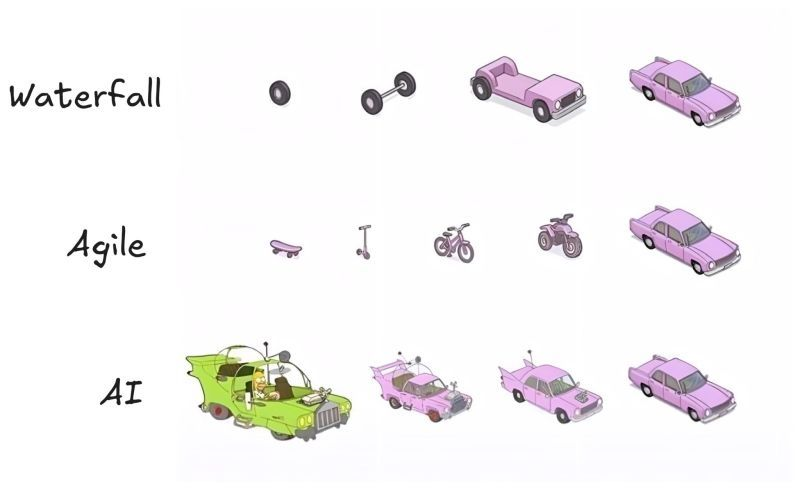
Honestly, this is the most accurate diagram I've seen.
Waterfall: You plan for 18 months and deliver exactly what nobody needs anymore.
Agile: You deliver something usable at every step, but the CEO keeps asking, "Where's the car?"
AI: You get the car on day one. It has six wheels, the doors are on backwards, and it has a rocket launcher. You spend more time making it yours than actually "building"; it's shaping. owning. verifying. That's what the best AI developers do now. They don't build. They shape and own.
GLP-1 drugs are the ultimate validation of the techno-solutionist approach to society's most challenging problems.
The obesity crisis seemed liked it would just get worse and worse forever. Scolding from public health officials didn't work. Proposals to completely overhaul our food systems were dead on arrival.
Instead, we invented a weekly shot (based on Gila monster venom!) that fixes obesity directly.
And now, thanks to the economic incentives in our biomedical industry, we have follow-on drugs that will be cheaper, even more effective, and easier to administer (by taking a pill instead of a shot).
Policymakers should be focused on figuring out how we can get more breakthrough drugs like GLP-1s (and faster). They also should think hard about which slopulist ideas might inadvertently kill the goose that lays the golden eggs.
🚨🇮🇱🇮🇷 In what might be some of the most powerful footage to come out of today, Israelis and Iranians are dancing and celebrating side by side in the streets of London.
Prediction: When Iranians overthrow their brain-rotted religious dictator, become a liberal democracy, and rejoin the global economy, they’ll become one of the biggest economic powers in the world. Iranians are some of the smartest, hardest-working, and most entrepreneurial people I’ve ever met.
I fully supported our strike on Iranian nuclear facilities last year.
Build on this momentum if further kinetic actions are necessary.
These brave protesters deserve our full support to break this brutal regime.
We need more rugged individualism, not less.
Build on the frontier. Be independent. Decentralize power. Accelerate civilizational progress. Celebrate economic freedom.
This comment is actually instructive in explaining how California manages to waste enormous sums of public money. It isn’t “theft” in the narrow legal sense. Nobody is stuffing cash in duffel bags. But when taxpayers are compelled to fund projects that continuously produce almost no public value, the moral distinction between waste and theft starts to blur.
Spending more than $17 billion to deliver a single mile of track is a concrete example. To a reasonable citizen, this understandably feels like theft, even if it passes every formal rule.
The deeper problem is not corruption in the cartoon sense, but incentive failure caused by political capture. When one-party dominance persists long enough, success inside the system stops being measured by outcomes and starts being measured by activity. How many favored constituencies are paid, how many processes are satisfied, how many insiders benefit. Creating 16,000 union jobs becomes the metric of success, regardless of whether the project itself works.
In that environment, the purpose of the spending quietly flips. The act of allocating money replaces the intended result of the work. Officials come to believe they have succeeded because they followed the political logic of the system, and they are genuinely confused when citizens object to the absence of results.
Imagine if the private economy operated this way. Imagine the most unprofitable companies received more capital precisely because they failed, while productive firms were starved because they “didn’t need it.” Society functions only when capital flows increasingly toward effectiveness, not toward the largest failures. California’s public allocation system increasingly does the opposite…and then calls it success, because the people inside the system like @igardon actually *believe* it’s success.
San Francisco just got a proposal for the tallest tower on the West Coast.
And this is not just about one building. This plan would transform a vacant city block into a dynamic mix of housing, office space, retail, and public space by developing the former PG&E and Matson headquarters.
This shows what's possible when people believe in our city's future. Let's go, San Francisco.
If we punish people for creating outsized value, fewer will try, and society loses.
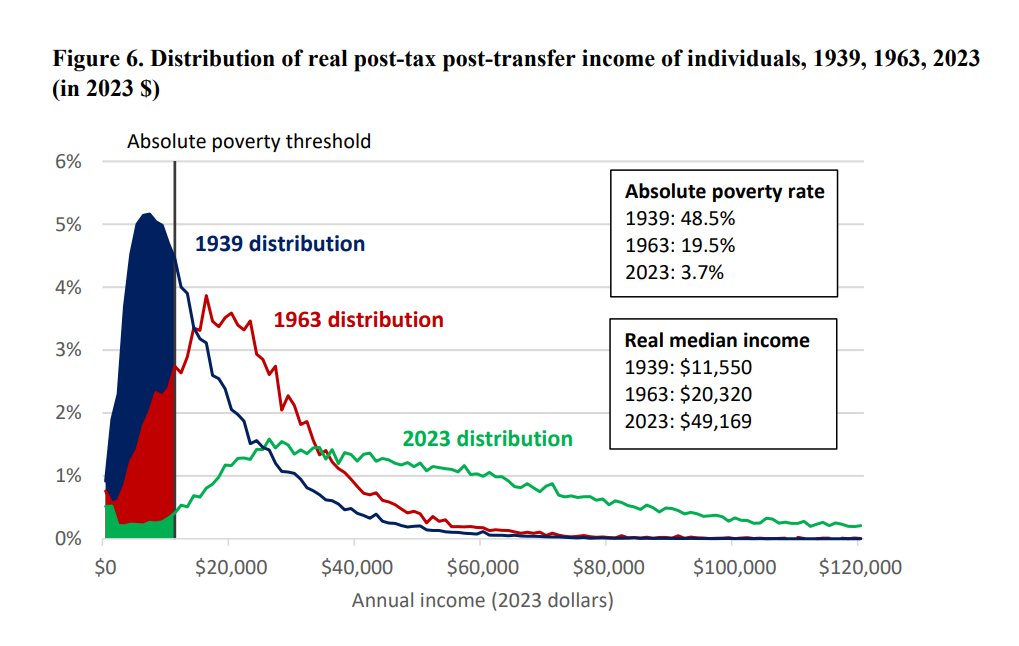
We can look to China, India, and Vietnam. When I was born, poverty rates were 88%, 60%, and 80%. Each country embraced market reforms and let their versions of capitalism take root. Inequality soared, billionaires were minted, and today, poverty has dropped to ~0% in China, 12% in India, and 2% in Vietnam.
We’ve never seen a country lift hundreds of millions out of poverty without also creating inequality and extreme wealth. In fact, every major case of mass poverty reduction came with more billionaires, not fewer. And I think most citizens would take that trade.
People often speak about inequality, poverty, and injustice in the same breath, but they’re not the same thing. Pakistan has far less income inequality than the US, but very few would say a poor Pakistani has a better life than a poor American.
You can reduce inequality two ways: lift the bottom up, or push the top down. The first works. The second often backfires.
Poverty is a problem to be solved. Unfairness is a problem to be solved. Wealth inequality is not by itself a problem.
We should do everything we can to lift people up, but not by tearing down those who create value! Progress comes from innovation, not envy.
AKA
WE SHOULD HAVE MORE BILLIONAIRES