In this new open access (🔓) article, @GuangyiPan explains how middle powers function not as passive recipients of great-power regionalism but as active agents, recalibrating the spatial dimensions of regional cooperation to mitigate structural imbalances. https://t.co/xTDdXsHOUf
In this paper from our special issue on small European states’ relations with China, @DiegoTelias and @RQTurcsanyi explain how the Viktor Orbán government in Hungary approached ties with China, in the context of his worldview and domestic political agenda. https://t.co/fRwhL4MfXX
In this article from our special issue on small European states’ relations with China, @VictorDeDecker and Astrid Pepermans explain how in the case of Belgium, internal state structures complicate operationalisation of the EU’s economic security agenda. ⤵️ https://t.co/dGLT4wOEGx
‘A small state in big power politics: the securitisation or riskification of Sino-Irish relations.’
Read this paper by Niall Duggan, in our special issue on small European states’ relations with China. ⤵️ https://t.co/Vo78hwGa51
In this special issue paper, Juris Jurans and Una Aleksandra Berzina-Cerenkova explain how non-establishment actors in Latvia have sought to leverage China’s presence and interests to create political opportunities and enhance their bargaining power. ⤵️ https://t.co/PbkAVeCbjE
In this new article, Benjamin Bartlett examines the adoption of cyber-security into the US-Japan alliance between 2000 and 2015. ⤵️ https://t.co/k1pvHcGsum
In this special issue paper, @BartekKowalski1 examines the factors shaping Serbia’s agency vis-a-vis China at the intersection of foreign and domestic policies, including personal diplomacy, ontological security and the vested interests of the ruling elite.https://t.co/uKPgzj1Pze
In this special issue paper, @Joshua_Eisenman and @KaraNemeckova examine Czechia’s relations with China, demonstrating how specialized expertise, institutional ties, and consistent, values-driven policies can help smaller states resist great power coercion.https://t.co/NxTNPBDCWR
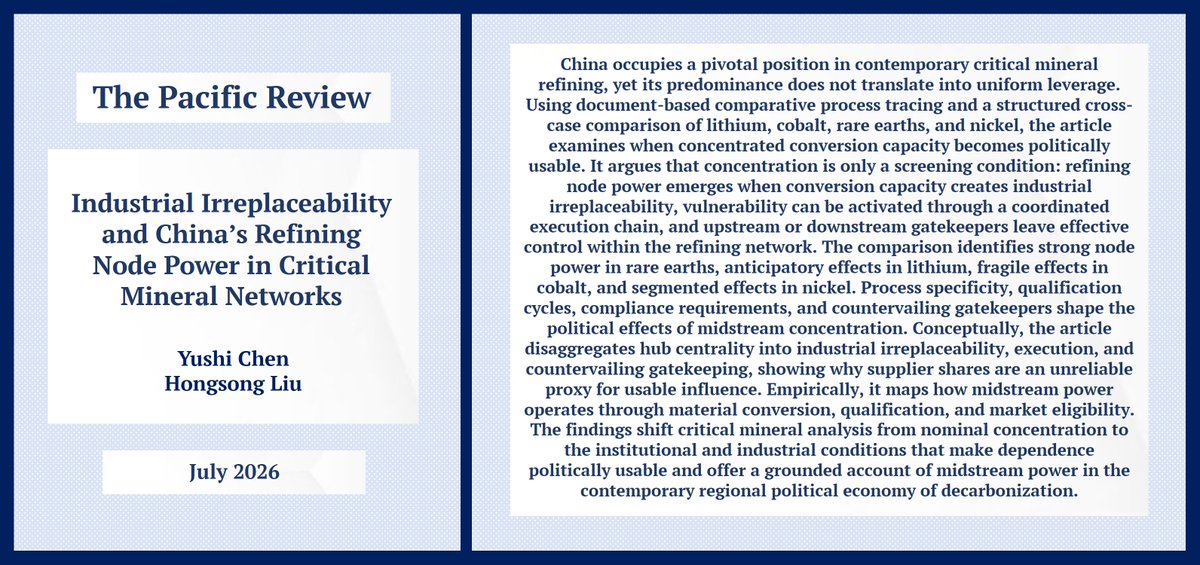
‘Industrial irreplaceability and #China’s refining node power in critical mineral networks.’ https://t.co/bCdgk8iBaC
New article by Yushi Chen and Hongsong Liu ⤵️
In this open access (🔓) special issue introduction, @RQTurcsanyi and @Joshua_Eisenman elaborate on how small European states shape their relationships with #China. The issue covers six country cases: Czechia, Ireland, Belgium, Hungary, Latvia, and Serbia. https://t.co/RQZjqVsphy
Our latest issue (Vol. 39, Issue 4) is out! 📖
‘Small European states’ relations with #China: Enhancing autonomy and advancing interests.’
This special issue is edited by @RQTurcsanyi and @Joshua_Eisenman.
Take a first look at the line-up here: https://t.co/tj66vUcowB
New metrics for @ReviewPacific ⤵️
Our Impact Factor has increased from 2.0 in 2024 to 2.4 in 2025, with our ranking among Area Studies journals 13/184.
Huge thanks to authors, reviewers, and all those that have engaged with the journal in the last year.
‘Dialogue among divided nations: interactional resilience in inter-Korean and cross-strait relations.’
New article by Jianjun Lian and Yuyi Chou ⤵️ https://t.co/tUjpw6HLuk
In @Diplomat_APAC, Yuhang Ding and Sailin Li expand on the findings of their recent article in @ReviewPacific, explaining how the Russia-Ukraine war has rewired Southeast Asia’s arms trade. https://t.co/1iypMFrlaJ
Yung Lin argues that #Taiwan’s civic-embedded public diplomacy extends democratic participation into the international arena, involving civil society and cultural institutions as diplomatic actors.
Read this new article (open access 🔓) here: https://t.co/27BCvXEygc
‘Constrained sovereignty, insecure margins: the #ASEAN Way and human security challenges in Malaysian border communities.’
Read this new article by Aizat Khairi, Muhammad Luqman Rosli and Abdul Muein Abadi. ⤵️ https://t.co/sZcPIoSJCq
Why have #China’s efforts to socialise other states produced such divergent outcomes?
@Andreeaioanabu and Maryia Danilovich address this question by examining China’s socialisation attempts with states in Central and Eastern Europe and in Central Asia. ⤵️ https://t.co/eRU0rtgr4E
In this new article, Alan Tidwell argues the conditions that once allowed Pacific Island states to hedge among major powers are narrowing. ⤵️ https://t.co/nyanFTf4lZ
In this new article, Yong Chi and Yanxiao Li examine transcripts of official speeches from 2015-2025 to trace changes in the expression of #China’s developing-country role. ⤵️ https://t.co/br4bS4lp1B
In this new article, Moosung Lee draws on ontological security theory to argue that enduring hostility in EU–North Korea relations cannot be explained by material threat perception alone, framing contestation as embedded in incompatible self-narratives. ⤵️ https://t.co/8MjB9MGbYP