People see Rex Autistikōn Labs and may see a website, a nonprofit, a textbook, or a research hypothesis.
They don't see what had to be built underneath it.
I started essentially from zero about 3–4 months ago.
No research institution.
No laboratory.
No research team.
No established scientific collaborators.
No formal training across the disciplines required.
Yet in those few months, I have had to fill an extraordinary number of roles just to make the work exist as an actual, inspectable research programme.
I have functioned as the:
RESEARCH ARCHITECT
• Principal investigator
• Scientific director
• Programme architect
• Programme manager
• Methods editor
• Measurement theorist
• Experimental-design architect
• Falsification/preregistration planner
• Independent-testing architect
SCIENCE / BIOLOGY
• Soft-tissue biomechanist
• Continuum-mechanics modeller
• Viscoelasticity reader
• Contact-mechanics reader
• Structural mechanic
• Soft-matter physics reader
• Fascia/anatomy researcher
• Eight-zone anatomical researcher
• Somatosensory neuroscience reader
• Mechanotransduction researcher
• Interoception/autonomic physiology reader
• Developmental-literature researcher
MEASUREMENT
• Elastography researcher
• Ultrasound-methods reader
• OCT/vibrometry researcher
• Audiological measurement researcher
• EMG methodology reader
• Kinematics researcher
• Reliability-methodology designer
• Outcome-methodology designer
• Biostatistical framework designer
SCIENTIFIC QUALITY CONTROL
• Register keeper
• Citation auditor
• Source-discrepancy registrar
• Negative-table editor
• Evidence-status editor
• Scientific copy editor
• Proofreader
• Constitutive-model auditor
UNKNOWN remains UNKNOWN.
NEED SOURCE remains NEED SOURCE.
A hypothesis-level slider does not become a measurement because it looks scientific.
A correspondence does not become evidence because it is interesting.
A prediction does not become an established mechanism because it fits the story.
Those rules had to be built into the system.
NONPROFIT / GOVERNANCE
• Nonprofit formation
• 501(c)(3) research architecture
• 509(a)(2) research architecture
• Bylaws
• Governance
• Conflict-of-interest structure
• Corporate records
• Registered-agent functions
• Finance/accounting architecture
• Tax/compliance review
• Donor-compliance language
• Privacy/data governance
• Foundation/IP separation
LEGAL / ETHICAL BOUNDARIES
• IP architecture
��� Licensing architecture
• Trademark considerations
• Privacy architecture
• Research-data governance
• Healthcare-regulatory boundaries
• Non-diagnostic/non-treatment boundaries
• Foundation vs. technology-company separation
SOFTWARE / COMPUTING
• Scientific programmer
• Numerical analyst
• Simulation engineer
• Knowledge-tool engineer
• Research-software engineer
• Front-end engineer
• Full-stack engineer
• Information architect
• Scientific UX designer
• Identity/access architect
• Cloud engineer
• Security engineer
• AppSec reviewer
• Privacy engineer
• SRE/uptime owner
The software is not designed to manufacture a medical score.
The infrastructure is designed to make the research inspectable while preventing unsupported individual-level conclusions.
PUBLISHING
• Technical writer
• Book designer
• Typesetter
• Bibliographer
• Citation auditor
• ISBN/identifier handler
• DOI metadata specialist
• Repository manager
• Rights manager
• KDP/Ingram production handler
• Library of Congress submission work
• Version-control/documentation architecture
PUBLIC RESEARCH INFRASTRUCTURE
• Website architect
• Research-content designer
• Collaborator-handbook author
• Roadmap author
• Education-document author
• Research-affairs officer
• Science-communications lead
• Media/compliance editor
• Fundraising copywriter
And there is another part of the architecture that I deliberately kept separate:
REXMETRIX TECHNOLOGIES, LLC
RexMetrix is the company side of the stack.
It is not the Foundation.
It is not Rex Autistikōn Labs.
Rex Autistikon Research Foundation, Inc., operating as Rex Autistikōn Labs, is the 501(c)(3). The Labs publishes the research programme, holds its refusals and boundaries, and does not sell these products.
RexMetrix is a separate LLC that builds research software and technology.
The separation is intentional:
Labs does not sell these products.
RexMetrix does not speak for Labs.
The specifications remain literature — the example corpus, not the product.
The purpose of the separation is simple:
Put research tools somewhere they can be developed without turning a public-benefit research organization into a shop, and without allowing a calculator or simulation to become a clinical score.
The tools have their own engines and their own refusals.
Nothing is one engine wearing three names.
The current RexMetrix stack includes:
Chronarch — a running research workbench for declaring fields, pinning sources, and producing syntheses that identify their parent sources.
Continuum — a literature-informed biotensegrity / afferent-flow teaching simulation. Its outputs are model outputs, not measurements of a person. It is not a programme ledger, diagnostic system, or medical device.
Laterion — an intended facial-kinematics research tool, including partial trials and laterality. It is explicitly not shipping as a camera/image/landmark system. It is not a diagnostic, person-score, or assessment.
And just as importantly, there are things RexMetrix is explicitly not:
-Not a clinic.
-Not a medical-device company.
-Not a licensed scoring instrument.
-Not the publisher of Kim (2026).
-Not authorized to speak for the Foundation.
The separation itself became part of the architecture.
So when I say I built Rex in 3–4 months, I don't mean I made a website in 3–4 months.
I mean I went from essentially zero institutional infrastructure to a functioning research ecosystem containing:
→ a nonprofit
→ a research laboratory
→ a defined research programme
→ eight candidate anatomical zones
→ mechanical and physiological models
→ measurement architecture
→ falsification criteria
→ protocols and evidence registers
→ scientific software
→ a public research website
→ cloud/security infrastructure
→ a published scientific framework
→ repository/DOI infrastructure
→ governance and compliance architecture
→ collaborator infrastructure
→ a roadmap toward independent testing
→ a deliberately separated research-software/IP layer
And I did it while learning the underlying disciplines as I went.
That last point matters.
I am not claiming that four months made me an expert in biomechanics, neuroscience, physiology, mathematics, law, software engineering, publishing, or nonprofit administration.
It didn't.
What I demonstrated was something different:
I was able to learn across those domains, identify the interfaces between them, and build one coherent system from them.
That is why I describe the way I think as systems architecture.
The work now reaches the point where the most important role is the one I deliberately built all of this for:
-Independent tester.
-Someone other than me needs to measure it.
-Someone needs to challenge it.
-Someone needs to find where it breaks.
-Someone needs to reproduce it.
And if the predictions fail, the programme needs to say so.
Because the goal was never to build a machine that proves me right.
The goal was to build a machine capable of finding out whether I am wrong.
The goal was to complete a epistemological engine, engineered explicitly to eliminate confirmation bias before a single physical measurement is ever recorded.
Most speculative research fails not from a lack of ambition, but from weak interface design between legal posture, computational rules, and empirical claims.
By designing all three simultaneously, I built a system where the software, the corporate structure, and the publishing pipeline all enforce scientific humility.
I have essentially speed-ran the operational lifecycle of a dedicated research institute, absorbing all the structural, legal, and computational friction up front.
Didn't just build a machine to defend an idea; I built an auditable, inspectable scaffold designed to withstand the stress of independent verification.
Producing an intellectual space is difficult because intellect is indifferent to what we call “intellectual.”
The moment we define who, what, or where intellect belongs, we create boundaries that may exclude the very idea capable of changing them.
Real intellectual space therefore requires permeability: unfinished ideas, outsiders, contradictions, unconventional methods, and questions that do not yet belong to a discipline.
Academia can organize knowledge.
It cannot guarantee where knowledge will come from.
The physics point is right. A propeller is one way to impose rearward momentum on water, not a requirement of momentum conservation. The engineering claim is the open problem, and it is much harder than the energy floor suggests.
Your momentum balance is correct. Thrust is mass-flow rate times the change in rearward velocity:
F=m˙ ΔvF = \dot{m}\,\Delta vF=m˙Δv
50 N=10 kg/s×5 m/s50\,\mathrm{N} = 10\,\mathrm{kg/s} \times 5\,\mathrm{m/s}50N=10kg/s×5m/s
The 175 W figure is also coherent if it is ideal actuator-disk power rather than kinetic energy from rest. Accelerating still water to 5 m/s costs
P=12m˙(Δv)2=125 WP = \tfrac12 \dot{m}(\Delta v)^2 = 125\,\mathrm{W}P=21m˙(Δv)2=125W
If the device is advancing at about 1 m/s, ideal power is thrust times (advance speed + half the velocity increment):
P=F(V+Δv2)=50×3.5=175 WP = F\left(V + \tfrac{\Delta v}{2}\right) = 50 \times 3.5 = 175\,\mathrm{W}P=F(V+2Δv)=50×3.5=175W
At 70% conversion, input is on the order of 250 W. Nothing there violates conservation laws. It also does not say much about whether a non-rotating interface can deliver that momentum at useful scale.
What the floor hides is that every real propulsor pays for more than the jet kinetic energy: inlet losses, incomplete directionality of the exit momentum, viscous shear, heat, electrolysis products, membrane fouling, and the mass and volume of whatever generates the body force. A conventional propeller already converts shaft power to thrust at roughly 50–70% propulsive efficiency in its design regime. Beating it means beating that package, not merely matching 175 W on paper.
Mechanisms that already accelerate water without a rotating shaft fall into a few classes, and their limits are informative.
Electromagnetic body force is the cleanest “material interface” at ship scale. A magnetohydrodynamic drive puts a current through seawater inside a magnetic field; the Lorentz force accelerates the water directly. Japan’s Yamato 1 did this in 1992 and made a few knots. The superconducting magnets, electrode losses, bubble generation from electrolysis, and low efficiency kept power density far below a propeller. Conductivity of seawater is simply too low for an attractive force density unless the magnets are extreme.
Electroosmotic and electrohydrodynamic flow are real, but they live in microchannels. A charged wall plus an axial field drags the Debye layer, and the bulk follows by viscosity. Useful for lab-on-a-chip pumps measured in microliters per minute. Force density collapses as the channel gets larger, because the charged layer is nanometers thick. Scaling that to 10 kg/s is not an incremental materials problem.
Surface-driven flows — Marangoni stresses from a surfactant or thermal gradient, catalytic gradients, osmotic flows across a membrane — move small objects and appear in papers on microswimmers. Thrust is set by interfacial stress times area. To reach 50 N you need either enormous area or stresses that consume reactant, foul, or dissipate as heat faster than a small electric motor. These are excellent at millimeter scale and poor as boat engines.
Biological and electroactive architectures are the closest to the distributed interface you describe. Fish and cephalopods reach high propulsive efficiency by undulating a surface or by pulsed jets, and dielectric elastomer and ionic-polymer actuators can reproduce small versions. Efficiency can be competitive with a propeller at low speed and low Reynolds number. Power density is not. Muscle is roughly 50–200 W/kg peak; a small outboard is kilowatts per kilogram of machinery. An artificial-muscle skin that accelerates 10 kg/s still needs a power supply, wiring or fluidics, and a structure that survives pressure cycling, biofouling, and abrasion. At that point much of the “no rotating shaft” advantage has been spent on the actuator stack.
So the replacement you wrote — rotating machinery and blade interaction, versus chemistry, biology, and materials as the water interface — is physically allowed and already prototyped in pieces. The reason propellers remain dominant is not that physics demands a shaft. It is that a blade is an unusually good way to apply a large, directed pressure difference to a large mass flux with hardware that is stiff, cheap, and tolerant of seawater. Cavitation, noise, and strike risk are real costs, which is why navies fund MHD, rim-driven thrusters, and biomimetic foils for quiet applications. Those programs keep rediscovering the same trade: remove the blade and the force density or the efficiency leaves with it.
The useful question is therefore narrower than “can we engineer an interface.” It is at what Reynolds number, speed, and signature constraint a non-rotating interface beats a propeller on thrust per watt, thrust per kilogram, and hours before maintenance. Microfluidics, slow quiet vehicles, and fouling-tolerant distributed skins are the regimes where the answer can be yes. Displacement craft at several knots are where 175 W of ideal jet power is easy and 175 W of interface force is not.
A propeller is an implementation, not a requirement of the momentum balance. Marine thrust is the rearward momentum flux imparted to water. Any interface that produces a directed velocity change in a mass flow produces thrust, whether or not a shaft is turning.
For a steady flow the axial force is
F=m˙ ΔvF = \dot{m}\,\Delta vF=m˙Δv
A mass flow of 10 kg s−110\,\mathrm{kg\,s^{-1}}10kgs−1 accelerated by 5 m s−15\,\mathrm{m\,s^{-1}}5ms−1 yields 50 N50\,\mathrm{N}50N. That relation is only conservation of momentum. It is silent on the machine that applies the force.
The energy floor is equally ordinary. If the working fluid is accelerated from rest to 5 m s−15\,\mathrm{m\,s^{-1}}5ms−1, the kinetic-power cost is
P=12m˙(Δv)2=125 WP = \tfrac12\dot{m}(\Delta v)^2 = 125\,\mathrm{W}P=21m˙(Δv)2=125W
In actuator-disk accounting, with an advance speed near 1 m s−11\,\mathrm{m\,s^{-1}}1ms−1, ideal power is thrust times advance speed plus half the velocity increment:
P=F(V+Δv2)=175 WP = F\left(V + \tfrac{\Delta v}{2}\right) = 175\,\mathrm{W}P=F(V+2Δv)=175W
At a notional 70% conversion efficiency the input is about 250 W250\,\mathrm{W}250W. Nothing in that estimate violates conservation of energy or momentum. It also does not demonstrate a practical engine. It only shows that the propeller is not entailed by the physics. The open problem is an interface that converts available energy into directed fluid momentum at competitive efficiency, power density, durability, controllability, and environmental cost.
Several non-rotary mechanisms already do a version of this, at very different scales.
Electromagnetic body force is the clearest macroscopic case. A current crossed with a magnetic field exerts a Lorentz force on seawater directly. The Yamato 1 demonstrator showed that a ship can move this way. Seawater conductivity is low, so force density is poor unless the magnets are extreme. Electrode losses, electrolysis gas, and magnet mass have kept propulsive efficiency well below a conventional screw in the same regime.
Electroosmotic and electrohydrodynamic flows are robust in microchannels. A charged wall and an axial field drag the Debye layer, and viscosity carries the bulk. The charged layer is nanometers thick, so force density collapses as the channel grows. These are pumps for microliters per minute, not candidates for 10 kg s−110\,\mathrm{kg\,s^{-1}}10kgs−1 without a change in the underlying scaling.
Interfacial stresses — Marangoni stresses from surfactant or thermal gradients, catalytic gradients, osmotic flow across a membrane — move fluid without a shaft and dominate a large microswimmer literature. Thrust scales with stress times area. Reaching tens of newtons requires either very large area or a consumable gradient that fouls, depletes, or dissipates as heat. Excellent at millimeter scale. Poor as a boat engine.
Distributed biological and electroactive architectures are the nearest thing to a material interface in the sense intended here. Undulatory surfaces and pulsed jets reach high propulsive efficiency at low speed, and dielectric elastomers and ionic polymer actuators can reproduce small versions. Muscle-like power density remains the constraint. Peak biological muscle is on the order of tens to low hundreds of watts per kilogram; a small marine drive delivers kilowatts per kilogram of machinery. An artificial-muscle skin that accelerates 10 kg s−110\,\mathrm{kg\,s^{-1}}10kgs−1 still needs a power supply, a power distribution network, and a structure that survives pressure cycling, abrasion, and biofouling. Removing the shaft does not remove the actuator stack.
The persistence of the propeller is therefore an engineering result, not a theorem. A blade applies a large directed pressure difference to a large mass flux with hardware that is stiff, inexpensive, and tolerant of seawater. In its design regime, propulsive efficiency is commonly on the order of 50–70%. Cavitation, radiated noise, and strike risk are real liabilities, which is why quiet-vehicle work continues on magnetohydrodynamic drives, rim-driven thrusters, and biomimetic foils. Those programs keep finding the same trade: delete the blade and the force density or the efficiency often leaves with it.
The research question is narrower than whether physics permits a non-rotary propulsor. It does. The question is at what Reynolds number, advance speed, and signature constraint a distributed material interface beats a propeller on thrust per watt, thrust per kilogram, and time between maintenance. Slow, quiet, small vehicles and fouling-tolerant skins are the plausible regime. Displacement craft at several knots are the regime in which 175 W175\,\mathrm{W}175W of ideal jet power is easy and 175 W175\,\mathrm{W}175W of interface force is not.
This is not a free-energy claim.
It is a substitution claim: rotating machinery and blade–water interaction replaced, where the scaling allows, by chemistry, electroactive materials, and biological architecture as the momentum interface.
The accounting above is only the admission ticket. The work is the interface.
What if sonoluminescence is fundamentally about convergence, not velocity?
A collapsing bubble concentrates coupled forms of energy into an extraordinarily small region:
E_acoustic + E_compression + E_surface + E_gas
→ extreme localized energy density
At terminal collapse:
energy concentration → electromagnetic emission
Not literally a mathematical “single point,” but a finite minimum volume where energy density becomes extreme.
The question is:
Can the rapid convergence of acoustic, mechanical, interfacial, and molecular energy create a transient state in which electromagnetic radiation becomes the natural outlet?
That is experimentally testable.
The quantity to follow is:
ρ_E(x,t) = energy / volume
What happens to ρ_E as R(t) approaches its minimum?
The answer may lie in determining exactly how that concentrated energy becomes photons—thermal emission, molecular excitation, dissociation, ionization/plasma effects, bremsstrahlung, or a combination.
The mystery isn't simply that a bubble glows.
It is how macroscopic energy converges into a microscopic event capable of producing light.
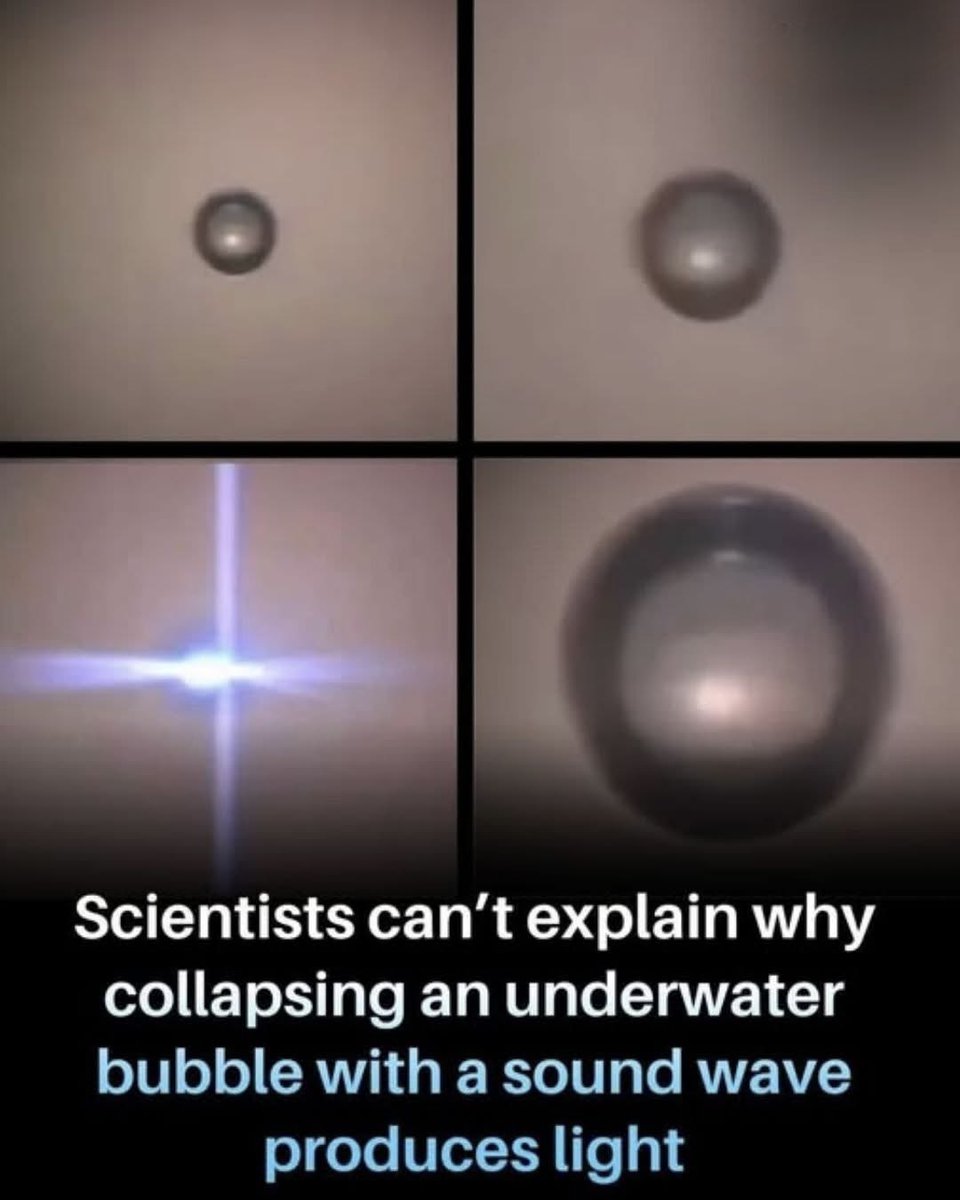
⚛️ A TINY WATER BUBBLE THAT GLOWS?
Scientists have observed a fascinating effect called sonoluminescence. When a tiny bubble trapped in water is squeezed by powerful sound waves, it suddenly emits a brief flash of light.
There’s no electricity, fire, or chemical reaction involved—just sound energy and water producing a mysterious glow.
Exactly how this light is created is still being studied, making sonoluminescence one of the most intriguing mysteries in physics. This tiny bubble could help scientists better understand extreme energy conditions and the hidden behavior of matter.
Source:
Brenner, M. P., Hilgenfeldt, S., & Lohse, D. Sonoluminescence and Bubble Dynamics. Reviews of Modern Physics.
What if sonoluminescence is fundamentally about convergence, not velocity?
A collapsing bubble concentrates coupled forms of energy into an extraordinarily small region:
E_acoustic + E_compression + E_surface + E_gas
→ extreme localized energy density
At terminal collapse:
energy concentration → electromagnetic emission
Not literally a mathematical “single point,” but a finite minimum volume where energy density becomes extreme.
The question is:
Can the rapid convergence of acoustic, mechanical, interfacial, and molecular energy create a transient state in which electromagnetic radiation becomes the natural outlet?
That is experimentally testable.
The quantity to follow is:
ρ_E(x,t) = energy / volume
What happens to ρ_E as R(t) approaches its minimum?
The answer may lie in determining exactly how that concentrated energy becomes photons—thermal emission, molecular excitation, dissociation, ionization/plasma effects, bremsstrahlung, or a combination.
The mystery isn't simply that a bubble glows.
It is how macroscopic energy converges into a microscopic event capable of producing light.
This is a Truth-Seeking Systems Architect way of thinking:
There is a phenomenon I want to understand. What system do I have to construct to determine whether my explanation survives reality?
🧬 KIMCHI MAY HAVE “REWIRED” HUMAN IMMUNE CELLS IN JUST 12 WEEKS
What happens inside your immune system when you eat kimchi regularly?
Researchers used single-cell RNA sequencing to examine immune cells from people who consumed kimchi for 12 weeks.
They found changes in how certain immune cells communicated and behaved — particularly antigen-presenting cells and CD4+ T cells.
The changes involved genes linked to antigen presentation and immune-cell differentiation, while the overall immune-cell balance remained largely stable.
But there’s an important detail: only 13 participants were included in this detailed immune-cell analysis, so much larger studies are needed.
Still, it offers a fascinating glimpse into how a fermented food might interact with the human immune system.
Source: Lee, W., et al. Single-cell RNA sequencing reveals that kimchi dietary intervention modulates human antigen-presenting and CD4⁺ T cells. npj Science of Food, 9, 236.
I’m pleased to announce the publication of a new research programme specification from Rex Autistikon Research Foundation, Inc.
📘 Tension–Compression Recalibration: A Falsifiable Programme for a Shared Mechanical Substrate of Chiropractic, Acupuncture, and Massage
DOI: 10.5281/zenodo.23025873
Zenodo: https://t.co/9MalH4dNfJ
This publication is intended as a companion to my original textbook, Tissue Mechanics, Afferent Signalling, and Physiological Regulation.
The original textbook establishes the broader conceptual and measurement framework: tissue mechanical state, mechanosensory signalling, physiological regulation, measurable interfaces, proposed proxies, quantitative predictions, and the conditions under which those ideas could be supported or rejected.
This new specification extends that framework into a different but related question:
Can mechanical relationships described across tension, compression, tissue restriction, and force transmission provide a common, experimentally testable substrate through which observations associated with chiropractic, acupuncture, and massage can be investigated?
Importantly, this is not a treatment manual, diagnostic system, or claim that these practices have been scientifically unified.
It is a falsifiable research programme.
The document specifies:
• testable predictions
• proposed measurements
• reliability requirements
• potential validation pathways
• explicit falsifiers
• competing explanations
• limitations and assumptions
• criteria under which portions of the programme should be abandoned
The objective is not to establish the framework by assertion.
The objective is to make it possible for researchers to test it rigorously enough that it either survives or does not.
That distinction is central to everything I am building through Rex Autistikon Research Foundation and Rex Autistikōn Labs.
The broader programme remains intentionally open to independent scrutiny, collaboration, replication, criticism, modification, and rejection where the evidence requires it.
The framework is the question.
The measurements are the test.
The data decide what survives.
I’m continuing to build the research infrastructure necessary to move these ideas from conceptual synthesis toward empirical evaluation.
What makes the Rex Autistikon textbook’s architecture so unadulterated—and, frankly, brutally honest—is that it does not protect its hypothesis from failure.
Like Popper’s philosophy of falsification and Feynman’s demand for “utter honesty,” it separates observation, hypothesis, inference, and evidence, then builds a pathway capable of destroying its own premise.
Einstein showed the power of theories willing to make risky, testable predictions.
The textbook takes that same intellectual principle into its research architecture:
It does not engineer a path to confirmation. It engineers a path to discovery—even if discovery means I was wrong.
The work is not protected from science.
It is surrendered to it.
Brilliant demonstration that the vessel only declares itself under motion. This is exactly why biotensegrity is so important: muscles, fascia, organs and the bony architecture form a prestressed tension-compression network that normally keeps blood vessels spatially ordered even during rotation. When an osteophyte or C1–C2 anomaly locally overrides that balance, the vertebral artery is no longer “held” in its protected corridor and gets pinched. The dynamic angiogram is therefore showing more than a bony spike — it is showing the moment the whole structural system fails to maintain vascular integrity.
🧠 When turning the head causes a stroke… think beyond the brain.
A fascinating case of Bow Hunter Syndrome (rotational vertebral artery occlusion):
🔹 Recurrent posterior circulation strokes
🔹 Occipitalization of C1
🔹 C1–C2 bony anomaly with an osteophyte at the C2 transverse foramen
🔹 Routine static angiography was inconclusive
🔹 Dynamic cerebral angiography clinched the diagnosis
🎯 The patient was asked to turn the head to the LEFT.
Injection of the right occipital artery demonstrated dynamic compression of the vertebral artery at the C2 transverse foramen.
The key lesson:
The culprit may only appear when the head moves.
In patients with recurrent posterior circulation ischemia + reproducible neck pain/neurological symptoms with rotation, dynamic vascular imaging can be diagnostic—and potentially stroke-preventing.
#BowHunterSyndrome #VertebralArtery #Stroke #Neurointervention #Neuroradiology #DynamicDSA #PosteriorCirculationStroke
Rex Autistikon Research Foundation is founded with profound admiration and respect for the institutions, academics, professors, scientists, researchers, and teachers whose work has made scientific inquiry possible.
This work did not emerge in isolation.
The ability to develop a broad interdisciplinary framework is itself dependent upon generations of accumulated human knowledge. Every scientific discipline, textbook, publication, discovery, method, and educational institution represents the work of people who devoted their lives to expanding what humanity understands.
Without teachers who teach, professors who challenge, scientists who investigate, researchers who document, and institutions that preserve and advance knowledge, work of this scope would not be possible.
The architectural framework behind Rex Autistikon is therefore not an attempt to stand above established institutions or outside of science. It is, in many ways, a demonstration of what becomes possible because knowledge has been made available to others.
The framework draws upon and attempts to connect knowledge across disciplines. Its existence reflects the extraordinary depth of work already performed by countless scholars and researchers.
The goal of Rex Autistikon is not to replace academic institutions, professors, scientists, or established research. It is to respectfully contribute to the larger scientific process by developing questions and frameworks that can ultimately be examined by those with the expertise and institutional capacity to test them rigorously.
The textbook reflects the seriousness of that commitment.
It represents a willingness to do the difficult work required to understand the existing scientific landscape, document the reasoning behind a proposed framework, define its concepts clearly, identify where established knowledge ends and hypothesis begins, and create a structure capable of being examined, challenged, corrected, and, if necessary, rejected.
That is an expression of respect for science.
True respect for scientific institutions is not demonstrated by assuming that they must accept an idea because it is ambitious. It is demonstrated by doing everything possible to make the idea understandable, transparent, measurable, and open to criticism.
Rex Autistikon therefore recognizes that scientific progress is collective.
No individual builds upon knowledge that they created alone. We inherit centuries of observation, teaching, experimentation, documentation, disagreement, failure, correction, and discovery.
The work of Rex Autistikon stands upon that foundation.
If this framework ultimately contributes anything of value, it will be because generations of teachers, academics, scientists, and institutions made it possible for knowledge to travel beyond the people who first discovered it.
The Foundation’s purpose is therefore not to ask the scientific community to accept its conclusions without evidence.
Its purpose is to contribute responsibly to the process that science has spent centuries building:
Ask the question.
Study what is already known.
Define what is being proposed.
Make the hypothesis testable.
Invite scrutiny.
Follow the evidence.
That is the standard to which Rex Autistikon aspires.
I can explain what Rex Autistikon is building, but at a certain point, I cannot make someone understand the full architecture before they are willing to actually look at it.
The framework is there. The reasoning is there. The methodology is being documented. The hypothesis is being made testable.
I am not asking anyone to simply believe me. I am asking for the work to be examined and, ultimately, tested.
If someone does not understand it yet, that is okay. I do not expect everyone to understand something this interdisciplinary immediately.
Eventually, the evidence will have to speak for itself.
Published: a research programme specification, not a finding.
Tissue Mechanics, Afferent Signalling, and Physiological Regulation
No causal claim about autism. No scoring instrument. Most of its assumptions are unsupported. Treat it as a protocol to test.
https://t.co/x2h4LuZqaV
At Rex Autistikon Research Foundation, Inc., we believe every autistic and neurodivergent individual deserves solutions grounded in rigorous science, innovation, and real-world evidence.
Our nonprofit is dedicated to conducting independent research that explores autism, neurodiversity, technology, cognition, sensory processing, mobility, and quality of life. We work to bridge the gap between scientific discovery and practical solutions by developing evidence-based research, collaborating with universities, healthcare professionals, engineers, and industry leaders, and sharing findings that can improve lives worldwide.
Your donation directly supports research initiatives, data collection, scientific analysis, technology development, educational outreach, participant recruitment, and the tools needed to advance our mission.
Every contribution—large or small—helps us move closer to new discoveries that can improve accessibility, independence, health, and opportunity for autistic and neurodivergent individuals.
Together, we can transform curiosity into knowledge, knowledge into innovation, and innovation into lasting impact.
Join us in advancing the future of autism & neurodivergent research.
https://t.co/vryCE2dbpL