🎉 Exciting news! Our recent work has been featured by the Department of Electrical & Computer Engineering at the @UWaterloo!
Check it out: https://t.co/Y3TCnNn24c
#UWaterloo#ECEUWaterloo#CPAMI
We’re releasing Action100M: the largest open dataset of ~15 years of video with dense action + caption annotations.
It's a key ingredient behind VL-JEPA, now open to fuel the next generation of VLMs, World Models, and Robotics policies.
Dataset on HF: https://t.co/bUs67QyOdd
Advanced Machine Intelligence (AMI) is building a new breed of AI systems that understand the world, have persistent memory, can reason and plan, and are controllable and safe.
We’ve raised a $1.03B (~€890M) round from global investors who believe in our vision of universally intelligent systems centered on world models. This round is co-led by Cathay Innovation, Greycroft, Hiro Capital, HV Capital, and Bezos Expeditions, along with other investors and angels across the world.
We are a growing team of researchers and builders, operating in Paris, New York, Montreal and Singapore from day one.
Read more: https://t.co/kyVAL7EoFx
AMI - Real world. Real intelligence.
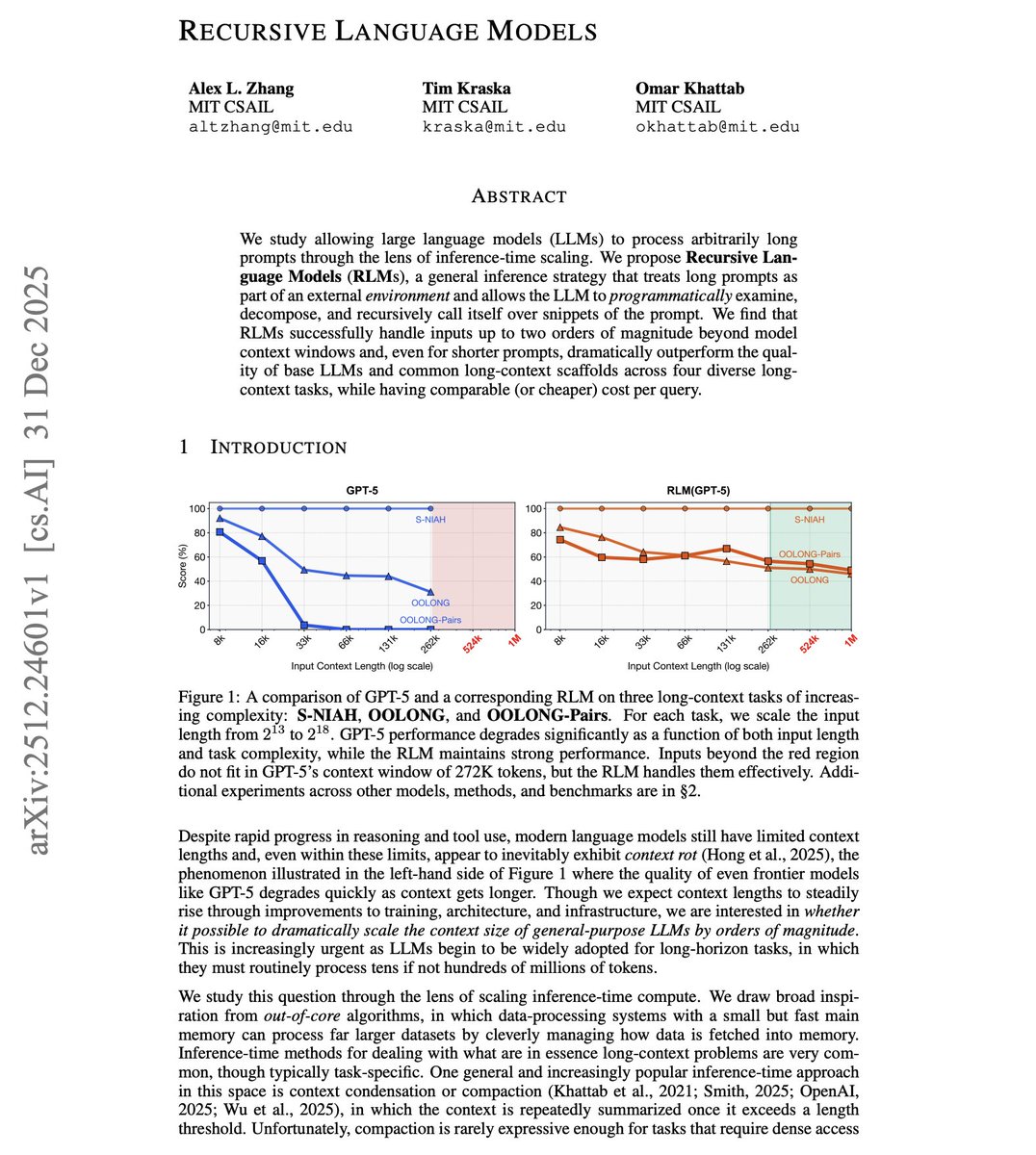
MIT researchers propose Recursive Language Models
You are going to hear more on this in 2026.
Why does it matter?
What if LLMs could process inputs 100x longer than their context window?
Context length is a hard constraint.
You can extend it with architectural changes, but there's always a limit. Most approaches try to squeeze more into the window or compress what doesn't fit.
This new research takes a different approach. Instead of fighting the context limit, work around it programmatically.
Recursive Language Models (RLMs) treat long prompts as an external environment. The model can examine the prompt, decompose it into sections, and recursively call itself on snippets. It's inference-time scaling applied to context length.
Rather than forcing everything through attention in one pass, let the model strategically partition and process information across multiple recursive calls.
The results are impressive. RLMs successfully handle inputs up to two orders of magnitude beyond model context windows. A model with an 8K context can effectively process 800K tokens.
But here's what's surprising: even for shorter prompts that fit within context, RLMs dramatically outperform base LLMs and common long-context scaffolds across four diverse tasks.
This suggests something interesting.
Maybe sequential attention over the entire input isn't always the best strategy, even when it's technically possible. Programmatic decomposition and recursive processing might be fundamentally better for certain tasks.
The approach achieves comparable or cheaper cost per query relative to alternative long-context methods.
Context length limitations constrain what agents can do. Processing entire codebases, long documents, or extended conversation histories requires workarounds. RLMs offer a general inference strategy that turns context limits into a soft constraint rather than a hard one.
🎉 Excited to share that our team presented two papers at #ICCV2025 Workshop!
1️⃣ A Signer-Invariant Conformer and Multi-Scale Fusion Transformer for Continuous Sign Language Recognition
📄 https://t.co/hcSR12vost
💻 https://t.co/LDFyh778tu
#ICCV2025#MSLR
🤖deepagents: the open source, multi-model agent harness
We're releasing 0.2 of deep agents, with a big addition: a "backend" abstraction
This lets you swap the filesystem you use from a local filesystem to a remote VM to a database to anything
blog: https://t.co/uiLQYwSDUW
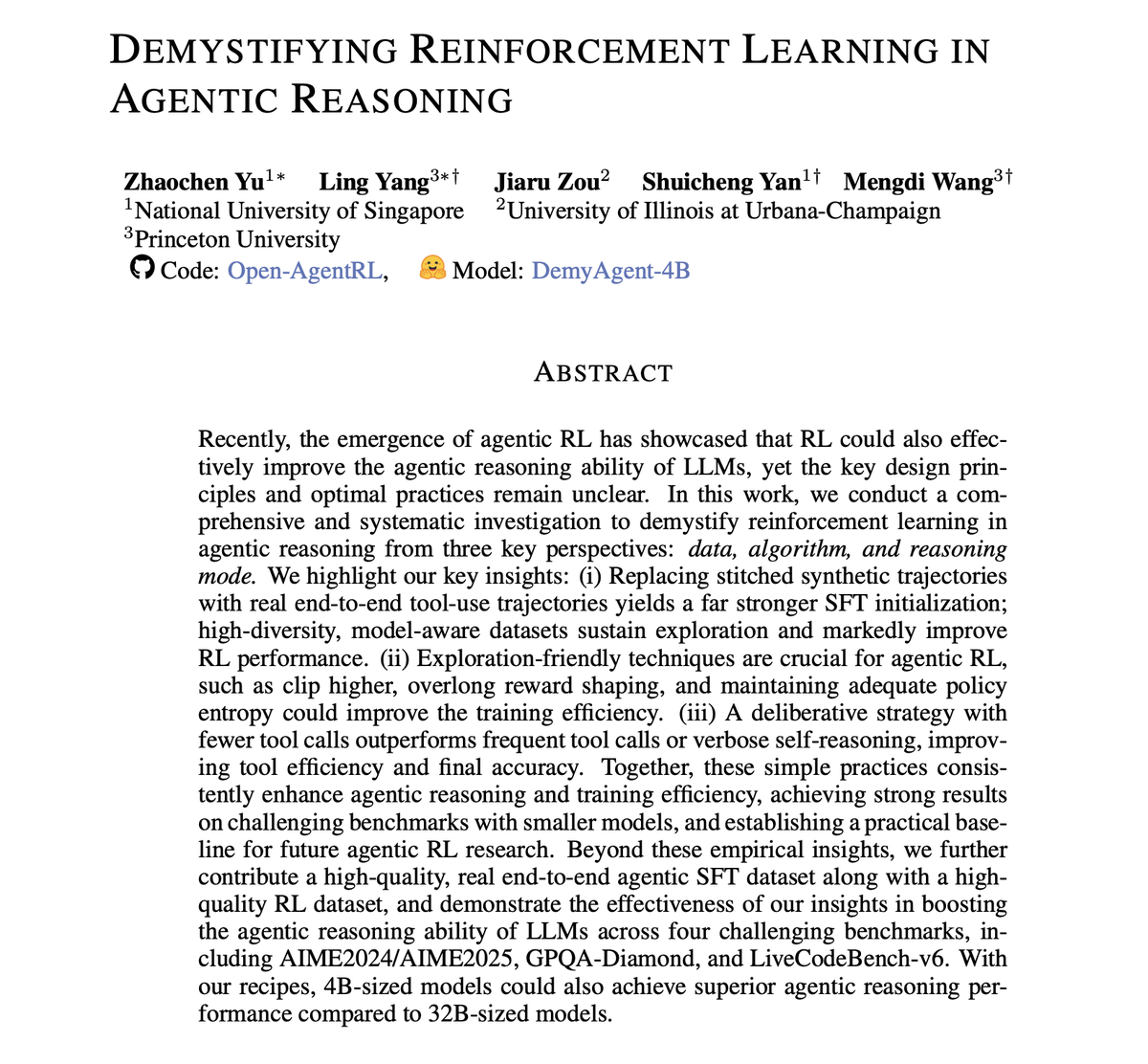
Why does RL work for enhancing agentic reasoning?
This paper studies what actually works when using RL to improve tool-using LLM agents, across three axes: data, algorithm, and reasoning mode.
Instead of chasing bigger models or fancy algorithms, the authors find that real, diverse data and a few smart RL tweaks make the biggest difference -- even for small models.
My 7 key takeaways from the paper:
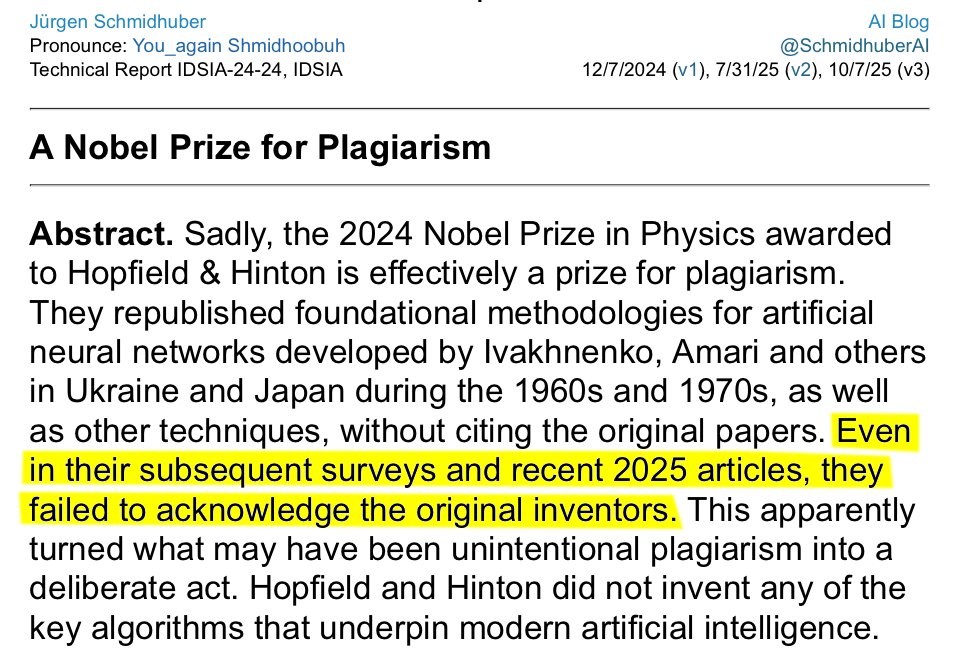
2025 update: A Nobel Prize for Plagiarism (Technical Report IDSIA-24-24). Sadly, the 2024 Nobel Prize in Physics awarded to Hopfield & Hinton is effectively a prize for plagiarism. They republished foundational methodologies for artificial neural networks developed by Ivakhnenko, Amari and others in Ukraine and Japan during the 1960s and 1970s, as well as other techniques, without citing the original papers. Even in their subsequent surveys and recent 2025 articles, they failed to acknowledge the original inventors. This apparently turned what may have been unintentional plagiarism into a deliberate act. Hopfield and Hinton did not invent any of the key algorithms that underpin modern artificial intelligence.







![SciFi's tweet photo. Towards Robust Reinforcement Learning for Small-Scale Language Model Agents
Md Rezwanul Haque, Md. Milon Islam, Fakhri Karray
https://t.co/tGlmaxCUxF [𝚌𝚜.𝙰𝙸 𝚌𝚜.𝙲𝙻 𝚌𝚜.𝙻𝙶 𝚖𝚊𝚝𝚑.𝙾𝙲 𝚜𝚝𝚊𝚝.𝙲𝙾] https://t.co/A0oanpImXu](https://pbs.twimg.com/media/HOcOKJGWsAAyWzR.png)

![CSVisionPapers's tweet photo. CAST: Channel-Aware Spatial Transfer Learning with Pseudo-Image Radar for Sign Language Recognition
Md. Shakhoyat Rahman Shujon, Sheikh Md. Galib Mahim, Md. Milon Islam, Md Rezwanul Haque, Md Rabiul Islam, Hamdi Altaheri, Fakhri Karray
https://t.co/SWwgfOKQwL [𝚌𝚜.𝙲𝚅] https://t.co/clpJee9Lxl](https://pbs.twimg.com/media/HIHrqi5WIAAVt3J.png)